What is instructional design
1. Instructional design - introduction
Instructional design is a systematic process of analyzing learning needs, defining goals, and designing, developing, implementing, and evaluating teaching materials and activities. It starts from basic pedagogical theories (cognitivism, constructivism, behaviorism) and applies them in a concrete context in order to achieve clear learning outcomes.
Instructional design is a theoretically and methodologically based approach to planning, designing, implementing, and evaluating the teaching process with the aim of improving the effectiveness of learning and teaching. It is a systematic, reflective, and iterative process that starts from clearly defined educational goals and includes the analysis of student needs and the teaching context, the selection and organization of content, the determination of teaching methods, the design of learning activities, and the development of criteria and instruments for evaluating achievements. In contrast to spontaneous or experience-driven instructional planning, instructional design insists on the logical connection of all elements of the teaching process, from set outcomes to evaluation methods, and on the application of educational theories in concrete teaching practice.
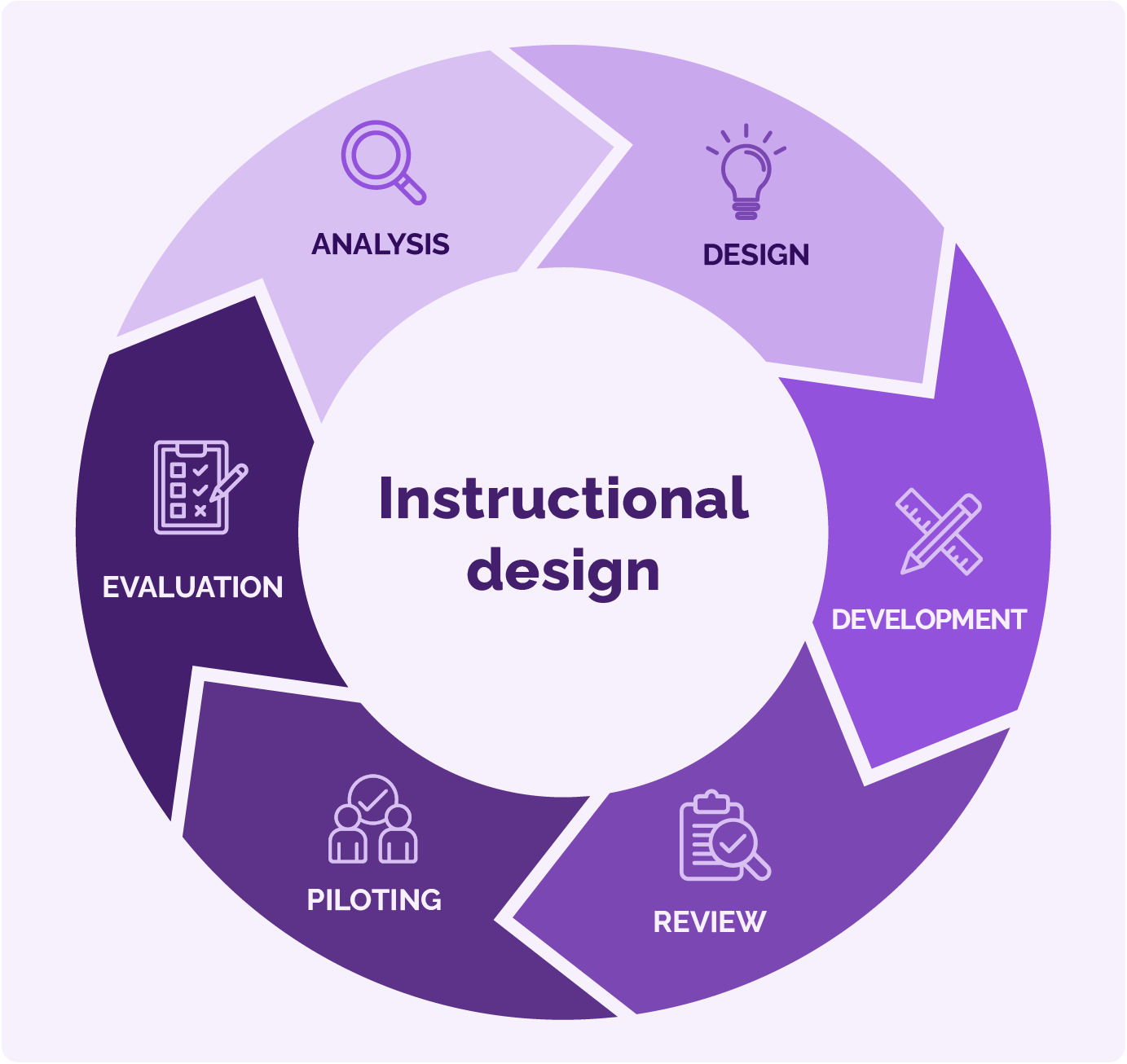
The development of the concept of instructional design can be more precisely traced back to the mid-20th century, when the growing need for mass and standardized forms of education, especially in military and industrial systems, prompted the development of a systematic approach to planning, implementing, and evaluating instruction.
The specificity of instructional design is reflected in its systematic and purposeful organization of the educational process, which begins with the analytical identification of the educational needs of the target group. In the context of higher education, this involves an analysis of the level of students' prior knowledge, their experience with the subject matter, academic skills (e.g., the level of development of critical thinking or the ability to learn independently), but also institutional requirements, the outcomes of the qualification framework, and labor market expectations. Based on these insights, clearly operationalized outcomes are formed that do not remain at the level of declarative goals, but are concretized in the behaviors and knowledge that students need to demonstrate upon completion of the course or educational unit. The selection and structuring of teaching content is carried out in accordance with the aforementioned outcomes.
Teaching strategies focus on the active role of the student in the educational process. This includes the design of problem-oriented tasks, the use of case studies, a workshop approach, as well as hybrid forms of teaching that combine asynchronous and synchronous learning. Teaching materials are designed in a modular way, in a form that allows students to use them flexibly and independently, but with clearly defined outcomes and success criteria. Special attention is paid to the accessibility of the materials: the contents are adapted to different devices, checked in different Internet browsers, and the intelligibility of the linguistic expression is ensured, as well as technical support for students with different levels of digital literacy.
There are a number of instructional design models, and in the following activities, we will focus on the most important and influential among them. However, it is worth noting that there is no single best model that you will use once you become familiar with it in practice, but rather you will usually use a mix of them, depending on the given educational context in which you find yourself when planning and creating your digital teaching materials and e-courses.
In digital education, where personal interaction is often reduced, clearly structured tasks, a time frame for completing activities, and automated feedback mechanisms become crucial. The use of digital tools to monitor student progress (such as learning analytics) further supports the ability to adapt teaching activities and identify learning difficulties.
An integral part of instructional design is the evaluation of not only student achievement, but also the quality of instructional design. This evaluation includes the collection of feedback, analysis of results, audit of activities, and reflection on the success of selected methods and strategies. This enables iterative improvement of teaching and encourages reflective practice.
Background Colour
Font Face
Font Size
Text Colour
Font Kerning
Image Visibility
Letter Spacing
Line Height
Link Highlight
Paragraph Width
Text Alignment