Teaching objectives and learning outcomes
2. Bloom's Taxonomy
Learning objectives are described and classified by the taxonomy of learning objectives. It classifies the desired behavior of students and the way in which students react, think, or feel after being exposed to the influence of teaching and their learning (Bloom, 1970, according to Cindrić et al, 2016). Bloom's taxonomy was created in 1956 based on analyses of intellectual behaviors through which students acquire academic knowledge. During its existence, it has been revised several times, based primarily on findings in the field of cognitive psychology. The main reason for the latest revision was that the category of knowledge is by its nature two-dimensional, while the original taxonomy presents it as one-dimensional.
According to Bloom's taxonomy, achievement levels are divided into three categories:
- cognitive (knowledge and understanding)
- affective (attitudes and beliefs)
- psychomotor (skills and abilities).
Furthermore, Cindrić states that the principles of creating a taxonomy are as follows:
- the main differences between taxonomic categories are mainly the differences that teachers see between different forms of student behavior.
- it must be logical and consistent in its internal structure, meaning that each term must be defined and applied consistently throughout the taxonomy.
- it must be descriptive, i.e., each objective must be presented in a relatively neutral manner.
Divjak (2009) states that there is a hierarchy of learning outcomes in higher education:
- general learning outcomes that describe the level of academic achievement within the framework of the Bologna process
- specific learning outcomes for a field or combination of fields
- specific learning outcomes for a particular study program or area, including the requirements of target occupations
- specific course learning outcomes that include criteria for student success.
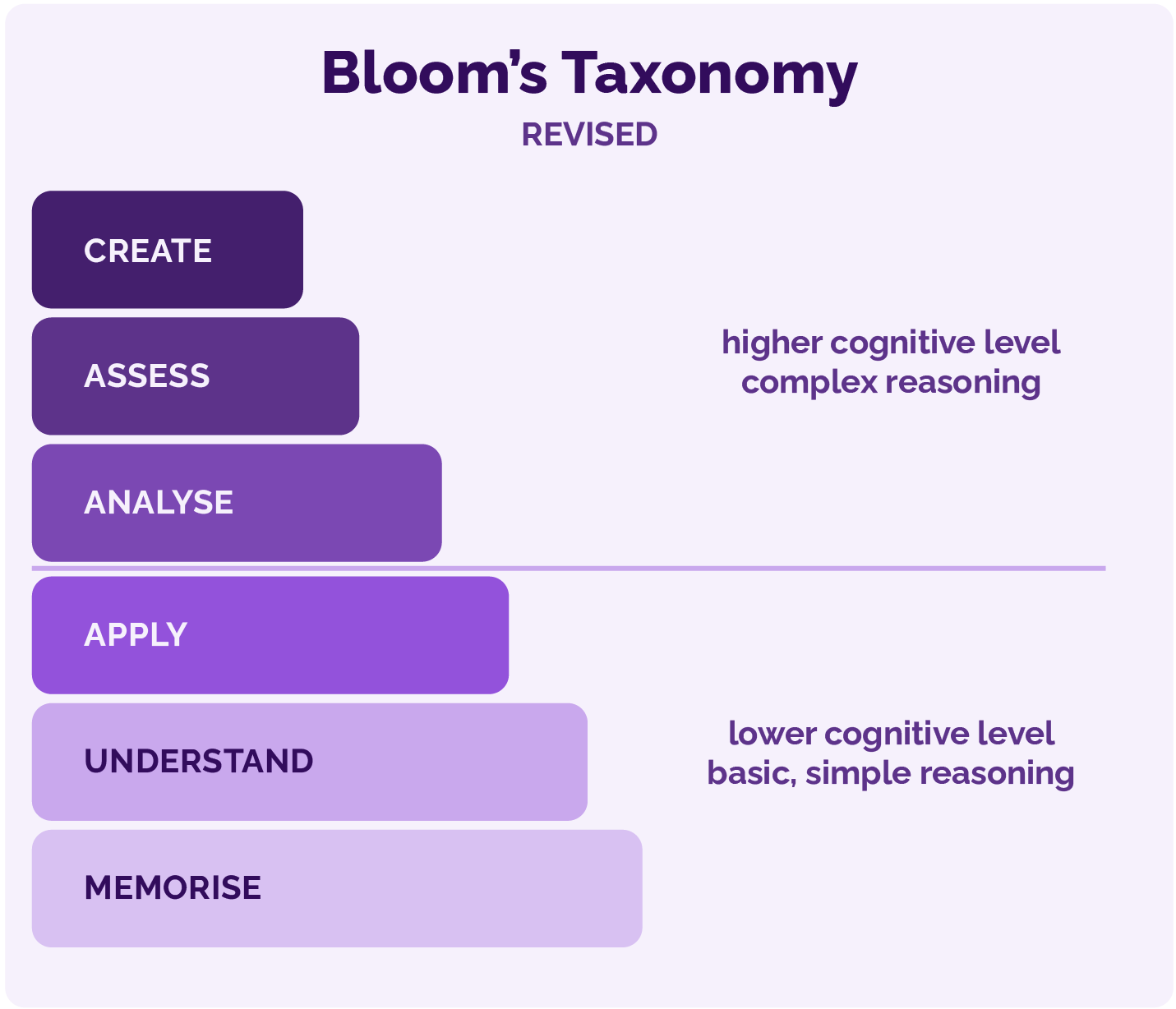
Bloom defines six categories in the cognitive area that are determined by behavior. Hierarchy in the categories is respected because each subsequent category describes more complex behavior than the behavior in the previous category. This means that the categories are arranged in such a way that they follow the principle from simpler to more complex verbal achievement and from concrete to abstract knowledge.
Cognitive categories are listed below.
1. Knowledge is divided into:
- knowledge of details (recall and reproduce information, know terminology and specific facts)
- knowledge of ways and means of managing details (organizing, investigating, judging and criticizing, expressing ideas and phenomena, knowing the processes of movement, criteria for verifying or judging facts, principles, opinions or procedures, and methodology for investigating specific problems or phenomena)
- knowledge of general universal concepts in a particular field - important schemes and models for the organization of phenomena and ideas, theories and generalizations (the highest level of abstraction and complexity).
2. Understanding consists of:
- translation, which represents the accurate translation of content from one language form to another
- interpretation, which refers to the interpretation of content and its reorganization or reinterpretation
- extrapolation, which refers to the translation or processing of information, its interpretation, and the prediction of possible consequences.
3. Application is the ability to apply abstract concepts in specific and concrete situations.
4. Analysis can be:
- component analysis, which is the identification of the components that make up information
- relationship analysis that serves to determine interpersonal connections and the influence of components of individual information
- analysis of organizing principles, which is the identification of explicit or implicit organizing principles on the basis of which the content is structured.
5. Synthesis is the ability to combine components into a whole, that is, independently write original communications, propose a work plan, and formulate appropriate hypotheses based on analysis.
6. Assessment is the ability to judge the value of content and methods in a field according to certain criteria. It is possible to evaluate on internal and external standards. Internal standards are the ability to assess the accuracy of facts with respect to evidence and documentation, while external standards are the ability to evaluate theories or facts about certain cultures.
Most teachers are familiar with the above six learning categories; however, for successful work, it is not enough just to know, but also to implement these categories into concrete knowledge, abilities, and skills so that students can show how they understood the information and how they are used in practice.
When talking about types of knowledge, according to Krathwohl, the revised version of Bloom's Taxonomy divides it into 4 types (according to Kovač and Kolić-Vehovec, 2008):
- factual knowledge – knowledge of the basic elements that students must know in order to become familiar with the subject or solve a problem (knowledge of terminology and knowledge of individual details and elements)
- conceptual knowledge – knowledge of the mutual connection between the fundamental elements of a larger structure that enables joint functioning (knowledge of classifications and categories, knowledge of principles and generalizations, and knowledge of theories, models, and structures)
- procedural knowledge – knowledge of how to do something, test methods, criteria for use, algorithms, techniques, methods (knowledge of skills and procedures related to a particular subject, knowledge of techniques and methods, and knowledge of criteria for deciding on the application of certain procedures)
- metacognitive knowledge – knowledge about oneself as a student, study contents and learning and thinking strategies, self-regulation of one's own learning, knowledge of cognition and awareness of knowledge of cognition (knowledge of one's own way of learning, knowledge of features of the content to be adopted, knowledge of strategies for learning the content and skills of self-monitoring and self-regulation of learning).
In addition to cognitive goals, there are also psychomotor and affective goals. It is important to point out that cognitive and psychomotor goals can be operationalized, but the problem arises with affective goals because they relate to the acquisition of certain values and the adoption of attitudes and opinions.
The psychomotor area, therefore, has five stages:
- imitation – learning about an action and imitating it after a demonstration
- manipulation – working according to instructions, which means that oral or written instructions are converted into appropriate psychomotor activity
- precision – psychomotor activity is more and more precise and safe, and is carried out more confidently
- activity analysis – conscious analysis of an individual activity is perfected through long-term repetition
- naturalization – maximum internalization, the student achieves automation.
The affective area has the following levels (Krathwohl et al., according to Cindrić et al):
- acceptance – acceptance of teaching, recognition of the importance of learning, sensitivity to social problems, acceptance of diversity, and tolerance
- reaction – fulfilling obligations, following rules, participating in discussions, volunteering for tasks, helping others, being interested in the subject being taught
- critical evaluation – supporting democratic processes, a preference for good literature, accepting scientific principles in everyday life, appreciating the need for social progress
- organization – respecting the balance between freedom and responsibility, recognizing the need for systematic problem solving, taking responsibility, accepting one's own strengths and weaknesses
- value judgment – expressing self-respect and respect for others, willingness to cooperate, ability to establish objective evaluation criteria, diligence and self-discipline, positive self-image.
It should be emphasized that regular verification of the achievement of learning outcomes and their relevance is extremely important in the context of evaluating courses and study programs. If it turns out to be necessary, or if the outcomes are not covered or are not achieved, they need to be revised.
We recommend an article related to digital aspects and Bloom's Taxonomy, available at the link, as well as a short video on the same topic.
Background Colour
Font Face
Font Size
Text Colour
Font Kerning
Image Visibility
Letter Spacing
Line Height
Link Highlight
Paragraph Width
Text Alignment