Student - student communication; student - teacher; student - system
2. Community of Inquiry (CoI) Model
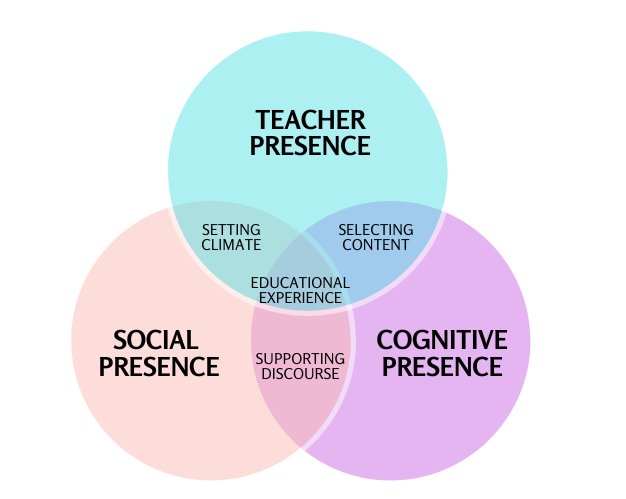
Inquiry (CoI) model is one of the most influential theoretical frameworks for understanding and improving learning in online and blended learning environments. Developed early this century, this model assumes that successful online learning is the result of the integration of three interrelated components: cognitive presence, social presence, and teacher presence. Each of these components has a specific role, but their actions are complementary, and complete educational experiences only occur when all three dimensions are balanced and mutually supportive.
1. Cognitive Presence
Cognitive presence refers to the student's ability to construct and validate meaning through reflection, exploration, and discussion. It represents the intellectual foundation of learning, as it encompasses the processes of asking questions, analysing information, connecting new and prior knowledge, and applying acquired insights to problem solving.
In the higher education context, cognitive presence requires structured activities that encourage critical thinking, such as case study analysis, guided discussions, project work, and research assignments. In an online environment, this dimension particularly benefits from a combination of asynchronous and synchronous formats: asynchronous discussions provide time for reflection, while synchronous encounters allow for rapid exchange of ideas and real-time discussion.
2. Social Presence
Social presence is defined as the degree to which participants in an online community feel connected, accepted, and visible to each other. It includes emotional availability, mutual trust, and a sense of belonging to the community. The role of social presence is not only to create a pleasant atmosphere, but also to ensure that students freely express their opinions, take active roles in discussions, and feel responsible for their shared learning.
Building social presence in online learning involves personalised communication (e.g., addressing students by name, recognising their contributions), creating a safe space for expression (encouraging tolerance for different viewpoints), and active moderation of discussions by teachers (directing the dialogue and maintaining the dynamics of interaction). In higher education, where the importance of academic dialogue and collaborative learning is emphasised, social presence is a key foundation for developing deeper student engagement.
3. Teaching Presence
Teacher presence encompasses planning, guiding, and facilitating the cognitive and social processes necessary to achieve planned learning outcomes. It includes designing curriculum and instructional activities, managing the dynamics of interactions, and providing timely and constructive feedback.
In online and blended environments, the teacher is simultaneously an organiser, mentor, and moderator. Through a clear course structure, defining communication rules, and a constant presence in discussions, the teacher ensures that the learning process remains focused and productive. Teacher presence also includes sensitivity to student needs, flexibility in approach, and the ability to adjust strategies in response to feedback.
Integration of the CoI Model Components
Cognitive, social, and teacher presence do not operate in isolation, but are in constant interaction with each other. Cognitive presence ensures intellectual depth of learning, social presence creates conditions for the open exchange of ideas, and teacher presence connects these elements into a structured and meaningful educational process. In higher education, the application of the CoI model allows teachers to systematically plan activities that develop all three dimensions in a balanced way, thereby achieving greater student engagement, better academic results, and a more positive learning experience in online and blended courses.
Background Colour
Font Face
Font Size
Text Colour
Font Kerning
Image Visibility
Letter Spacing
Line Height
Link Highlight
Paragraph Width
Text Alignment