Learning outcomes at study programme and course level
6. Constructive alignment
Constructive alignment is an approach to course planning that ensures all elements of the teaching process – learning outcomes, learning and teaching activities, and assessment – are mutually aligned and directed toward achieving clearly defined goals. The concept was developed by Biggs and Tang (2011) and is based on constructivist learning theory, which emphasises the active role of students in building knowledge and acquiring skills.
In this approach, learning outcomes represent the foundation – clear statements of what a student should know, understand, and be able to do after completing a course or programme (ENQA et al., 2015).
Based on these outcomes, learning and teaching activities are selected to enable students to actively construct knowledge, whether through participation in discussions, research, practical work, or collaboration. In addition to established approaches, the use of innovative learning and teaching methods (iLeD, 2024) is recommended.
Finally, assessment must be aligned with the learning outcomes and measure exactly what the outcomes define, using appropriate methods (e.g., essays, presentations, practical tasks, quizzes).
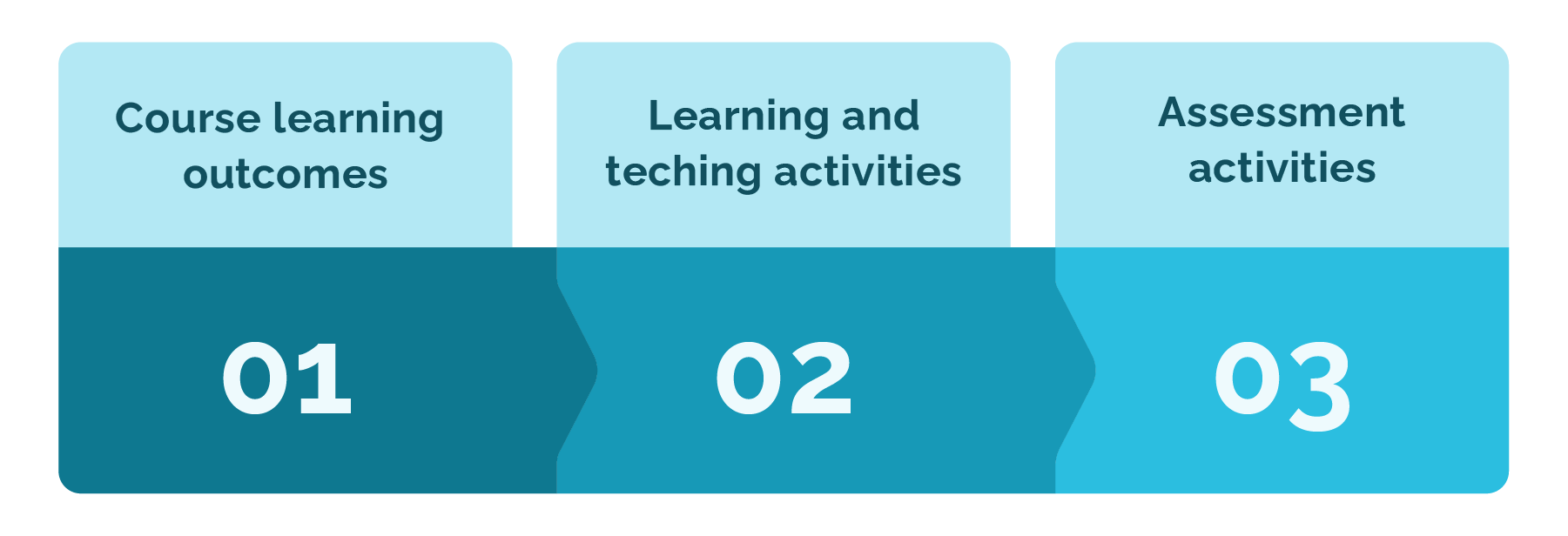
Figure 7. Constructive alignment
The advantages of constructive alignment include transparency, fairness, and pedagogical effectiveness. Students clearly understand what is expected of them, and teachers have a structured framework for planning and evaluation. This approach is increasingly important in the context of quality assurance, as it is aligned with ESG (2015) standards, particularly Standards 1.2 and 1.3.
A tool that supports reflection on constructive alignment is provided in the form of a table (Divjak, 2014).
Background Colour
Font Face
Font Size
Text Colour
Font Kerning
Image Visibility
Letter Spacing
Line Height
Link Highlight
Paragraph Width
Text Alignment