Defining clear and measurable learning outcomes
5. Constructive alignment
Constructive alignment is a pedagogical approach that aligns all key elements of the teaching process: learning outcomes, learning activities, and assessment. Its goal is to encourage active and meaningful learning among students.
Constructive alignment (Biggs, 1996) refers to the alignment of three key elements of teaching:
- learning outcomes – what students are expected to achieve
- teaching activities – which enable the achievement of the outcomes
- assessment – which evaluates exactly what is defined in the learning outcomes.
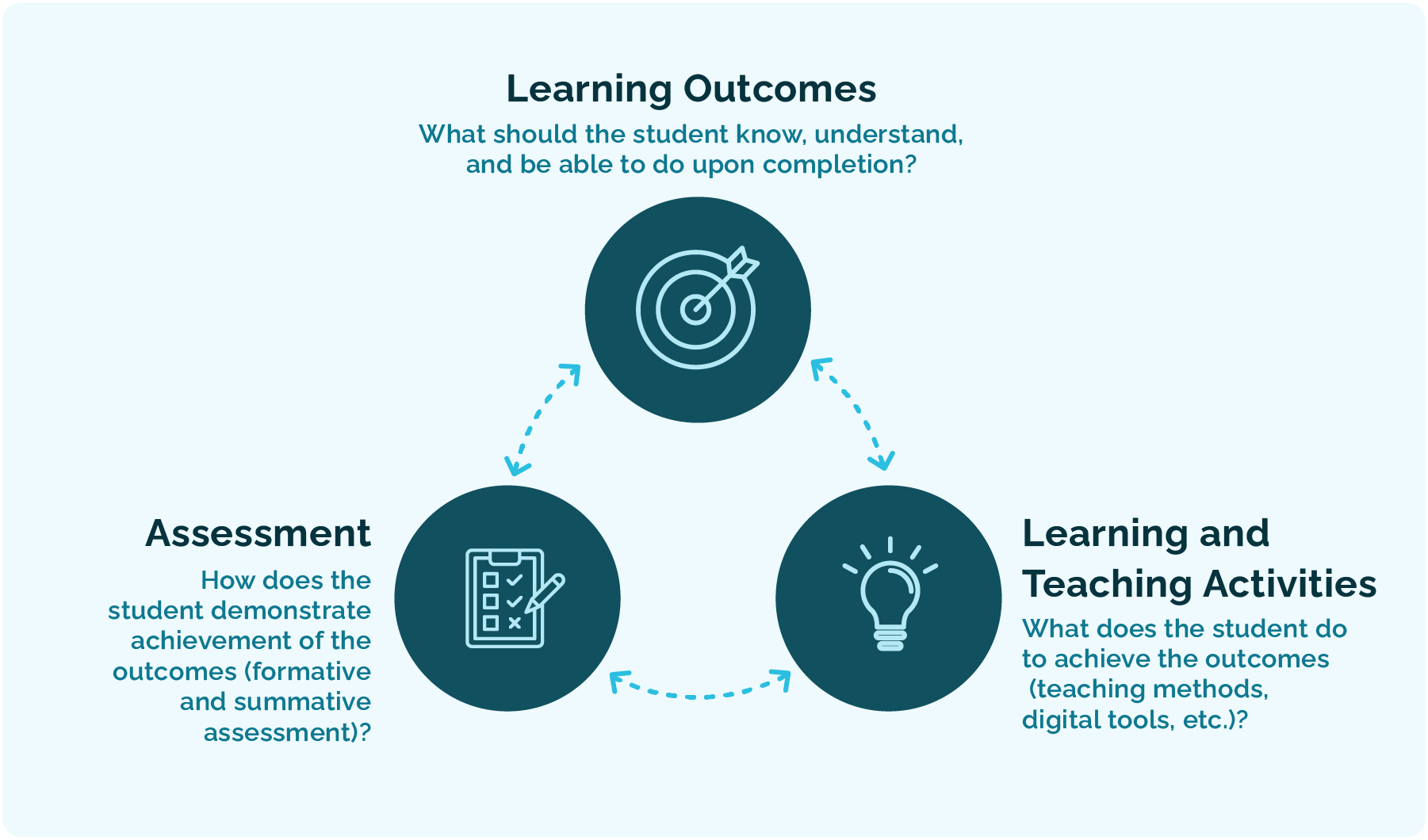
Figure 1. Conceptual design
Constructive alignment consists of two interrelated principles – the constructive approach to learning and the alignment of teaching elements – which together enable an effective and meaningful educational process.
Constructive:
- It is grounded in constructivist learning theory, according to which students actively construct knowledge through their own experience and engagement in meaningful tasks.
- Learning is not the passive reception of information, but active participation in problem-solving, discussions, projects, and other activities.
Alignment:
- It refers to coherence:
- between learning outcomes (what a student should know and be able to do)
- between teaching activities (what the student does during learning)
- between assessment methods (how we assess the achievement of those outcomes).
- All components should be consistent – for example, if the outcome is “analyse,” the student must have the opportunity to analyse, not just listen to a lecture, and the assessment should evaluate that analysis.
According to Biggs (1999): What and how students learn depends to a major extent on how they think they will be assessed. When activities and assessment are aligned with the achievement of learning outcomes, students are motivated to learn what truly matters, rather than simply studying for an exam.
By ensuring constructive alignment between learning outcomes, teaching activities, and assessment, teachers can create a more effective learning environment that responds to the diverse needs of students (Divjak et al., 2025).
Table 3. Examples of constructive alignment across all levels of Bloom’s taxonomy:
|
Level |
Learning outcome |
Teaching activity |
Assessment |
|
remembering |
list the basic characteristics of digital learning materials |
interactive presentation with a glossary and quiz |
multiple-choice quiz |
|
understanding |
explain the difference between declarative and functional knowledge |
pair discussion + comparison table |
a summary with explanations of the differences |
|
applying |
apply visual design principles in creating learning materials |
creating an infographic in Canva or Genially |
submission and rubric-based assessment (visual clarity, structure, message) |
|
analysing |
analyse examples of good practice in digital education |
analysis of three learning resources using predefined criteria |
reflection or a table with arguments and recommendations |
|
creating |
design an interactive digital learning resource |
group creation of content in H5P |
project assessed with a rubric (interactivity, didactic value) |
Adapting content to students
To ensure learning outcomes are achievable, content and activities should be adapted to the diverse needs and characteristics of students – their prior knowledge, interests, learning styles, and context.
This includes:
- using different formats (text, video, interactive exercises)
- enabling a choice of tools, examples, or tasks
- aligning content with students’ professional practice or experience
- monitoring progress through learning analytics and providing timely feedback.
Adapting does not mean lowering standards, but creating meaningful learning pathways towards the same learning outcomes.
You can learn more about learning outcomes and constructive alignment in the online e-course Learning Design.
Background Colour
Font Face
Font Size
Text Colour
Font Kerning
Image Visibility
Letter Spacing
Line Height
Link Highlight
Paragraph Width
Text Alignment