Role of Self-Assessment in Developing Self-Regulation
6. Recommendations for Practice
The following set of five practical recommendations for instructors on effectively and efficiently guiding the self-assessment process is taken from Radović et al. (2023):
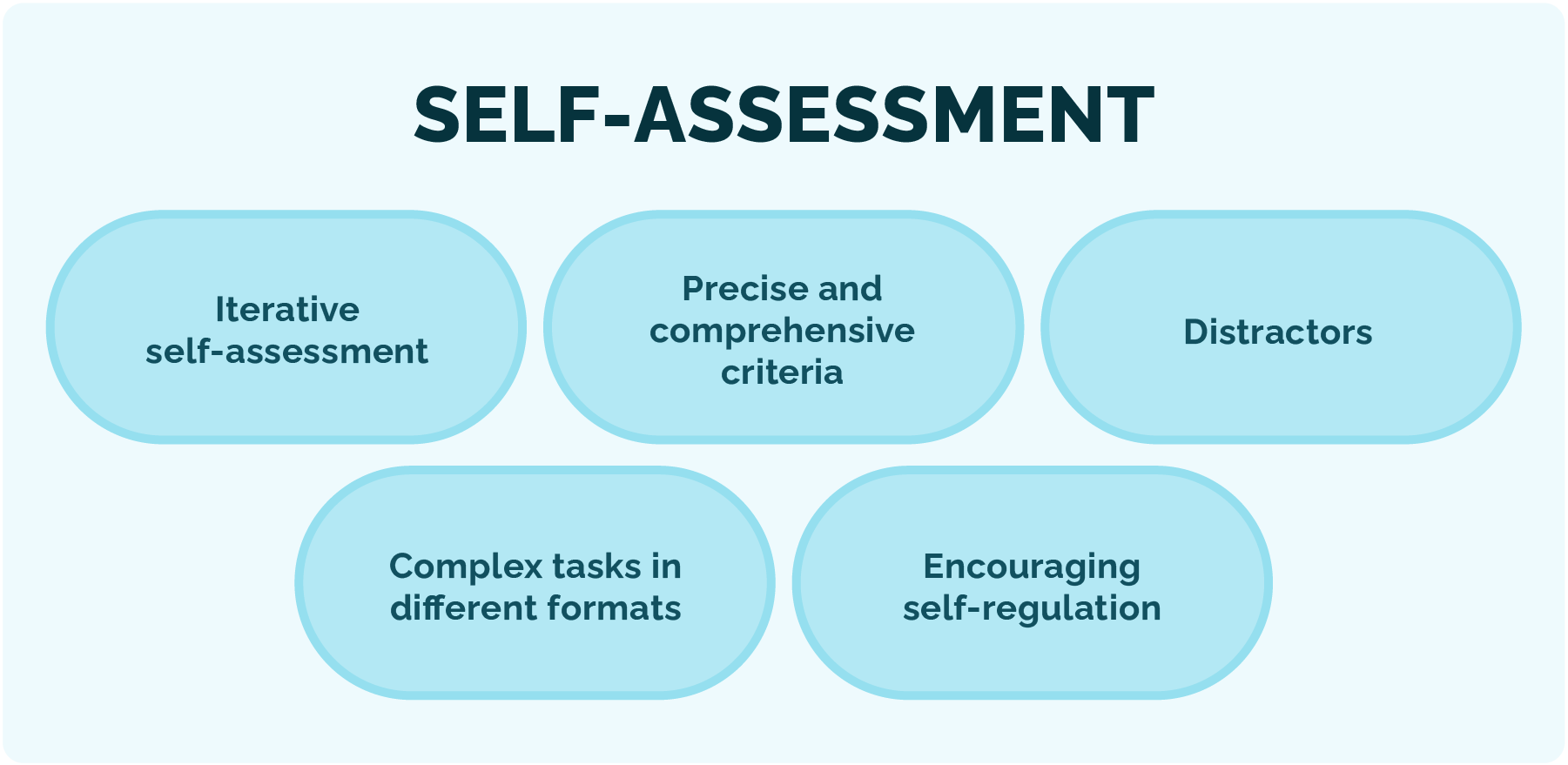
Figure 2. Recommendations summary
1. Enable iterative self-assessment
Ensure that students have the opportunity not only to assess their solutions using predefined criteria, but also to revise and resubmit their work for additional assessment. This iterative process encourages deeper engagement with course content and supports continuous refinement of understanding.
2. Use precise and comprehensive criteria
When designing self-assessment tasks, include clear, concrete, and well-defined criteria. Well-articulated criteria allow students to identify even subtle improvements in their learning. Such an approach increases both the accuracy and the overall value of the self-assessment.
3. Incorporate distractors to deepen understanding
Include distractors—responses that appear correct but are actually based on common errors or misconceptions. This approach encourages students to think critically about their own understanding and to distinguish between correct and incorrect options.
4. Balance task complexity using varied formats
Use a variety of task types—from numerical problems and short responses to multiple-choice items. Also consider the expected length of responses, as tasks requiring more elaborate explanations may pose a greater challenge for accurate self-assessment.
5. Encourage self-regulation through motivational mechanisms
Consider introducing motivational elements that promote active engagement in self-assessment. For example, awarding badges for participation or providing bonus points for accurately solved tasks can encourage students to engage in consistent self-assessment and reflection throughout the course.
Research (Panadero & Jonsson, 2013) confirms that the use of rubrics with explicit criteria and performance levels enhances the reliability and validity of self-assessment. Finally, the use of digital tools and LLM-based systems can effectively support student reflection and metacognitive development.
Background Colour
Font Face
Font Size
Text Colour
Font Kerning
Image Visibility
Letter Spacing
Line Height
Link Highlight
Paragraph Width
Text Alignment