Instructions for participants of the e-course “Artificial Intelligence in Education”
3. E-course structure
The e-course consists of five thematic units. The table below shows how each unit contributes to achieving the e-course learning outcomes and the distribution of points for summative and formative assessment by topic. Points from the formative assessment are used only to monitor your progress and provide feedback; they are not included in the calculation of your final result in the e-course. The final result is calculated solely based on the total number of points from the summative assessment.
|
Thematic units/learning outcomes |
Identify, through analysis, the potential advantages and challenges of applying artificial intelligence in education.
|
Critically select artificial intelligence tools and systems that meet specific educational needs.
|
Apply artificial intelligence tools and systems to personalise teaching, encourage active learning and adapt to student needs, while respecting the specificities of the subject, educational environment and the credibility and reliability of sources. |
Propose concrete improvements to educational practices by applying artificial intelligence tools and systems to a selected example.
|
Formative assessment |
Summative assessment |
|
1. Artificial intelligence and data literacy in the digital society |
40 % |
|
|
|
19 |
10 |
|
2. Education and artificial intelligence: differentiation, personalisation and active learning |
60 % |
|
|
|
15 |
13 |
|
3. Artificial intelligence tools and systems in education |
|
90 % |
10 % |
|
15 |
17 |
|
4. Creating and adapting educational activities with artificial intelligence tools and systems while respecting the credibility and reliability of sources |
|
10 % |
80 % |
10 % |
21 |
27 |
|
5. Practical guidelines for the successful application of artificial intelligence in education with an emphasis on teachers and management staff |
|
|
10 % |
90 % |
30 |
33 |
|
TOTAL: |
100 % |
100 % |
100 % |
100 % |
100 |
100 |
E-course structure:
1. Thematic unit: Artificial Intelligence and Data Literacy in the Digital Society
In theoretical terms, this thematic unit introduces participants to the fundamental concepts of artificial intelligence (AI) and data literacy in the context of education and the digital society. It covers basic concepts, the historical development and types of artificial intelligence, and data literacy, with particular attention to ethics, privacy, bias and data reliability. Special emphasis is placed on understanding the relationship between data literacy and the responsible use of AI in education.
In practical terms, participants analyse digital educational content through interactive lessons and tests and participate in structured debates and discussions. By using AI tools and systems and engaging in reflective tasks, they develop the ability to critically analyse the advantages, challenges and limitations of applying artificial intelligence in educational settings.
2. Thematic unit: Education and artificial intelligence: differentiation, personalisation and active learning
In theoretical terms, this unit provides knowledge about the application of artificial intelligence in education, emphasising differentiation and personalisation of learning, identification of student needs, encouragement of active learning, and broader implications and challenges in applying artificial intelligence technologies. Participants will analyse the technical, ethical, security and legislative aspects of artificial intelligence use, including current regulations such as the EU AI Act. By studying case studies and theoretical materials, they will develop the ability to critically analyse the application of artificial intelligence in educational systems.
In practical terms, participants will analyse the use of artificial intelligence tools and systems in differentiated and personalised learning. They will participate in group work and discussions, evaluate specific examples and challenges, and make presentations that critically demonstrate the advantages and disadvantages of applying artificial intelligence in education. Through this, they will develop skills to apply theoretical knowledge in real educational situations.
3. Thematic unit: Artificial intelligence tools and systems in education
In theoretical terms, in this unit, participants will gain insight into the various categories of available AI tools and systems for use in education. The focus is on critically analysing and selecting AI tools and systems based on specific educational needs, as well as understanding the organisational, technical and pedagogical challenges involved in their implementation. Participants will be introduced to types of tools (generative, adaptive, analytical, administrative), criteria for their selection, and examples of successful implementations in educational institutions.
In practical terms, participants will engage in research and hands-on activities to select an AI tool or system with educational potential, analyse its technical and pedagogical aspects, and prepare and present their analysis results. Through group work, using AI tools and systems to create presentations and videos, participants will assess challenges and propose solutions for introducing the selected tool into the educational system, with an emphasis on organisational aspects. Additionally, reflection and self-assessment questions will help participants evaluate their progress and encourage further exploration of the topic.
4. Thematic unit: Creating and adapting educational activities with artificial intelligence tools and systems while respecting the credibility and reliability of sources
In theoretical terms, this thematic unit focuses on understanding and practical application of artificial intelligence tools and systems to create and adapt educational activities. Participants will explore the potential of artificial intelligence for personalising teaching, encouraging active learning and addressing the diverse needs of students. Special emphasis is placed on selecting reliable and credible sources when working with artificial intelligence tools, as well as considering the specific requirements of different subjects and educational environments. The unit will also examine how artificial intelligence can assist instructors and university teachers in designing, implementing and adapting the educational process.
In practical terms, participants will use artificial intelligence tools and systems to create and adapt educational content through hands-on activities, applying principles of query engineering to improve the relevance and quality of outputs from artificial intelligence systems. Through workshops, group tasks and simulations, they will design educational scenarios and content that address real educational needs. Participants will evaluate the authenticity of sources and adapt content to specific educational settings and the individual needs of students or other learners. Additionally, reflection and self-assessment questions will help learners monitor their own progress and encourage further exploration of the topic.
5. Thematic unit: Practical guidelines for the successful application of artificial intelligence in education with an emphasis on teachers and management staff
In theoretical terms, this thematic unit aims to develop concrete guidelines for the effective, responsible and sustainable application of artificial intelligence in higher education institutions, with an emphasis on the roles of higher education teachers and management staff. Participants will be introduced to instructional design models (such as the ADDIE model extended with artificial intelligence components), examples of best practices for integrating artificial intelligence into curricula, and the impact of both the narrower (teaching content, participant/student characteristics) and broader (institutional policies, legislative frameworks) educational environments on the implementation of artificial intelligence in the educational process. Guidelines and reflective activities will also analyse the ethical, pedagogical, technical and organisational aspects of applying artificial intelligence tools and systems.
In practical terms, participants will develop critical thinking skills and apply artificial intelligence in education through activities such as analysing and evaluating case studies, discussions, questionnaires and project tasks. They will participate in forums and use AI tools and systems for research, summarisation and reflection. For the final assignment, participants will create their own proposal for applying AI in a real educational environment, including the creation of digital educational content using AI tools and systems, and a proposal for evaluating the acquired knowledge. They are encouraged to connect the knowledge, skills and abilities gained throughout the module to their own educational environments.
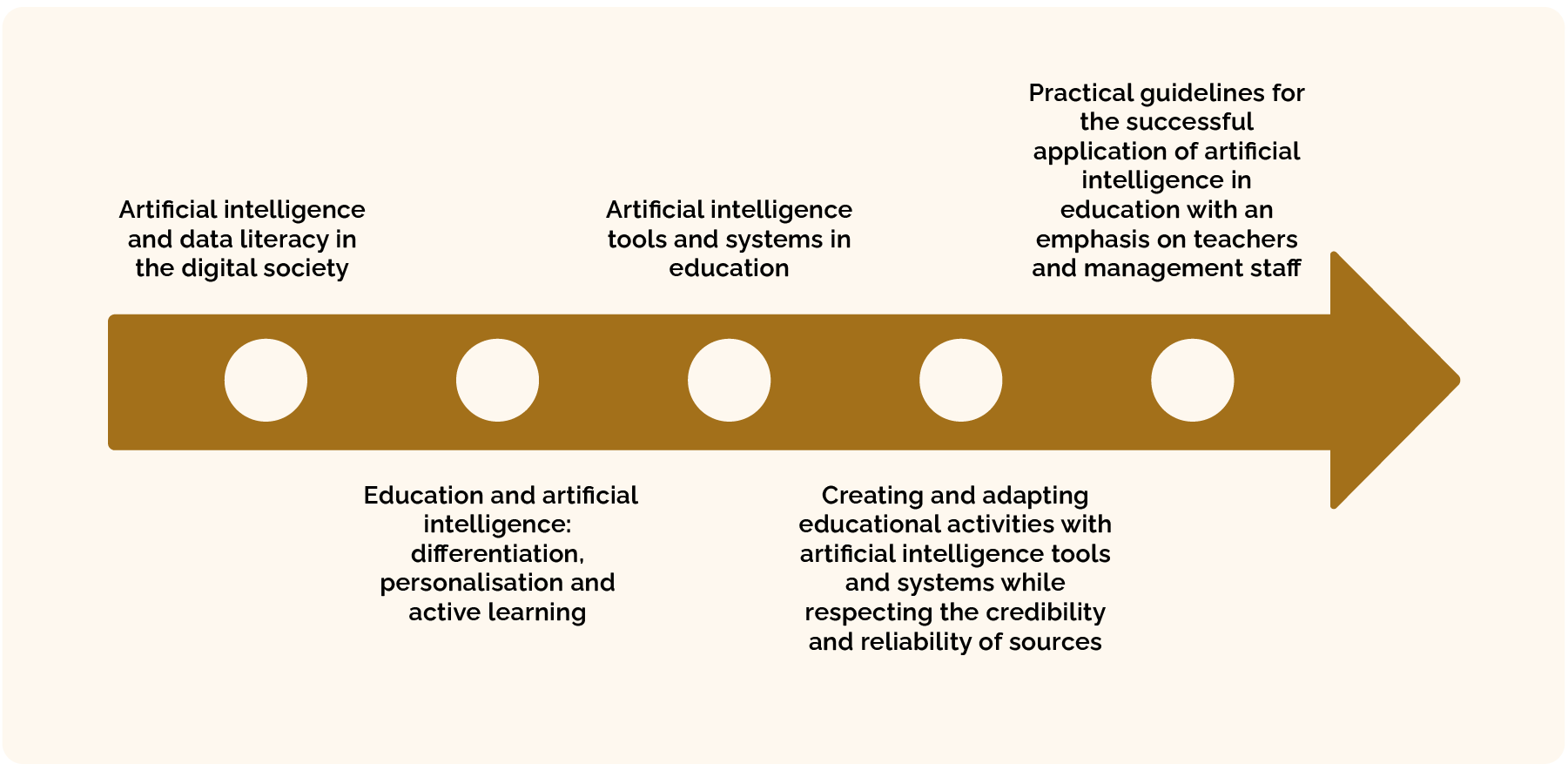
Figure: Presentation of summative evaluation
Background Colour
Font Face
Font Size
Text Colour
Font Kerning
Image Visibility
Letter Spacing
Line Height
Link Highlight
Paragraph Width
Text Alignment