Basic didactic concepts
| Site: | Loomen za stručna usavršavanja |
| Course: | Pedagogy in a Digital Environment |
| Book: | Basic didactic concepts |
| Printed by: | Gost (anonimni korisnik) |
| Date: | Saturday, 24 October 2026, 10:43 PM |
1. Basic didactic concepts - introduction
In this activity, you will be introduced to the basic didactic terms and concepts that underpin the educational process. Key teaching terms, as well as the distinctions between a curriculum and a program, will be explained. In addition to theoretical explanations, practical examples will be presented to illustrate their application and highlight their importance and purpose. This approach will help clarify the connection between theory and real pedagogical situations.
2. Teaching
Education is one of the fundamental pedagogical categories and functions, encompassing both knowledge and abilities. In didactics, the development of abilities represents the functional aspect of education, or the functional task of teaching, as it relates to the role of individuals as personalities in social life and work. Abilities are developed through activities, based on certain predispositions and objective environmental conditions. The task of teaching, therefore, is to encourage the development of abilities through numerous and diverse activities.
Teaching is a goal-oriented, planned, and programmed process involving two participants: the teacher and the learner (pupil or student). It takes place both within educational institutions (such as primary and secondary schools, higher education institutions, and adult education institutions) and outside them (for example, in companies or non-governmental organizations). Teaching is carried out according to teaching and/or thematic plans and programs. The focus of teaching should be on the activities of learners (Petričević et al., 2005).
An educational institution is an institution that meets prescribed conditions, such as goals, curriculum, teachers, instructional media, and facilities, for the education of preschool children, primary and secondary school students, higher education students, and adults. Within the lifelong learning system, educational institutions include kindergartens, primary schools, secondary schools (general, artistic, and vocational), higher education institutions (universities and professional institutions), and adult education institutions (Petričević et al., 2005).
The emergence of digital technology has initiated the transformation of traditional teaching into technology-supported forms of instruction. Initially, digital tools are used as supplements to classical teaching, for example, for presenting multimedia content, assigning online tasks, or enabling communication outside the classroom. Over time, these practices develop into blended (hybrid) teaching, in which face-to-face activities are systematically combined with activities in a virtual environment. Students process part of the content online, often at their own pace, while classroom time is focused on discussion, application of knowledge, and collaborative learning.
Further advances in technology and digital platforms have led to the development of online teaching, which takes place entirely in a virtual environment. In this model, there is no physical presence in an educational institution; instead, videoconferencing, virtual classrooms, digital materials, and interactive tools are used. Online teaching offers flexibility, access to education regardless of location, and opportunities for personalized learning, but it also requires a high level of digital competence and self-regulation on the part of students. This development illustrates how technology is gradually transforming pedagogy, teaching methods, and the role of teachers.
Within the structure of teaching, it is necessary to distinguish several aspects: organizational, cognitive, psychological, and methodological. According to Poljak (1980), these aspects represent stages of the teaching process. Organizational or didactic components include planning, preparation, introduction, problem formulation, collection of material, processing, task performance, practice, repetition, consolidation, assessment, and evaluation.
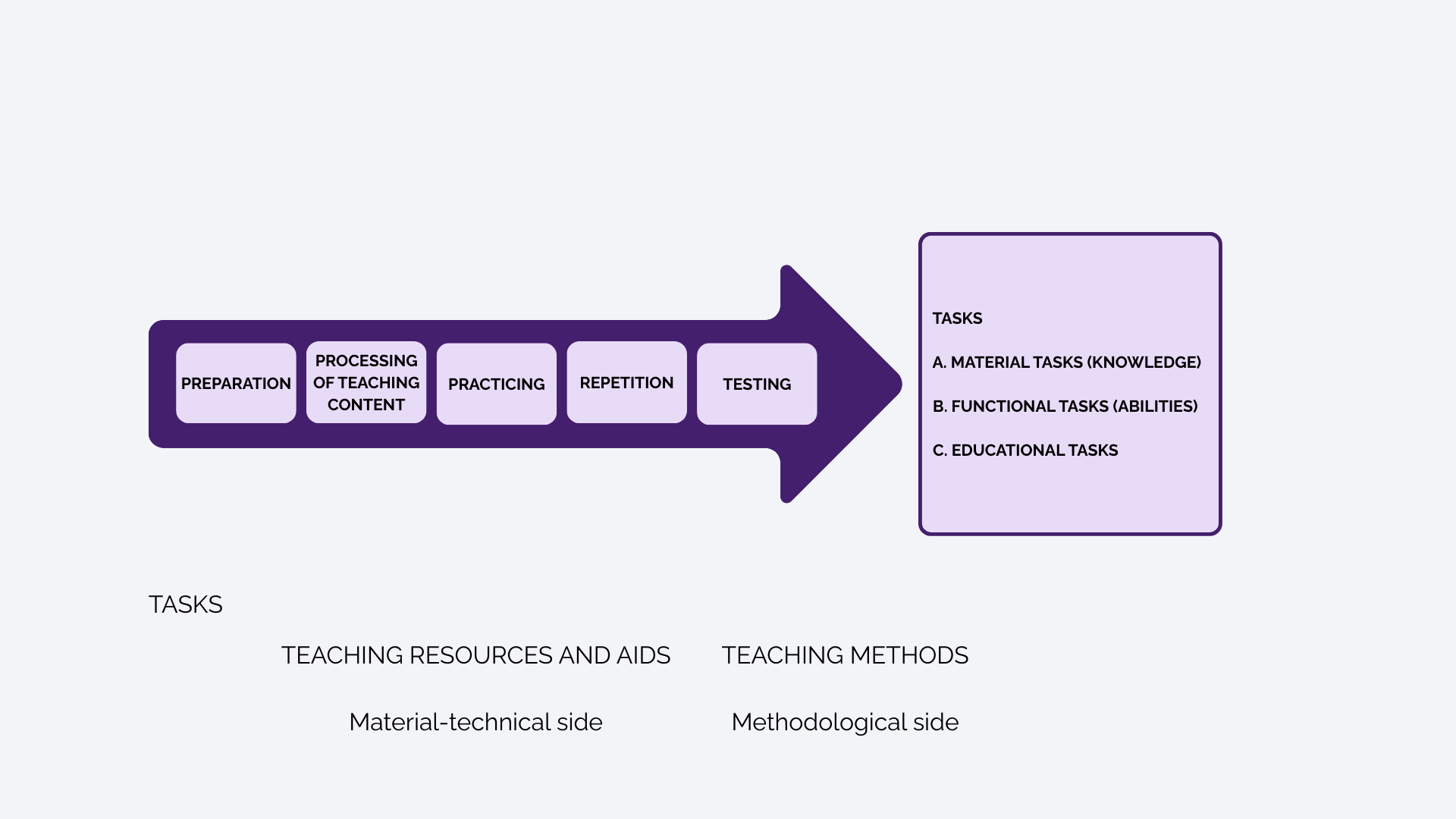
The graphical representation shows that the teaching process, including its individual stages, has a material-technical, cognitive, psychological, and methodological dimension. These dimensions consist of numerous elements that are integrated both successively and simultaneously at each stage of the teaching process as its microelements.
Teaching begins with planning and preparing teaching units and is carried out through various activities within the lesson, ranging from the use of technical tools to the construction and reconstruction of teaching content, educational measures, board work, and oral assessment. Teaching concludes with the evaluation of both the teaching process and student achievement (Pranjić, 2005). It is important to note that organizing teaching in a digital environment presents additional challenges, which will be discussed in more detail in the following parts of the course.
3. Curriculum
A curriculum is a didactic document that defines the scope, depth, and sequence of teaching content. It prescribes, usually in tabular form, educational areas, the order in which these areas are taught, and the weekly number of hours allocated to each area. The curriculum serves as a tool for achieving established external educational goals at a specific level of education, representing the path that teachers and students follow to attain these goals. In higher education, the curriculum is referred to as an implementation plan and, unlike a study program, it plans the delivery of teaching in a specific academic year.
An implementation plan, or implementation curriculum with its associated course implementation curricula, is a document according to which a higher education institution organizes teaching for a given academic year. The implementation plan is developed by the higher education institution and establishes a list of compulsory and elective courses, along with the names of the teachers and associates responsible for delivering them in accordance with the study program. It also defines the types of instruction, such as lectures, seminars, exercises, consultations, fieldwork, and knowledge assessment. In addition, the plan specifies the language of instruction and the locations where teaching will take place. Furthermore, the implementation plan determines the mode of delivery—whether face-to-face, online, or hybrid—as well as the start and end dates and the timetable of teaching activities. It also outlines the methods of assessment and the fulfillment of study obligations, exam periods and criteria, a list of required and recommended literature, and other information necessary for the orderly and high-quality delivery of teaching. Based on the implementation curriculum for a specific study program, each course instructor develops their own course implementation curriculum.
Examples of implementation plans from different universities, one detailed for an individual course, and the other with general, shorter information for all undergraduate and graduate studies at a single HEI:
- University of Zadar, Department of Teacher Education, implementation plan of the course Introduction to pedagogy
- University of Zagreb, Faculty of Education and Rehabilitation Sciences, implementation plan of full-time university undergraduate and graduate studies for the academic year 2025/2026.
Curriculum
A curriculum is a document that prescribes the scope, depth, and sequence of teaching content in a particular subject. It is broader than a syllabus, as it outlines not only the topics to be covered but also the extent, depth, and order in which they are presented and taught.
The internal objectives of a course are derived from the established external educational objectives for a specific qualification level. In accordance with these internal objectives, course content is derived from a defined occupational standard. Together, they determine what knowledge, skills, and competences students are expected to acquire and what they should be able to do by the end of the course.
Poljak emphasizes that subjects within a curriculum follow a specific order during schooling. In primary and secondary education, this order is organized by grade level, while in higher education, it is organized by years of study.
The arrangement of subjects may be successive, simultaneous, and combined.
A successive arrangement means that subjects are studied gradually, one after another, in a fixed sequence. In this model, one subject is completed before moving on to the next. This arrangement has both advantages and disadvantages. Its advantage lies in the fact that learners can focus on a single subject at a time, which simplifies the organization of teaching. However, its disadvantage is that a subject must be studied with full intensity over a certain period, which can be demanding for students. In addition, scientific fields are interconnected, and a better understanding often requires studying concepts and knowledge from the perspectives of multiple subjects. A strictly successive arrangement does not allow for such interdisciplinary perspectives. In contrast, a simultaneous arrangement involves studying several subjects at the same time. This approach reduces some of the disadvantages of the successive arrangement, which is its main advantage. However, it also presents challenges, as it can be difficult to maintain the same level of concentration and engagement across multiple subjects. For this reason, a combined arrangement seeks to integrate the strengths of both approaches while minimizing their weaknesses and is therefore considered the most effective option.
4. Course description - components
The course description in the curriculum consists of a number of elements that together ensure clarity, consistency, and pedagogical effectiveness of teaching. Each of these elements has its own function in the planning, implementation, and evaluation of the course and contributes to the transparency of the teaching process. Below is a brief overview of the components of a course description according to the usual structure in the Croatian higher education system. Here you can download that document in Word (.DOCX).
1. General information
This section provides basic information about the course, including the course title, the names of the lecturer and collaborator, the year and semester in which the course is offered, the expected number of students, and the ECTS credit value. It also includes information on the number of teaching hours (lectures, seminars, and exercises) and the proportion of each form of instruction within the total ECTS value, as well as the expected number of hours of independent student work.
2. Course description
This central part of the implementation plan includes a series of elements that determine the educational content, outcomes, and methodology of work.
1.1. Course objectives
The objectives of the course are defined, specifying the knowledge, skills, and competences that students are expected to acquire upon completion of the course. These objectives focus on the development of the theoretical and/or practical aspects of the course’s professional and scientific content.
1.2. Course enrollment requirements
Enrollment prerequisites are listed, if applicable, such as previously completed courses or a required level of prior knowledge.
1.3. Course learning outcomes
The section also describes the specific knowledge and skills that students should demonstrate after successfully completing the course. Learning outcomes are formulated in a measurable and verifiable manner and are aligned with the teaching and assessment methods.
1.4. Connection with the learning outcomes of the study program
It states how the course contributes to meeting the learning outcomes of the study program.
1.5. Course content
The course structure is presented according to thematic units, teaching units, or weeks. This section serves as the basis for creating an implementation plan.
1.6. Teaching method
The organizational form of teaching is determined (e.g., classical, modular, online, etc.).
1.7. Types of teaching
This specifies which forms of teaching are used within the course (e.g., lectures, seminars, exercises, fieldwork, mentoring) along with the corresponding number of teaching hours.
1.8. Student obligations
Activities that students need to complete during the course are defined, such as attending classes and completing seminar papers, essays, research, or practical assignments.
1.9. Monitoring student work
It states which forms of monitoring will be used to evaluate students. This includes various methods such as attendance, activity, written and oral exams, seminar papers, projects, etc.
1.10. Grading and evaluation of student work
The method of forming the final grade is defined, including the number and type of preliminary exams, the final exam, etc.
1.11. Required reading
The titles of the basic literature required for mastering the content of the course are listed.
1.12. Additional literature
Additional literature is listed here that is not necessary, but can contribute to a better understanding of the content and broadening knowledge.
1.13. Quality assurance methods
Describes methods for ensuring and monitoring the quality of course delivery and the acquisition of intended knowledge, skills, and competencies. This may include analysis of pass rates, student surveys, evaluations of learning outcomes, and other forms of internal quality assurance.
5. Additional terms
In the context of planning and structuring the teaching content of a course, it is common to use the terms thematic unit, teaching topic, and teaching unit. Although these terms are sometimes treated as synonyms in practice, a systematic approach to teaching requires that they be distinguished according to their scope and purpose within the teaching process.
Thematic unit
"A thematic unit consists of more complex parts of the curriculum dominated by a certain central theme permeated by a basic idea" (Poljak, 1991). It represents a coherent segment of course content that encompasses a group of interconnected topics and concepts. It usually includes several thematic units and is broader in both time and content. It often corresponds to a larger logical or problem-based component of the course (e.g., "History of Research Methodology" or "Fundamentals of Syntax"). In the planning process, it serves as an organizational framework that helps structure the material according to the stages of learning.
Teaching topic
A teaching topic refers to a narrower segment of content within a teaching unit and covers a specific theoretical or practical area. A topic may be developed through one or more teaching units. Although in higher education planning greater emphasis is usually placed on teaching units and teaching topics, the teaching topic can serve as an intermediate level of organization, particularly when course content requires more detailed articulation.
Teaching unit
According to Poljak (1991), a teaching unit is the amount of teaching content planned for a single teaching hour or a double hour (so-called block hour) and is derived from the analysis of a whole or a topic. It represents the smallest content and organizational element of teaching and has a clearly defined topic, objectives, learning outcomes, and teaching methods. A teaching unit may take the form of a lecture, seminar, exercise, or another form of teaching activity, and its purpose is to achieve specific learning outcomes.
Distinguishing between these levels is useful for precise planning, aligning content with learning outcomes, and developing implementation plans that are clear, transparent, and methodically based.
6. Bibliography
Petričević, D., Nikolić, G., Domović, D., & Obad, J. (2017). Kurikulumske i didaktičko-metodičke osnove visokoškolske nastave. Public Open University Zagreb.
Poljak, V. (1980). Didaktika. Školska knjiga.
Pranjić, M. (2005) Didaktika: Povijest, Osnove, Profiliranje, postupak. Golden marketing - Tehnička knjiga: Faculty of Croatian Studies, University of Zagreb.
Background Colour
Font Face
Font Size
Text Colour
Font Kerning
Image Visibility
Letter Spacing
Line Height
Link Highlight
Paragraph Width
Text Alignment