Traditional and contemporary pedagogical approaches
| Site: | Loomen za stručna usavršavanja |
| Course: | Pedagogy in a Digital Environment |
| Book: | Traditional and contemporary pedagogical approaches |
| Printed by: | Gost (anonimni korisnik) |
| Date: | Sunday, 25 October 2026, 12:01 AM |
1. Traditional pedagogical approaches
Traditional teaching is based on a model of knowledge transfer from teacher to student, with the teacher occupying a central, authoritative role in the educational process. This approach has shaped educational systems around the world for centuries, and its structure and methodology are still present, especially in institutional and formally organized forms of education.
The traditional model assumes frontal teaching as the dominant form of delivery, with the teacher managing the process, transmitting information, and directing the learning process. The student, on the other hand, takes on the passive role of a recipient of knowledge. He or she is expected to listen, write down, and reproduce the content. Knowledge is perceived as an objective, ready-made fact that is transmitted verbally, most often in the form of a lecture. Teaching is structured, with an emphasis on discipline and standardized evaluation procedures such as oral and written exams.
The methods used in traditionally organized classes include lectures, dictations, and memorization of facts. The evaluation of what has been learned is focused on the accuracy of the reproduction of what was taught and what was learned.
We can say that the foundation of traditional teaching was laid by J. A. Komensky (Didactica magna), who formulated the principles of universal teaching and the school system. This approach was dominant in the development of state school systems in the 19th and 20th centuries, and later in the organization of higher education. Its influence is still visible in the way curricula are structured, the time organization of teaching, and evaluation mechanisms.
In the higher education context, traditional approaches are particularly present in the form of lecture courses, where the teacher presents, and students take notes and later reproduce the content in exams. Although many study programs have included seminars, exercises, and project assignments, the structure of the teaching often remains hierarchical, with limited space for student interaction and reflective learning. Such an approach is particularly visible in large lecture halls, in courses in basic scientific disciplines.
When we talk about the traditional approach, we should also talk about the modern view of the teaching process. The table below shows the difference between the traditional and modern views of the teaching process, and a more detailed comparison will be presented in other units of the e-course.
Table 1. The difference between the traditional and modern views of the teaching process
|
Traditional view of the teaching process
|
Modern view of the teaching process
|
|---|---|
| Teacher at the center of the teaching process | Student at the center of the teaching process (subject) |
|
|
Learning objectives and outcomes that students need to achieve, competencies, i.e., what a student can and should know and what they can and should be capable of in a certain time cycle, year, or semester
|
| A teacher is a transmitter of knowledge | The teacher is a moderator |
| Content-oriented teaching and information transfer | Teaching focused on discovering meaning, cognition, and encouraging learning |
| Emphasis on direct teaching | Emphasis on active teaching |
| Teaching precedes learning | Teaching and learning are intertwined (active teaching results in active learning) |
| The dominance of one-way communication | Realization of two-way and multi-way communication |
| Knowledge transfer: an instructional approach | Knowledge acquisition and construction: a constructivist approach |
|
Ex-cathedra teaching
|
Project-based teaching; mentoring system; active learning methods, and strategies |
| Limited choice of teaching methods and strategies | Availability of different teaching methods and strategies |
|
Student as a passive recipient of information and a "helpless listener"
|
Student as an active participant in the teaching process |
| Prescriptive-content approach | Curriculum and competency approach |
| A linear view of the nature of learning | A cyclical and nonlinear view of the nature of learning |
| Frontal work as the dominant teaching form | Changing different social forms in teaching |
| Mistakes and incorrect answers are a reflection of ignorance | Mistakes are learning opportunities and are allowed in the learning and teaching process |
| Summative approach to evaluation | Formative approach to evaluation |
| Culture of inquiry | Culture of evaluation |
The role of the teacher
In a traditional educational environment, it is the teacher who provides information, explains, conducts formal lectures, dominates the teaching space, decides on everything, and does everything for the students. The teacher is the primary source of information, and he "delivers" knowledge to students.
Although the traditional teaching method may have its advantages, such as efficiency in transferring large amounts of information or simplicity of teaching organization, there are still more negative sides. Primarily, this is the passive role of students. Since the teacher is the one who gives “ready-made” conclusions, students are only passive observers of what the teacher assigns to them. This reduces the level of engagement, creativity, reflexivity, and critical thinking. Although this approach can be useful in introductory or theoretical courses aimed at acquiring basic terminology, historical overview, or technical facts, there is a possibility that this approach can reduce motivation and thus superficial learning.
Examples of traditional teaching approaches at HEI (not referring to real courses!)
Examples of traditional teaching at the higher education level can be identified in various study programs. For example, at the Faculty of Humanities and Social Sciences, within the History study program, frontal lectures in the course Modern European History are often conducted in a way that the teacher presents the material, and students note down key information. At the Faculty of Law, a typical form of traditional teaching is oral exams in the courses Criminal Law or Civil Law, where students are expected to reproduce exact definitions, articles, and provisions. At the Faculty of Electrical Engineering and Computing, an example of traditional teaching can be exercises in the course Fundamentals of Electrical Engineering that are performed according to pre-set tasks and instructions from the teacher, without room for a more creative or research-based approach.
The following link is available in Croatian only. Participants may use free AI-powered translation tools to access the provided materials.
Sources for the table: Sveučilište u Zadru. (2018). Priručnik za izradu ishoda učenja Sveučilišta u Zadru.
2. Modern pedagogical approach
New educational models require a change in the entire so-called traditional learning and teaching process and the organization of a modern educational environment that will be based on modern educational theory. Bransford et al. define three basic forms of organization of the teaching process that can be applied in an electronic educational environment: Student-oriented, knowledge-oriented, and evaluation-oriented education (Figure 1). By combining these three forms, we create an ideal educational environment for the creation of active and professional individuals, or so-called 21st-century citizens who are ready for life in a knowledge society (Banek Zorica, 2014).
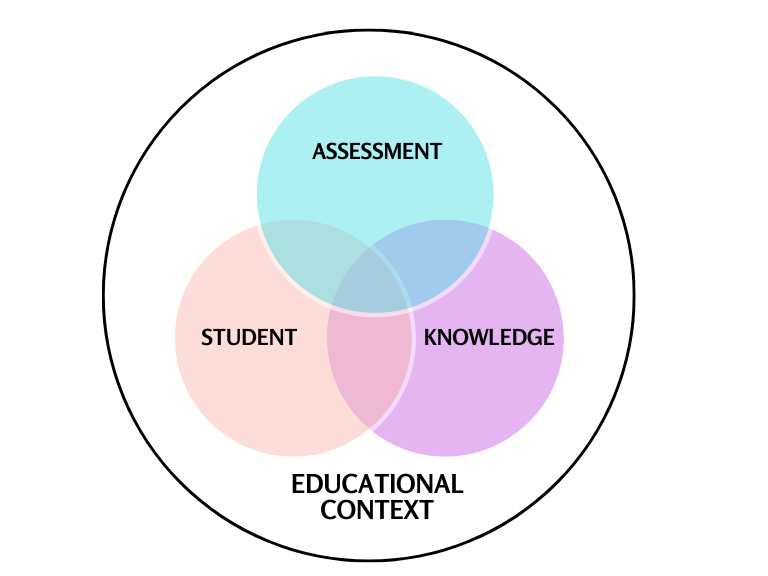
Student-oriented environment
This term is used to describe an environment that pays special attention to the knowledge, skills, attitudes, and beliefs that students bring to the educational setting. This concept seeks to uncover students' opinions and attitudes towards a particular issue, while sensitively discussing their possible "misconceptions", offering them insight into different situations that they need to think about and draw certain conclusions. In this way, it seeks to enable them to adapt their ideas and build on the conceptual and cultural knowledge they bring with them to the educational setting.
Student-centered environments involve teachers who are aware that students construct their own meanings and draw on their beliefs, understandings, and cultural practices to make their teaching. If teaching is about building connections between the subject and the student, in this form of teaching, teachers strive to take both sides into account. Teachers strive to gain insight into what students know and what their interests and passions are: what each student knows, what is important to them, what they can do, and what they want to do. They then focus on connecting these prior experiences with new insights and understandings of the problem.
Knowledge-oriented environment
A knowledge-oriented environment aims to develop learners into knowledgeable individuals by teaching in ways that promote deep understanding and the transfer of knowledge. An expert’s ability to think and solve problems does not depend solely on a general set of “thinking skills” or strategies; rather, it requires well-organized knowledge that supports planning and strategic thinking. This approach is closely linked to learner-centered environments, particularly in situations where teaching builds on learners’ prior knowledge and initial understanding of a specific subject or concept. If the knowledge that learners bring to different educational situations is not taken into account, it becomes difficult to predict what they will understand from new information (Banek Zorica, 2014).
Knowledge-oriented environments also emphasize the types of information and activities that help students develop a meaningful understanding of specific disciplines. If students are not provided with all the key information related to a particular problem or topic, their understanding may be incomplete or misguided. In addition to presenting facts, it is essential to foster an understanding of problems and events by examining them from multiple perspectives in order to draw valid and well-founded conclusions.
Many traditional curriculum models tend to produce fragmented knowledge and isolated skills rather than organizing them into coherent wholes. Such models often fail to support the gradual and structured refinement of students’ informal ideas through the adoption of the concepts and procedures characteristic of a particular discipline.
The activities used in knowledge-oriented learning environments are designed to enable students to explore, explain, extend, and evaluate their own learning. Ideas are most effectively adopted when students recognize the need to apply them, as this allows them to see the relevance of knowledge and better understand what they have learned. One of the key challenges of knowledge-oriented environments is achieving a balance between activities that support conceptual understanding and those that promote the automation of skills necessary for effective performance.
Contemporary theories of education emphasize active student engagement and are supported by research into brain functioning. Studies have shown that learning activities bring about changes in neural structures, not by chance, but through the formation and reorganization of new neural connections. In these dynamic processes, both social and environmental factors play a significant role. As a result, modern teaching increasingly draws on theoretical approaches such as constructivism and connectivism (Špiranec & Banek Zorica, 2008).
Examples of modern approaches to teaching at HEI (not referring to actual courses!)
Examples of modern approaches to teaching in higher education reflect a shift from the passive acquisition of knowledge toward active learning and student participation. For example, in the Marketing course at a Faculty of Economics and Business, students may work in small groups on market research projects and develop their own marketing campaigns, which they then present to their peers. In the Engineering Project course at the Faculty of Mechanical Engineering, students may address real-world problems through teamwork, using specialized software tools, and receiving guidance from instructors. Similarly, in the Language Teaching Methodology course at a Faculty of Humanities and Social Sciences, students may participate in simulated teaching sessions, record their performances, and analyze them through joint discussion and feedback, thereby developing reflective and professional competencies.
3. Constructivism
The modern pedagogical approach is based on the understanding of education as an active, dynamic, and reflective process that relies on scientifically based learning theories. While the traditional teaching model was based on behaviorist principles that emphasized the transfer and reproduction of knowledge, modern approaches are developing under the influence of constructivist and post-constructivist theoretical frameworks. Theories such as constructivism, connectivism, and social constructivism emphasize the importance of the active role of students in the learning process, independent discovery of meaning, and creation of new knowledge through experience, collaboration, and reflection. These concepts direct modern teaching towards the development of critical thinking, self-regulated learning, and the ability to connect different sources of knowledge, especially in a digital and online context. The teacher takes on the role of a mentor and facilitator who shapes a stimulating educational environment, directs the processes of research and reflection, and encourages students to actively participate and take responsibility for their own progress. Modern teaching strategies, such as problem-based and project-based learning, are developed on the theoretical foundations of constructivism and connectivism, which connect theoretical knowledge with practical situations and enable the development of competencies necessary for lifelong learning and professional activity.
Although different directions have been developed over time within the constructivist paradigm, which is attributed to thinkers such as J. Dewey, J. Piaget, L. Vygotsky, and J. Bruner, it as a whole nurtures the idea of the student as an individual who expands and elaborates his knowledge in a constructive process - constructive insofar as new information is integrated into existing knowledge. In doing so, not only has the existing structure of knowledge changed, but also the new information acquires additional qualities through this "fitting".
In other words, learning is described within such starting points as a constant process of expanding and (re)organizing one's own knowledge. Constructivism introduces a new quality into theories of learning and cognition that have traditionally been dominated by the communicative metaphor. It implied that some body of knowledge, located outside the individual and contained, for example, in a textbook or lecture, was to be transferred to the student. If such communication was not successful, the error was attributed to the message (e.g., the way in which the knowledge of a particular message was organized), the source of the message (inadequacy of the textbook), or the recipient (e.g., the level of the student's prior knowledge). A new and alternative interpretation of the learning process, namely constructivism, interprets that teaching is not a process in which knowledge is communicated, but a constant and active process of knowledge construction.
Thus, the basic principles of constructivism predict that knowledge is not received passively through the senses or communication, but is constructed by an active, thinking object. Knowledge is an organized experiential world of the subject, not an objective ontological reality; it is individual, flexible, and constantly changing. From this definition arise recommendations for the design of educational processes that, instead of the traditional paradigm of teaching, i.e., the mediation of knowledge, require the learner to question, verify, reject, or modify his or her constructs of reality.
The aim is for students to select and process information as independently as possible, create hypotheses, and make decisions. Within the framework of such perception, they independently discover principles and laws in the content they are learning. The teacher's role changes: he or she should first introduce students to a new area and help them discover how they can acquire new knowledge most easily and effectively, and over time, make them independent so that they learn how to learn on their own (learning to learn). According to constructivist principles, learning should involve students' independent work on problems related to the material they need to master, i.e., they should solve more complex tasks related to the real world, use case analyses, work on projects, etc.
Examples of the constructivist approach in teaching
Example 1. – Study of medicine: problem-based learning (PBL)
A small team of students is given a description of a patient and, by activating prior knowledge, formulates what they know and what they need to investigate. This is followed by independent and team study of sources, creation of a concept map, and discussion with guided questioning. It ends with a short reflection on how the new knowledge was constructed and how to apply it in a clinical decision.
Example 2. – Study of computing: project-based learning (PjBL)
Students design and develop an IoT (Internet of Things) prototype for a real user. They iteratively test the solution, keep a learning journal, plan work on the kanban board, and regularly perform peer evaluation. Knowledge is created through design, trial and error, and public product demonstration.
Example 3. - Study of the social-humanistic direction: social annotation and inquiry
In a digital environment, students jointly record and comment on primary sources (e.g., text, map, artifact) and compare perspectives and jointly define success criteria. From these notes, they develop interpretations and mini-case studies, which they then present and revise based on feedback. The emphasis is on joint construction of meaning and metacognition.
4. Connectivism
Connectivism as a theoretical concept was created at a time when the possibilities of including technology in the teaching process were only being considered and re-examined. However, with the maturing of technology in the 1990s and its application in education, there is a redirection of strategies and approaches to learning and the opening of space for new directions such as connectivism. According to George Siemens, the originator of this latest current of thinking in education, the existing lines of interpretation of learning built by behaviorists, cognitivists, and even constructivists do not explain technologically supported learning in a satisfactory way.
A theory is needed that will consider the new and restructured technologically based learning context. Siemens believes that it is necessary to pay more attention to the direct impact of technology, specifically to chaos and networks, and the new questions that arise: what happens when knowledge is not acquired linearly and systematically, and when cognitive processes, which were once performed by learning individuals, are left to machines (e.g., information storage and retrieval). Technology and the establishment of new connections affect learning activities. In this way, connectivism integrates the principles of chaos theory, networks, and self-organization.
Learning is a process that takes place in unclear and complex environments and cannot be fully under the control of individuals. It is essentially focused on connecting with specialized sets of information, and the connections that allow us to expand our knowledge are more important than the current knowledge we possess.
Examples of the connectivist approach in teaching:
Example 1. - Economics/marketing study: network market analytics and PLE/PLN
The student builds a personal learning environment (PLE) and a personal learning network (PLN): follows experts, newsletters, and data sources, and uses dashboards and data repositories to monitor trends. Knowledge is created by connecting the nodes of the network: tagging terms, blog summaries, and sharing examples on community platforms. The assessment includes a portfolio, a network map of connections, and a reflection on how connections influenced decisions in the marketing case study.
Example 2. – Architecture studio: studio with open network references
The student shapes the concept through online research of references and communities of practice: open libraries of details, competition databases, forums, and workshops. The process uses collaborative boards, parametric design, and open evaluation templates. Learning is documented through a learning diary, online mentoring, and peer assessment; the final proof is a public presentation.
Example 3 – Journalism Study: online research and fact-checking
The student develops a network of sources and tools for open intelligence gathering (OSINT), participates in the community of verifiers, and keeps files of topics in joint documents. With the help of social networks and newsletters, he/she builds a network of relevant sources and shares the learning results as guides and micro lessons.
5. Socioconstructivist approach
The socio-constructivist approach, dominant in the educational systems of Scandinavian countries, especially Finland, considers learning to be an active process that occurs in interaction with other people. Lonka (2020) points out that participation in cultural practices and joint activities shapes our cognitive activity in numerous ways. Context is not only situational but also depends on culturally and historically developed traditions. Cognitive development is very much dependent on the specific type of cultural environment in which it can be realized.
It was developed in response to the limitations of previous learning theories that neglected the social and cultural context of educational practices. It starts with the epistemological assumption that knowledge is not transmitted as a fait accompli from teacher to student, but is actively constructed in interaction with others, within specific sociocultural conditions. Starting from constructivist foundations, this approach further emphasizes the dialogic nature of learning in which language, social communication, and cultural patterns of action are key factors in shaping cognitive development. Knowledge, in this framework, is not a fixed and universal category, but rather contextual, dynamic, and socially conditioned.
This approach requires the transformation of the teacher's traditional role as a source of information into that of a facilitator and organizer of a collaborative environment in which learners are encouraged to solve problems together, construct a shared conceptual framework, and reflect on their own experiences. The learner is seen as an active participant in the community, and learning is seen as a process that is achieved through participation in authentic activities. In this way, knowledge becomes the result of joint construction, not just individual cognition.
6. Problem-based and project-based learning
In his book, Lonka (2020) emphasizes the need to move away from the current traditional teaching methods by actively engaging students through group discussions, interesting cases, and similar activities. He identifies two forms of learning, which are outlined below.
Problem-based learning typically begins with an authentic or engaging case that students are unable to solve using their existing knowledge. This gap encourages them to acquire new knowledge through independent inquiry and investigation. In this process, students learn relevant facts as well as principles of reasoning related to the case. Problem-based learning is widely used in medicine and the health sciences, and research indicates that it fosters deep learning and the development of clinical thinking.
Project-based learning, which is commonly applied in vocational education, focuses on learning aligned with workplace requirements. In this approach, projects are often carried out in companies or other real-world settings outside educational institutions.
These two approaches to learning and the associated teaching strategies will be discussed in greater detail in the following sections.
7. Conclusion
From the perspective of a university teacher, traditional teaching offers clear control over the content, pace, and structure of lectures; however, it also positions the teacher as the primary source of knowledge and limits opportunities for individualized and interactive learning. Modern approaches, particularly in digital environments, require teachers to be more flexible, adaptable, and committed to the continuous development of their pedagogical practices and technological competencies.
From the student’s perspective, traditional teaching provides the security of a well-defined structure and clearly articulated expectations, but it often results in a passive role in the learning process. In contrast, modern approaches emphasize students’ active participation and the development of critical thinking and collaborative skills, with digital environments creating new opportunities for inquiry, communication, and creativity. By integrating the strengths of traditional clarity with modern, participatory models in digital contexts, teaching can be designed to be both well structured and highly conducive to active learning.
8. Bibliography
Banek Zorica, M. (2014). E-učenje temeljeno na objektima učenja. U J. Lasić-Lazić (Ur.), Informacijska tehnologija u obrazovanju. (str. 33-59). Zagreb: Department of Information Studies, Department of Information and Communication Sciences, Faculty of Humanities and Social Sciences, University of Zagreb.
Lonka, K. (2020). Fenomenalno učenje iz Finske. Zagreb: Naklada Ljevak.
Siemens, G. (2005). Connectivism: A learning theory for the digital age, International Journal of Instructional Technology and Distance Learning, 2. http://www.itdl.org/Journal/Jan_05/article01.htm
Sveučilište u Zagrebu, Poučavanje
Špiranec, S., & Banek Zorica, M. (2008) Informacijska pismenost: teorijski okvir i polazišta. Zagreb: Department of Information Studies, Department of Information and Communication Sciences, Faculty of Humanities and Social Sciences, University of Zagreb.
Radočaj-Jerković, A., & Škojo, T. (2021). Analiza primjene nastavnih strategija u visokoškolskoj nastavi umjetničkog područja. Metodički ogledi, 28(1), 243-269. https://doi.org/10.21464/mo.28.1.13.
Background Colour
Font Face
Font Size
Text Colour
Font Kerning
Image Visibility
Letter Spacing
Line Height
Link Highlight
Paragraph Width
Text Alignment