Instructional design models
| Site: | Loomen za stručna usavršavanja |
| Course: | Pedagogy in a Digital Environment |
| Book: | Instructional design models |
| Printed by: | Gost (anonimni korisnik) |
| Date: | Saturday, 24 October 2026, 1:18 AM |
1. Introduction
Instructional design is based on a planned and systematic approach to the creation of teaching materials and learning experiences. In order to facilitate this process and make it more effective, various instructional design models have been developed to serve as guidelines for teachers and designers in their work. The models do not offer a universal solution, but rather represent structures and steps that can be adapted to a specific context, type of learners and learning objectives. Their role is to ensure clarity, consistency, and quality in all phases of the process – from needs analysis, through content design and development, to implementation and evaluation.
By using instructional design models, teachers and designers can avoid a haphazard approach and ensure that all elements of instruction are connected into a logical and coherent whole. In modern higher education, and especially in the digital environment, these models gain added value because they help align pedagogical goals with technological capabilities.
In this activity, the following instructional design models will be briefly introduced:
- ADDIE
- SAM
- TPACK
- SAMR.
2. Instructions for the task
Your task is to explore several proposed models of instructional design and analyze their main features. Pay attention to how each model defines the stages of the process, what the role of the teacher is, how much emphasis is placed on needs analysis and evaluation, and how flexible the model is in a digital environment.
After reviewing the models, critically assess which one would be most appropriate for your educational context (e.g., higher education, online teaching, vocational training, lifelong learning). Justify your decision by comparing the advantages and limitations of the selected model compared to others.
You can rely on scientific sources, professional literature, and practical examples to prepare your analysis. You will need to use the results of the analysis in the activities that follow.
3. ADDIE model
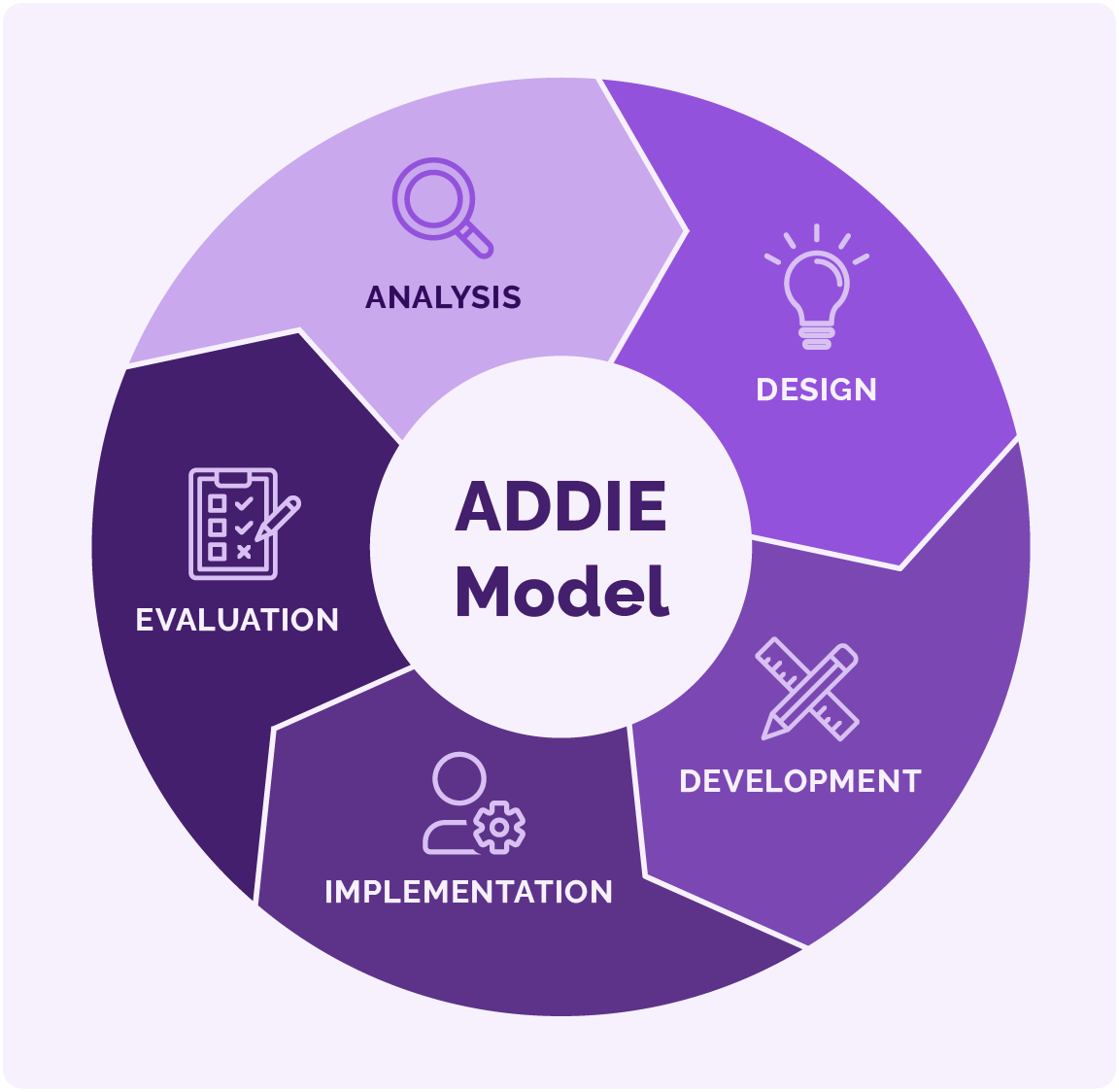
ADDIE model
One of the best-known and most used models of instructional design is ADDIE (Analyse, Design, Develop, Implement, Evaluate), which provides a clear framework for structured planning and implementation of the educational process during the five stated phases: analysis, design, development, application, and evaluation. The questions mentioned after each phase refer to what the instructional designer assisting the teacher/subject matter expert should pay particular attention to. If the teacher is also an instructional designer, they will solve some of these questions through internal analysis.
In the first phase, analysis, the educational problem is defined, the characteristics of the target group are identified (prior knowledge, competencies, motivation, technical readiness), the objectives are established, and the contextual conditions of learning are specified. In higher education, this phase includes, for example, an analysis of the study program and the expected outcomes of the qualification, but also an analysis of the conditions of teaching (number of students, possibility of using e-learning, availability of resources, etc.).
Questions that need to be asked during this phase are usually:
- What are the learning objectives?
- What is the audience?
- What are their needs?
- Are there any limitations in learning?
- What is the learning environment like?
- What tools and resources are available?
- What is the time frame?.
The design phase, in which the teaching content is structured, didactic strategies are determined, the sequence of activities is planned, and the form of assessment is defined. This phase also determines the types of teaching media and technologies that will be used, paying attention to their didactic function. It is crucial that the design is aligned with the learning outcomes, as well as the program outcomes.
During this phase, it is necessary to:
- interview subject experts (experts whose expertise covers the content of the future e-college, if you are both an expert and the author of the e-college, do the analysis yourself) in order to get detailed information and insights into the content
- determine the appropriate media and technological tools for students to use
- determine how collaborative and interactive the content should be
- determine the knowledge and skills that students should develop after each assignment.
Development phase refers to the creation of actual teaching materials: lectures, scripts, visuals, quizzes, case studies, and other resources. In digital education, this includes the creation of interactive elements, videos, and templates for independent work, as well as the development of tests and evaluation rubrics. Pilot testing of individual elements is often carried out during this phase.
Questions that need to be asked during this phase are usually:
- Is the creation/development of digital teaching materials timely in order to meet the target deadlines?
- Do any content or resources need to be redesigned or developed?
- Are there any incompatibilities (related to tools and digital content)?
- Are some digital tools or activities unusable?.
Implementation is the phase in which the designed teaching materials and activities are applied in a real educational situation. This could be the implementation of a course in the next semester or a workshop for teachers or students. During implementation, the instructional designer or teacher monitors how what has been planned works in real conditions and records user reactions and technical and pedagogical challenges encountered by the students or teacher.
If it is a project where the instructional designer helps teachers in the development of e-colleges, at this stage, it is necessary:
- begin training instructors/teachers on learning outcomes, recommended delivery methods, and appropriate use of tools and technology
- ensure that the leader of the e-course/e-college has all the materials and tools the participants need to complete the necessary learning activities
- establish a way to document student performance during the e-course
- create a backup plan for lessons and activities if the instructor encounters technical difficulties while delivering the e-course/e-college.
The final phase, assessment, includes a dual aspect: formative evaluation, which is carried out during all previous phases to improve the material and approach, and summative evaluation, which is carried out after implementation to determine the effectiveness of the program. Evaluation can be carried out, for example, by: student surveys, learning analytics, etc.
Questions at this stage usually concern how to improve an already conducted e-course/e-college for the next year of execution:
- Have the problems been solved and the learning objectives achieved?
- How receptive were the participants to the activities and materials?
- Are changes needed in the scope and sequence of e-course content?
- Are there areas that could be improved or made more efficient?.
4. SAM model
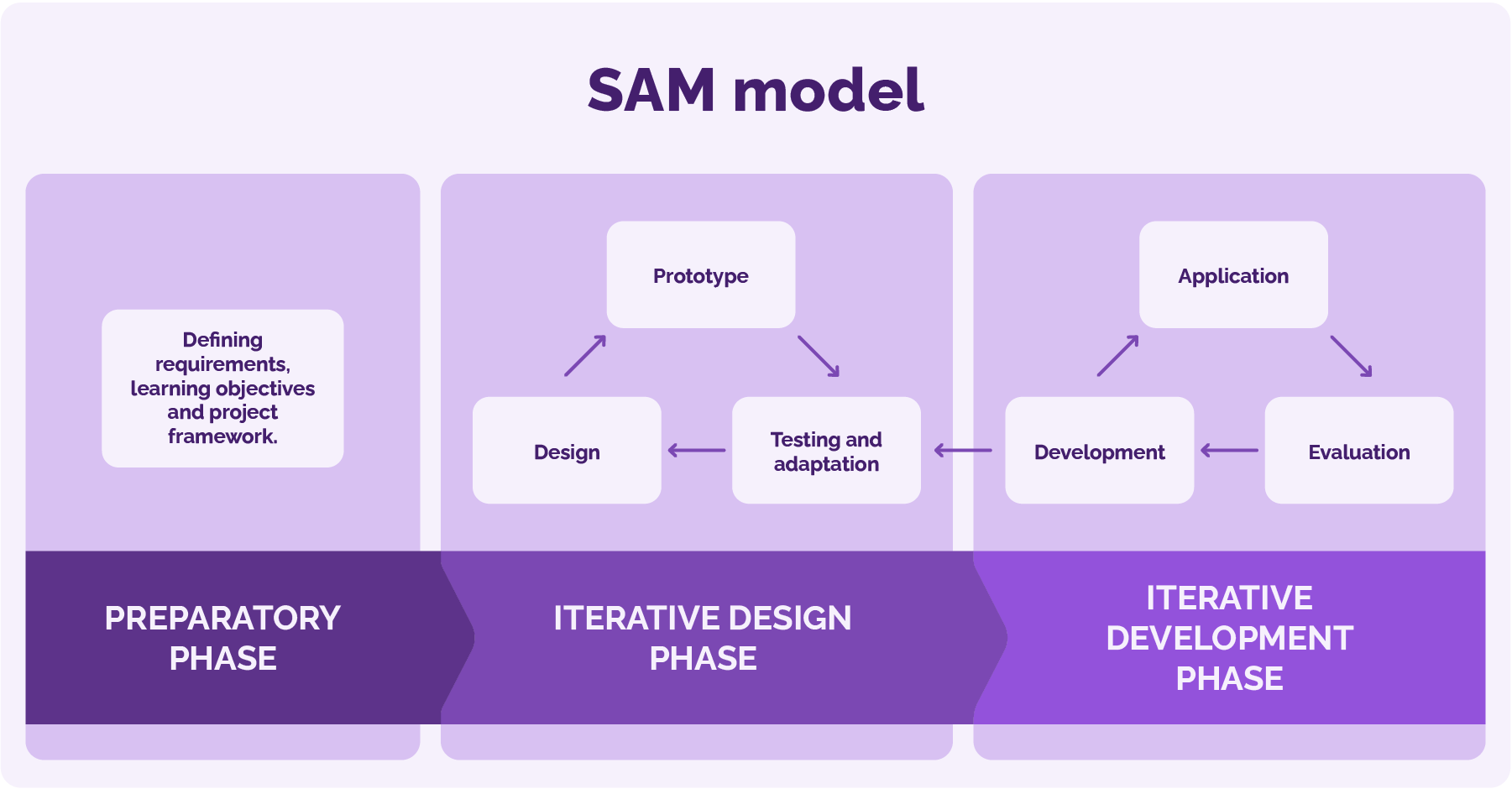
SAM model (Successive Approximation Model)
Due to the fact that when applying the ADDIE model, adjustments are introduced only after evaluation, a need arose for a more flexible approach that allows for continuous evaluation and adjustment during development. SAM3 (Successive Approximation Model) was designed to overcome these limitations. It is based on an iterative process in which design, development, and evaluation are carried out in parallel and cyclically. This approach allows for faster feedback and adjustments, reducing development time and increasing compliance with user needs.
It consists of a preparation phase, a design phase, and a development phase, with the design and development phases being repeated in at least three iterations. Each iteration is based on feedback and evaluation of the previous iteration.
The preparatory phase begins with defining the project's goals and gathering information about the target group. It includes understanding students' needs, learning styles, and the prior knowledge and competencies they need to acquire. This phase often results in the creation of initial sketches that serve to test ideas and serve as a basis for planning further development.
During the design phase, initial versions of educational content and activities are created, which are constantly tested and improved based on the feedback included in each iteration. With each iteration, the design becomes more detailed and customized.
Finally, in the development phase, the solution is finalized in several versions (alpha, beta, and final version). Each version is evaluated and improved based on feedback, which ensures the optimal quality of the final product (Tomić, 2025).
The peculiarity of the SAM model is in the dynamic management of feedback: instead of the evaluation taking place exclusively at the end of the educational cycle, it is an integral part of every iterative cycle. This enables continuous quality control, adaptation of content according to students' needs, and flexible response to technological and pedagogical changes.
In the context of higher education, the SAM model is particularly applicable to the development of e-courses. Its advantage is reflected in the reduction of the risk of inconsistency of teaching objectives, activities, and assessment, but it requires intensive cooperation of different participants in the educational process and greater technological support, and very often it is more difficult to predict the time frame required for the development and design of more complex forms.
One of the fundamental specificities of the SAM model is rapid prototyping as a basic didactic principle. Instead of focusing all efforts on creating final versions of teaching materials before checking their effectiveness, SAM advocates creating an initial prototype that is immediately tested in a real educational context, usually with a target group of students. The prototype does not have to be complete, but it must be functional enough to recognize possible difficulties, ambiguities, or deficiencies in the learning structure. This approach allows for quick direction correction and supports the principle of education that develops in dialogue with users, not for users.
Another important element of the SAM model is its collaborative nature, or social dimension. The design process involves various stakeholders: teachers, content experts, learning designers, technical support, and student representatives. This collaboration enables the integration of different perspectives and knowledge: pedagogical, technical, content, and application. Such an approach is not only organizationally but also epistemologically significant and reflects the belief that quality education cannot be planned in isolation, but as a result of interdisciplinary consensus and dialogue.
In the context of university teaching, an important advantage of SAM is its reflective structure. Unlike rigidly defined documentation procedures, SAM allows for the management of the process through workbooks, notes, and evaluation forms that are constantly updated and revised. This positions the teacher not as a producer of a static plan, but as a reflective practitioner who constantly reexamines his or her own pedagogical decisions in light of student reactions, changes in digital environments, and the developmental goals of the study program.
Ultimately, the SAM model is not just an alternative methodology for creating educational content but represents a pedagogical turn towards learning based on dialogue, adaptation, and iteration. In the higher education context, this means the development of a curriculum that is not based on the assumption of universal knowledge and methods, but on the recognition of the diversity of students, contexts, and educational goals.
5. SAMR model
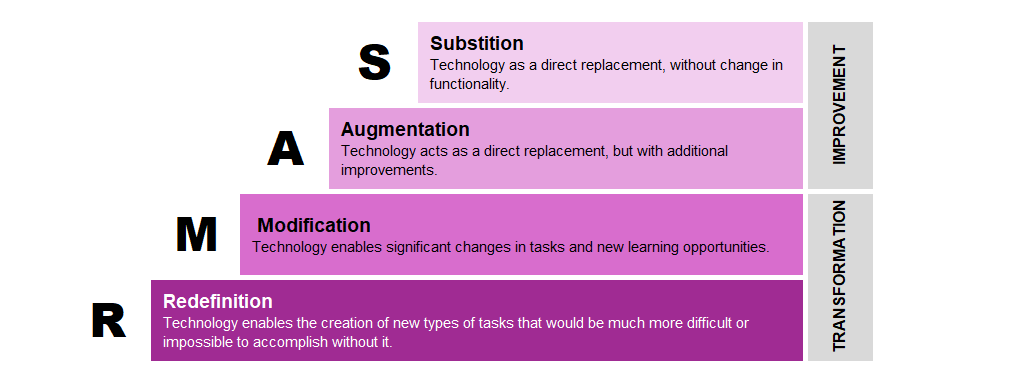
SAMR model
The SAMR model was developed in 2010 by Ruben Puentedura and consists of four levels of online learning, roughly ordered according to their transformative power. SAMR is a reflection tool that can help teachers think about how the integration of digital technology supports learning in specific educational contexts/situations and activities. The abbreviation SAMR stands for substitution, augmentation, modification, and redefinition.
The individual phases of the model are described below.
In the substitution phase, technology is used to solve a task that could equally well be done without the use of technology, for example, students solve a printed task on paper or use a digital source such as a book.
In the augmentation phase, technology is used for a task that would otherwise take much longer or be more difficult (complex) if students were to complete it without the use of technology, e.g., students complete an online exam with closed questions that are automatically graded and scored by a distance learning system. Students edit text on a computer, adding images, sound, or video, and the like.
The phases of substitution and augmentation represent the foundation of the transformation of the educational process, which is actually carried out in the remaining two phases: modification and redefinition.
In the modification phase, technology provides students with new learning opportunities. For example, after writing a seminar, students can record it as a short video and share it with their colleagues. They can also create an infographic or poster with interactive elements (such as video, audio, and links to other resources).
In the redefinition phase, technology provides the possibility of creating new types of tasks that would be much more difficult to achieve or impossible without the use of technology, such as recording and producing an interactive video on a topic, creating a digital book, an interactive timeline with plenty of multimedia content and links to external content for each of the points/events, and interactive maps with data collected during field research and the like.
The link above is available in Croatian only. Participants may use free AI-powered translation tools to access the provided materials.
6. TPACK model
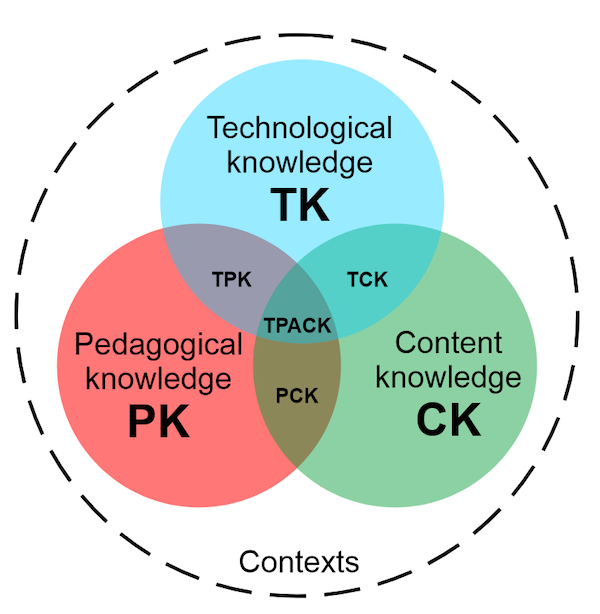
What is TPACK?
TPACK stands for Technological Pedagogical Content Knowledge. At the heart of the TPACK framework is TPACK knowledge, an integrated understanding of how to teach specific content using appropriate pedagogical strategies supported by appropriate technology. The model is based on the assumption that quality teaching with technology requires a focused overlap of three knowledge areas (CK, PK, and TK, whose additional intersections encompass new sub-areas):
- Content Knowledge (CK) is a teacher's knowledge of the subject matter to be learned or taught. It includes knowledge of concepts and theories, ideas, organizational frameworks, and evidence, as well as established practices and approaches for developing such knowledge.
- Pedagogical Knowledge (PK) is a teacher's knowledge of the processes, practices, or methods of learning and teaching. It encompasses, among other things, the overall purpose of education and its values and goals, and refers to understanding the learning process, classroom management skills, lesson planning, and assessment.
- Technological Knowledge (TK) is knowledge about certain ways of thinking and working with technology, tools, and resources. Working with technology can be applied to all technological tools and resources and includes a broad enough understanding of information technology to be productively applied at work and in everyday life, recognizing when information technology can help or hinder goal achievement and constantly adapting to information technology changes/developments.
- Pedagogical Content Knowledge (PCK) is based on Shulman's idea of pedagogical knowledge applicable to the teaching of specific content. The emphasis is on the transformation of the teaching topic that occurs during its interpretation, finding different ways of interpreting it, and adapting instructional materials to alternative concepts and prior knowledge. It covers the very core of the work of teaching, learning, curriculum, assessment, and reporting.
- Technological Content Knowledge (TCK) is the understanding of how technology and content influence and constrain each other. Teachers must master more than the subject matter they teach. They must also have a deep understanding of how the subject matter (or the kinds of representations that can be constructed) is transformed by the application of particular technologies. Teachers need to understand which specific technologies are best suited to address subject matter learning in their domains and how content dictates or even changes technology, or vice versa.
- Technological Pedagogical Knowledge (TPK) is an understanding of how teaching and learning can change when certain technologies are used in a specific way. This includes knowing the pedagogical advantages and limitations of a range of technological tools related to the discipline and developing an appropriate pedagogical design and strategy.
- Technological Pedagogical Content Knowledge (TPACK) is a combined form of knowledge that contains all three main components (content, pedagogy, and technology). It is the foundation of effective teaching with technology and requires an understanding of the concepts of technology application, pedagogical techniques that use technology in constructive ways to teach material, knowledge of what makes certain concepts difficult or easy to learn, and how technology can help correct some of the problems that students (learners) face. It also requires knowledge of students' (learners') prior knowledge and theories of epistemology, and knowledge of how technologies can be used.
Why is TPACK important?
The model helps teachers see technology not as an add-on to teaching, but as an active component of didactic reflection. By applying the TPACK framework, teachers reflect on these questions:
- What is the goal of teaching?
- What content is key to understanding?
- Which method best suits the goals and content?
- What digital tools can enhance the learning experience?.
In this way, technology becomes a means, not an end, and supports learning in a meaningful and effective way.
Applying the TPACK framework in lesson planning
When planning levels of technology integration, TPACK can be used as a tool for analysis and reflection:
- low level of integration: technology is used passively for content presentation
- medium level of integration: technology enables interaction and collaboration
- high level of integration: technology is inseparable from the teaching process and enables personalized, creative, and problem-based learning.
TPACK also helps teachers develop digital competencies because it highlights not only the technical, but also the pedagogical function of technology.
TPACK and teacher professional development
Developing TPACK competencies does not happen automatically. It is necessary to include the TPACK framework in teacher education and professional development, encourage teamwork and interdisciplinary projects, use reflective practice, i.e., analyze one's own teaching scenarios with the TPACK model, and apply digital pedagogy in designing e-courses and OER content in order for a teacher to fully acquire these competencies.
The TPACK framework provides a systematic approach to understanding and integrating technology into the educational process. Rather than using technology haphazardly or out of a need to modernize or because it's "modern," TPACK directs us toward thoughtful and contextualized application. Such an approach not only improves teaching but also strengthens the role of the teacher as a pedagogical expert in the digital age.
7. Bibliography
Hoić Božić, N., & Holenko Dlab, M. (2021). Uvod u e-učenje: obrazovni izazovi digitalnog doba. Rijeka: University of Rijeka, Department of Informatics.
Hamilton, E., Rosenberg, J., & Akcaoglu, M. (2016). The Substitution Augmentation Modification Redefinition (SAMR) Model: a Critical Review and Suggestions for its Use. TechTrends. 60. https://doi.org/10.1007/s11528-016-0091-y.
Sam (successive approximation model). ELM Learning. (2024). https://elmlearning.com/hub/instructional-design/sam-successive-approximation-model/.
Tomić, V. (2025). Planiranje i provedba hibridne nastave. CARNET.
ELM learning. SAM (Successive Approximation Model) pristup e-učenju
E-learning Designer's Academy. Što je to SAM model instrukcijskog dizajna?
Schmidt, D. A., Baran, E., Thompson, A. D., Mishra, P., Koehler, M. J., & Shin, T. S. (2009). Technological Pedagogical Content Knowledge (TPACK): The Development and Validation of an Assessment Instrument for Preservice Teachers. Journal of Research on Technology in Education, 42(2), 123–149. https://doi.org/10.1080/15391523.2009.10782544.
University of Washington, ADDIE model
Digital learning institute, Proces ADDIE dizajna učenja za instrukcijske dizajnere
Instructional design, ADDIE model
Nearpodblog TPACK model objašnjen primjerima iz učionice
Digital technologies hub, TPACK model
Edutopia, Moćni model za razumijevanje dobre integracije tehnologije
Twitterova družina, Model SAMR
Bouchrika, I. (n.d.). How to use SAMR model in designing instruction for 2025 (an Edtech Integration Guide)
Background Colour
Font Face
Font Size
Text Colour
Font Kerning
Image Visibility
Letter Spacing
Line Height
Link Highlight
Paragraph Width
Text Alignment