Teaching objectives and learning outcomes
| Site: | Loomen za stručna usavršavanja |
| Course: | Pedagogy in a Digital Environment |
| Book: | Teaching objectives and learning outcomes |
| Printed by: | Gost (anonimni korisnik) |
| Date: | Saturday, 24 October 2026, 4:07 AM |
1. Learning outcomes as operationalization of teaching objectives
Considering the concept of teaching objectives, their function and application in higher education, naturally leads to the concept of learning outcomes. Learning outcomes represent a concrete, clearly defined, and measurable operationalization of teaching objectives. While objectives focus on teachers’ plans and intentions, learning outcomes, through their student-centred structure, precisely define the knowledge, skills, and competences that a student should demonstrate upon completion of the learning process.
Unlike objectives, which often remain at the level of broad pedagogical intentions, learning outcomes answer a fundamental question: What will a student know, understand, or be able to do after completing a particular teaching unit, course, or study programme? Their key role lies in transforming abstract educational intentions into concrete, observable student actions. In this way, learning outcomes support structured teaching planning as well as reliable assessment of student achievement.
Well-formulated learning outcomes are based on the principles of clarity, measurability, and student-centredness. They are expressed as statements that begin with an active verb (for example: The student will be able to analyse…, The student will apply…, The student will evaluate…), emphasising behaviours that can be observed, assessed, and evaluated. Rather than focusing on teaching content, learning outcomes emphasise what students will be able to do with that content. This represents a shift from traditional teacher-centred instruction and knowledge transmission to a modern curriculum that highlights the active role of students in the learning process.
The formula for strong learning outcomes:
Examples of learning outcomes:
- The student will be able to explain the basic concepts of research methodology.
- The student will be able to apply statistical methods to data analysis.
Vlahović-Štetić and Kamenov (2016) note that learning outcomes can be defined at the level of a study programme, course, or individual teaching unit. At each of these levels, they help both students and teachers understand the intended results of the educational process. Clearly articulated learning outcomes serve to:
- help students understand what is ultimately expected of them;
- clarify what students can expect from a particular teaching unit or course;
- inform prospective students about the knowledge and skills they will acquire upon graduation;
- enable teachers to clearly define the outcomes they aim to achieve in a course or study programme;
- guide the selection of teaching content aligned with desired outcomes;
- support the choice of appropriate teaching methods;
- inform suitable approaches to monitoring progress and assessing achievement.
The validity and effectiveness of learning outcomes also stem from their alignment with the level of study and qualification requirements. At the undergraduate level, learning outcomes typically emphasise understanding, describing, and applying knowledge. At graduate and postgraduate levels, students are expected to engage in more complex cognitive processes such as analysis, synthesis, evaluation, and the independent creation of knowledge. In this way, learning outcomes facilitate vertical progression in education by clearly distinguishing levels of complexity and depth.
In addition, learning outcomes in higher education can be classified according to the types of competences they develop. The cognitive domain encompasses intellectual processes such as understanding, logical reasoning, critical thinking, and creative problem-solving. The psychomotor domain includes practical and technical skills requiring coordination, precision, and procedural execution, which are particularly important in vocational, medical, and artistic disciplines. The affective domain relates to the emotional and value-based dimensions of learning, including attitudes, ethical judgement, responsibility, and professional behaviour, areas that are often overlooked but are essential to the development of a well-rounded academic and professional identity.
2. Bloom's Taxonomy
Learning objectives are described and classified by the taxonomy of learning objectives. It classifies the desired behavior of students and the way in which students react, think, or feel after being exposed to the influence of teaching and their learning (Bloom, 1970, according to Cindrić et al, 2016). Bloom's taxonomy was created in 1956 based on analyses of intellectual behaviors through which students acquire academic knowledge. During its existence, it has been revised several times, based primarily on findings in the field of cognitive psychology. The main reason for the latest revision was that the category of knowledge is by its nature two-dimensional, while the original taxonomy presents it as one-dimensional.
According to Bloom's taxonomy, achievement levels are divided into three categories:
- cognitive (knowledge and understanding)
- affective (attitudes and beliefs)
- psychomotor (skills and abilities).
Furthermore, Cindrić states that the principles of creating a taxonomy are as follows:
- the main differences between taxonomic categories are mainly the differences that teachers see between different forms of student behavior.
- it must be logical and consistent in its internal structure, meaning that each term must be defined and applied consistently throughout the taxonomy.
- it must be descriptive, i.e., each objective must be presented in a relatively neutral manner.
Divjak (2009) states that there is a hierarchy of learning outcomes in higher education:
- general learning outcomes that describe the level of academic achievement within the framework of the Bologna process
- specific learning outcomes for a field or combination of fields
- specific learning outcomes for a particular study program or area, including the requirements of target occupations
- specific course learning outcomes that include criteria for student success.
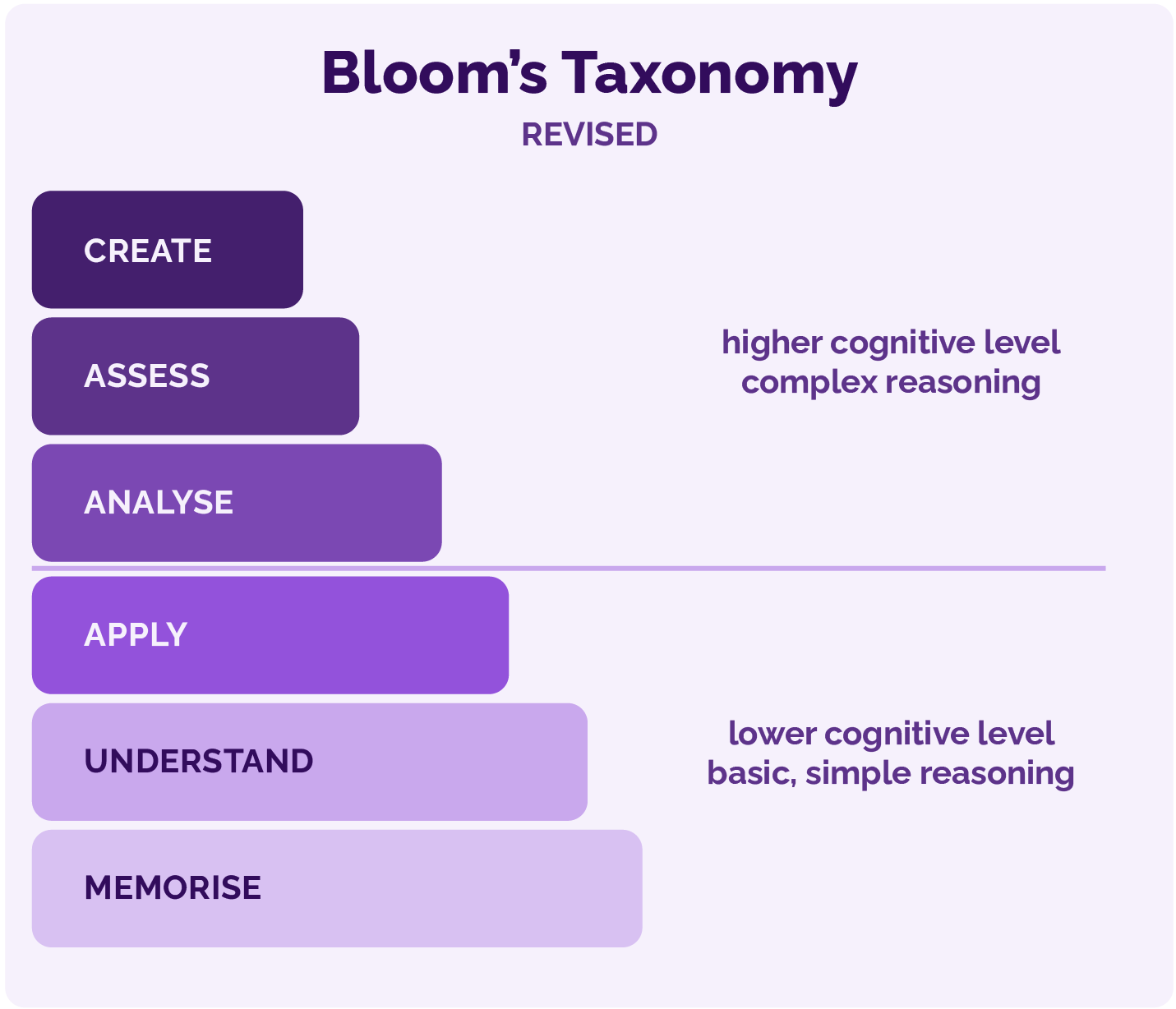
Bloom defines six categories in the cognitive area that are determined by behavior. Hierarchy in the categories is respected because each subsequent category describes more complex behavior than the behavior in the previous category. This means that the categories are arranged in such a way that they follow the principle from simpler to more complex verbal achievement and from concrete to abstract knowledge.
Cognitive categories are listed below.
1. Knowledge is divided into:
- knowledge of details (recall and reproduce information, know terminology and specific facts)
- knowledge of ways and means of managing details (organizing, investigating, judging and criticizing, expressing ideas and phenomena, knowing the processes of movement, criteria for verifying or judging facts, principles, opinions or procedures, and methodology for investigating specific problems or phenomena)
- knowledge of general universal concepts in a particular field - important schemes and models for the organization of phenomena and ideas, theories and generalizations (the highest level of abstraction and complexity).
2. Understanding consists of:
- translation, which represents the accurate translation of content from one language form to another
- interpretation, which refers to the interpretation of content and its reorganization or reinterpretation
- extrapolation, which refers to the translation or processing of information, its interpretation, and the prediction of possible consequences.
3. Application is the ability to apply abstract concepts in specific and concrete situations.
4. Analysis can be:
- component analysis, which is the identification of the components that make up information
- relationship analysis that serves to determine interpersonal connections and the influence of components of individual information
- analysis of organizing principles, which is the identification of explicit or implicit organizing principles on the basis of which the content is structured.
5. Synthesis is the ability to combine components into a whole, that is, independently write original communications, propose a work plan, and formulate appropriate hypotheses based on analysis.
6. Assessment is the ability to judge the value of content and methods in a field according to certain criteria. It is possible to evaluate on internal and external standards. Internal standards are the ability to assess the accuracy of facts with respect to evidence and documentation, while external standards are the ability to evaluate theories or facts about certain cultures.
Most teachers are familiar with the above six learning categories; however, for successful work, it is not enough just to know, but also to implement these categories into concrete knowledge, abilities, and skills so that students can show how they understood the information and how they are used in practice.
When talking about types of knowledge, according to Krathwohl, the revised version of Bloom's Taxonomy divides it into 4 types (according to Kovač and Kolić-Vehovec, 2008):
- factual knowledge – knowledge of the basic elements that students must know in order to become familiar with the subject or solve a problem (knowledge of terminology and knowledge of individual details and elements)
- conceptual knowledge – knowledge of the mutual connection between the fundamental elements of a larger structure that enables joint functioning (knowledge of classifications and categories, knowledge of principles and generalizations, and knowledge of theories, models, and structures)
- procedural knowledge – knowledge of how to do something, test methods, criteria for use, algorithms, techniques, methods (knowledge of skills and procedures related to a particular subject, knowledge of techniques and methods, and knowledge of criteria for deciding on the application of certain procedures)
- metacognitive knowledge – knowledge about oneself as a student, study contents and learning and thinking strategies, self-regulation of one's own learning, knowledge of cognition and awareness of knowledge of cognition (knowledge of one's own way of learning, knowledge of features of the content to be adopted, knowledge of strategies for learning the content and skills of self-monitoring and self-regulation of learning).
In addition to cognitive goals, there are also psychomotor and affective goals. It is important to point out that cognitive and psychomotor goals can be operationalized, but the problem arises with affective goals because they relate to the acquisition of certain values and the adoption of attitudes and opinions.
The psychomotor area, therefore, has five stages:
- imitation – learning about an action and imitating it after a demonstration
- manipulation – working according to instructions, which means that oral or written instructions are converted into appropriate psychomotor activity
- precision – psychomotor activity is more and more precise and safe, and is carried out more confidently
- activity analysis – conscious analysis of an individual activity is perfected through long-term repetition
- naturalization – maximum internalization, the student achieves automation.
The affective area has the following levels (Krathwohl et al., according to Cindrić et al):
- acceptance – acceptance of teaching, recognition of the importance of learning, sensitivity to social problems, acceptance of diversity, and tolerance
- reaction – fulfilling obligations, following rules, participating in discussions, volunteering for tasks, helping others, being interested in the subject being taught
- critical evaluation – supporting democratic processes, a preference for good literature, accepting scientific principles in everyday life, appreciating the need for social progress
- organization – respecting the balance between freedom and responsibility, recognizing the need for systematic problem solving, taking responsibility, accepting one's own strengths and weaknesses
- value judgment – expressing self-respect and respect for others, willingness to cooperate, ability to establish objective evaluation criteria, diligence and self-discipline, positive self-image.
It should be emphasized that regular verification of the achievement of learning outcomes and their relevance is extremely important in the context of evaluating courses and study programs. If it turns out to be necessary, or if the outcomes are not covered or are not achieved, they need to be revised.
We recommend an article related to digital aspects and Bloom's Taxonomy, available at the link, as well as a short video on the same topic.
3. Writing learning outcomes
The learning outcomes-based approach to teaching emphasizes the need to clearly define expectations, i.e., what students will be able to do after completing the course requirements, already in the planning of the curriculum or syllabus. Well-formulated outcomes are not enough on their own if teaching methods and methods of assessment are not aligned with them, because without this connection, it is difficult to achieve the desired changes in students' knowledge, skills, and attitudes. The quality of the process depends on the alignment of the planned outcomes, including the levels of cognitive processes and types of knowledge, with the selected teaching strategies and assessment procedures. This relationship is called curricular or constructive alignment, where well-defined learning outcomes form the starting point for the development of effective strategies for teaching, learning, and assessment of what has been learned (Anderson, 2002, according to the Manual for the Development of Learning Outcomes of the University of Zadar, 2018).
The following notes may be helpful when writing learning outcomes:
- First, you need to think about what the student should know/be able to do after the lesson and be realistic about it.
- The outcome should be formulated as a continuation of the sentence: After learning, the student will be able to...
- You should try to use active, precise verbs such as: list, make, choose, apply, show, explain..., and avoid verbs such as: know, make aware, learn, understand, be aware…
- The outcome should be discussed with colleagues and students (whether it is clear enough and whether students know what is expected of them).
Designing learning outcomes is also possible using the SMART method (Drucker 1955). In doing so, we make sure that the learning outcome is:
- specific
- measurable
- attainable
- relevant
- time-bound
The SMART method serves as a framework for formulating learning outcomes so that specificity requires clearly defined behavior or competence, measurability predicts success indicators or criteria, and attainability verifies realism with respect to resources and level of study. Relevance relates the outcome to course goals and the needs of students or the profession, while the time frame defines the deadline by which achievement is expected. By applying SMART, outcomes become transparent and verifiable, and learning activities and evaluation methods are more easily coordinated.
Given their comprehensive role, learning outcomes are not just a teaching aid but a fundamental component of the entire curriculum process. Their function extends from the initial phase of planning teaching content, through the selection of appropriate teaching methods and forms of work, to the development of evaluation and performance assessment instruments. In this way, learning outcomes enable teachers to structure the teaching process and students to have a clear orientation and understanding of their own educational paths.
The importance of active verbs
The following link is available in Croatian only. Participants may use free AI-powered translation tools to access the provided materials.
When writing learning outcomes, it is very important to pay attention to the importance of active verbs; that is, you should use precise verbs and avoid imprecise verbs.
Precise verbs:
- analyze
- make
- compare
- to distinguish
- describe
- argue.
Imprecise verbs:
- awaken
- appreciate
- learn
- know
- understand
- remember.
Example of writing learning outcomes at the course level:
- Learning outcomes at the subject level must be derived from objectives defined at the program level.
- Learning outcomes are always formulated and published in writing.
- Expected learning outcomes are statements written by teachers that specify what the student should know, understand, and/or be able to demonstrate at the end of the learning process.
- The starting point for shaping the outcome is clearly defined general and professional competences.
- It is optimal to define between four and eight learning outcomes for one subject.
- The beginning of the sentence defining the outcome should begin with the phrase:
After successfully completing the course, the student will be able to... and should be followed by the level of achievement expressed with an active verb according to Bloom's Taxonomy.
4. Conclusion
Distance learning is characterized by flexibility in place and time, digitally mediated interaction, and a combination of synchronous and asynchronous activities. Clear planning with visible outcomes, a defined pace of work, and transparent assessment criteria, supported by micro-checks and timely feedback that sustain motivation and guide progress, is essential.
The student’s role is emphatically active and self-regulatory, and the quality of the learning experience depends on a sense of community, the teacher’s presence in the digital environment, and meaningful assignments that connect theory with practice. At the same time, flexibility is constrained by the need for shared deadlines, supervised assessments of knowledge, and clearly defined outcomes that require practical work.
Ensuring the accessibility of such educational services requires planned support, as technical infrastructure, digital competencies, and socio-economic conditions are not equally distributed. The best results are achieved through an organized system in which the teacher, the e-learning center, and IT services provide coordinated pedagogical and technical support, and where course design is simple, consistent, and focused on learning.
5. Bibliography
Anderson, L. (2002). Curricular Alignment: A Re-Examination.Theory Into Practice – THEORY PRACT. 41. 255-260. https://doi.org/10.1207/s15430421tip4104_9.
Cindrić, M., Miljković, D., & Strugar, V. (2016). Didaktika i kurikulum. Zagreb: IEP-D2, Faculty of Teacher Education.
Divjak, B. (Ed.) (2009). Ishodi učenja u visokom školstvu. Varaždin: Faculty of Organization and Informatics, University of Zagreb.
Divjak, B. (2017) Ishodi učenja - zašto i kako?
Drucker, P. F. (1955). The practice of Management. William Heinemann.
Kovač, V., Kolić-Vehovec, S. (2008.) Izrada nastavnih programa prema pristupu temeljenom na ishodima učenja – Priručnik za sveučilišne nastavnike. Rijeka: University of Rijeka.
Sveučilište u Zadru. (2018). Priručnik za izradu ishoda učenja Sveučilišta u Zadru. https://www.unizd.hr/Portals/0/kvaliteta/Prirucnik_za_izradu_ishoda_ucenja.pdf?ver=2019-03-07-133532-253.
Vlahović-Štetić, V., & Kamenov, Ž. (2016). Kako ostvariti željene ishode u studijskim programima? Priručnik za sveučilišne nastavnike. Zagreb: FF Press.
Background Colour
Font Face
Font Size
Text Colour
Font Kerning
Image Visibility
Letter Spacing
Line Height
Link Highlight
Paragraph Width
Text Alignment