Microlesson "Peer-level assessment using digital tools"
| Site: | Loomen za stručna usavršavanja |
| Course: | Pedagogy in a Digital Environment |
| Book: | Microlesson "Peer-level assessment using digital tools" |
| Printed by: | Gost (anonimni korisnik) |
| Date: | Saturday, 24 October 2026, 4:07 AM |
Description
Review the microlesson Peer-level assessment using digital tools and make notes about what you have learned.
1. Microlesson "Peer-level assessment using digital tools"
Microlesson Peer-level assessment using digital tools
Teacher Antun wants to familiarize his students with using evaluations as learning tools, specifically through self-assessment and peer assessment. From his experience with previous generations, he knew that peer assessment results on paper were often lost, inaccessible, and impossible to store. To address this, he decided to conduct peer assessments more frequently using digital technologies, storing the results in digital form. He searched online using the keywords “peer assessment,” “evaluation,” and “digital tools.” The nearly 17,000 results overwhelmed him. After reviewing the first few pages, he found that most were not relevant to his query. He began to wonder how he could effectively conduct peer evaluation using digital tools.
The following link is available in Croatian only. Participants may use free AI-powered translation tools to access the provided materials.
* The original microlesson was created as part of CARNET's EduBlic project and is available at the link. Since it is released under the CC Attribution-NonCommercial-ShareAlike 4.0 International license, it has been adapted for a higher education context and published under the same license.
2. Methods of evaluation while learning
Methods of evaluation while learning
In assessment while learning, the procedures are based on methods of self-assessment, i.e., self-reflection and peer assessment (e.g., self-assessment using grading tables, learning diaries, assessment scales, consultations with the teacher, etc.). It refers to the active involvement of the student in the assessment process with constant support from the teacher through various peer and self-reflective assessment activities.
In e-learning, it is possible to use assessment scales, interactive lessons, tasks, or simulations, choosing the complexity of tasks according to self-assessment, reflection after solving, digital learning diaries, e-portfolios, and exit tickets. It is possible to include peer evaluation as part of collaborative activities in which peers monitor group work, with students deciding on evaluation criteria.*
For assessment as learning to be effective, in analyzing the success of their own learning, students must clearly know in advance what the goals/outcomes are for a particular lesson/unit/week/semester.
In addition to learning outcomes, students should also be familiar with evaluation criteria so that they can recognize different levels of their own achievements.
Peer assessment
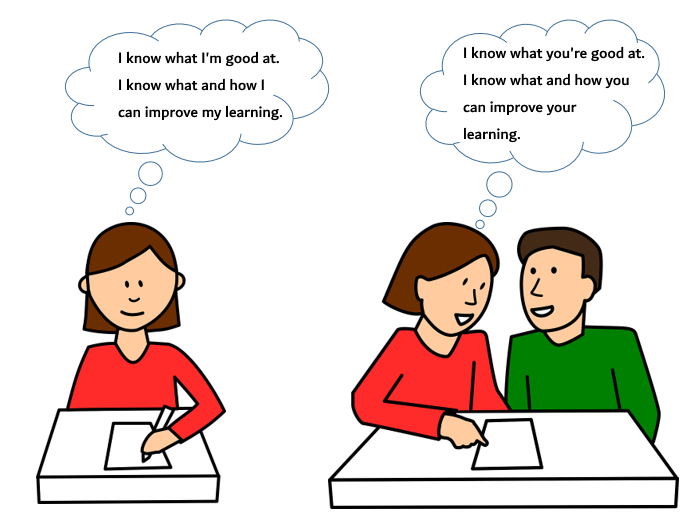
Peer assessment is a form of collaborative learning regulation that is applied as a method in assessment while learning. By providing peer feedback, the student is actively involved in evaluating the learning and achievements of their peers, helping them to observe, monitor, and regulate the learning process.
Peer review helps students develop the ability to manage their own learning and set their own goals. It can follow self-review. For example, self-reviews can be followed by peer reviews, where students should be encouraged to focus on the positive aspects of others' work and then on ways to improve that work (rather than the negative aspects).
* Jandrić, P. & Tomić, V. (2020). CARNET-ov priručnik Postajem e-učitelj
3. Peer assessment with digital technologies
Peer assessment with digital technologies
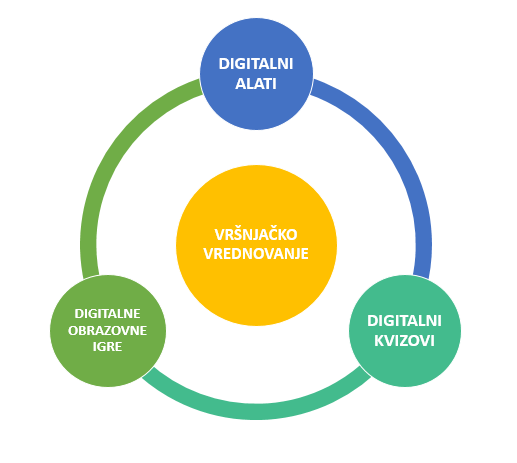
Peer assessment can be implemented with digital tools. The advantage is easier access to assessment instruments, availability of assessment instruments, remote communication, remote collaboration, and the development of digital competencies as new dimensions of knowledge.
For all forms of peer evaluation using digital tools, it is important to first define the criteria against which students will evaluate each other. The evaluation criteria must be based on educational outcomes and outcomes of educational activities, syllabus expectations, and methodological principles. It is desirable to involve students in the development of evaluation criteria for a particular topic and/or activity.
4. Digital tests
Digital tests are effective tools for peer assessment because they provide quick feedback on the success of solving certain tasks. Digital tests intended for peer assessment can be prepared by the teacher, but also by students under the guidance of the teacher, or by students independently.
Digital tests can be solved simultaneously by students, one-on-one, through role-playing: one student starts the test, the other plays it, and vice versa, and after a delay, when everyone solves the quiz at the appropriate time and shares the result with the other student. Examples of digital tools for creating tests are: Kahoot!, Testmoz, LearningApps, Wordwall, Socrative, etc.
5. Digital educational games
Play is a favorite and, above all, a necessary activity for people of all ages. Playing digital educational games enables peer assessment, which is carried out through a process of playing in which the student/students do not fear testing, checking, and/or evaluating. Examples of digital tools for preparing and creating digital games are: Puzzel.org, Wordwall, Purpose Games, Match The Memory, etc.
How and where to find digital tools that help in the peer assessment process?
The following link is available in Croatian only. Participants may use free AI-powered translation tools to access the provided materials.
CARNet's e-Laboratorij is a portal where users can find out all the information about tools, systems, and applications for use in the field of e-learning, including those for peer assessment. The e-Laboratorij portal is engaged in research, testing, and selection of available digital tools for use in teaching.
6. Conclusion
Teacher Antun made a wise decision to familiarize his students with assessment as learning through the use of peer assessment. Implementing peer assessment in a digital environment is also a beneficial choice. Assessment as learning conducted via peer assessment is one of several methods that teachers can apply either in real time or asynchronously using digital technologies.
There are many digital tools available for peer evaluation. Each tool should be adapted to this method, ensuring that questions and responses align with the evaluation criteria previously established for the activities, including both educational outcomes and specific activity objectives.
Digital tools for conducting peer evaluation have advantages over traditional methods:
- because they store the results of the evaluation for a long time
- because they allow easy and simple sharing of evaluation results
- because they provide the student with easier monitoring of learning progress
- because they provide the teacher with information about the effectiveness of the learning and teaching model.
Background Colour
Font Face
Font Size
Text Colour
Font Kerning
Image Visibility
Letter Spacing
Line Height
Link Highlight
Paragraph Width
Text Alignment