Standards and guidelines for quality assurance in the European Higher Education Area (EHEA)
| Site: | Loomen za stručna usavršavanja |
| Course: | Planning and Implementation of Online and Hybrid Teaching |
| Book: | Standards and guidelines for quality assurance in the European Higher Education Area (EHEA) |
| Printed by: | Gost (anonimni korisnik) |
| Date: | Saturday, 24 October 2026, 10:43 PM |
Description
In this activity, you will be introduced to quality assurance, which is implemented and monitored in higher education primarily through ESG standards. Be sure to take notes as you read, as the information contained here will be useful in later activities, especially in the discussion that follows.
1. European Standards and Guidelines (ESG)
The ESG is a set of standards and guidelines intended for external and internal quality assurance in higher education. It does not constitute quality standards or prescribe how quality assurance processes should be implemented, but it provides guidance, covering areas that are crucial to the quality of work and learning environments in higher education.
ESG is primarily concerned with ensuring quality in higher education: how it is taught, how students learn, and what kind of learning environment we provide. It also encompasses the connection to science, innovation, and the processes by which higher education institutions continuously improve their work, research, and management.
It applies to all types of studies within the European Higher Education Area, regardless of the form and location of delivery, including international programs.
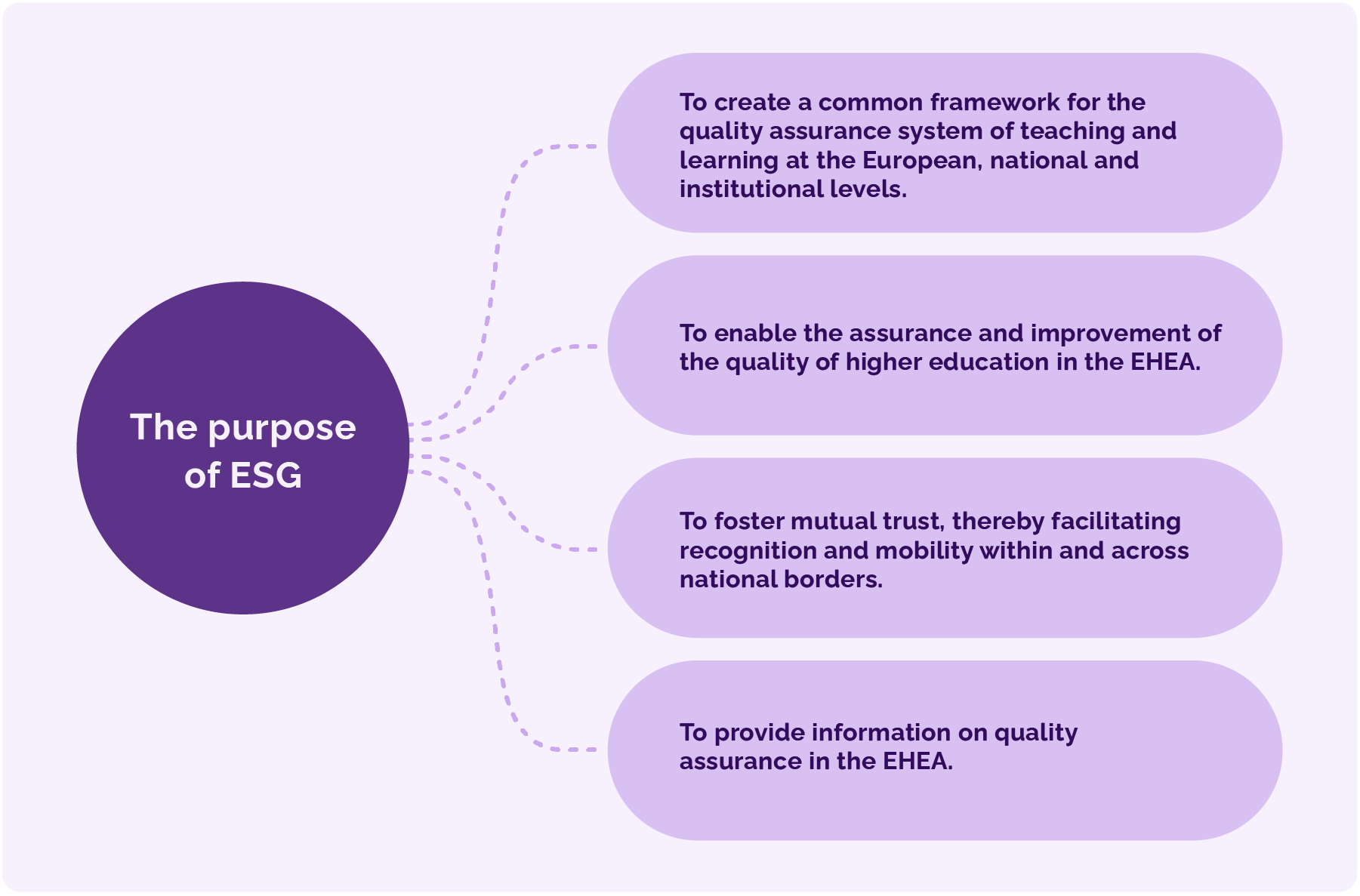
ESG has the following purposes:
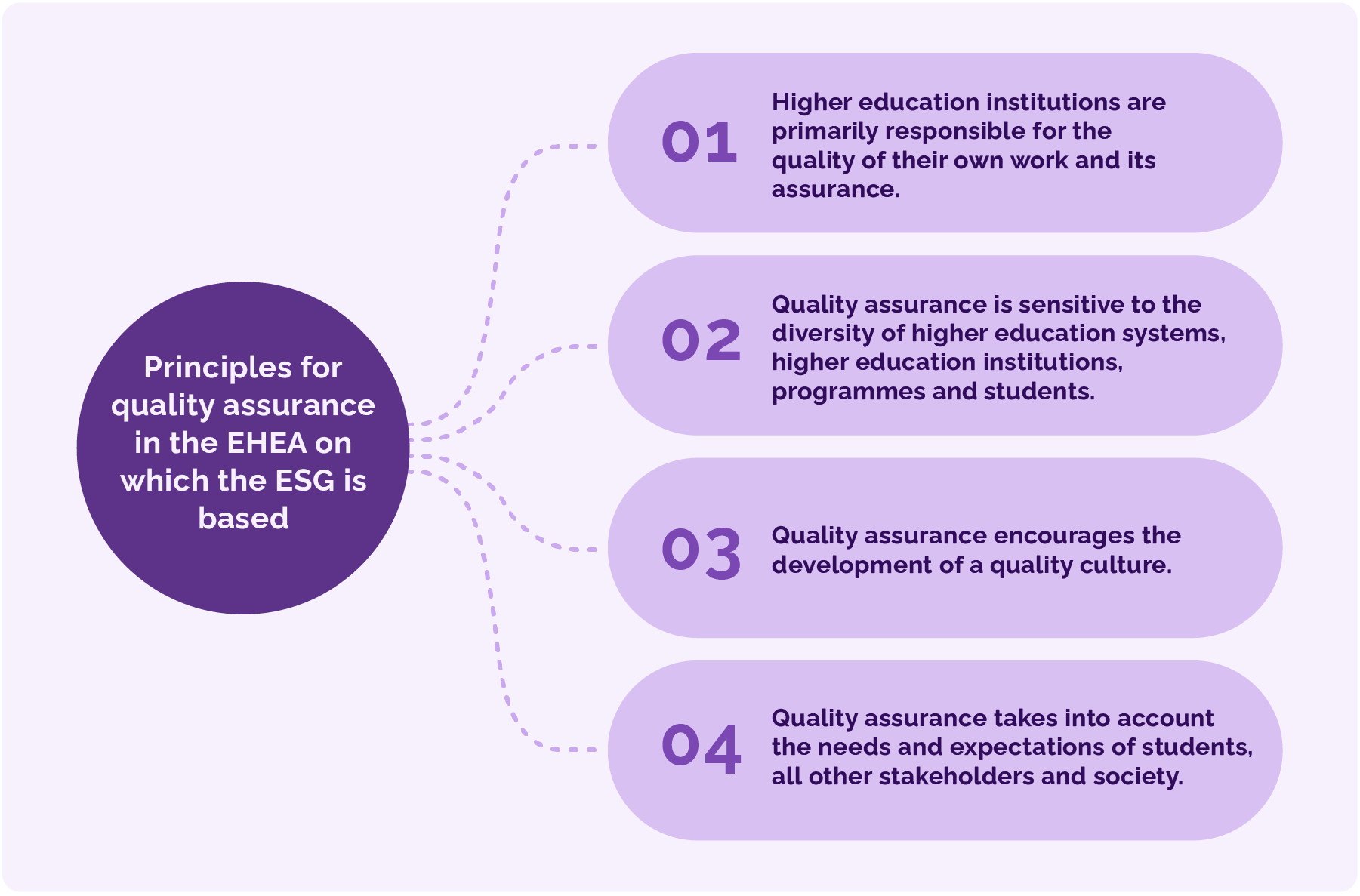
The ESG is based on the following four principles for quality assurance in the EHEA:
European standards and guidelines for quality assurance in higher education
The quality assurance standards are divided into three parts:
- internal quality assurance
- external quality assurance
- quality assurance agencies.
All three parts complement each other for the needs of both higher education institutions and agencies, if other stakeholders also contribute to the common framework. Therefore, all three parts should be taken as a whole.
The following link is available in Croatian only. Participants may use free AI-powered translation tools to access the provided materials.
You can read more about ESG at the link, where you will apply this knowledge as part of a later activity called „Discussion on the fundamental weaknesses at your institution".
2. Standards and guidelines for internal quality assurance
The standards contain quality assurance practices in higher education that are validated and accepted across the EHEA and should therefore be considered and respected by all types of higher education within the EHEA.
The guidelines explain why a particular standard is important and describe how it can be implemented. For the people in charge of quality assurance, they can serve as a suggestion of good practice in certain areas. Their implementation may vary depending on the context.
Standards and guidelines for internal quality assurance:
| Standard | Guidelines | |
| 1.1. Quality Assurance Policy | Higher education institutions must have a quality assurance policy that is publicly available and part of their strategic management. This policy must be developed and implemented by internal stakeholders through appropriate structures and processes, involving external stakeholders. | Policies and processes are the foundation of any coherent internal quality assurance system that forms a cycle of continuous improvement and contributes to the accountability of the higher education institution. Such a system supports the development of a quality culture in which all internal stakeholders take responsibility for quality and engage in quality assurance at all levels of a higher education institution. To facilitate this, a quality policy must be formally adopted and publicly available. |
| 1.2. Development and approval of the program | Higher education institutions must have procedures for the development and approval of their study programs. They must be designed to meet the objectives set for them, including the intended learning outcomes. The qualifications awarded under the program should be clearly described and presented, referring to the appropriate level of the national qualifications framework for higher education and thus to the Qualifications Framework of the European Higher Education Area. | Study programs are at the very core of the educational mission of higher education institutions. They provide students with academic knowledge and skills, including those that are transferable and can influence students' personal development and find application in their future careers. |
| 1.3. Student-centered learning, teaching, and assessment | Higher education institutions must ensure that programs are delivered in a manner that encourages students to take an active role in the learning process and that student assessment reflects this approach. | Student-centered learning and teaching play an important role in fostering student motivation, self-reflection, and engagement in the learning process. This involves careful design of study programs and their delivery, as well as evaluation of outcomes. |
| 1.4. Student enrollment and progression, recognition, and certification | Higher education institutions must consistently implement pre-established and published regulations covering all phases of study, i.e., enrollment, progression through studies, recognition, and certification. | Ensuring the conditions and support necessary for students to progress in their academic careers is in the best interest of each individual student, programme, higher education institution, and system. It is essential to have enrolment, recognition, and graduation procedures that are fit for purpose, particularly when students are mobile within and between higher education systems. |
| 1.5. Teaching staff | Higher education institutions must ensure the competence of their teachers and apply fair and transparent processes for the recruitment and development of their employees. | The role of teachers is crucial in creating a high-quality student experience and enabling the acquisition of knowledge, competences and skills. The growing diversity of the student population and a greater focus on learning outcomes require student-centred learning and teaching, which is why the role of teachers is changing. |
| 1.6. Learning resources and student support | Higher education institutions must adequately fund learning and teaching activities and ensure sufficient and easily accessible resources for learning and student support. | To provide an optimal study experience, higher education institutions provide a range of resources to support learning. Resources range from physical, such as libraries, workspaces, or computer equipment, to human, in the form of tutors, mentors, and other advisors. The role of support services is particularly important in facilitating student mobility within and between different higher education systems. |
| 1.7. Information management | Higher education institutions must ensure the collection, analysis, and use of information relevant to the effective management of programs and other activities. | Reliable data is essential for making well-informed decisions and knowing what is working well and what needs additional attention. Through effective processes for collecting and analyzing information on study programs and other activities, data is fed into the internal quality assurance system. |
| 1.8. Informing the public | Higher education institutions must publish information about their work, including the study programs they offer. This information must be clear, accurate, objective, valid, and easily accessible. | Information about the work of a higher education institution is useful to potential and current students, as well as alumni, other stakeholders, and the public. |
| 1.9. Continuous monitoring and periodic revision of the program | Higher education institutions must monitor and periodically review their programs to ensure that they are achieving their stated goals and meeting the needs of students and society. Reviews should be aimed at continuous program improvement. Actions planned or undertaken based on reviews should be communicated to all relevant stakeholders. | The goal of regular monitoring, revision, and modification of study programs is to ensure their appropriate implementation and create an effective learning environment and support for students. |
| 1.10. Periodic external quality assurance | Higher education institutions must periodically undergo external quality assurance procedures in accordance with the ESG. | External quality assurance in its various forms can confirm the effectiveness of internal quality assurance, act as a catalyst for change, and offer the higher education institution new perspectives. It also provides the public and the higher education institution itself with information that confirms the quality of the higher education institution's work. |
3. External quality assurance
External quality assurance in Part II recognizes the internal quality assurance standards in Part I, ensuring the relevance of higher education institutions’ internal activities in all external quality assurance processes. In the same way, Part III refers to Part II. These three parts are therefore complementary to each other for the needs of both higher education institutions and agencies, if other stakeholders also contribute to the common framework. All three parts should therefore be taken as a whole.
The standards and guidelines for external quality assurance are:
| Standard | Guidelines | |
| 2.1. Internal quality assurance | External quality assurance reviews the effectiveness of the internal quality assurance processes described in Part I of the ESG. | Quality assurance in higher education is based on the responsibility of higher education institutions for the quality of their own programmes and other activities. It is therefore important that external quality assurance recognises and supports the responsibility of higher education institutions for quality assurance. In order to ensure the connection between internal and external quality assurance, external quality assurance takes into account the standards in Part I. They can be referred to in various ways, depending on the type of external quality assurance procedure. |
| 2.2. Development of purposeful methodologies | External quality assurance must be explicitly defined and designed to meet the stated purposes and objectives, considering relevant regulations. Stakeholders must be involved in the design and continuous improvement of external quality assurance. | To ensure effectiveness and objectivity, it is essential that external quality assurance has clear purposes agreed upon by stakeholders. |
| 2.3. Process implementation |
External quality assurance processes must be reliable, useful, pre-established, consistently implemented, and published. They include:
self-assessment or equivalentexternal evaluation, which usually includes a visit to the higher education institution report as a result of external evaluation consistent follow-up. |
External quality assurance that is carried out professionally, consistently, and transparently guarantees its own acceptance and influence. |
| 2.4. External experts | External quality assurance is carried out by committees of external experts that include student representatives. | At the heart of external quality assurance is the broad range of expertise of external experts who contribute diverse perspectives to the agency's work, including those of higher education institutions, academic staff, students, and employers/professions. |
| 2.5. Outcome criteria | All final outcomes or opinions arising from external quality assurance, even when not formal decisions, must be based on clearly defined and published criteria that are applied consistently. | External quality assurance, primarily its outcomes, has a significant impact on the higher education institutions and programmes it evaluates and assesses. To ensure fairness and reliability of the procedures, the outcomes of external quality assurance are based on pre-established and published criteria, consistently interpreted and evidence-based. The external quality assurance system can have different types of outcomes, such as recommendations, opinions, or formal decisions. |
| 2.6. Reporting | The full reports of expert committees on external quality assurance processes must be published, clear, and accessible to the academic community, external partners, and other interested parties. If the agency makes formal decisions based on the reports, these must be published together with the reports. |
The expert committee report is the basis for the follow-up activities that the higher education institution undertakes after the external evaluation, and it also provides information to society about the work of the higher education institution. In order to serve as a basis for action, the report must be clear and concise in language and content, and contain:
description of the context (which places the higher education institution within its own context)a description of the specific external evaluation procedure and the expert committee that participated in its implementation; evidence, analysis, and findings conclusions characteristics of good practices that the higher education institution has demonstrated in its work recommendations for activities in the follow-up phase. |
| 2.7. Complaints and appeals | Complaints and appeals procedures must be clearly defined as part of the external quality assurance process, and higher education institutions should be informed about them. | To protect the rights of higher education institutions and ensure the fairness of decisions, external quality assurance is carried out in an open and accountable manner. Nevertheless, there is a possibility of misunderstanding or dissatisfaction with the process or its formal outcome. |
You can read more about ESG at the link.
4. Quality Assurance Agency
Quality assurance agencies in higher education and science are important because they ensure that institutions meet established standards of excellence, transparency, and accountability. They encourage continuous improvement of teaching and research processes and strengthen public confidence in the value of acquired qualifications and academic achievements.
Agencies carry out various external quality assurance activities to achieve different objectives. These include evaluations, reviews, assessments, accreditations, and other similar activities at the program or institutional level, which can be carried out in different ways. When agencies also carry out other tasks, it is necessary that external quality assurance activities are clearly separated from other areas of work. In the Republic of Croatia, such an agency is called the Agency for Science and Higher Education (AZVO).
The standards and guidelines for agencies are collectively developed in these seven groups: activities, quality assurance policies and procedures, official status, independence, thematic analyses, resources, internal quality assurance and professional conduct, and periodic external evaluations of agencies.
The following link is available in Croatian only. Participants may use free AI-powered translation tools to access the provided materials.
Standards and guidelines for agencies are only mentioned because they are not usually dealt with by VU teachers, but if you wish, you can read about them in more detail at the link.
Background Colour
Font Face
Font Size
Text Colour
Font Kerning
Image Visibility
Letter Spacing
Line Height
Link Highlight
Paragraph Width
Text Alignment