E-learning as a new educational paradigm
| Site: | Loomen za stručna usavršavanja |
| Course: | Planning and Implementation of Online and Hybrid Teaching |
| Book: | E-learning as a new educational paradigm |
| Printed by: | Gost (anonimni korisnik) |
| Date: | Saturday, 24 October 2026, 1:18 AM |
Description
In this activity, topics related to e-learning as a new educational paradigm will be presented, with special emphasis on the concept of the student at the centre of the educational process.
1. Introduction
E-learning represents a new educational paradigm that is changing the way we learn, teach, and access knowledge. Unlike traditional education, which is based on physical presence and linear information transfer, e-learning enables a spatially and temporally flexible, interactive, and adaptive educational experience. It is based on the use of digital technologies for content distribution, collaboration, and communication, with increasing use of multimedia, mobile learning, and personalised approaches. As a paradigm, e-learning emphasizes the active role of the student, encourages lifelong learning, and supports the development of digital competences needed in the 21st century. In this context, e-learning is no longer just an alternative form of teaching, but an integral part of modern education.
E-learning can be defined very broadly as the use of technology to shape the educational process. Although unfortunately very broad, this definition describes the full breadth of the entire educational process in an electronic environment. For narrower definitions, we can only use different types of distance learning that arise and are defined according to the users for whom they are intended and the type of implementation of the teaching process. Roughly speaking, e-learning can be divided into distance learning and hybrid learning.
The term distance learning itself appeared very early in the form of correspondence schools, and most often for people who did not have an educational institution nearby and had to study from home. Originally, e-learning meant distance learning supported by technology. With the further modernisation of distance learning, the two most widespread forms of teaching that include the use of digital technologies have emerged today: online teaching and hybrid teaching. Online teaching is conducted entirely in an online environment, while hybrid teaching takes place both live and via information and communication technologies.
With the development of different generations of computers and the possibilities they offer, new forms of distance learning and computer-assisted learning have emerged, and the terminology itself has changed. In most cases, to date, there has been a synergy of different forms or types of learning, so the meanings behind different terms have changed, and the vocabulary of terms itself has expanded. As technology is constantly improving, new forms are always emerging. New current trends in education include the application of artificial intelligence in education, gamification, or the application of computer games for learning purposes, personalised learning through data analytics, learning through augmented reality, virtual reality, and others.
2. The student is at the center of the educational process
The concept of placing the student at the centre of the educational process is one of the fundamental principles of modern education. Unlike the traditional model, in which the teacher was the primary source of knowledge, today the emphasis is placed on the active role of the student. This means that the student is no longer a passive recipient of information, but an active participant and creator of his or her own learning process.
In practice, this approach implies that the educational process is designed to start from the needs, interests, and prior knowledge of students. Teaching content and teaching methods are adapted to different learning styles, and students are allowed to participate in the design of tasks, projects, and research activities. By using methods such as problem-based learning, teamwork, project and research learning, students develop critical thinking, creativity, and the ability to solve complex challenges.
Technology, and especially learning management systems (LMS), further empower students. Through LMSs, students have constant access to materials, can monitor their own progress, communicate with teachers and peers, and receive continuous feedback. This strengthens their responsibility for their own learning and encourages self-regulation.
The role of the teacher in this model is changing, and he is no longer just a lecturer, but a mentor, facilitator, and supporter of students. The teacher directs the process, provides feedback, and provides resources, but leaves the students to play an active role in research and discovery of knowledge.
At the institutional level, the concept of "student at the centre" means creating a stimulating and inclusive environment that provides opportunities for students to develop academic, professional, and personal competencies. This includes flexible curricula, adaptation of teaching methods, as well as providing support in the form of counseling centres, mentoring programmes, and digital tools.
Such an approach not only contributes to more successful learning but also to the development of independent, responsible, and engaged individuals ready for lifelong learning and active participation in society.
3. Hybrid learning
Hybrid learning represents a combination of a traditional educational environment with the support of e-learning. It is currently the most widespread form of learning, as it enables student-centered learning. Namely, all the advantages of distance learning, such as access to education anytime, anywhere, are used here, and the sharp boundaries between the two learning methods are lost. This form represents the application of a new educational paradigm in which investigative and collaborative learning is encouraged, and the teacher becomes the leader throughout the learning process.
In the hybrid type of learning, it is assumed that students remain connected to colleges and universities (meaning they don't have to be far away), but all the possibilities offered by technology today remain at their disposal to meet their needs and facilitate and improve the learning process, including lifelong education.
E-learning encourages exploratory learning and teaching, and compared to traditional classroom teaching, some of the advantages, according to Bates (2004), are:
- students have access to high-quality teaching and learning anytime, anywhere
- information that could previously only be provided by a teacher is now available on demand via the Internet.
If multimedia teaching materials are of high quality and well designed for learning, they can be more effective than traditional classroom teaching, because students acquire knowledge faster with the help of illustrations, animations, different structuring of the material, and when they have greater supervision or greater interaction with the teaching material.
New technologies can be designed to develop high-level skills such as problem-solving, decision-making, and critical thinking. Interaction with teachers can be organised and managed through online communication to ensure greater accessibility and adaptability for both students and teachers. Computer-assisted communication can facilitate team teaching, collaboration, and communication with teachers from other institutions, and the creation of multicultural and international student groups.
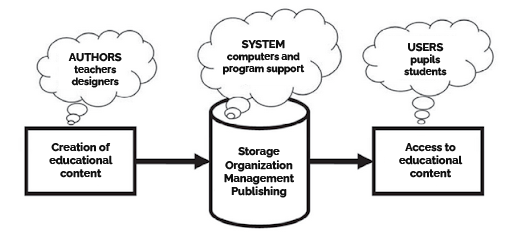
E-learning is a generic term that includes all types of distance learning, computer-based learning, and the Internet or intranet. Although it primarily refers to learning in an electronic environment outside the framework of physical institutions, today it increasingly refers to learning in an electronic educational environment, which also includes the so-called hybrid learning (blended learning), i.e., a combination of physical and virtual educational environments. It is important to emphasize that e-learning and the environment in which it takes place consist of three main components: the teacher or author who creates educational content, the system in which this content is stored and organised, and the user, i.e., the student or participant. Given the technological capabilities and the institution that organises e-learning programmes, these components can be expanded or narrowed, but the main idea remains the same.
The image shows the basic components of an electronic educational environment.
4. Learning analytics
In the last two decades, the digital transformation of education has brought about a series of profound changes in the way the teaching process is organised, implemented, and evaluated. The development of e-learning, which was initially developed as a complement to distance education and is now increasingly used as an integrated part of higher education, has opened space for the systematic collection and analysis of large amounts of data on student behavior and achievement. It is precisely this data availability that has created the foundations for the development of learning analytics, a new interdisciplinary approach that views education not only through a pedagogical and didactic prism, but also through the possibilities offered by computer science and the processing of large data sets.
Learning analytics is defined as the process of collecting, measuring, analysing, and interpreting data about students and their educational contexts with the aim of understanding and optimising the learning process and making informed pedagogical decisions. Although it shares its roots with the evaluation of the educational process, learning analytics focuses on the processing of real, mostly digitally collected traces of user behavior, such as activities in the e-learning system, time spent with certain contents, quiz results, interactions on forums, or ways of navigating through teaching material.
In the context of higher education, the application of learning analytics can span multiple levels. At the student level, it enables the provision of personalised feedback and guidance to students based on their learning needs, habits, and achievements. At the teacher level, it provides valuable insights into the effectiveness of teaching materials and methods, uncovers patterns in learning that may indicate a risk of dropout or low achievement, and helps design more effective curricula. At the institutional level, analytics can serve strategic management, programme evaluation, and data-driven educational policymaking.
Theoretically speaking, learning analytics relies on several disciplines: pedagogy serves to understand pedagogical concepts and goals, computing and information sciences develop tools for data processing and visualisation, while psychology contributes to the interpretation of behaviour and motivation. Such interdisciplinarity requires careful interpretation of the results, because quantitative data cannot fully cover all dimensions of learning.
It is important to emphasize that the effective application of learning analytics is not limited to the technical implementation of tools, but requires pedagogically thoughtful design of metrics and indicators, clear ethical regulation of data collection and use, and active involvement of teachers in the interpretation of results. Also, the integration of analytics into the higher education context presupposes digital literacy of teaching staff, institutional support, and continuous education of all stakeholders in the education system.
5. Literature
- Bates, T. (2004). The promise and the myths of e-learning in post-secondary education. The Network Society. https://doi.org/10.4337/9781845421663.00025.
Background Colour
Font Face
Font Size
Text Colour
Font Kerning
Image Visibility
Letter Spacing
Line Height
Link Highlight
Paragraph Width
Text Alignment