Analysis of the current situation at HEI
| Site: | Loomen za stručna usavršavanja |
| Course: | Planning and Implementation of Online and Hybrid Teaching |
| Book: | Analysis of the current situation at HEI |
| Printed by: | Gost (anonimni korisnik) |
| Date: | Saturday, 24 October 2026, 10:43 PM |
Description
In this activity you will learn what should be included in a HEI condition analysis. Be sure to take notes as you read, as the information contained here will be useful in later activities.
1. Introduction
Analysis of the current state of a higher education institution (HEI) or other educational institution is a fundamental and indispensable step in the process of planning, establishing and maintaining a quality e-learning system. Without thorough analysis, it is difficult to ensure that digital technologies will be implemented in a way that corresponds to the specific needs, goals and context of that HEI.
Such an analysis should be comprehensive and encompass a few interrelated aspects that together shape the conditions for the successful introduction and further development of digitally supported education. Key elements to consider include technical infrastructure (computer and network equipment, internet availability, software support), digital competences of teaching and non-teaching staff, students' readiness to learn in a digital environment, organisational structure, and institutional support for e-learning, existing pedagogical practices, and the alignment of the e-learning strategy with the mission and vision of the institution.
In addition, it is important to analyse the legal and regulatory framework that affects the implementation of e-learning, as well as potential sources of financing, sustainability and system development. It is also necessary to consider the existing platforms and tools used, their effectiveness, integration and acceptance among end users.
Analysis of the situation should include qualitative and quantitative methods of data collection, such as surveys, interviews, focus groups, reviews of existing documentation, and technical reviews, to obtain the most complete picture of the real situation.
Based on the results obtained, it is possible to identify strengths that can be built on, as well as weaknesses and obstacles that need to be addressed. Only based on a clearly defined starting point can a sustainable strategy for the digital transformation of education be developed within the institution, leading to a higher quality, more accessible, and more modern educational experience for all participants in the educational process.
The following topics will be covered in this activity:
- level of digital competence of teachers
- what types of teaching are there (lectures, seminars, exercises, laboratory work, field work, practical work)
- teachers' needs for instructional designer/pedagogical support services
- IT equipment and internet access speed.
2. Level of teachers' digital competences
One of the key elements that needs to be included in any analysis of the digital readiness of an educational institution is the level of digital competence of teachers. It is a fundamental indicator of the extent to which teachers possess the skills, knowledge, and attitudes necessary for the quality use of digital tools in teaching and learning. Assessing digital competences involves not only checking technical literacy, but also a deeper understanding of how technology can improve pedagogical processes and contribute to the development of student competences.
It is necessary to determine how well teachers are trained to use digital technologies in teaching, to what extent they apply online, hybrid, and blended teaching methods, and whether they are familiar with the basic principles of e-pedagogy and the didactic application of technology. In this sense, it is useful to look at digital competences through the DigCompEdu Framework and its six levels.
It is important to distinguish between basic technical skills, such as using a learning management system (LMS), creating simple digital materials and basic communication through digital channels, and more advanced competencies, which include the design of complex digital content, the design of interactive and collaborative activities, the systematic use of digital tools for formative and summative assessment and critical reflection on the pedagogical value of technology. In practice, this means that teachers at levels A1–A2 will primarily focus on adopting and trying out tools, B1–B2 on meaningful integration and professional use in teaching, and C1–C2 on leading innovation, mentoring colleagues, and systematically improving teaching practices.
Data on the level of digital competence of teachers can be collected in several ways: through self-assessment, structured surveys and questionnaires, through the analysis of the use of digital tools in real courses, as well as through a systematic review of existing e-courses and their teaching practices. In this way, a comprehensive picture of the current state is obtained, but also areas where additional professional development, mentoring, or systematic support of the institution are needed are identified.
Example: The results of a survey conducted among teachers at one faculty showed that 70% of them know how to use the basic functionalities of the Moodle system, but only 25% actively use advanced options such as interactive quizzes, forums, and a system for monitoring student progress. The above results are a consequence of the lower familiarity with the use of advanced options by teachers at HEI and, at the same time, indicate the need for additional teaching education.
3. Types of teaching at the institution
In the analysis, it is also important to thoroughly consider what types of teaching are carried out within the institution and to what extent they are already adapted to modern digital approaches. It is necessary not only to record the presence of different forms of teaching, but also to take a closer look at their frequency, pedagogical role, and the way they fit into the curriculum. Among the most common forms are lectures, seminars, exercises, laboratory work, fieldwork, and practical work, each of which carries specific requirements, but also different opportunities in the context of digitalisation, i.e., the integration of educational technologies.
For example, lectures are generally easier to transfer online because they can be organised via videoconferencing tools or as pre-recorded materials. Seminars, on the other hand, require greater emphasis on interactivity and collaboration, which require the use of group work tools, discussion forums, or collaborative documents. When it comes to exercises, especially in natural and technical sciences, it is often necessary to combine online instructions with software tools or virtual environments. Laboratory work poses a particular challenge because many practical skills cannot be fully transferred to a digital environment; therefore, simulation tools and virtual laboratories are being developed that can at least partially replace physical presence. Fieldwork requires additional creativity — for example, the use of mobile applications for recording data, digital maps, or augmented reality. Finally, practical work in professional and artistic disciplines requires special forms of hybrid learning, where theoretical elements can be digitised, but practical skills remain tied to the physical environment and live mentoring.
A detailed categorisation of all forms of teaching and a good knowledge of their specificities allows for a deeper understanding of which activities can be fully digitised, which are advisable to implement in a hybrid form, and which require creative and innovative adaptations. In this way, an institution can plan realistic and sustainable digital transformation strategies, rather than simply applying a single solution to all teaching situations. Systematic mapping of teaching activities according to their digital feasibility also helps in planning investments in technology, in organising professional development for teachers, and in developing recommendations for future pedagogical practices.
Example: At the Department of Biology, lectures and seminars were quickly moved online during the pandemic, while field exercises in botany had to be held in smaller live groups, with additional online preparation and processing of data in digital form.
4. Teachers' needs for pedagogical support
The analysis should include an assessment of teachers' needs for instructional design or pedagogical support services, since the successful digital transformation of teaching depends not only on technical equipment and digital skills, but also on high-quality pedagogical design of teaching activities. Not all teachers are experts in designing teaching materials for the online environment, and many do not have enough time to systematically research digital teaching methods. Therefore, it is important to determine the extent to which there is an interest and need for professional assistance in planning courses, structuring teaching content, choosing the most appropriate teaching methods, and designing tasks and evaluation activities that match the specificities of the online and hybrid environment.
The role of an instructional designer and e-pedagogy expert is not only technical but also includes advice on the pedagogical effectiveness of the approaches used, suggestions for improving interaction between teachers and students, as well as support in designing active and collaborative learning methods. Such support can significantly contribute to the quality of e-teaching, increase student engagement, reduce the risk of reduced student participation/activity in the online environment, and make it easier for teachers to use digital educational tools. Continuous support is especially important, not just one-off training, because teachers discover new challenges and issues through practice that require professional guidance (similarly, teachers who have completed training for beginners after some time using educational technologies in their classes need training for more advanced users, and the like).
Information on such needs can be collected through various methods: focus groups with teachers provide an in-depth understanding of their experiences and challenges; evaluation questionnaires provide a broader quantitative picture of the level of need and areas where support is most needed; and individual consultations open space for a personalised approach and more detailed consideration of specific teaching situations. Based on such data, an institution can develop systematic support mechanisms, from constantly available instructors and mentors to online repositories with instructions and examples of good practice, to workshops and professional development programmes.
Teachers can get support at their own institution in e-learning support centres, IT services, and similar support offices, as well as in SRCE or on CARNET.
Example: A mentoring support programme was introduced at one university, where each teacher had the opportunity to collaborate with an instructional designer during the preparation of e-courses. Evaluation results showed an increase in student satisfaction and greater interactivity of the courses compared to the previous year.
5. IT equipment and internet access
An essential part of any analysis is a detailed insight into the institution's equipment with information and communication technology, as well as the quality and speed of internet access. Technical infrastructure is a basic prerequisite for the successful implementation of digital teaching, and its level directly affects the possibility of applying modern pedagogical and technological solutions (with competent teaching staff, of course).
It is necessary to assess not only the availability of computers, but also the presence of portable devices (laptops, tablets), interactive whiteboards and smart displays, cameras, microphones and speakers, and other additional equipment that enables high-quality recording or transmission of teaching activities in real time. It is also useful to include software resources in the analysis, such as licensed educational applications, learning management systems (LMS), or specialised software packages for certain scientific disciplines (e.g., SPSS, MATLAB). This provides a comprehensive insight into whether the institution has a sufficient combination of hardware and software necessary for the complete digitalisation of the teaching process.
An equally important element is the speed and reliability of the internet connection. It is not enough to look only at the infrastructure of the higher education institution building, but also at the conditions in which teachers and students access content from home. A stable and fast internet connection is crucial in situations where classes are held live via videoconferencing tools, when collaborative platforms are used, or when students need to access rich multimedia content. The lack of a stable connection can significantly hinder participation in online activities, reduce the quality of communication, and cause a feeling of exclusion among students.
These technical aspects must be met so that teachers can plan, create, and deliver digital teaching without any obstacles, and students can participate equally in the educational process without any technical barriers. In addition to accessibility, it is also important to consider the level of equipment, as differences between departments or individual teachers can result in uneven teaching quality. Therefore, the analysis should also include strategies to address possible technical inequalities, such as providing shared resources, support in the form of school laboratories or device lending programmes for students and teachers.
Example: During the preparation for the hybrid semester, it was found that several classrooms did not have adequate video streaming equipment, and the HEI building's internet access speed did not have sufficient bandwidth. In response, the institution acquired additional equipment and arranged for an expansion of the internet network in cooperation with CARNET.
6. Basic list for conducting a HEI condition analysis
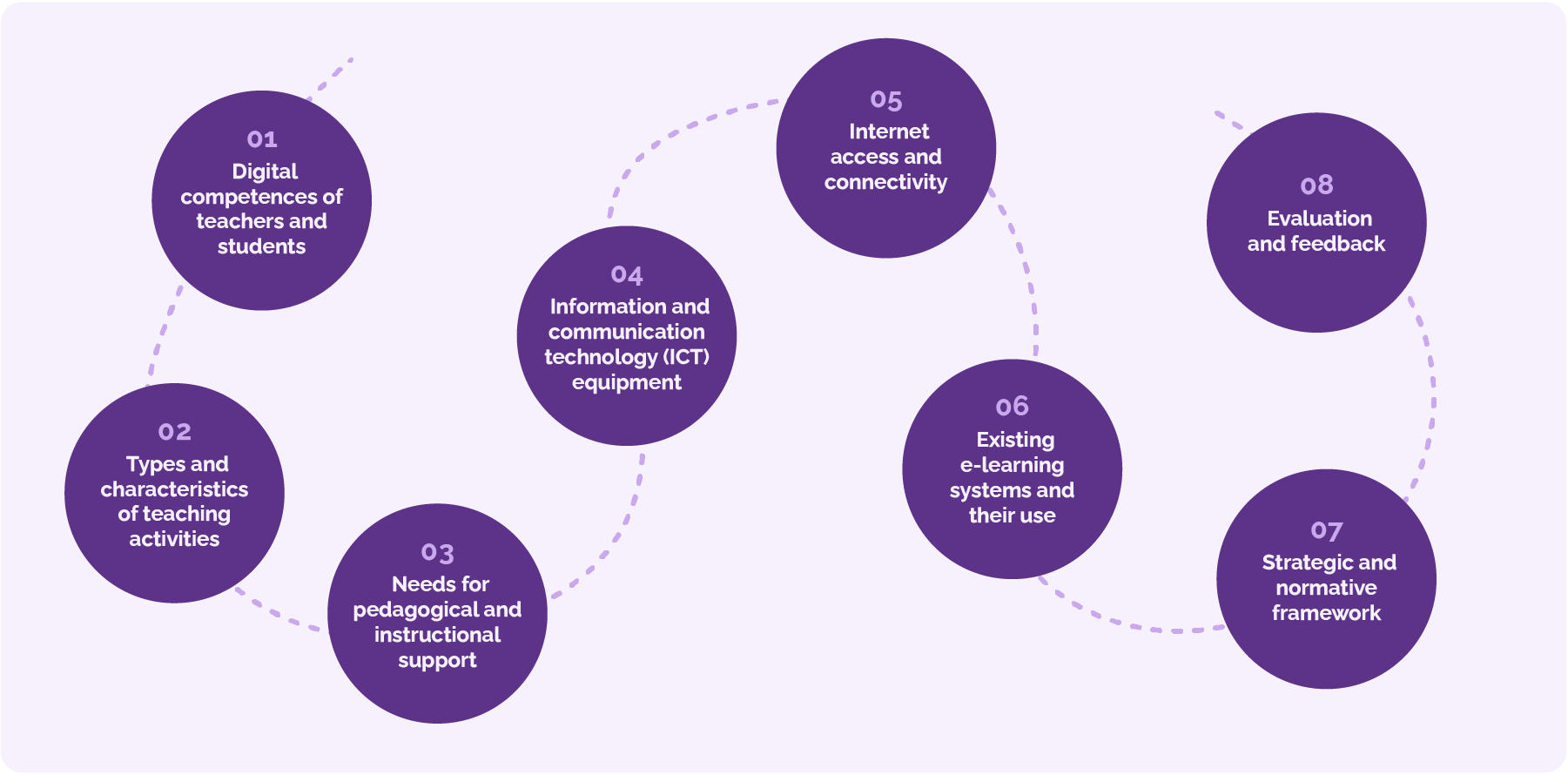
The basic list for conducting a HEI status analysis should contain at least the elements listed below, i.e., the answers to the questions contained in each category should be known. All this information and data cannot be collected with a single tool or method, nor in a very short period, but there must be secondary sources and records that are maintained continuously at the HEI level.
7. Recommendations for improving e-learning at HEI
The following links and documents are available in Croatian only. Participants may use free AI-powered translation tools to access the provided materials.
The result of the analysis of the existing situation may be recommendations for improving the application of e-learning at that HEI (of course, in accordance with the current situation, as well as the possibilities of the HEI, both financial and organisational).
Such recommendations can be divided into several categories, as follows:
Creating an institutional e-learning strategy
A higher education institution should develop a clearly defined e-learning strategy that will contain goals, priorities, and a timeframe for the development of digitally supported education. The strategy should be aligned with the mission and vision of the institution and integrated into the overall development plan. It is important that the strategy is not a stand-alone initiative but is viewed in the broader context of the digital transformation of education, scientific activity, and management. An example of a strategy from one HEI is the E-learning Strategy of the Faculty of Organization and Informatics, University of Zagreb, available at the link.
Investing in strengthening the digital competences of teaching and non-teaching staff
For e-learning to be effective, it is necessary to continuously develop the digital competences of teaching and administrative staff. This includes organising systematic education, workshops, and professional training related to the use of digital tools, distance learning platforms, and modern methodological approaches. It is also important to encourage teaching staff to join professional communities, research projects, and international initiatives dealing with digital education.
Improve technical and digital infrastructure
A functional e-learning system relies on a stable technical infrastructure. For this purpose, the higher education institution should ensure a fast and reliable internet connection, appropriate computer equipment, and the availability of necessary software solutions. Learning management platforms (LMS) must be regularly upgraded, technically supported, and connected to other relevant information systems, such as the student information management system (SIMS). The HEI should decide whether it wants to use its own servers to host the LMS or whether it will outsource this to experts from CARNET or SRCE and the servers hosted by them.
Development of e-college quality standards
It is necessary to develop and implement pedagogical and technical guidelines for the design and delivery of e-courses to ensure a consistent and high level of quality. The establishment of standards should include criteria for the design of teaching content, interactivity, accessibility, and systematic evaluation of courses. Regular monitoring and improvement of the quality of e-courses will contribute to the professionalisation of digital classes and an improvement of the students' user experience. An example of the framework for the development and assessment of e-college quality from the University of Rijeka is available at the link.
Encouraging the development of hybrid and flexible learning
The higher education institution should systematically promote the application of blended learning models, which combine the advantages of contact and online teaching. Such models allow greater flexibility for students, especially those who work or study remotely. In addition, it is important to develop opportunities for asynchronous and synchronous learning, depending on the content, course objectives, and student needs (which also includes the legal framework, i.e., the amendment of the HEI study regulations (an example of a regulation that recognises online teaching as one of the types of delivery methods is available at the link).
Improving support for students in the online environment
Students should have access to clear and timely information on how to participate in online classes, the use of digital tools, and available forms of support. In addition to technical support, it is recommended to establish mentoring systems, regular communication with students, and channels for providing feedback (in addition to websites and mailing lists, social networks should be included). All of this contributes to greater motivation, engagement, and success of students in the digital environment.
Establishing organisational and administrative support
In order to systematically develop e-learning, it is necessary to establish appropriate organisational structures. It is recommended to establish an office/centre or appoint an e-learning coordinator who will have a clear role in planning, monitoring, and supporting digital educational activities. It is necessary to clearly define the responsibilities and processes within the institution so that all stakeholders have available support and guidelines in the implementation of e-learning. It is necessary to establish an e-learning committee at the HEI level, which would (at a minimum) consist of some of the board members, teachers with experience in using educational technologies/e-learning and heads of e-learning support centres.
Monitoring and evaluation of the application of e-learning
The higher education institution should develop mechanisms for systematic monitoring and evaluation of the implementation of e-learning. This includes collecting feedback from teachers and students through surveys, analysing data from the LMS, and comparing learning outcomes. Based on these insights, it is possible to identify what is working and what requires adjustments, thereby ensuring continuous improvement of the e-learning system.
Encouraging the exchange of good practice examples
The institution should actively encourage the exchange of experiences among teachers, for example, through internal seminars, presentations, and publications. Showing examples of successful e-courses and digital innovations can serve as inspiration and support for colleagues who are just starting to implement e-learning. In addition, sharing good practices strengthens a collaborative culture and contributes to building a learning community within the institution.
Ensuring sustainability and investing in the further development of online and hybrid classes
To maintain the quality of online and hybrid teaching in a stable and continuous manner, it is necessary to secure financial resources, both for existing support and for new tools, content development, teacher training, and the development of new teaching methods using digital technologies. For the long-term sustainability of the e-learning system, it is important to plan financial resources within the institution's budget. In addition to internal resources, the higher education institution should actively monitor funding opportunities through national and international projects, especially those related to the digitalisation of education. Funding should not be viewed as a cost, but as an investment and strategic investment in ensuring the quality and competitiveness of higher education.
8. Conclusion
For higher education institutions, the analysis of the state of e-learning is a strategically important activity that enables a comprehensive understanding of institutional capacities, needs, and challenges in the process of digital transformation of education. This analysis serves as a basis for making informed decisions on the development of digital infrastructure, the empowerment of teaching staff, and the improvement of pedagogical practices in accordance with the principles of modern higher education.
By identifying key strengths — such as existing IT resources, teachers' experience in working with digital tools or previous initiatives — but also weaknesses that limit the wider application of e-learning, the higher education institution can develop a targeted and feasible improvement plan. The results of the analysis also help align the institutional e-learning strategy with national and European education policies, including quality standards, digital inclusion, and academic mobility.
In the context of increasing expectations for flexible, accessible, and high-quality higher education, an analysis of the state of e-learning enables higher education institutions to proactively shape their teaching models, ensure relevance and competitiveness in the education market, and strengthen their role in the digital society and economy in the long term.
Background Colour
Font Face
Font Size
Text Colour
Font Kerning
Image Visibility
Letter Spacing
Line Height
Link Highlight
Paragraph Width
Text Alignment