Comparison of the ADDIE model and the ABC method
| Site: | Loomen za stručna usavršavanja |
| Course: | Planning and Implementation of Online and Hybrid Teaching |
| Book: | Comparison of the ADDIE model and the ABC method |
| Printed by: | Gost (anonimni korisnik) |
| Date: | Saturday, 24 October 2026, 11:34 PM |
Description
In this activity you will have the opportunity to compare the ADDIE model and the ABC method.
IMPORTANT: This activity is mandatory!
1. Comparison of the ADDIE model and the ABC method
You need to study the ADDIE model and the ABC method. The first step is to become familiar with their basic features, phases, and methods of application. Use the available sources that you will receive as part of this activity, but if necessary, research additional literature to get a more complete picture of each model/method. Once you have become familiar with both approaches, you need to analyse them according to the criteria proposed in the activity itself.
In your analysis, you should consider the strengths and weaknesses of both models, the way they structure the design process, flexibility, time and resource requirements, collaborative opportunities, and pedagogical value. Pay particular attention to assessing the applicability of each model in your specific educational context, making sure to consider student characteristics, group size, available technical resources, institutional policies, and teaching format.
Based on the analysis you have conducted, you should draw a conclusion about which model or combination of elements from both models can best support your teaching objectives. You should justify the results of your assessment with arguments based on the sources you have studied and your professional experience. You will also apply the results in the following activity.
2. Key about ABBIE model and ABC method
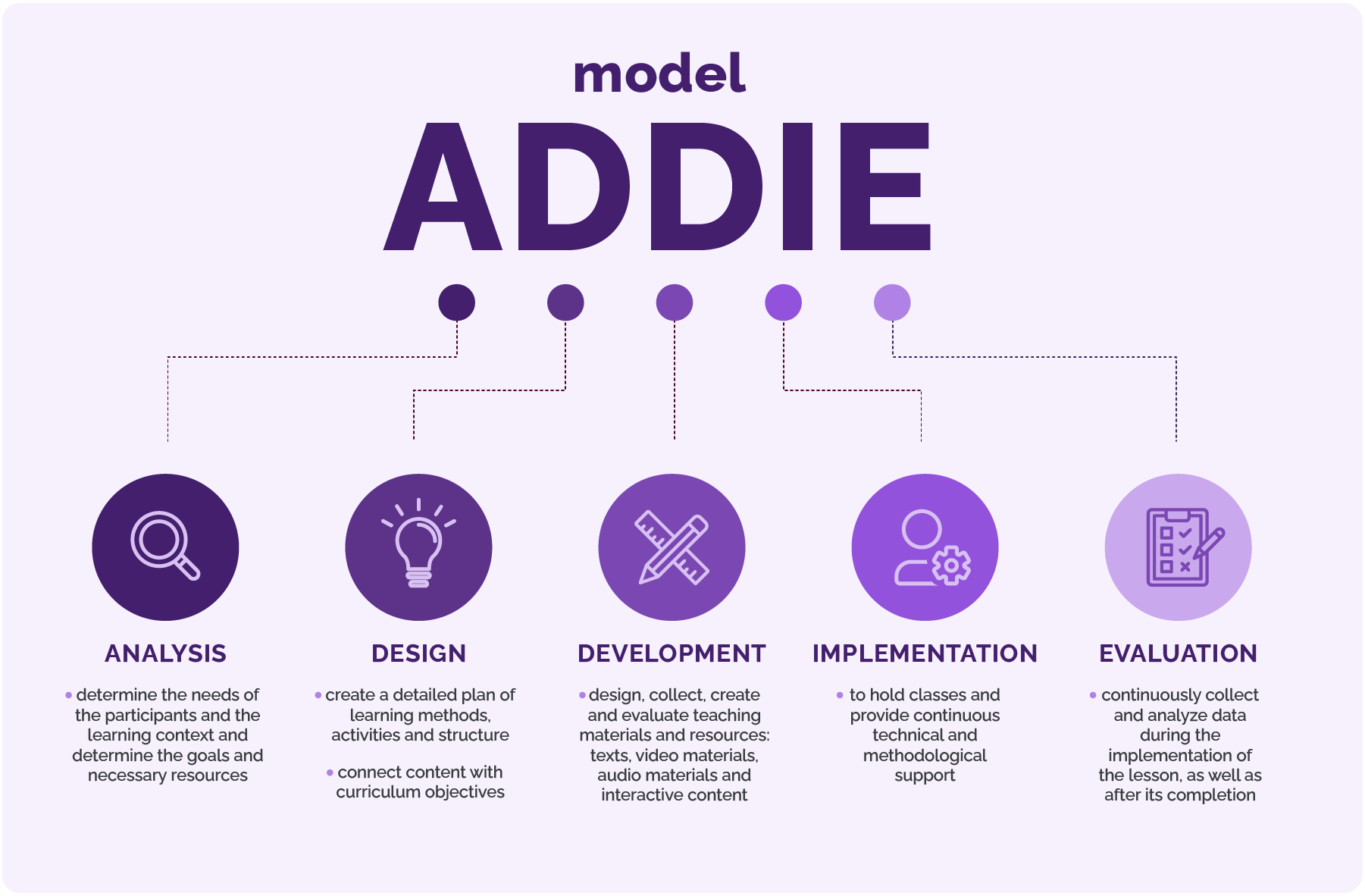
The ABC model is based on the design of student activities that can be a combination of two or more of the following types of learning:
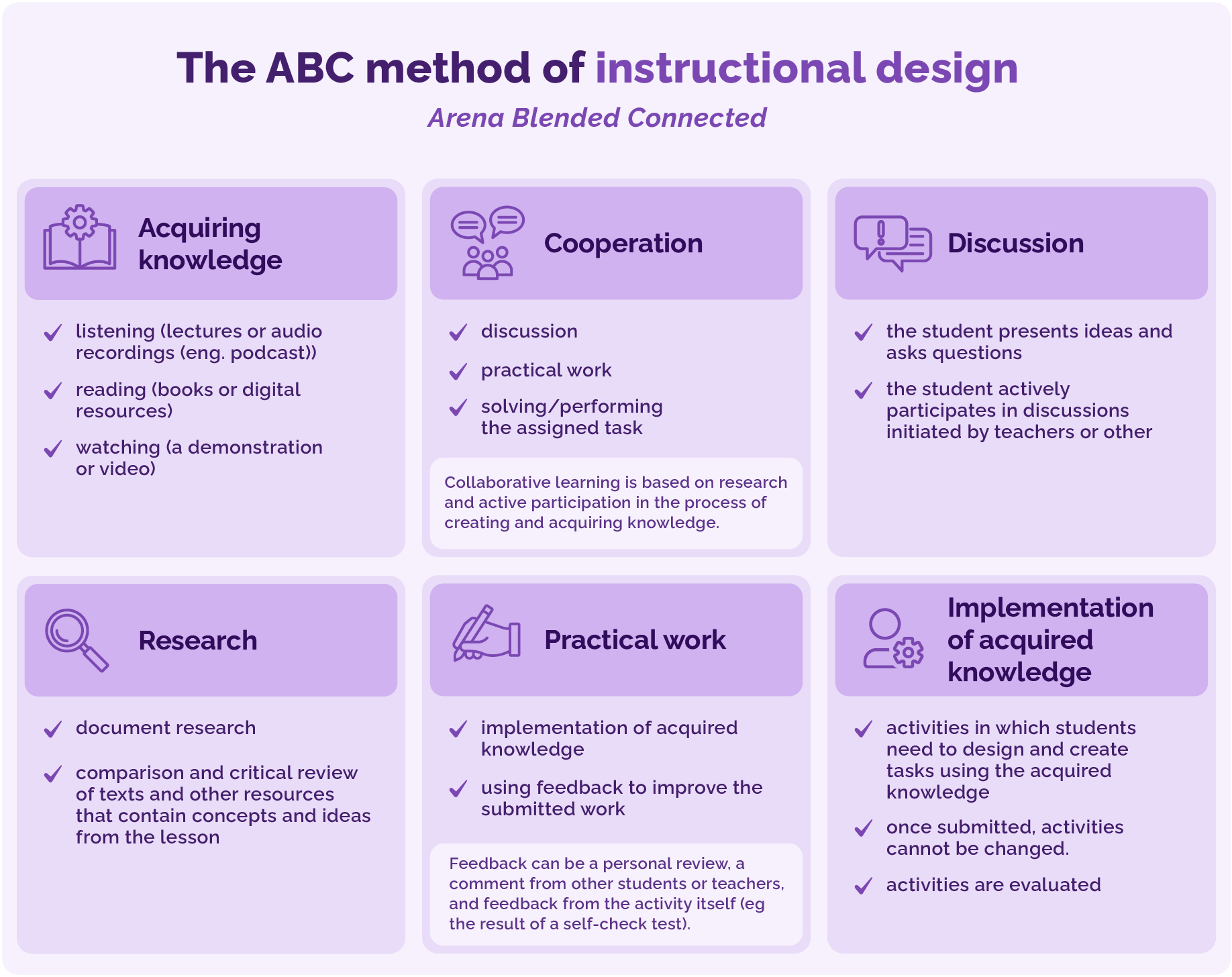
A good design has a combination of all activities, while the evaluation includes not only the final knowledge check, but also evaluates the student's contribution to active involvement in some or all activities.
3. Sources
Sources you can use (but of course, do not limit yourself to them):
- ADDIE Model
- ADDIE Model in Instructional Design
- ABC method
- ABC materials in Croatian (materials in ZIP archive).
4. Criteria for independent assessment of ADDIE and ABC models
These are the criteria by which you should conduct your own assessment. You do this on a scale of 1 to 5 (where 1: Very poor; 2: Poor; 3: Satisfactory; 4: Good; 5: Excellent) in the Excel template available on the next tab.
1. Alignment with learning outcomes
Assess how well the chosen model allows for clear definition and linking of teaching activities to planned learning outcomes. Consider whether you were able to clearly follow the connections between objectives, activities, and evaluation during planning or implementation of the model.
2. Structure and systematicity of the process
Evaluate how logical, consistent, and easy to follow the process of working according to the model was. Pay attention to whether the model offered a clear sequence of steps and whether these steps helped you get from planning to implementation without difficulty.
3. Flexibility and adaptability
Assess the extent to which the model allowed changes and adaptations during the work. Consider how easy it was to make changes to the activity plan or content when a new idea emerged or when circumstances changed.
4. Participation and collaboration
Consider how much the model encouraged collaborative work among team members or stakeholders. Assess whether you had the opportunity to involve colleagues in joint planning, discussions, and decision-making during the implementation of the model.
5. Efficiency in relation to time and resources
Evaluate how efficient the application of the model was in relation to the available time and resources. Consider whether you were able to achieve a satisfactory result with the existing conditions, or whether the process required more than was realistically available.
6. Pedagogical quality and innovation
Assess the extent to which the model encouraged the development of quality teaching solutions that are pedagogically sound and innovative. Consider whether working according to the model led to the creation of creative activities, new teaching methods, or interesting ways of engaging students.
7. Possibility of evaluation and improvement
Assess how much the model provides opportunities and tools for evaluation of the teaching process and improvement in the future. Consider whether the evaluation was an integral part of the model and whether you could make concrete suggestions for improvement based on it.
8. Applicability in your own educational context
Consider how applicable the model you are evaluating would be in your specific educational practice. Include specific conditions such as student types, class sizes, teaching format (online, hybrid, or in-person), institutional policies, available technical resources, and cultural environment. Assess whether you could implement the model into your teaching processes without significant adaptations or whether extensive changes would be required to make it work. Also consider how students would respond to the model and whether it would support your pedagogical goals in the long term.
5. Self-assessment form
The self-assessment form in MS Excel format is available at the link. Download it and save it on your own device. Fill it out at your own discretion
Scale description:
- Very weak
- Poorly
- Satisfactorily
- Good
- Excellent.
You submit the completed form as part of the next activity, along with the announced analysis.
Background Colour
Font Face
Font Size
Text Colour
Font Kerning
Image Visibility
Letter Spacing
Line Height
Link Highlight
Paragraph Width
Text Alignment