Assessment
| Site: | Loomen za stručna usavršavanja |
| Course: | Planning and Implementation of Online and Hybrid Teaching |
| Book: | Assessment |
| Printed by: | Gost (anonimni korisnik) |
| Date: | Saturday, 24 October 2026, 11:35 PM |
Description
In this activity, you will learn more about the types of assessment at the higher education level (including examples of digital tools through which they can be implemented).
1. Introduction
In this activity, you will learn more about the types of assessment at the higher education level (including examples of digital tools through which they can be implemented). Assessment of student work and achievement represents one of the key components of any serious and high-quality educational process, especially in the context of higher education. It is not merely an administrative or formal obligation of teaching staff, but an integral part of pedagogical practice that profoundly influences the dynamics of teaching and learning.
This activity addresses fundamental concepts related to assessment, starting from basic definitions and purposes to various approaches that can be applied in practice. Special emphasis is placed on the development of methods that are not only reliable and fair but also pedagogically stimulating, motivating, and oriented toward the development of student competences.
Assessment should not be understood exclusively as a mechanism for assigning grades or merely categorising students based on their results. It represents much more than that, as it is a tool that can support learning, provide guidance for progress, and enable a deeper understanding of content.
For students, assessment provides insight into their own progress, weaknesses, and areas that require additional work. For teachers, on the other hand, assessment provides feedback on the effectiveness of their teaching methods, clarity of explanations, and alignment of learning outcomes with teaching activities. Well-designed assessment systems contribute to the creation of a higher-quality, reflective, and responsible educational environment. For example, analysis of student assignments can show how well a particular topic was understood; exam questions may reveal knowledge gaps among a larger group of students, while student course evaluations can provide insight into perceptions of assessment fairness.
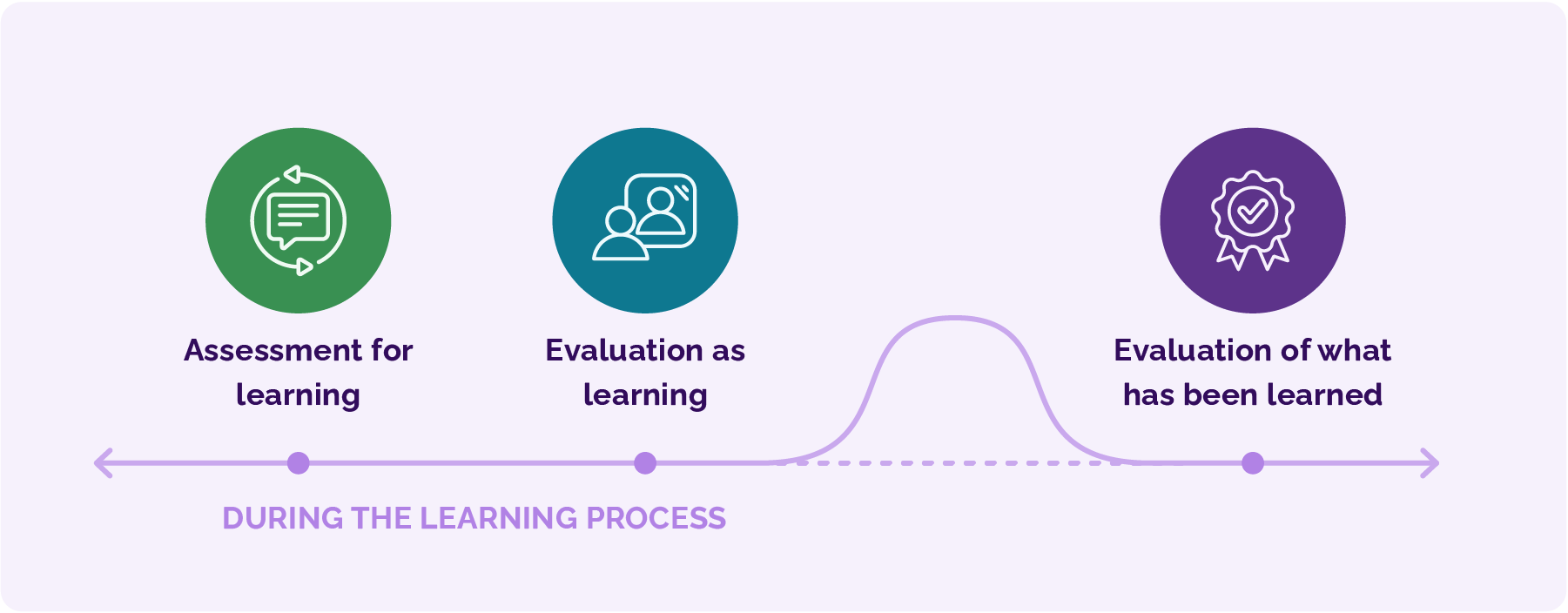
We distinguish three basic approaches to assessment:
Assessment for learning (diagnostic and formative functions) serves to improve and plan future learning and teaching. It is an integral part of the continuous teaching and learning process and takes place during instruction. It does not result in a grade, but in qualitative feedback and exchange of experiences related to learning processes and the acquisition of knowledge and skills in relation to defined learning outcomes.
Assessment as learning (peer assessment and self-assessment) implies the active involvement of students in the assessment process and the development of students’ autonomous and self-regulated approach to learning. Through peer assessment, students are actively involved in achieving learning outcomes, and they direct and adapt their learning toward goal attainment.
Assessment of learning (summative function) represents an evaluation of the level of student achievement after a certain period of learning and teaching. Through assessment of learning, information is summarised about what a student knows and is able to do at the end of a defined time period, in order to document and report on their achievements and progress.
This activity covers the following subtopics:
- phases of the assessment process
- diagnostic assessment
- formative assessment
- summative assessment
- assessment strategies and tools
- assessment and learning outcomes
- additional resources
2. Phases of the Assessment Process
The assessment process consists of several phases: testing, assessment or measurement, grading, and finally, the provision of feedback.
Testing
The teacher collects information by asking questions or assigning tasks in which students are expected to demonstrate specific knowledge, skills, and attitudes, which are reflected in their responses or completed work. Difficulties arise when questions or instructions are not formulated clearly, precisely, and concretely, resulting in students not understanding what is expected of them.
Assessment or Measurement
This is a structured procedure in which the teacher analyses and interprets data collected during testing, relying on predefined criteria in order to determine the extent to which learning outcomes have been achieved. In this process, the teacher simultaneously acts as a measurement instrument and as the person making judgements, which opens space for various subjective influences that may compromise objectivity. When student achievement is expressed numerically, this is referred to as measurement, whereby results are quantified (e.g., the student correctly solved 6 out of 10 tasks), but without providing qualitative insight into the level or depth of understanding.
Grading
Based on previously measured achievement, a grade is assigned to the student, expressed as a number, letter, or percentage, conveying information about the scope and value of the achieved knowledge. This grade serves to classify students into specific categories, for example, on a scale from 1 to 5 or from A to F. Overall student achievement is assessed against predefined criteria, meaning that assessment is criterion-referenced and independent of other students’ performance.
Providing Feedback
Feedback offers both quantitative and qualitative insight into the learning process, achieved results, and student progress. Its purpose is to help students understand the extent to which they have achieved the intended learning outcomes and to identify specific areas that require additional work. When provided by the teacher, feedback has the greatest effect if it is timely, clearly formulated, relevant, and focused on encouraging further development. Only such feedback can effectively support decision-making regarding next steps in teaching and learning and contribute to empowering students in their educational process.
3. Diagnostic Assessment
Diagnostic assessment is conducted to determine the quality and level of students’ knowledge and skills prior to the start of the teaching and learning process. Teachers adapt and plan teaching and learning activities based on the results of diagnostic assessment. It serves as a basis for designing an individualised approach aimed at determining appropriate forms of student support.
For example, at the beginning of a course, a teacher may assign a short online test to assess students’ basic knowledge of programming in Python. The results help determine whether it is necessary to revise fundamental concepts or proceed directly to more complex tasks. In a foreign language for specific purposes course, students may write a short essay or translate a professional text to allow the teacher to assess language competence and organise work in smaller groups according to needs. In a statistics course, a diagnostic assessment may include solving several basic mathematical tasks to determine whether algebraic foundations need to be revised before introducing statistical concepts.
4. Formative Assessment
Formative assessment refers to a process that takes place during learning rather than at its conclusion. It primarily serves a developmental function. Its main purpose is to identify progress and learning difficulties in real time, allowing both students and teachers to adapt their approaches to improve outcomes. In formative assessment, the focus is not on the final grade, but on the learning process itself. We can therefore say that the core components of formative assessment are assessment for learning and assessment as learning. This approach promotes a deeper understanding of content and develops awareness of one’s own learning, metacognitive skills, and learner autonomy. Formative assessment monitors the teaching and learning process in order to identify student difficulties and develop understanding prior to summative assessment.
This type of assessment includes various forms of feedback, often immediate and concrete. Teachers use comments on draft versions of student work, conduct short quizzes to check understanding, ask students to keep reflective journals, or encourage them to express their doubts and uncertainties. For example, a teacher may provide constructive comments on a draft seminar paper, offer additional explanations after a short digital in-class test, or ask students to record weekly reflections on what they understood and what remained unclear in a learning journal. In contemporary contexts, formative assessment is increasingly supported by digital tools that enable automated and personalised feedback, further increasing its effectiveness and strengthening students’ active role in their own learning.
Examples of formative assessment using Moodle LMS
- Short quizzes with feedback for each question: the teacher creates a quiz in which each question includes detailed explanations of correct and incorrect answers, enabling students to receive immediate feedback and learn from mistakes.
- Reflection or discussion forum: students post their own examples, reflections, or task solutions, while teachers and peers provide comments and suggestions for improvement (peer assessment).
- Assignment with multiple submission attempts: students submit a draft, receive teacher feedback through comments or rubrics, revise their work, and then submit a final version.
- Lesson with branching and feedback messages: students progress through a lesson in which each decision or answer leads to different explanations and advice, encouraging active learning and self-assessment.
5. Summative Assessment
Unlike formative assessment, summative assessment aims to provide a final evaluation of students’ knowledge, skills, or competences after a defined period of learning, most commonly at the end of a teaching unit, course, or semester. This evaluation results in an official grade that is recorded in the student information system and often has formal consequences for further studies.
Summative assessment, therefore, has a certifying function and focuses on determining the level of knowledge achieved relative to predefined criteria. In educational practice, summative assessment includes various forms of examinations, final essays, projects, research papers, presentations, and oral defences. For example, a student may take a final written exam at the end of a semester in art history, submit an extensive research paper in sociology, or orally defend a teaching methodology project.
Although its role is important, it is essential to be aware of the risks of placing excessive emphasis on this type of assessment. An exclusive focus on final results can lead to neglect of the learning process, student demotivation, and the development of “grade-oriented learning” strategies rather than genuine understanding. It is therefore desirable to balance summative assessment with formative approaches to ensure more comprehensive and fair evaluation of student work.
If we compare formative and summative assessment, their key characteristics can be summarised as follows:
|
Formative Assessment
|
Summative Assessment
|
|---|---|
|
takes place during the learning or teaching process
|
takes place at the end of the learning or teaching process
|
|
provides feedback on the learning process
|
evaluates learning outcomes against a standard
|
|
not graded
|
graded
|
6. Assessment Strategies and Tools
Successful assessment cannot be conducted without carefully selected strategies and instruments that ensure clear, consistent, and transparent grading. For assessment to be purposeful, criteria and standards must be defined in advance and made available to students. Clear communication of expectations is crucial for building trust in the assessment system and guiding student effort toward desired learning outcomes.
Higher education teachers have a wide range of tools and methods at their disposal. These include analytical and holistic rubrics that allow detailed evaluation of different aspects of student work, closed-ended tests useful for quick knowledge checks, and open-ended questions that encourage analysis, synthesis, and critical thinking. For example, a teacher may use rubrics to assess seminar papers, conduct a standardised multiple-choice test to check basic concepts, or design a complex question requiring argumentation, such as: “Compare two theoretical approaches to communication and explain their advantages in a teaching context.” Increasingly, portfolios, projects, self-assessment, and peer assessment are used to strengthen student autonomy and reflective skills.
Moodle, as one of the most widely used learning management systems, offers numerous built-in activities that support effective and flexible assessment of student achievement. Teachers can use activities such as Quiz, Assignment, and Workshop to monitor student progress and provide feedback. The Quiz activity supports various question types, including multiple choice, true/false, matching, short answer, and essay questions, with options for automatic grading and customised feedback. Additional features such as time limits, random question selection, and multiple test versions help ensure fair assessment.
The Assignment activity allows students to submit work in various formats (text, documents, multimedia), while teachers can assess submissions using predefined criteria, including rubrics and numerical scales. Feedback can be provided in textual form, as annotations, or via audio/video, further personalising communication with students.
The Workshop activity is particularly useful for formative assessment, as it enables peer assessment whereby students evaluate each other’s work according to predefined criteria, fostering the development of evaluative and reflective skills.
7. Assessment and Learning Outcomes
One of the fundamental principles of quality assessment in contemporary education is alignment with clearly defined learning outcomes. Learning outcomes describe the specific knowledge, skills, and attitudes that a student should develop and demonstrate upon completion of a learning activity, course, or study programme. These outcomes form the basis for designing assessment criteria and selecting appropriate assessment methods.
It is important to ensure that all forms of assessment, whether formative or summative, correspond to the cognitive level required by the learning outcomes. For example, if a learning outcome in a statistics course states that a student "interprets the results of basic statistical analyses", an appropriate assessment might involve analysing a table of t-test results and producing a written summary of conclusions. If a learning outcome in a pedagogy course requires students to "apply learning theories in concrete educational situations", a suitable activity would be a case study in which students propose a teaching strategy based on a specific theoretical model. In a communication skills course, if the outcome states that a student "clearly and logically presents professional content", assessment could be based on an oral presentation evaluated using a rubric covering clarity of expression, structure, and use of professional terminology.
Assessment should focus on what is relevant to learning objectives and be adapted to the level of study, ensuring academic relevance and pedagogical justification. In this way, assessment becomes not merely a measurement tool but a powerful means of guiding and supporting learning.
8. Conclusion
Establishing an effective and fair assessment system has a profound impact on the overall teaching and learning experience. Teachers who understand the differences among assessment types and strategically select methods aligned with course objectives contribute to the development of more active, motivated, and competent students. Transparency of criteria, diversity of methods, timeliness of feedback, and alignment with learning outcomes form the foundation of a modern, inclusive, and student-centred approach to assessment.
Such an approach not only measures achievement but actively contributes to the development of academic and professional competences essential for lifelong learning and participation in a knowledge-based society. The use of rubrics for assessing research papers, combining online quizzes and essays as part of hybrid assessment, or organising constructive peer feedback on presentations are just some concrete examples of how principles of contemporary assessment can be translated into effective teaching practice.
9. Literature
- Evaluation and grading of student work at the Faculty of Philosophy. Faculty of Philosophy, University of Osijek. https://www.ffos.unios.hr/download/vrednovanje-i-ocjenjivanje-na-ffos-3-lektorirano.doc
- Guidelines for the evaluation of learning outcomes in higher education. University of Rijeka. https://uniri.hr/wp-content/uploads/2022/07/Smjernice_za_vrednovanje_ishoda_ucenja_u_visokoskolskoj_nastavi-3.pdf
- Evaluation of student achievements in an online environment. SRCE. https://www.srce.unizg.hr/edu/primjena-e-ucenja-u-obrazovnom-procesu/provjera-znanja-i-ocjenjivanje/vrednovanje
Background Colour
Font Face
Font Size
Text Colour
Font Kerning
Image Visibility
Letter Spacing
Line Height
Link Highlight
Paragraph Width
Text Alignment