Student - student communication; student - teacher; student - system
| Site: | Loomen za stručna usavršavanja |
| Course: | Planning and Implementation of Online and Hybrid Teaching |
| Book: | Student - student communication; student - teacher; student - system |
| Printed by: | Gost (anonimni korisnik) |
| Date: | Saturday, 24 October 2026, 4:07 AM |
Description
In virtual learning environments, successfully establishing and maintaining communication and developing a social presence is crucial for the quality of the teaching process, which you will learn more about in this activity.
1. Introduction
In virtual learning environments, the successful establishment and maintenance of communication, as well as the development of social presence, are fundamental prerequisites for a quality teaching process. Social presence in this context implies the ability of participants to perceive each other as visible, accepted, and connected members of the community, even when they are physically distant. It creates an environment in which students feel safe to express their opinions, ask questions, and actively participate in teaching activities. When such presence is not developed, communication is reduced to the exchange of information without deeper engagement, and e-courses risk becoming static and demotivating, devoid of the dynamic interaction that encourages critical thinking and collaborative learning.
In the higher education context, where students are expected to develop independent thinking, the ability to argue and critically evaluate sources, the role of communication and social presence becomes even more important. Higher education teaching in a virtual form must replace the elements of spontaneous discussions and academic dialogue that occur naturally in the physical classroom. This is achieved through carefully designed activities that encourage interaction, such as guided discussion forums, synchronous meetings, and collaborative projects. In such an environment, teachers assume the role not only of experts in the subject area, but also of designers of learning experience, moderators of discussions, and promoters of the creation of a kind of academic micro-community. This ensures that online courses are not just a transfer of information, but a space for active and meaningful learning, which enables students to develop the competencies needed for future professional activity.
2. Community of Inquiry (CoI) Model
Inquiry (CoI) model is one of the most influential theoretical frameworks for understanding and improving learning in online and blended learning environments. Developed early this century, this model assumes that successful online learning is the result of the integration of three interrelated components: cognitive presence, social presence, and teacher presence. Each of these components has a specific role, but their actions are complementary, and complete educational experiences only occur when all three dimensions are balanced and mutually supportive.
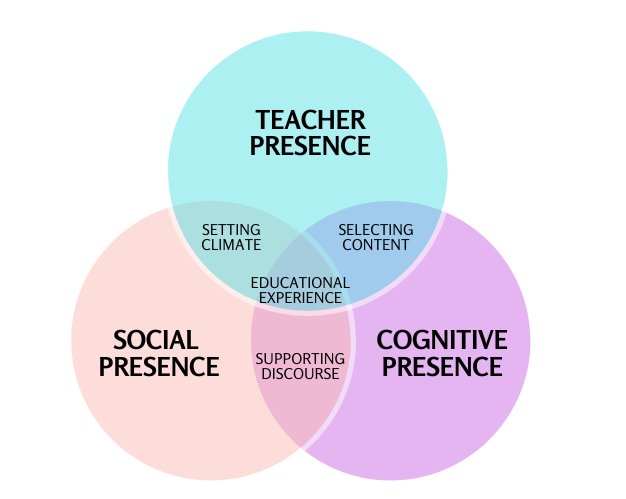
1. Cognitive Presence
Cognitive presence refers to the student's ability to construct and validate meaning through reflection, exploration, and discussion. It represents the intellectual foundation of learning, as it encompasses the processes of asking questions, analysing information, connecting new and prior knowledge, and applying acquired insights to problem solving.
In the higher education context, cognitive presence requires structured activities that encourage critical thinking, such as case study analysis, guided discussions, project work, and research assignments. In an online environment, this dimension particularly benefits from a combination of asynchronous and synchronous formats: asynchronous discussions provide time for reflection, while synchronous encounters allow for rapid exchange of ideas and real-time discussion.
2. Social Presence
Social presence is defined as the degree to which participants in an online community feel connected, accepted, and visible to each other. It includes emotional availability, mutual trust, and a sense of belonging to the community. The role of social presence is not only to create a pleasant atmosphere, but also to ensure that students freely express their opinions, take active roles in discussions, and feel responsible for their shared learning.
Building social presence in online learning involves personalised communication (e.g., addressing students by name, recognising their contributions), creating a safe space for expression (encouraging tolerance for different viewpoints), and active moderation of discussions by teachers (directing the dialogue and maintaining the dynamics of interaction). In higher education, where the importance of academic dialogue and collaborative learning is emphasised, social presence is a key foundation for developing deeper student engagement.
3. Teaching Presence
Teacher presence encompasses planning, guiding, and facilitating the cognitive and social processes necessary to achieve planned learning outcomes. It includes designing curriculum and instructional activities, managing the dynamics of interactions, and providing timely and constructive feedback.
In online and blended environments, the teacher is simultaneously an organiser, mentor, and moderator. Through a clear course structure, defining communication rules, and a constant presence in discussions, the teacher ensures that the learning process remains focused and productive. Teacher presence also includes sensitivity to student needs, flexibility in approach, and the ability to adjust strategies in response to feedback.
Integration of the CoI Model Components
Cognitive, social, and teacher presence do not operate in isolation, but are in constant interaction with each other. Cognitive presence ensures intellectual depth of learning, social presence creates conditions for the open exchange of ideas, and teacher presence connects these elements into a structured and meaningful educational process. In higher education, the application of the CoI model allows teachers to systematically plan activities that develop all three dimensions in a balanced way, thereby achieving greater student engagement, better academic results, and a more positive learning experience in online and blended courses.
3. Types of communication in virtual environments
Communication in virtual learning environments can be realised in two basic forms: asynchronous and synchronous. Each of them has its specific advantages and limitations, and their combination creates optimal conditions for the active, meaningful, and inclusive participation of all students.
Asynchronous communication
It involves the exchange of messages and content that does not require the simultaneous presence of all participants. The most common forms are discussion forums, email, and comments on submitted assignments. This form of communication provides students with time to reflect, research, and structure responses, thus encouraging reflective thinking. In the context of higher education, where critical analysis and argumentation are expected, asynchronous channels allow for deeper processing of information and more even participation of students, including those who struggle to engage in rapid live discussions.
Synchronous communication
It involves simultaneous interaction between participants, most often via videoconferencing tools. Such meetings enable immediate exchange of information, rapid elaboration of ideas, and immediate resolution of ambiguities. In addition, synchronous meetings strengthen social presence because they create a sense of shared time and space, which positively affects the connection between participants. However, this form of communication requires precise time organisation and reliable technical infrastructure, which can be a challenge in international or technically heterogeneous student groups.
An optimal virtual learning environment combines both forms of communication, thus achieving a balance between flexibility and immediacy. Synchronous meetings can be used to spark discussions, clarify key concepts, and foster a sense of community, while asynchronous activities allow students to deepen their understanding and contribute to discussions at their own pace.
Carefully selected tools play a key role in encouraging and maintaining social presence in both types of communication. Discussion forums enable structured, long-term, and topically focused exchanges of opinion. Collaborative platforms like Padlet and Mir offer a space for joint expression of ideas, visualisation of concepts, and collaborative planning. Video conferencing tools like BigBlueButton, Zoom, Google Meet, and MS Teams support synchronous meetings, workshops, and group work in real time.
Despite the opportunities they offer, maintaining a social presence in virtual environments often poses several challenges for teachers and students. Low student engagement in asynchronous activities can lead to fragmented and superficial discussions. Information overload, known as information fatigue, reduces students’ ability to actively participate and respond effectively. Technical difficulties, including unstable internet connections or insufficient familiarity with digital tools, further complicate communication. Finally, the lack of clearly defined rules and expectations regarding the manner and frequency of participation can result in uneven contributions from individual students.
In higher education, where the aim is to form a critically oriented, independent, and responsible academic community, conscious planning of communication types, careful selection of tools, and constant maintenance of a social presence are key to the success of e-courses.
4. Student-student communication
Communication among students is the foundation for creating an active learning community in a virtual environment. When students share ideas, comment on work, and collaborate on assignments, they not only develop knowledge but also the social skills needed for professional life. This communication encourages the exchange of different perspectives and experiences, which leads to a deeper understanding of the course content and increases motivation to participate.
In the context of the Community of Inquiry model, student-student communication especially contributes to social presence, as it allows students to see themselves as active members of the community, but also to cognitive presence, since discussions and collaboration encourage the joint construction of knowledge. When students can explain concepts to each other or solve problems together, they move from a passive to an active role in the learning process. The teacher has the task of designing activities that will not only be formally collaborative but will provide a real opportunity for interaction and reflection.
Examples of communication:
Google docs
In the first example, a group of students collaborated on a report in the collaborative online tool Google Docs, with each contributing a piece of content, and all participants commenting and suggesting changes.
Moodle activity Forum
In another example, students participate in a thematic discussion on a Moodle forum, where they analyse a case study, with minimal teacher involvement to encourage their independent argumentation.
Moodle activity BigBlueButton
The third example involves a live online discussion via the BigBlueButton activity in the Moodle LMS, in which two groups present opposing viewpoints, followed by a joint reflection on the quality of the arguments, which simultaneously develops cognitive and social skills.
5. Student-teacher communication
Student-teacher relationships in a virtual environment have multiple roles: they shape the academic experience, guide the learning process, and strengthen student motivation. The teacher in the digital space is not only a lecturer, but also a mentor, moderator, and evaluator who must balance knowledge transfer, student support, and course structure. The quality of this communication directly influences the perception of Teacher Presence according to the Community of Inquiry model, as it encompasses planning activities, leading discussions, and providing feedback.
Student-teacher communication also has an important impact on social presence, as the teacher's availability, tone of communication, and timeliness of responses contribute to a sense of security and belonging. When students perceive the teacher as present and engaged, they are more likely to actively participate in the lesson and ask questions. The teacher can combine synchronous and asynchronous forms of communication to achieve the optimal balance between immediacy and thoughtful responses.
Examples of communication:
Jitsi Meet
In the first example, the teacher holds individual online consultations via the Jitsi Meet video conferencing tool, during which the student presents their project, and the teacher asks questions, suggests changes, and agrees on next steps.
Moodle activity forum type "Questions and Answers"
In another example, a teacher answers student questions in a “Questions and Answers” forum within the Moodle LMS, providing detailed explanations and links to additional resources.
Personalised feedback
The third example includes personalised feedback on a given seminar, where the teacher not only evaluates the work, but also gives concrete suggestions for improving the structure of the argument and the quality of the sources.
6. Student-system communication
Communication between the student and the virtual system refers to interaction with the interface, automated messages, feedback, and navigational elements within the VLE. Although often invisible at first glance, this dimension strongly influences the student experience because it shapes the way students navigate content, follow deadlines, and respond to tasks. A system that is well structured and pedagogically thought out can support teacher presence in the Community of Inquiry model, as technical elements take over some of the teacher's organisational and orientational functions.
In addition, quality student-system communication can support cognitive presence, especially through immediate feedback that students receive during self-assessments, or through navigational instructions that guide them through a logical learning sequence. Automated elements, such as deadline reminders, help maintain the rhythm of work and reduce the risk of missing obligations.
Examples of communication:
Moodle LMS calendar notifications
In the first example, the Moodle LMS provides information to the student via a built-in calendar that the deadline for submitting an assignment is approaching, along with a link to relevant materials and instructions.
Moodle LMS tests with closed questions
In another example, a student takes an online test and receives immediate feedback on the accuracy of their answer, along with feedback for each question, allowing them to instantly learn from their mistakes.
Moodle LMS interactive guide for new learners
The third example refers to the interactive guide for new participants of the e-college, which — through a series of short instructions — helps the student become familiar with the schedule, location of materials, and rules of participation/work in the e-college.
7. Conclusion
All three dimensions of communication, student-student, student-teacher, and student-system, within the Community of Inquiry model form an integrated system that shapes the learning experience. Social presence provides a sense of connection and mutual trust, Teacher presence provides structure and direction, and Cognitive presence encourages deep and meaningful learning. A teacher who consciously plans and maintains all three dimensions of communication, applying strategies of personalization, safe space, and active moderation, can significantly improve the quality of teaching and student engagement in a virtual environment.
8. Literature
- CoI Framework. CoI. University of Athabasca. https://coi.athabascau.ca/coi-model/
- About the Framework: An introduction to the Community of Inquiry. The Community of Inquiry. (n.d.). https://www.thecommunityofinquiry.org/coi
- Kim, J. (2020). The 11 Mediums of Higher Ed Communication. Inside Higher Ed | Higher Education News, Events and Jobs. https://www.insidehighered.com/blogs/learning-innovation/11-mediums-higher-ed-communication
- Elkington, S. (2023). How are we using different modes of communication to engage students with their learning. https://www.qaa.ac.uk/news-events/blog/how-are-we-using-different-modes-of-communication-to-engage-students-with-their-learning#
Background Colour
Font Face
Font Size
Text Colour
Font Kerning
Image Visibility
Letter Spacing
Line Height
Link Highlight
Paragraph Width
Text Alignment