Example of SWOT analysis tools
| Site: | Loomen za stručna usavršavanja |
| Course: | Digital Technologies for Communication, Collaboration, and Professional Development |
| Book: | Example of SWOT analysis tools |
| Printed by: | Gost (anonimni korisnik) |
| Date: | Saturday, 24 October 2026, 2:39 PM |
Description
As part of this activity, a SWOT analysis of the implementation of the BigBlueButton videoconferencing tool at the large HEI (University of Zagreb) will be presented, with an introduction in which you will be additionally introduced to the method of evaluation using SWOT analysis in the higher education context.
1. Introduction
SWOT analysis is an analytical framework that enables the systematic identification of strengths, weaknesses, opportunities, and threats. In the academic environment, it is applied at the level of an institution, study program, or individual project to assess their alignment with educational strategies and development goals, and evaluate the quality of implementation of teaching and research activities.
SWOT analysis was developed in the 1960s and 1970s by researchers at Stanford University, as part of a project funded by Fortune 500 companies. Their goal was to find the reasons for unsuccessful corporate planning and to design a more effective change management system. They originally designed the SOFT (Satisfactory, Opportunity, Fault, Threat) framework, which was later modified at Harvard into today's SWOT (Strengths, Weaknesses, Opportunities, Threats).
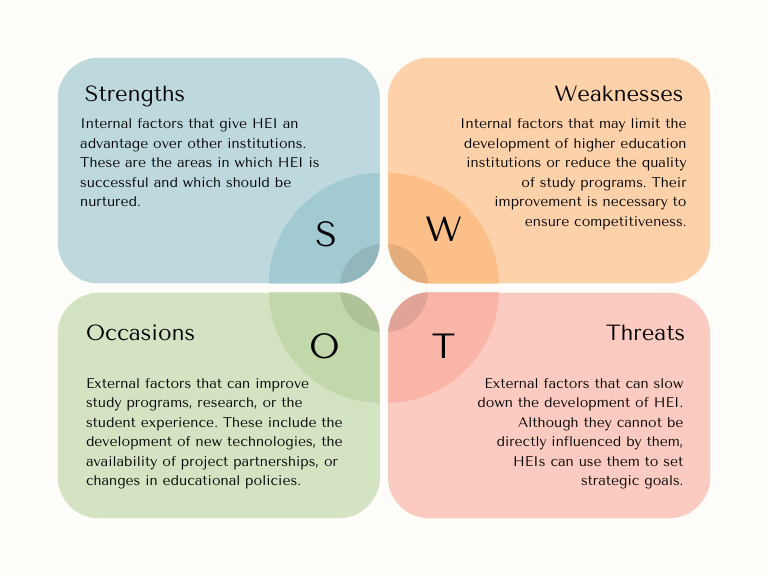
SWOT analysis allows you to identify internal strengths and weaknesses and external opportunities and threats. It is presented in the form of a matrix with four quadrants, each representing one element:
- Strengths
- Weaknesses
- Opportunities
- Threats.
The following link is available in Croatian only. Participants may use free AI-powered translation tools to access the provided materials.
We recommend that you read a useful resource related to conducting a SWOT analysis (from page 3 onwards) available at the link (Krečak, 2025).
2. Examples of SWOT analysis elements
The examples of SWOT analysis elements below refer to the analysis of a fictional higher education institution.
Strengths are internal factors that give a higher education institution an advantage over other institutions. These are areas in which the institution is successful and which should be nurtured.
Examples of strengths:
- reputation and tradition: recognition in the academic community
- quality of teaching and research work: satisfied students and partners
- human resources: expert teachers and researchers
- material and digital infrastructure: libraries, laboratories, e-learning.
Weaknesses are internal factors that can limit the development of an institution or reduce the quality of study programs. Their improvement is necessary to ensure competitiveness.
Examples of weaknesses:
- lack of financial and human resources
- weak organization of administrative processes
- insufficient international cooperation or mobility
- outdated infrastructure or technology
Opportunities are external factors that can enhance the development of higher education institutions. Although they cannot be directly influenced, institutions can use them to set strategic goals.
Examples of opportunities:
- growing interest in certain scientific and professional fields
- digitization and development of new educational technologies
- availability of national and European funds
- strengthening international networks and partnerships.
Threats are external factors that can negatively impact higher education and reduce the long-term performance of institutions.
Examples of threats:
- strong competition from other domestic and foreign universities
- changes in legislation and educational policies
- demographic decline and reduction in the number of students
- economic instability and reduction of public funding.
3. Examples of questions for SWOT analysis
Examples of questions for a SWOT analysis of a higher education institution
When conducting a SWOT analysis in an academic environment for, for example, a higher education institution, it would be useful to ask questions tailored to each of the four elements:
Strengths analysis questions
- What qualities of our study program or institution do students value most?
- What makes us better than other higher education institutions?
- What are our most important competencies and specialties?
- What resources (human, infrastructure, academic) do we have that competing institutions do not?
Weakness analysis questions
- What is the biggest dissatisfaction for students or partners?
- What are the most common complaints or problems in teaching, research, or administration?
- Why do some students decide to enroll in another institution or discontinue their studies?
- What processes or practices could we improve?
- What are our biggest obstacles in achieving academic goals?
- What do competing institutions offer that we do not?
Opportunity analysis questions
- How can we improve the quality of teaching and student support?
- What forms of communication and promotion attract the most interest of potential students?
- How to additionally include and retain existing students and alumni?
- Are we using existing resources (teachers, infrastructure, digital tools) in the most effective way?
- Are there funds, mobility programs, or partnerships that we haven't taken advantage of yet?
- What new forms of teaching or research are most promising?
Threat analysis questions
- What external factors (e.g., legislative changes, demographic trends) could negatively impact our development?
- How strong is the competition between domestic and foreign universities and faculties?
- Are there any regulatory or administrative obstacles that can make it difficult for us to do business?
- How does the economic and social situation affect enrollment policy and funding?
- What are the risks associated with the institution's reputation?
4. Advantages and disadvantages of SWOT analysis
Advantages of SWOT analysis
List of advantages of SWOT analysis, especially in educational and organizational contexts:
- Easy to use: an easy-to-understand tool that does not require complex methods or specialized knowledge.
- Comprehensive perspective: simultaneously encompasses internal (strengths and weaknesses) and external factors (opportunities and threats).
- Encourages strategic thinking: encourages participants to analyze the current situation and plan for future development.
- Decision support: helps to set priorities and align resources with goals.
- Flexibility: can be used for businesses, projects, institutions, or educational programs.
- Participatory approach: often involves multiple stakeholders (e.g., students, teachers, employees), which contributes to a better understanding of the situation.
- Identifies opportunities for development: highlights where resources can be best used.
- Identifies risk areas: warns of threats and weaknesses that need to be mitigated or removed.
Disadvantages of SWOT analysis
The disadvantages of SWOT analysis, on the other hand, are as follows:
- Generality and subjectivity: results depend on the assessment of the participants, so they may be imprecise or biased.
- Lack of prioritization: SWOT identifies factors but does not determine their importance or order of resolution.
- It does not provide solutions: it describes the situation but does not offer specific strategies or action steps.
- Statistical limitations: does not use quantitative data or measurable indicators, unless they are additionally included.
- Possible over-complexity: if too many factors are included, the analysis can become unwieldy and dysfunctional.
- Short-term perspective: focuses on the current situation, so it easily ignores long-term trends and changes.
- Context-dependent: the same factor can be a strength in one context and a weakness in another (e.g., the size of the institution).
- Risk of superficial use: often used as a formality in planning, without deeper elaboration or subsequent monitoring.
5. SWOT analysis: BigBlueButton at the Faculty of Humanities and Social Sciences, University of Zagreb
Introduction
The Faculty of Humanities and Social Sciences, University of Zagreb (FFZG) is one of the largest institutions in the science and higher education system in the Republic of Croatia, with more than 7000 students at all three levels of study: undergraduate, graduate, and postgraduate. FFZG has introduced the BigBlueButton videoconferencing system as a basic tool for videoconferencing in integration with the existing Omega distance learning system, based on Moodle LMS. The Omega system has been the official e-learning platform at the Faculty since 2004.
This decision arose from the need to provide students and teachers with a reliable, integrated, and free solution for conducting distance learning, especially during the sudden transition to online work models in early March 2020. BigBlueButton, as open source software developed with an emphasis on educational needs, proved to be a natural choice: it provides support for live lectures, interactive discussions, group work in so-called breakout rooms, surveys, and whiteboards. Integration into Moodle LMS enabled teachers to easily schedule and conduct online classes within an already familiar environment. Although it required a strong infrastructure and continuous IT support, BigBlueButton ensured the Faculty's digital sovereignty and enabled control over data, which proved important in the long-term development of digital teaching. In five years of use, more than 70,000 video recordings of lectures, consultations, exams, and meetings were created, and many more videoconference sessions were held that were not recorded.
SWOT analysis
Conclusion
The introduction of the BigBlueButton system at the Faculty of Humanities and Social Sciences, University of Zagreb, proved to be a strategically important move in the digitalization of teaching. Thanks to the integration with Moodle LMS, teachers received a functional and reliable tool within a familiar environment, which facilitated the transition to online and hybrid forms of learning. BigBlueButton stood out as a solution that is fully focused on the needs of education, enabling interactivity, collaboration, and inclusiveness in teaching. Its strengths, such as open source and control over data, are also a challenge because they require constant investment in technical infrastructure and support. Compared to commercial tools, the user experience may seem less attractive, but its pedagogical value and flexibility give it a significant advantage. In the long term, BigBlueButton represents an important step in preserving the digital sovereignty of the HEI and the university and in building a sustainable e-learning model.
6. References
Background Colour
Font Face
Font Size
Text Colour
Font Kerning
Image Visibility
Letter Spacing
Line Height
Link Highlight
Paragraph Width
Text Alignment