Visibility of scientists
| Site: | Loomen za stručna usavršavanja |
| Course: | Digital Technologies for Communication, Collaboration, and Professional Development |
| Book: | Visibility of scientists |
| Printed by: | Gost (anonimni korisnik) |
| Date: | Saturday, 24 October 2026, 10:43 PM |
Description
This activity will covert topics related to the visibility of scientists and research.
Table of contents
- 1. Introduction
- 2. Open science
- 3. Publications in open access journals
- 4. Updated ORCID, ResearchGate and Google Scholar profiles
- 5. Presentations at conferences and poster sessions
- 6. Writing popular science articles and blogs
- 7. Collaboration in interdisciplinary and commercial projects
- 8. National and international repositories
- 9. Conclusion
- 10. References
1. Introduction
The visibility of scientists is today one of the key factors in academic and professional advancement. It involves not only the number of published papers, but also the way in which research results are accessible, recognized, and applied in the scientific and wider community. In the past, the exchange of scientific information was limited to traditional publication channels, while modern trends, from open science to digital repositories, enable much faster and wider dissemination of knowledge.
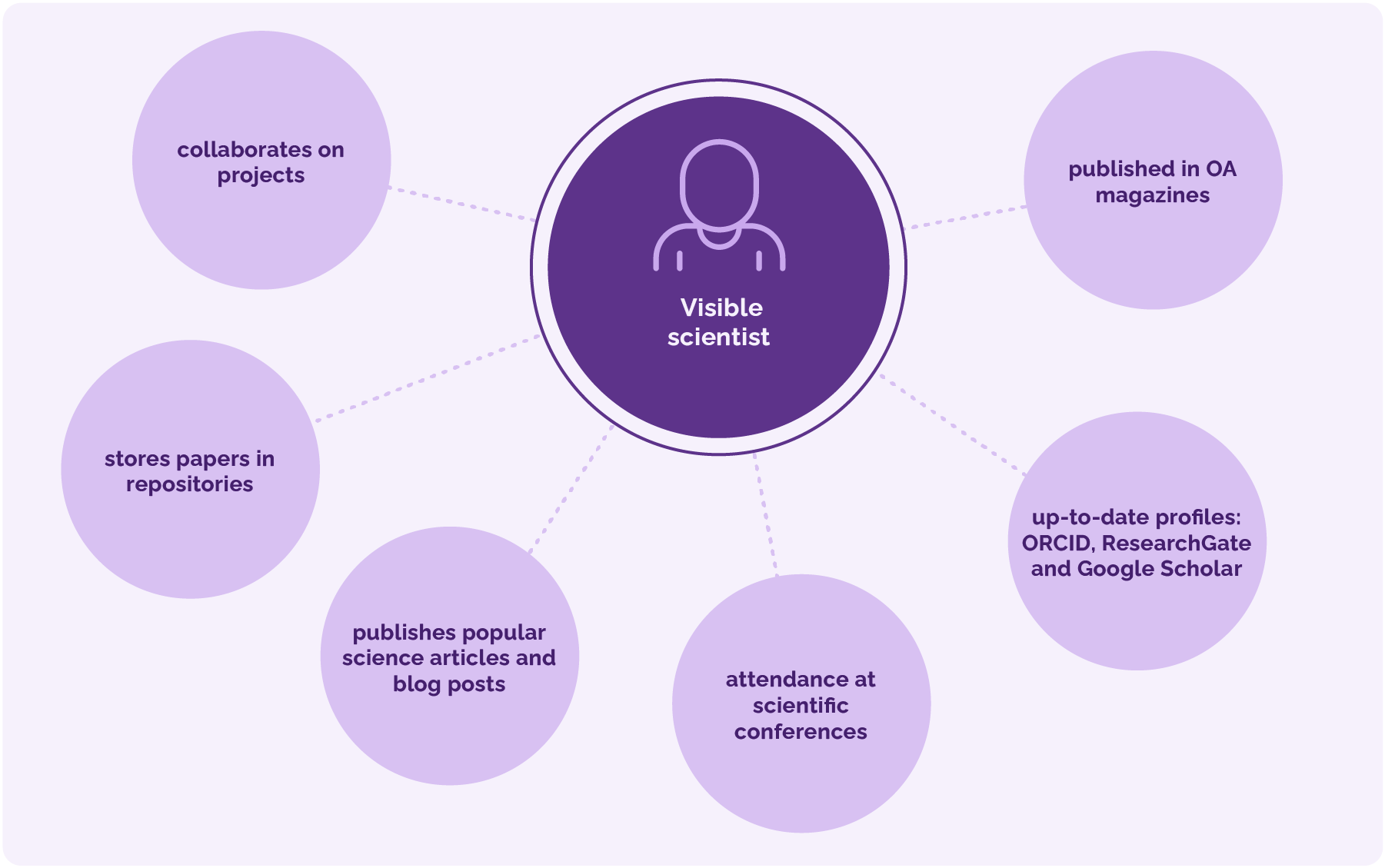
The increased importance of open access and transparent sharing of data, as well as the development of digital tools such as ORCID, ResearchGate, and Google Scholar, emphasize the proactive management of one's own research identity. In addition, conferences, poster sessions, and interdisciplinary collaborations offer the opportunity to directly present results and create professional networks. Popular science articles, blogs, and public presentations play a special role in strengthening visibility, which enables communication with a wider audience and emphasizes the social relevance of science.
In this context, various dimensions of scientist visibility will be considered, from publications in open-access journals, through building professional profiles and networks, to participation in repositories and projects. All these elements together shape the recognition of an individual, but also influence the development of the scientific community as a whole.
2. Open science
Openness of scientific information is not a new phenomenon, but is rooted in the very foundations of scientific communication and education. In the past, the exchange of scientific knowledge was limited by available technologies, but with the development of the first journals and later advanced communication channels, there was a significant increase in the number of published works and the dissemination of research results. During the 20th century, the rapid increase in scientific production led to the fact that journal editorial boards transferred some of the responsibilities to commercial publishers, whose main interest was the realization of profit, rather than the free flow of scientific information.
At the same time, the emphasis on the prestige of certain journals and publishers has created a kind of race in which scientists strive to publish as many papers as possible in highly reputable publications. Such an approach often limits the sharing of knowledge and slows down the progress of science and innovation. The move towards more open science requires a shift away from this logic of competition towards early and transparent sharing of data and research results.
Open science marks a shift from the traditional practice of publishing exclusively in scientific journals to a model in which data, methods, and results are available early in the research process. The key is to shift the emphasis from publishing “as quickly as possible” to sharing “as early as possible.”
The drivers of this trend lie in the development of new technologies, the exponential growth of research data, social expectations that science should focus on current challenges, and the increasing willingness of citizens to engage in research processes. Increased openness, faster and better scientific communication create a flow of knowledge that benefits both researchers and the scientific community, but also society as a whole.
What are the benefits of open science?
- allows greater access to knowledge
- accelerates research progress
- encourages collaboration and interdisciplinary research
- improves research reproducibility
- improves the transparency of the research process
- optimizes resource allocation
- encourages public involvement in science through citizen science
- stimulates innovation by enabling collaboration, knowledge exchange, and the development of new ideas and technologies
- contributes to economic growth by facilitating the dissemination of research findings and encouraging the reuse of data and resources.
3. Publications in open access journals
The following link is available in Croatian only. Participants may use free AI-powered translation tools to access the provided materials.
Open access is free, free, and unhindered online access to digital scientific information that enables reading, storing, distributing, searching, retrieving, indexing, and/or other lawful use. Free in this context means permanently free from any restrictions and setting conditions for access and use (Hrvatska deklaracija o otvorenom pristupu, 2012)
Open Access (OA) is divided into three levels:
- Green OA allows open access by archiving or self-archiving works in digital repositories. Depending on the publisher's requirements, the author's version of the manuscript before or after review, and sometimes the final version published in the journal, can be archived. Works are mainly archived in institutional repositories, which are most often done by the authors themselves, or in publicly available subject repositories, and can also be published on the personal web pages of the authors or institutions. Access to the stored works is often subject to an embargo, i.e., a period of time that must elapse before the work becomes publicly available. The embargo period is determined by the publisher, and in some cases, archiving may be mandatory due to the requirements of the research funder or the author's institution.
- Gold OA involves publishing scientific papers in journals that provide open access. These can be fully open journals or so-called hybrid journals, where only a portion of the articles are available in open access. In the gold path, articles are available to the public immediately after publication. The costs of publishing in open access (Article Processing Charges – APC) are most often borne by authors, their institutions, or research funders. However, there are also examples where publishers cover the costs themselves or they are financed from state funds, as is the case with some Croatian scientific journals. This model is often called diamond or platinum open access because it allows openness without costs for authors.
- Diamond OA is a model for publishing scholarly works in which scholarly journals and publishing platforms do not charge a fee to authors or readers. This model is a publishing initiative initiated and led by the academic community. Diamond journals provide completely free access to and use of scholarly information, further increasing the availability of research results to the wider public. This model often depends on public funding, grants from academic institutions, or donations.
A major initiative to promote open access and open science has been implemented since 2018 by cOAlition S, a group of research funding organizations, with the support of the European Commission and the European Research Council (ERC). cOAlition S aims to achieve full and immediate open access to scientific publications. To achieve this goal, they have developed Plan S, which requires all research funders supporting this initiative to require immediate open access to all scientific publications resulting from their funding.
Plan S contains ten principles:
- Authors or their institutions retain copyright. All works must be published under an open license, preferably under the CC BY license.
- Funders will provide the criteria that high-quality journals, open access platforms, and repositories must provide.
- In cases where high-quality open access journals or platforms do not yet exist, financiers will provide support in their establishment and the establishment of an open access infrastructure.
- Where applicable, the costs of publishing works in open access are borne by funders or scientific institutions, not individual scientists. The emphasis is on the idea that all authors should have the opportunity to publish their works in open access.
- Funders will support different business models of open-access journals and platforms. When open access publication fees are applied, they must be proportionate to the publication services provided, and the structure of such fees must be transparent to inform the market and allow for potential standardization and limitation of fee payments.
- Funders will encourage governments, higher education institutions, scientific research organizations, libraries, and the academic community to harmonize strategies, policies, and practices, especially with the aim of ensuring transparency.
- The above principles will apply to all types of scientific publications, but it is necessary to take into account that ensuring open access to monographs and book chapters will take somewhat longer and will require a special process.
- Funders support the hybrid model solely as a transitional path within clearly defined time frames until full open access is achieved.
- Funders will monitor compliance with regulations and sanction grant beneficiaries who do not comply with the set conditions.
- Funders commit to evaluating the intrinsic value of the work when assessing research results in making funding decisions, regardless of publication channel, impact factor (or other journal metrics), or publisher.
4. Updated ORCID, ResearchGate and Google Scholar profiles
Professional online profiles are a kind of "digital business cards" of scientists and are a key tool for increasing their visibility in the global scientific community. Their purpose is not only to provide basic information about the researcher, but also to consolidate publications, research interests, collaborations, and impact metrics in one place. In today's digital environment, where fast and reliable access to information is crucial, updated profiles allow researchers to be easily recognizable and accessible to potential collaborators, institutions, and funders.
ORCID provides a unique and permanent identifier that links a researcher to all of their work, regardless of changes in institutions, countries, or even names. This avoids errors in authorship attribution, which is a common problem in scholarly communication. ORCID is increasingly becoming mandatory when submitting papers to journals or for project funding, further confirming its importance.
ResearchGate is a social network for scientists that allows them to share publications, post preprints, participate in discussions, and network with colleagues in related fields. It also offers the ability to track statistics such as the number of reads, citations, and downloads, giving researchers a better insight into the reach and impact of their work. Active use of this platform encourages collaboration and the exchange of ideas, especially on interdisciplinary topics.
Google Scholar automatically indexes works available on the Internet and generates a researcher profile with a list of publications, citation data, h-index, and other bibliometric indicators. Its advantage lies in its ease of use and wide coverage, making it one of the first sources that scientists, students, or journalists use when searching for literature and authors.
Regularly updating these profiles is essential to ensure their accuracy and relevance. Scientists who neglect to update them risk their most recent work becoming invisible, while systematically maintained profiles increase recognition and professional credibility. They make research results easier to find, encourage citations, and also serve as a tool for personal branding in the academic world. In short, actively maintained ORCID, ResearchGate, and Google Scholar profiles significantly contribute to strengthening the professional identity and visibility of scientists on a global level.
5. Presentations at conferences and poster sessions
Participating in scientific conferences and related events is one of the most visible ways to present one's research. Oral presentations provide an opportunity for scientists to present their results to a wider audience, answer questions, and engage directly with colleagues and potential collaborators. Poster sessions, although less formal, often offer more intensive one-on-one discussions and allow for more in-depth exchanges of experiences.
In addition to traditional live events, virtual conferences are increasingly common, enabling global participation and further expanding the circle of potential listeners. Recordings of presentations and posters published on online platforms continue to "live" after the event, thus extending the visibility of research.
Conferences are also important for the development of professional networks; meetings at such events often result in new joint projects, co-authorships, or participation in international initiatives. For young scientists, they are opportunities for their first appearance on the international scene and positioning within the scientific community.
6. Writing popular science articles and blogs
Popular science writing is becoming an increasingly important tool for expanding the visibility and relevance of scientific work. By publishing articles in popular journals, on online portals, or on their own blogs, scientists communicate with audiences outside the academic world. This builds public trust in science and brings complex topics closer to the public in an understandable and accessible way.
The advantages of this approach are multiple: scientists gain greater media recognition, their research becomes more visible to potential partners from the economy, and students and citizens better understand the role of science in society. Writing blogs or participating in podcasts and video presentations can significantly contribute to a researcher's personal branding and highlight them as an expert in a particular field.
These forms of communication require language adaptation – instead of technical terms, clear, descriptive, and understandable formulations are used. In this way, scientists not only broaden the visibility of their own work but also actively contribute to the scientific literacy of society.
7. Collaboration in interdisciplinary and commercial projects
In modern science, the boundaries between disciplines are becoming increasingly permeable, and the most significant discoveries and innovations often occur at the intersection of different scientific fields. Participation in interdisciplinary projects provides scientists with an opportunity for greater visibility because it involves a wider network of collaborators, different methods and perspectives, and results that are more easily applied in practice.
Collaboration with industry and commercial partners further increases the societal impact of research. Such projects often lead to the development of new products, services, or technologies, and thus to greater visibility of researchers in a broader context, outside of academia. Participation in such projects can result in greater financial resources, but also increased public recognition, as the results are often promoted in both business and media circles.
In this way, scientists build a reputation not only as academics, but also as practical innovators and socially responsible experts.
8. National and international repositories
Repositories represent one of the most effective ways to ensure the continued availability of research papers and data. National repositories, such as the Croatian Hrčak, provide free access to a large number of journals and scientific papers, while international repositories such as Zenodo, arXiv, or Europe PMC ensure global availability.
The advantage of repositories is that works stored on these platforms remain long-term available and easily searchable. They ensure the permanence and stability of scientific information, unlike commercial databases whose access may be limited or time-bound. In addition, repositories often allow the addition of additional materials, such as datasets, codes, or multimedia content, thereby increasing the transparency and applicability of research.
The use of repositories also contributes to higher citations of papers because they appear in open search engines such as Google Scholar. For young scientists, repositories are a great way to quickly increase visibility, while for experienced researchers, they help ensure the lasting impact of their work on the scientific community and society.
9. Conclusion
The visibility of scientists today is inextricably linked with openness, digital presence, and active involvement in various forms of communication and collaboration. Publications in open-access journals, updated professional profiles, participation in conferences, popular scientific writing, and involvement in interdisciplinary projects are complementary dimensions of building a scientific identity. National and international repositories additionally ensure the permanent availability and stability of research results.
In the contemporary academic and social context, scientists can no longer count on their work being recognized only through traditional publication channels. It is necessary to actively manage one's own visibility, use open science tools, and build bridges between the research community and the wider public. This not only increases personal recognition and professional reputation but also contributes to the broader goal of developing science that is transparent, accessible, and socially relevant.
10. References
- Open science. https://www.otvorena-znanost.hr/otvorena-znanost
- Open evaluation. https://www.otvorena-znanost.hr/otvoreno-vrednovanje/
- Open education. https://www.otvorena-znanost.hr/otvoreno-obrazovanje/
- Open research data. https://www.otvorena-znanost.hr/otvoreni-istrazivacki-podaci/
Background Colour
Font Face
Font Size
Text Colour
Font Kerning
Image Visibility
Letter Spacing
Line Height
Link Highlight
Paragraph Width
Text Alignment