Instructions for participants of the e-course Strategic Planning for Digital Technology Implementation in Higher Education
| Site: | Loomen za stručna usavršavanja |
| Course: | Strategic Planning for Digital Technology Implementation |
| Book: | Instructions for participants of the e-course Strategic Planning for Digital Technology Implementation in Higher Education |
| Printed by: | Gost (anonimni korisnik) |
| Date: | Thursday, 17 September 2026, 12:59 AM |
1. General information about the e-course
This e-course, Strategic Planning for Digital Technology Implementation, provides a thorough understanding of the digital transformation in higher education and teaches participants how to design and plan the application of digital technologies at a strategic level. Students analyze where digital technologies can be applied, and learn how to build a strategy for developing a methodology and create the corresponding action plan. Special emphasis is placed on agile approaches to strategic planning to respond to rapid changes in the implementation of the action plan, especially in situations where strategy implementation does not follow the plan.
Number of ECTS credits: 3
Participants:
- employees at higher education institutions in teaching and science positions;
- employees at higher education institutions in management positions;
- in a broader sense, participants of this course may also be employees of other institutions in the science and higher education system (e.g., employees of Srce, Carnet) and other relevant stakeholders in the science and higher education system (e.g., employees of agencies, ministries, and organizations that are in some way connected with higher education).
Learning outcomes of the e-course:
- describe the purpose and characteristics of digital transformation at a higher education institution;
- explain the goal, characteristics, and phases of strategic planning;
- analyze the components and areas of a digital technology application strategy;
- apply methods and techniques for defining elements of a digital technology application strategy;
- design a digital technology application strategy;
- create an action plan for the application of digital technologies.
2. Course work method
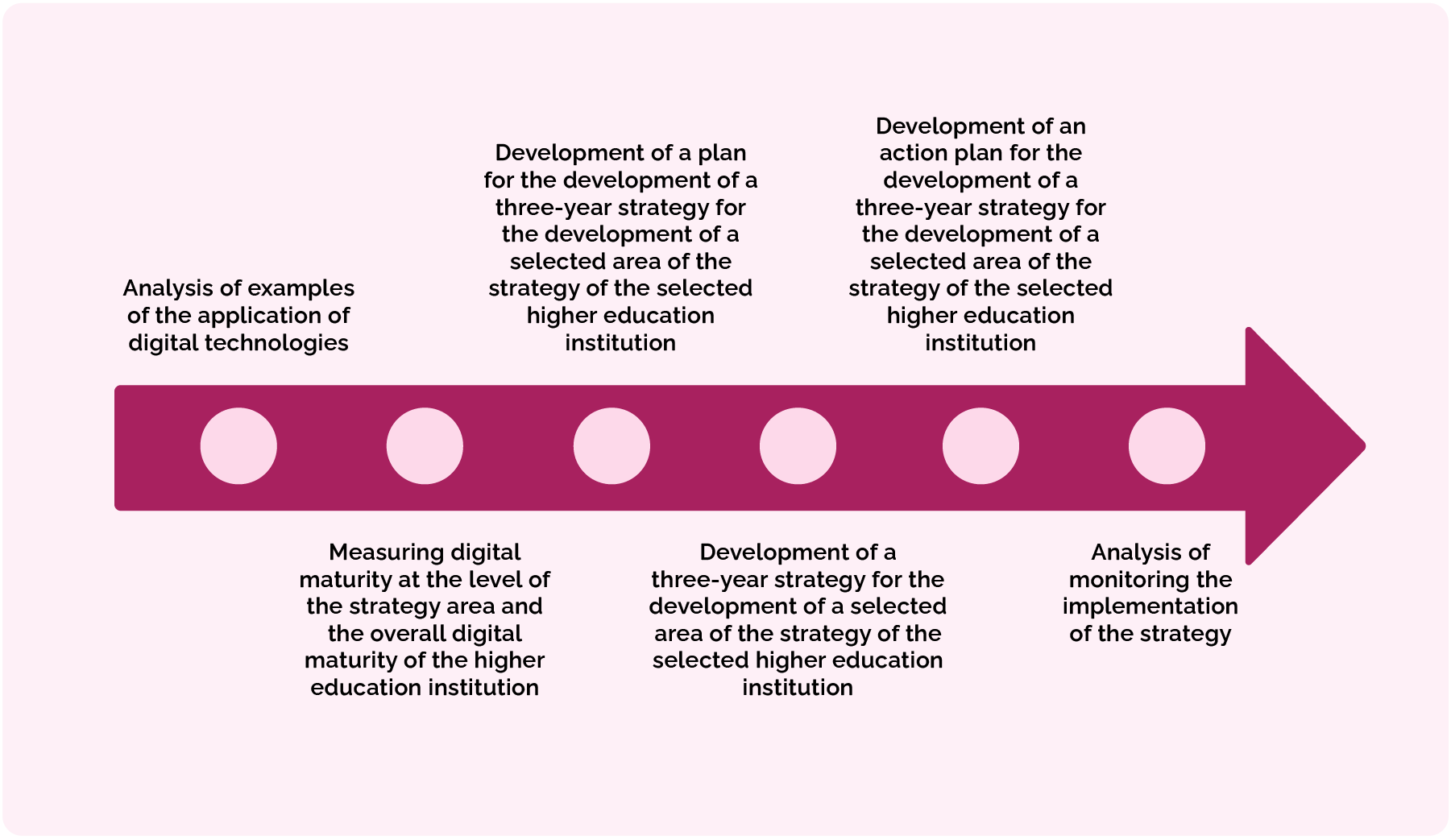
This mentored e-course contains six parts that are sequentially linked in both the theoretical and practical sense, through the completion of team tasks during e-course implementation.
Some tasks in the course are designed to be completed independently, while others can be worked on independently or in pairs. For tasks where it is possible to choose the mode of work (independently or in pairs), pair work is recommended throughout the e-course. It is desirable that the practical part is done with the same person in a pair throughout the course. Collaboration with other participants will be possible through planned activities (discussion and peer assessment).
The practical task is completed in a prepared Excel file that contains precise instructions for each of the six tasks. The parts of this file are linked by formulas in order to optimize work on practical tasks. Additionally, as statistics on strategic planning indicate major problems in implementation and monitoring the implementation of strategies, the Excel templates contain elements of automatic monitoring of strategy execution, so that participants in their own project assignments become aware of the importance of monitoring the implementation of the action plan (and thus the strategy). Through this, they can conclude that this need not be a demanding task, but can bring great benefits and accelerate strategy implementation. A detailed time plan for working on the topics will be disseminated by the instructor during the course.
3. E-course structure
The e-course consists of six thematic units. The following table shows the percentage contribution of each of the six topics to each learning outcome.
|
|
Describe the purpose and characteristics of digital transformation (10) |
Explain the goal, characteristics, and phases of strategic planning (10) |
Analyze the components and areas of the digital technology application strategy (10) |
Apply methods and techniques to define elements of a digital technology application strategy (10) |
Develop a strategy for implementing digital technologies (30) |
Create an action plan for the application of digital technologies (30) |
|
Digital Transformation |
60 % |
10 % |
||||
|
Areas of the Digital Technology Implementation Strategy |
10 % |
10 % |
70 % |
10 % |
5 % |
|
|
Strategic Planning |
20 % |
60 % |
10 % |
5 % |
||
|
Methodology for Developing a Strategy for Implementing Digital Technologies |
10 % |
60 % |
30 % |
10 % |
||
|
Action Plan for Implementing Digital Technologies |
10 % |
10 % |
10 % |
10 % |
40 % |
|
|
Agility in Strategic Planning, and final evaluation of created strategies and action plans |
10 % |
10 % |
10 % |
10 % |
50 % |
50 % |
E-course structure:
- Thematic unit 1. Digital Transformation
- Theoretically, this unit outlines the basic theoretical assumptions related to digital transformation, including its characteristics, determinants of maturity, types of digital changes, and the role of stakeholders in the process of digital transformation of higher education institutions.
- In practical terms, within this unit, participants need to select and analyze, according to given criteria, examples of business processes that represent examples of the application of digital technologies.
- Theoretically, this unit outlines the basic theoretical assumptions related to digital transformation, including its characteristics, determinants of maturity, types of digital changes, and the role of stakeholders in the process of digital transformation of higher education institutions.
- Thematic unit 2. Areas of the Digital Technology Implementation Strategy
- Theoretically, this unit analyzes the different frameworks of digital maturity used in the different approaches to defining the area of strategy for the application of digital technologies. The unit includes seven areas of strategy for the application of digital technologies, specific examples of the application of digital technologies for each area from Croatia and the world, and a presentation of trends in the area. Additionally, the connection between the field of application of digital technologies and two digital maturity frameworks for higher education, DigCompOrg and the digital maturity framework for higher education institutions (DMFHEI), is presented.
- In practical terms, participants work in pairs to choose a higher education institution of their choice (preferably their own) and, independently or with the help of responsible persons (board member(s)), conduct an evaluation of the institution to identify the digital maturity of the institution and each of the seven areas of digital maturity.
- Theoretically, this unit analyzes the different frameworks of digital maturity used in the different approaches to defining the area of strategy for the application of digital technologies. The unit includes seven areas of strategy for the application of digital technologies, specific examples of the application of digital technologies for each area from Croatia and the world, and a presentation of trends in the area. Additionally, the connection between the field of application of digital technologies and two digital maturity frameworks for higher education, DigCompOrg and the digital maturity framework for higher education institutions (DMFHEI), is presented.
- Thematic unit 3. Strategic Planning
- Theoretically, this unit provides a definition of strategic planning and its characteristics, strategy components, preferred practices regarding the formation of teams for the creation of strategies, the structure of the strategic planning plan, and statistics on the success of strategic planning.
- In the practical part, participants develop a plan for creating a three-year development strategy for the selected higher education institution for one of the areas of the digital technology application strategy. Ideally, they should select the area that is the least mature based on the analyses conducted in the task of the previous thematic unit.
- Theoretically, this unit provides a definition of strategic planning and its characteristics, strategy components, preferred practices regarding the formation of teams for the creation of strategies, the structure of the strategic planning plan, and statistics on the success of strategic planning.
- Thematic unit 4. Methodology for Developing a Strategy for Implementing Digital Technologies
- The theoretical part of this unit provides a detailed overview of the methods for developing a strategy, from analysis of the current situation to defining the strategic goals. The missions, visions, core values, strategic initiatives, and strategic goals of four Croatian and four foreign higher education institutions are presented.
- In the practical part, participants analyze the existing strategic plans for the selected higher education institution, analyze the current state of the field of application of digital technologies selected in the task of the previous thematic unit, and create a strategy for that field (vision, mission, values, and three strategic goals).
- The theoretical part of this unit provides a detailed overview of the methods for developing a strategy, from analysis of the current situation to defining the strategic goals. The missions, visions, core values, strategic initiatives, and strategic goals of four Croatian and four foreign higher education institutions are presented.
- Thematic unit 5. Action Plan for Implementing Digital Technologies
- In the theoretical part, the topic provides an overview of different approaches for the operationalization of strategic goals (breaking them down into concrete activities and operational goals). The steps of operationalizing strategic goals with a simplified balanced scorecard system (BSC) are clarified and demonstrated.
- In practical terms, an action plan needs to be created for the strategy created in the task of the previous thematic unit.
- In the theoretical part, the topic provides an overview of different approaches for the operationalization of strategic goals (breaking them down into concrete activities and operational goals). The steps of operationalizing strategic goals with a simplified balanced scorecard system (BSC) are clarified and demonstrated.
- Thematic unit 6. Agility in Strategic Planning
- The theoretical overview outlines the characteristics of agile management and the role of agility in monitoring the implementation of the action plan.
- In practical terms, participants simulate the implementation of an action plan using a template for an activity log in strategy implementation. After entering several completed activities in the activity log, participants will be able to simulate the progress of achieving operational and strategic goals through quarters. In the simulation, participants will be able to determine whether their operational goals are being achieved as intended or whether appropriate decisions need to be made, and thus see the role of agility in strategic management in a concrete example.
- The theoretical overview outlines the characteristics of agile management and the role of agility in monitoring the implementation of the action plan.
4. Technical information about the e-course
This e-course is implemented on the Loomen system, which is based on the open-source Moodle system. The e-course homepage is organized in accordance with the e-course structure, with links on the homepage leading to activities and resources in accordance with the e-course design.
The e-course can be accessed from a computer connected to the Internet, a smartphone, or a tablet. The e-course opens properly in all popular Internet browsers (Firefox, Opera, Chrome, Edge, etc.). The e-course is also available through a mobile application, though this does not always work optimally.
Faster navigation through the course is possible using the menu on the left, while on the right, it is possible to monitor upcoming activities, highlighted notifications, and track progress through the course.
The Loomen system is intuitive, and in case of difficulties using the system, it is necessary to contact the instructor.
5. Minimum technical requirements for attending the e-course
Types of content in an e-course:
- Educational multimedia (mostly textual) materials (e.g., lessons and pages) are available through the Loomen system by opening them directly in a web browser, and it is also possible to download all materials in PDF format. For this reason, the user must have a PDF reader installed. If, for example, Firefox or Chrome is used, then a PDF reader is not required because PDFs can also be opened in a web browser.
- The video lessons are originally located on Carnet's multimedia portal Meduza, and are integrated into the pages on Loomen, so they can be accessed without leaving the Loomen system. To watch the video lessons, an Internet connection of at least 2Mbit/s is required. In addition, headphones or speakers are required.
- The practical part of the task is completed in a spreadsheet, and it is necessary for the participant to have an appropriate tool installed, preferably MS Excel.
- The evaluation activities in the e-course are supported by the appropriate functionalities of the Loomen system, and no other technical prerequisites are required. Quizzes are fully opened in a web browser, and no other technical prerequisites are required.
- Synchronous activities in the course take place using the Big Blue Button platform, which is integrated into the Loomen system, and the technical prerequisites for participating in synchronous activities include a microphone, headphones, and Internet speed (preferably 5 Mbit/s and more).
6. Participant obligations
It is recommended that participants take part in as many activities as possible: reviewing and analyzing video lessons and educational materials, practical activities, and more. During the implementation of the e-course, it is possible to collect points, up to 50. The following table lists the mandatory activities in the e-course by topics, methods of implementation, and possible points achieved. Some activities have * next to the points. This is a graded activity, but (all) points are not awarded immediately, but at the end of the course (they are included in the points marked with **). The course is considered passed if at least 25 points are achieved in total, with at least a third of the points achieved in all graded activities.
Thematic unit |
Required activity or activity for points |
Alone / in pairs |
Points |
|
Digital Transformation |
Analysis of examples of the implementation of digital technologies (Forum and worksheet 1) |
A/P |
0 |
|
Areas of Digital Technology Application Strategy |
Analysis of the digital maturity of the selected higher education institution at the institutional level and at the level of seven areas of digital technology implementation (worksheet 2) |
|
|
|
Strategic Planning |
Why do some strategies fail? (Forum) |
A/P |
0 |
|
Methodology for Developing a Strategy for Implementing Digital Technologies |
Analysis of the mission, vision, core values, and strategic goals for one national and one foreign higher education institution (Forum) |
|
|
|
Action Plan for Implementing Digital Technologies |
Creating an action plan for a selected higher education institution and a selected area of application of digital technologies worksheet (worksheet 5) |
|
|
|
Agility in Strategic Planning, and final evaluation of created strategies and action plans |
Quiz |
A |
5 |
|
Total |
50 |
7. Contact information
For all content-related questions and questions related to attending the e-course, please contact your instructor.
For technical questions, please contact the e-mail address x@carnet.hr or phone 01 xxxxxxx.
8. Rules of conduct in the course
To ensure better collaboration, we have defined certain rules of conduct for this course.
- Respect other participants as if they were in the same room with you. In communication, cultivate a culture of respect and constructive dialogue. Behind every username is a real person – kindness and empathy are key to a positive learning environment.
- Use professional and clear language. Try to write grammatically correctly, avoid using capital letters (which can be interpreted as shouting), and strive to express your thoughts clearly. Inappropriate or offensive messages are not acceptable.
- Stay on topic and be concise. Your comments, replies, and messages should be related to the topic and structured so that they are understandable to others. You help both yourself and your colleagues when you express yourself clearly and with focus.
- Participate actively and on time. Your activity contributes to the quality of collective learning. Try to regularly check announcements, complete tasks within deadlines, and take part in discussions.
- Protect the privacy and confidentiality of information. Do not share other participants’ personal data without their explicit consent. Also, be cautious when sharing your own information in public areas of the course.
- Do not post promotional or unwanted content. The course is not a place for advertising, chain messages, or political statements. The focus should remain on course content and mutual learning.
- Express disagreement in a constructive manner. Direct criticism toward the content or idea, not the person. If you disagree, explain your opinion respectfully and acknowledge differing perspectives.
- Communicate through appropriate channels. For technical and organizational questions, use the designated forums or contact e-course mentors through official channels. Informal communication is welcome in designated spaces, provided basic courtesy is maintained.
- Prepare for participation in virtual meetings. If the course includes video sessions, it is recommended to use a camera (when possible), be in a quiet environment, and speak only when you have a comment or question. Respect others’ time and do not interrupt the session flow.
- Act in accordance with ethical and legal standards. Respect copyright, institutional policies, and applicable laws. Unauthorized use of content, plagiarism, or sharing of confidential information is not permitted.
This e-course is provided under the Creative Commons Attribution-NonCommercial-ShareAlike 4.0 International license. When using the work, we recommend acknowledging the authorship in the following way:
Kadoić N. (2025). Strategic Planning for Digital Technology Implementation. 1st edition. CARNET e-course.
Why these rules? The goal is to ensure a high-quality, inclusive, and professional learning environment where everyone feels comfortable.
What if the rules are violated? In case of non-compliance, course facilitators may issue a warning and, in more serious situations, take further action in accordance with institutional policy.
Who is responsible? All course participants share responsibility for maintaining a positive and professional atmosphere.
9. References
Each topic has a corresponding list of literature used in the preparation of the course, so depending on your specific interest in a particular topic, it is appropriate to consult the literature related to the text of interest.
Background Colour
Font Face
Font Size
Text Colour
Font Kerning
Image Visibility
Letter Spacing
Line Height
Link Highlight
Paragraph Width
Text Alignment