Digital Transformation in Higher Education - Fundamentals and Perspectives
| Site: | Loomen za stručna usavršavanja |
| Course: | Strategic Planning for Digital Technology Implementation |
| Book: | Digital Transformation in Higher Education - Fundamentals and Perspectives |
| Printed by: | Gost (anonimni korisnik) |
| Date: | Thursday, 17 September 2026, 2:57 AM |
Table of contents
- 1. Introduction
- 2. Definition and characteristics of digital transformation
- 3. Maturity determinants for digital transformation
- 4. Types of digital changes and examples of improvements
- 5. Digital transformation in higher education
- 6. Stakeholder roles in the digital transformation of higher education institutions
- 7. Digital culture and infrastructure
- 8. Conclusion
- 9. References
1. Introduction
Digital transformation is a key area of development for modern organizations, including higher education. In today’s world, where technology shapes almost every aspect of life, educational institutions must adapt their processes, goals, and approaches.
The importance of digital transformation in higher education goes beyond technical innovation – it represents an opportunity for deeper institutional change focused on improving learning quality, accessibility, and sustainable development.
After studying this learning material, participants will be able to:
- i. explain the concept of digital transformation and distinguish it from digitalization and automation (2/understanding);
- ii. describe the key characteristics of digital transformation in the context of education (2/understanding);
- iii. describe the dimensions of digital maturity of an educational institution (2/understanding);
- iv. differentiate the roles of various stakeholders in the process of digital transformation (4/analysis);
- v. explain the importance of digital culture and infrastructure in transformation processes (2/understanding).
2. Definition and characteristics of digital transformation
Digital transformation is the systematic and strategic integration of digital technologies into all aspects of an organization’s operations, including changes in culture, work organization, business models, and interaction with users [1].
According to the European Commission, digital transformation represents the rethinking and redesign of business processes through the use of technology to improve resource efficiency and performance [2].
Although they are often mentioned together, there is a clear distinction between digitalization, automation, and digital transformation, both in theory and practice. Each of these terms represents a different level of change in how organizations use digital technologies, even though they often appear in the same technological or business context. Unlike digitalization, where analogue content is converted into digital form, and automation, which optimizes existing processes, digital transformation involves a deeper strategic shift. It implies redesigning core processes and creating entirely new approaches that would not be possible without digital technology.
The characteristics of digital transformation include [3]:
- Comprehensiveness – transformation affects all levels and departments of an organization. For example, when a higher education institution introduces an e-learning system, it involves not only teachers and students who primarily use the system, but also technical support staff who enroll participants, resolve technical issues, and provide instructions, and management that plans system upgrades.
- User orientation – digital solutions should be focused on user needs. In education, this means building a personalized learning experience for students (e.g., introducing HyFlex teaching, where students choose between attending classes physically, online synchronously, or asynchronously).
- Agility – organizations must be ready to respond quickly to changes. For instance, during the COVID-19 pandemic, many universities switched to online learning within days, demonstrating the power of digital agility. More about agility will be covered in the final topic of this course.
- Data awareness – the use of data for decision-making has become a standard. The development of various learning analytics systems is in full swing, and one of the courses in the program "Managing the Digitalization of Educational Institutions" offered by CARNET is dedicated entirely to learning analytics (Learning Analytics) as a powerful tool for monitoring student performance and making timely decisions to prevent dropouts and ensure a positive learning experience. Student progress monitoring systems enable teachers to approach each student individually and improve teaching quality. Alongside learning analytics, it is also important to practically implement the concept of open education and science, which you can learn more about in the third course in the program "Managing the Digitalization of Educational Institutions", entitled Open Education and Open Science.
- Technological integration – the integration of tools such as artificial intelligence, cloud computing, and IoT devices enables new ways of managing educational processes.
In addition to the above, the characteristics of a digital organization also include innovation and organizational culture.
3. Maturity determinants for digital transformation
Digital maturity of an educational institution refers to its readiness to adopt, use, and continuously develop digital tools and approaches. Various maturity models, such as the DigCompOrg framework [4], are useful in understanding the level of digital readiness of educational institutions [1].
The key dimensions of digital maturity include [4]:
- Vision and leadership – the presence of a clear digital transformation strategy and the involvement of leaders who promote a digital culture.
- Digital competences – the level of digital literacy among teachers and students. For example, the use of tools such as Moodle, Microsoft Teams, or ChatGPT in everyday work.
- Digital pedagogy – the integration of technology into teaching approaches. This includes flipped classroom models, project-based learning using online collaborative tools, etc.
- Infrastructure and technical support – equipment accessibility, high-speed internet, server resources, and qualified ICT staff.
- Culture and change – the readiness of teaching and non-teaching staff to embrace change and engage in ongoing professional development.
You will learn more about the key dimensions of digital maturity in the second topic of this e-course, which focuses on areas of digital technology application that correspond to the key dimensions of digital maturity. DigCompOrg is not the only model of digital maturity. Other models also exist, and will be discussed and analysed more broadly in the second topic.
4. Types of digital changes and examples of improvements
It has already been stated that in everyday language, digital transformation is often mentioned alongside terms such as digitalization and automation. The relationship between these concepts is further complemented by the following terms: optimization, innovation, and disruption (see the interaction below).
Digital transformation in higher education takes place through several stages:
5. Digital transformation in higher education
The characteristics of digital transformation were presented earlier in point 1. However, in addition to its characteristics, it is important to understand that while digital transformation brings numerous advantages, it also imposes certain requirements.
Specifically, in the context of higher education, digital transformation provides the following advantages:
- Personalization of learning – Digital transformation involves the use of data to create individualized learning pathways [8].
- Hybrid teaching models – Digital transformation offers a combination of physical and virtual learning, providing flexibility for students with different needs [9].
- Automation of assessment – Digital tools enable faster and more objective evaluation of knowledge (e.g., AI-assisted essays, digital quizzes) [10].
- Increased accessibility – Through digital transformation, education becomes more widely available, including people in remote regions [11].
On the other hand, the requirements are also significant. Digital transformation requires:
- Continuous staff professional development – through digital literacy programs and pedagogy and methodology training [12].
- Investment in infrastructure – modernization of computers, networks, server systems, and software [13].
- Strategic planning – development of institutional plans that encompass all levels and stakeholders [14].
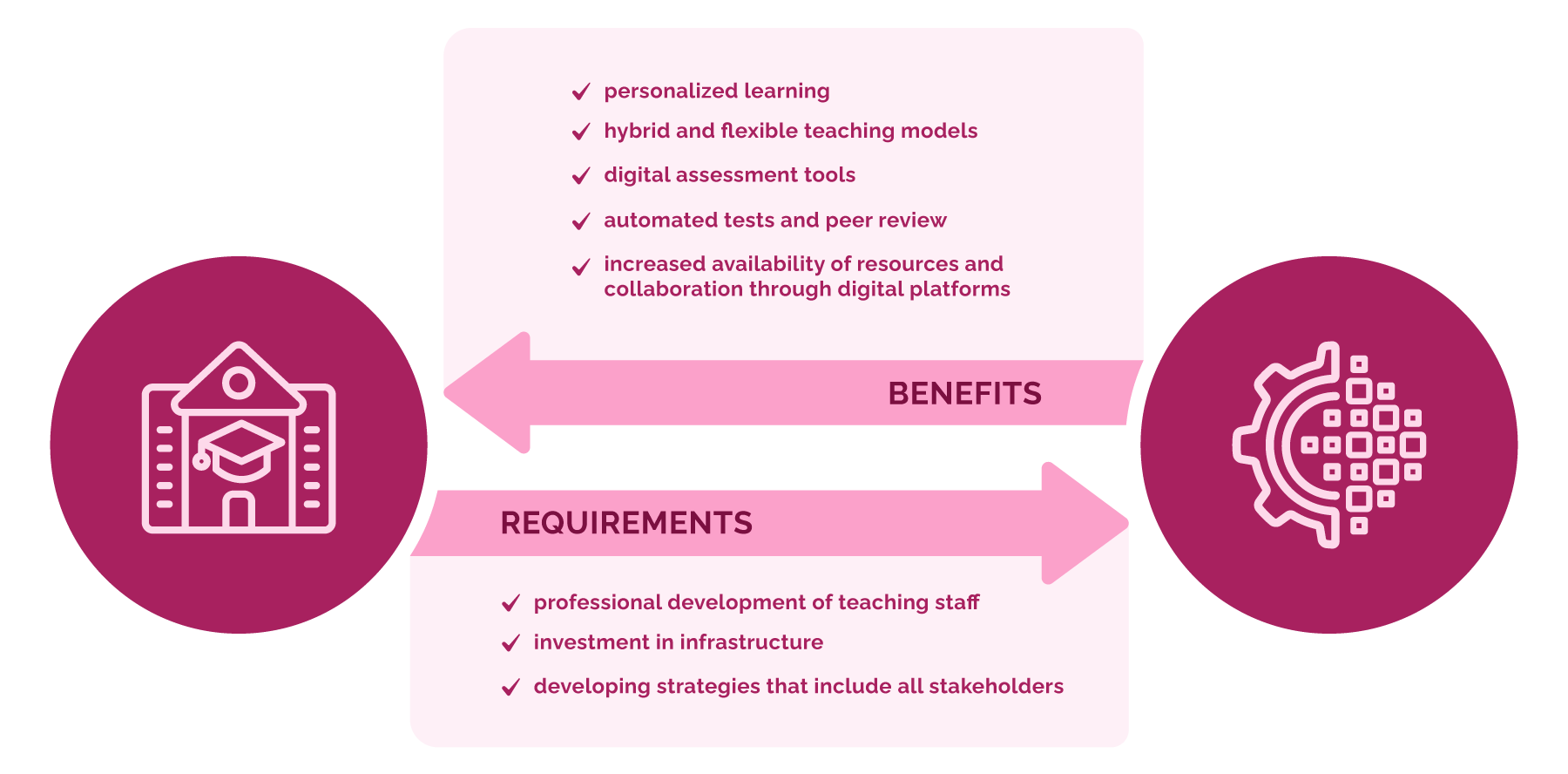
Figure: Digital transformation requirements for higher education institutions and the benefits it brings to the institution
6. Stakeholder roles in the digital transformation of higher education institutions
Digital transformation in higher education involves a wide range of stakeholders, from individuals to organizational units. Their roles and interests may vary, and they participate in, influence, or are affected by digital changes within the education system. Digital transformation in higher education is not merely a technical project – it is a complex socio-technological process that requires the active collaboration of all stakeholders. The main stakeholders [15] are described below.
7. Digital culture and infrastructure
Digital culture is a set of values, beliefs, and behaviors that promote digital thinking, innovation, and collaboration [16].
Building a digital culture requires leadership, support, and openness to experimentation. Successful institutions encourage interdisciplinarity, knowledge sharing, and open communication.
On the other hand, digital infrastructure encompasses all technical resources needed to support digital education – including server systems, software platforms, classroom equipment, and internet access [17].
Digital culture and infrastructure are two fundamental pillars upon which sustainable and effective digital transformation in higher education is built. While infrastructure enables “what can be done,” digital culture determines “how and why it is done.” Without a developed culture, infrastructure remains an underused potential; without infrastructure, culture remains a good intention without implementation.
8. Conclusion
Digital transformation is not just a trend or a passing innovation, but a long-term process of adaptation and innovation. In the context of higher education, it is an opportunity to empower educational institutions, enhance the quality of teaching, and increase access to knowledge. The key to success lies in a holistic approach that integrates people, processes, and technologies, with continuous learning and adaptation. Transformation must be rooted in strategy, guided by best practices, and supported by a strong digital culture.
9. References
[1] M. Westerman, D. Bonnet, and A. McAfee, "Leading Digital: Turning Technology into Business Transformation", Harvard Business Review Press, 2014. [Accessed: Jun. 16, 2026]
[2] European Commission, "COMMUNICATION TO THE COMMISSION European Commission digital strategy Next generation digital Commission", 2020. [Accessed: Aug. 1, 2025]
[3] OECD, "Measuring the Digital Transformation: A Roadmap for the Future", OECD Publishing, 2021. [Accessed: Aug. 1, 2025]
[4] European Commission, Joint Research Centre (JRC). (2016). European Framework for Digitally Competent Educational Organisations (DigCompOrg). [Accessed: Aug. 1, 2025]
[5] SID Global Solutions, "Three Waves of Digital Transformation – What You Need to Know to Stay Ahead," SIDGS. [Accessed: Aug. 1, 2025]
[6] TWJOIN, "Three Stages of Digital Transformation: The Blueprint and Practical Guide," TWJOIN. [Accessed: Aug. 1, 2025]
[7] Kortext, "StREAM at Leeds – Case study 1," University of Leeds, 2024. [Accessed: Aug. 1, 2025]
[8] H. A. Alamri, S. Watson, and W. Watson, "Learning Technology Models that Support Personalization within Blended Learning Environments in Higher Education," TechTrends, vol. 64, pp. 803–815, 2020. [Accessed: Aug. 1, 2025]
[9] J. Andersson and R. Johansson, "Hybrid work models: Digital tool usage in a hybrid higher education environment," Master’s thesis, Dept. of Informatics, Linnaeus University, 2022. [Accessed: Aug. 1, 2025]
[10] A. Williams, "Integrating artificial intelligence into higher education assessment," Intersection: A Journal at the Intersection of Assessment and Learning, vol. 6, no. 1, 2025. [Accessed: Aug. 1, 2025]
[11] M. Kovacheva, "Navigating Digital Transformation: A Framework for Identifying and Managing Learning in Higher Education," International Journal of Information Technologies and Education, vol. 4, no. 1, pp. 1–15, 2024. [Accessed: Aug. 1, 2025]
[12] S. M. S. Haque, S. Shaha, and S. Sharmin, "Future-Proofing the Workforce: Training and Development in the Digital Age," European Journal of Human Resource Management Studies, vol. 7, no. 2, pp. 54–73, 2024. [Accessed: Aug. 1, 2025]
[13] IEEE, "Infrastructure 2021: How Infrastructure and Technology Will Move Us Forward," IEEE Transmitter, 2021. [Accessed: Aug. 1, 2025]
[14] Y. Wang, "Research on the Implementation Path of Digital Transformation Planning in the Background of Digital Economy," in Proc. 2023 International Conference on E-Business and Internet (ICEBI), pp. 1–6, 2024. [Accessed: Aug. 1, 2025]
[15] S. M. S. Haque, S. Shaha, and S. Sharmin, "Enhancing Digital Transformation Success in Education through Stakeholder Engagement," Walden Dissertations and Doctoral Studies, 2024. [Accessed: Aug. 1, 2025]
[16] S. Kocak and J. Pawlowski, "Characteristics in Digital Organizational Culture: A Literature Review," in Proceedings of the 14th International Conference on Computer Supported Education (CSEDU 2022), pp. 213–220, 2022. [Accessed: Aug. 1, 2025]
[17] S. Wang and F. Wen, "Construction of Digital Education Infrastructure: Demands, Technologies and Plans," in Proceedings of the International Conference on New Media Development and Modernized Education (NMDME 2022), pp. 516–523, 2022. [Accessed: Aug. 1, 2025]
Background Colour
Font Face
Font Size
Text Colour
Font Kerning
Image Visibility
Letter Spacing
Line Height
Link Highlight
Paragraph Width
Text Alignment