Strategic Planning in Higher Education
| Site: | Loomen za stručna usavršavanja |
| Course: | Strategic Planning for Digital Technology Implementation |
| Book: | Strategic Planning in Higher Education |
| Printed by: | Gost (anonimni korisnik) |
| Date: | Thursday, 17 September 2026, 9:36 AM |
Table of contents
- 1. Introduction
- 2. What is strategic planning?
- 3. Key characteristics of strategic planning
- 4. The goal of strategic planning
- 5. Why is strategic planning important in the context of digital transformation?
- 6. Strategy components: mission, vision, goals, values
- 7. The flow and stages in the process of strategic planning
- 8. Forming strategy development teams
- 9. The plan for strategic planning
- 10. Statistics on the success of strategic planning
- 11. Conclusion
- 12. References
1. Introduction
In a rapidly changing world, higher education faces challenges brought by digital transformation, demographic changes, increasing labor market demands, and internationalization. The Croatian context is further complicated by the emigration of highly educated young people, low investment in science, and the fragmentation of the higher education system.
This is precisely why strategic planning becomes a key tool for all higher education institutions that wish to survive and grow in such an environment.
This learning unit provides broad insight into the processes of strategic planning in higher education. Through theoretical grounding and practical examples, participants will gain an understanding of key concepts, methodologies, and best practices in strategic planning.
In this lesson, participants will:
- i. explain the concept and importance of strategic planning in higher education through theoretical and practical aspects (2/understanding);
- ii. analyze key components of a strategic plan, including mission, vision, goals, and values (4/analyzing);
- iii. apply theoretical models to concrete cases from domestic and international practice (3/applying);
- iv. differentiate between the phases of the strategic planning process (2/understanding);
- v. critically evaluate the role of digital transformation in the strategic planning of higher education institutions (6/evaluating);
2. What is strategic planning?
Strategic planning is a systematic process through which organizations define their goals, mission, and vision, and develop plans and activities to achieve them within a specific time period.
It is a fundamental tool that enables higher education institutions to align internal resources and capacities with external opportunities and threats, and to define the direction they wish to pursue.
According to Bryson, strategic planning represents “a process of reflecting on the current situation, identifying a desired future, and defining the course of action through goals and initiatives” [1].
In the context of higher education, this means:
- setting clear development priorities;
- aligning teaching and research activities with societal needs;
- introducing innovations based on data analysis and stakeholder participation.
Example: The University of Rijeka defined 20 strategic goals in four key areas (including digital transformation, internationalization, and engagement with the local community) as part of its 2021–2025 strategy [12].
3. Key characteristics of strategic planning
Strategic planning in higher education is based on several key features that ensure its effectiveness and sustainability. According to Bryson and Hill, a high-quality strategic plan must be long-term, data-driven, inclusive, and results-oriented [1, 2].
4. The goal of strategic planning
The goal of strategic planning is to guide the organization toward long-term development, increase its resilience to environmental changes, and ensure that resources and activities are aligned with its mission and vision [13].
In higher education, this means:
- ensuring academic excellence and the relevance of study programs;
- improving the management of human and financial resources;
- enabling transparent, data-driven decision-making;
- the general aim of strategic planning is not only to define direction but also to ensure operational implementation through continuous performance monitoring.
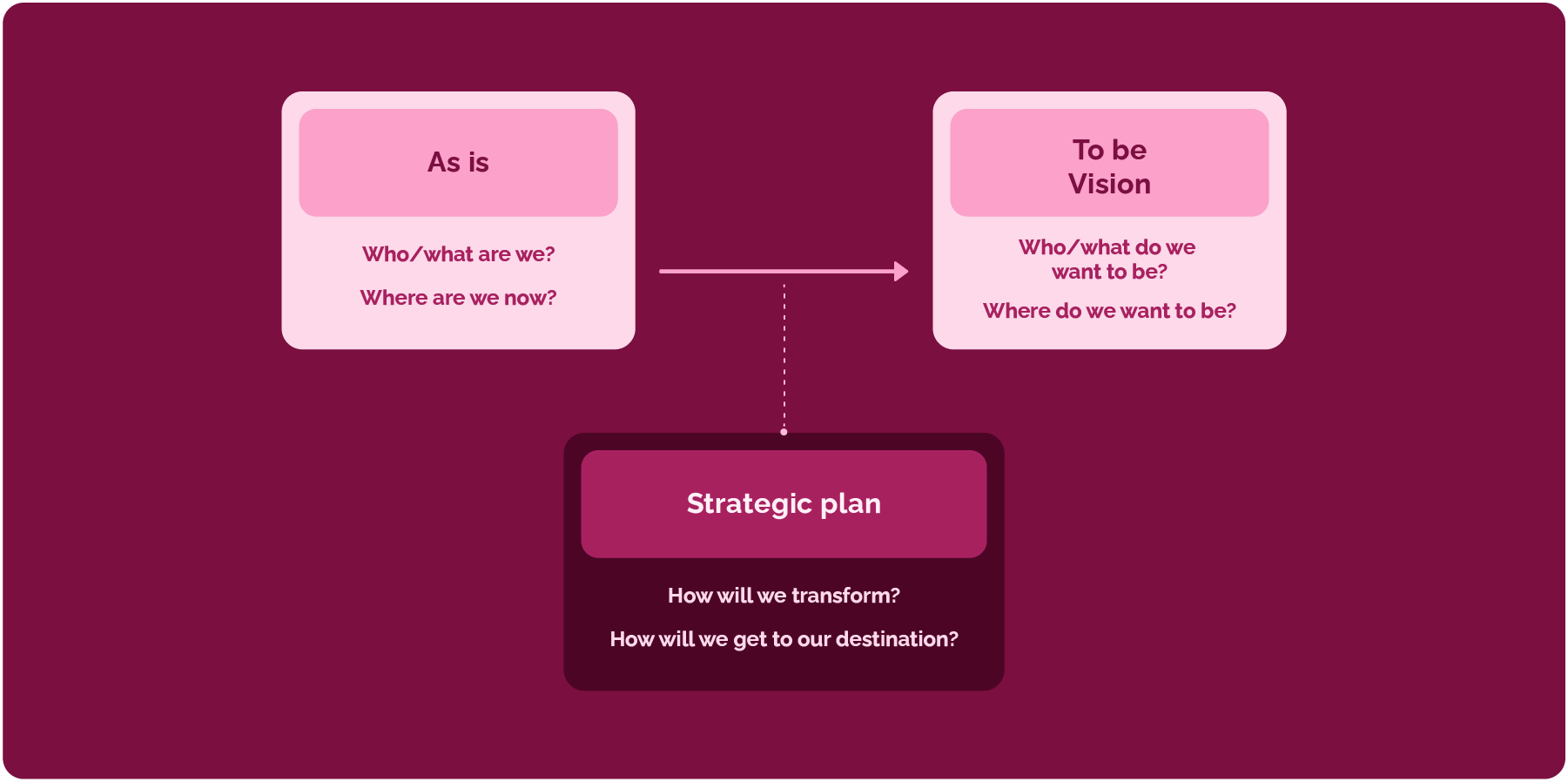
Figure: The idea of strategic planning
5. Why is strategic planning important in the context of digital transformation?
Strategic planning enables higher education institutions to systematically address digital challenges. It provides a framework for:
- planning digital infrastructure and staff training;
- securing resources for hybrid and online teaching models;
- integrating new technologies such as artificial intelligence into research and teaching processes.
According to the European University Association (EUA) report, institutions that included a digital component in their strategic planning achieved better adaptation to online environments during the pandemic [14].
Example: The University of Zadar integrated digital transformation across all levels of its strategic document, emphasizing the importance of open educational resources and digital tools in teaching [22].
Example: The City University of New York (CUNY) offers high-quality and affordable online education and by 2030 aims to increase the number of fully online certification and degree programs by 100% [15].
6. Strategy components: mission, vision, goals, values
The components of a strategy represent the fundamental pillars of every strategic plan. A clearly defined mission, inspiring vision, specific goals, and core values ensure the alignment of all stakeholders and give the organization its identity and direction.
Mission defines the purpose and core function of the institution – why it exists.
Example:
Mission of the University of Split: “To make education accessible to all, based on innovative teaching methods and guided by scientific excellence that inspires societal change.” [16]
Example:
Mission of the Massachusetts Institute of Technology (MIT): “The mission of MIT is to advance knowledge and educate students in science, technology, and other areas of scholarship that will best serve the nation and the world in the 21st century.” [17]
Vision represents an ambitious yet realistic picture of the desired future state.
Example:
Vision of the University of Split: “A European university recognized for the exceptional quality and impact of our graduates, research, innovation, and social contribution to solving the challenges of the future.” [16]
Example:
MIT does not formally state a separate vision, but its official presentation highlights: “MIT strives to be the world leader in research, innovation, and education in science, technology, and engineering.” [18]
Core values express the principles and beliefs that guide the institution’s behavior and decision-making.
Example:
The University of Split lists the following core values: inclusiveness, inspiration, innovation, collaboration, and talent [16].
Example:
MIT’s core values are: excellence and curiosity, openness and respect, belonging and community [17].
Strategic goals represent a more operational elaboration of the vision.
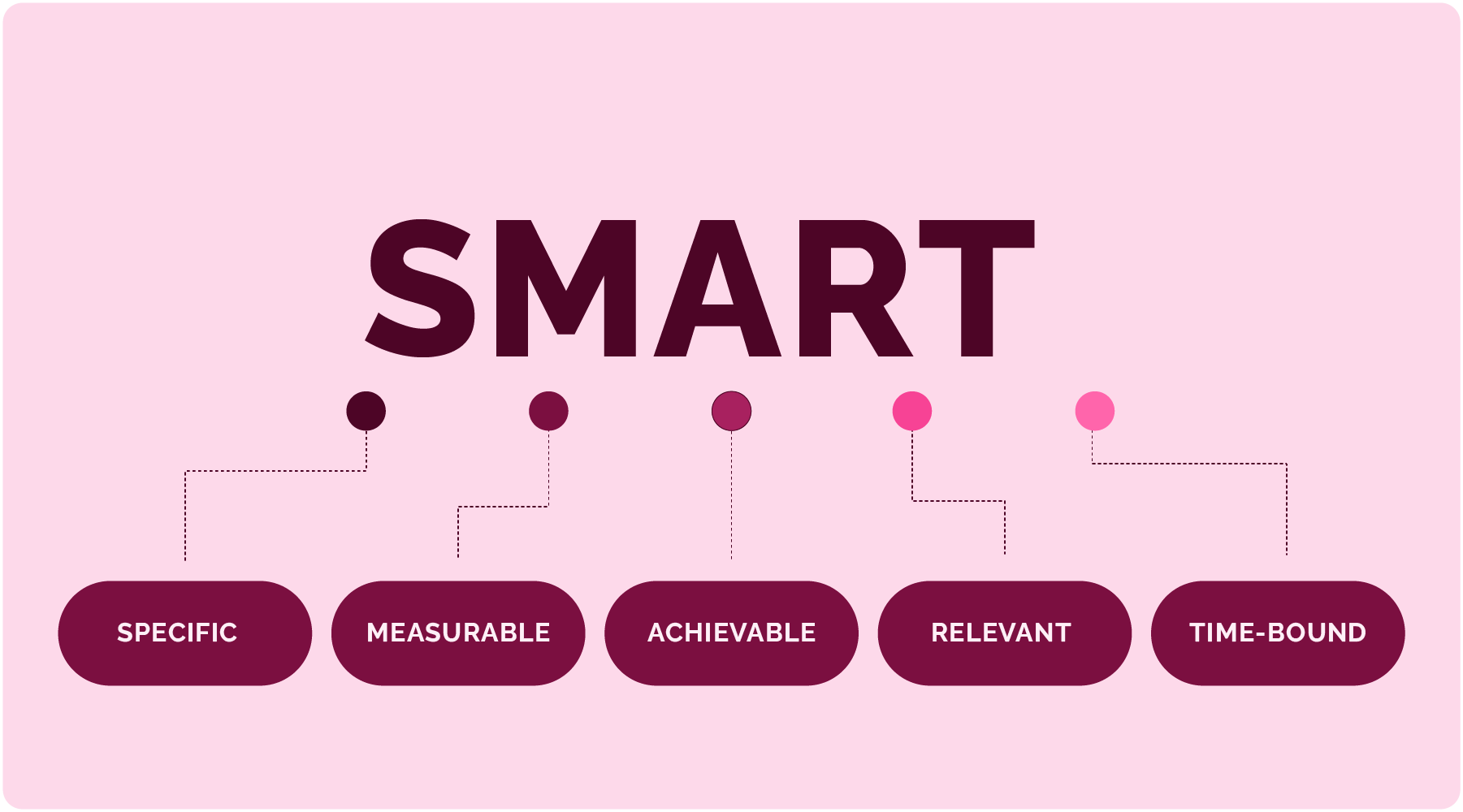
Goals must be formulated according to the SMART criteria [7]:
- Specific: clearly describe what is to be achieved, without ambiguity.
- Measurable: contain quantitative or qualitative success indicators.
- Achievable: realistically attainable given available resources and conditions.
- Relevant: aligned with the mission and strategic priorities of the institution.
- Time-bound: have a clearly defined deadline for completion.
Example: “Increase the number of scientific papers published in Q1 journals by 25% by the end of 2026.”
-
- Specific: the goal refers to publishing in Q1 journals.
- Measurable: “25 %” increase is clearly stated.
- Achievable: ambitious but realistic target.
- Relevant: research output is key to the university’s mission.
- Time-bound: deadline clearly defined – by the end of 2026.
Additional examples of SMART goals:
- “Introduce digital certificates for all first-year courses by July 2025.”
- “Increase the number of students in international exchange programs by 15 % over the next two academic years.”
- “Develop and implement three new interdisciplinary study programs by the end of 2026.”
- “Increase the number of full-time undergraduate students to 4000 by 2025.” [19]
Examples that are not SMART:
- “Improve the quality and relevance of education.” [16] → not measurable or time-bound.
- “Become a better university.” → not specific, measurable, or operationally relevant.
- “Enhance education and the student experience.” [17] → vague, lacking a time frame and concrete metrics.
Vision, mission, core values, and strategic goals form the central part of strategic planning. In some cases, after identifying the mission and vision, strategic areas can be defined, within which strategic goals are then developed. This step is not mandatory and is not always applied. These elements together form the continuum of strategic management (see Figure).
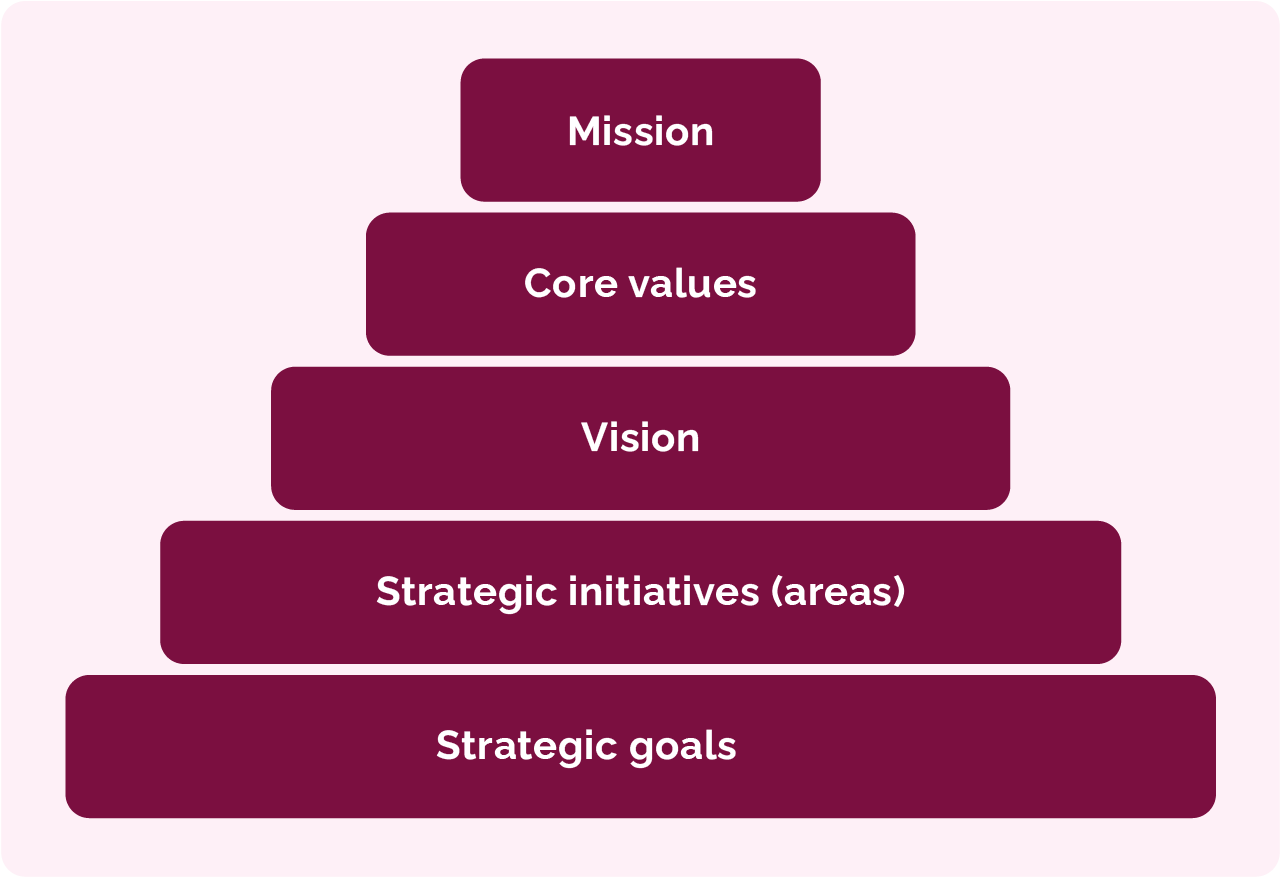
Figure: Continuum of Strategic Management
6.1. Assignment
7. The flow and stages in the process of strategic planning
The sequential flow of strategic planning consists of activities that create the core components of a strategy. In the classical model, the strategic planning process goes through several key phases that are both methodologically and substantively interconnected.
Activities in the sequential flow of strategic planning:
- Analysis of the current state – Through SWOT (Strengths, Weaknesses, Opportunities, Threats) and PESTLE (Political, Economic, Social, Technological, Legal, Environmental) analyses, higher education institutions identify internal strengths and weaknesses, and external opportunities and threats.
Example: The Faculty of Organization and Informatics at the University of Zagreb used SWOT analysis. [10]
Example: The Universities of Rijeka and Zadar conducted environmental analyses [12, 22], which, although not explicitly stated, essentially implemented a PESTLE approach. - Defining the desired future state – In this phase, the institution’s vision, mission, and core values are formulated. Common methods include strategic workshops, storytelling, focus groups, and the Delphi technique.
Example: The University of Split engaged staff and students in formulating its mission and values through a series of strategic workshops and focus groups. [16]
- Formulation of strategic goals – This phase defines exactly what is to be achieved. Goals are designed following the SMART principles, and methods such as group decision-making, dialogue-based techniques, and scenario analysis are often applied.
Example: The Faculty of Electrical Engineering and Computing of the University of Zagreb defined five key areas, each with one strategic goal and several specific objectives. [28]
- Operationalization of goals – The strategy is translated into specific action plans, timelines, and responsibilities. Creativity techniques and logical framework methods can help connect goals with realistic capabilities.
Example: University North uses task matrices and Gantt charts to support implementation. [35]
- Monitoring and evaluation – Key performance indicators (KPIs) are defined, reporting and evaluation methods are established, and mechanisms for adjusting the strategy are introduced.
Example: The University of Ljubljana publishes annual reports on strategic progress. [5]
For developing measurement tools and monitoring systems, the following are often used [36]:
- Balanced Scorecard;
- Total Quality Management (TQM);
- European Quality Assurance Framework (EQAR, ESG standards).
In a broader sense, strategic planning also includes the implementation of the strategy and continuous monitoring of its realization, followed by a final analysis of the cycle. The final analysis determines the extent to which the strategic goals and vision have been achieved, and often serves as the starting point for a new planning cycle.
By explaining the sequential flow of strategic planning, we have also described its phases. In most cases, the phases of strategic planning and the strategic planning cycle occur sequentially, where the output of one phase becomes the input for the next. It is also worth noting that mission and core values are often permanent elements of strategic planning—they do not change in every cycle.
The mission may change when the organization significantly alters its activities, experiences a major environmental shift (e.g., merger with another organization), or when there is a discrepancy between the mission and actual practice. Core values change even less frequently; in most cases, they are refined or expanded—for example, to reflect new priorities (such as sustainability, inclusiveness, or innovation) or when the organization undergoes digital transformation or internationalization processes.
The continuous process of strategic planning is shown in the figure below.
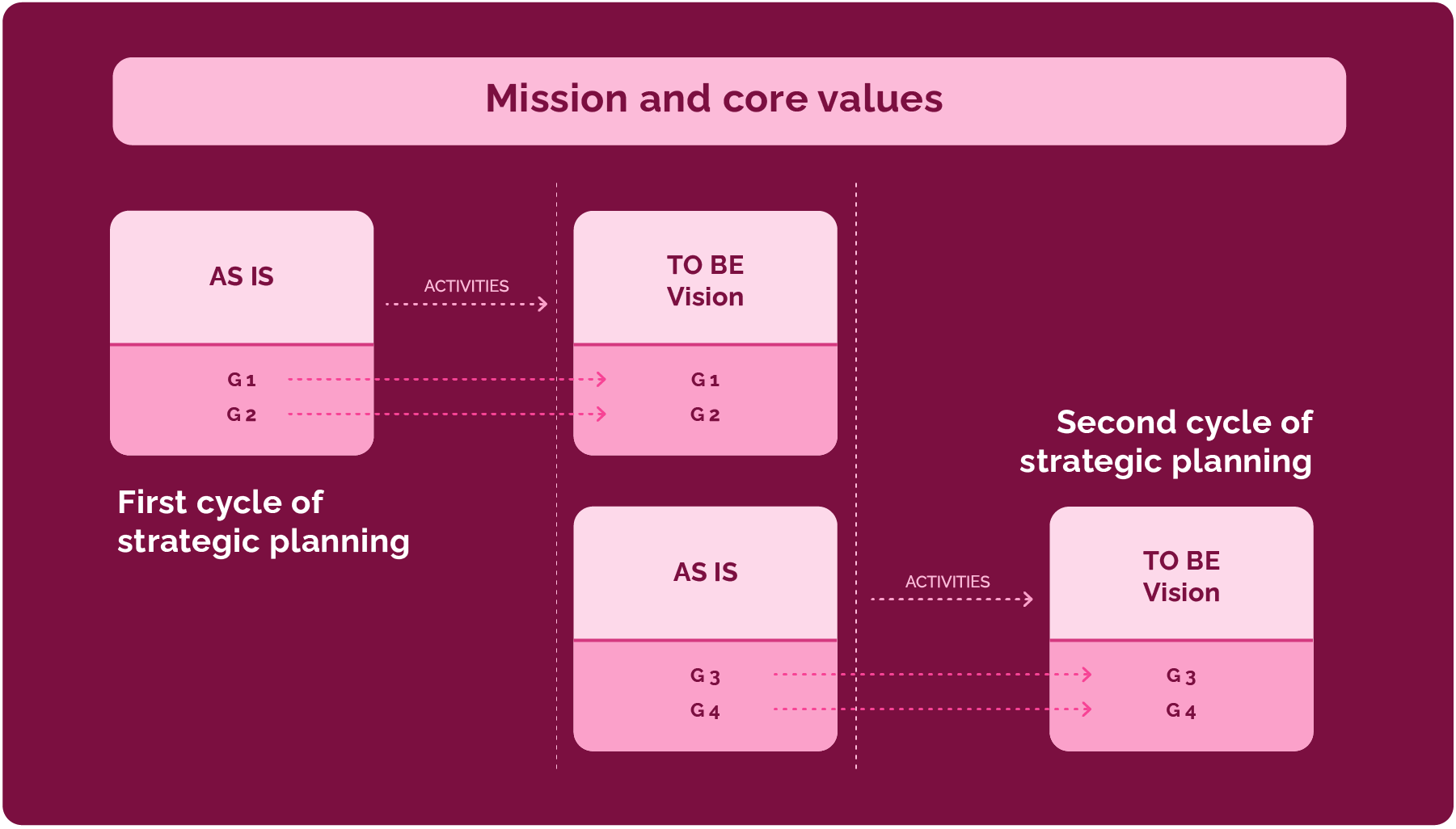
Figure: Strategic Planning Process
7.1. Assignment
8. Forming strategy development teams
The optimal strategic team typically consists of between 10 and 12 members, as according to professional guidelines, this is considered the ideal size for effective decision-making and ensuring diversity of perspectives [20]. Some sources mention 7 as the optimal number, others 9–15, some 10–15, and some 7–12 or 7±2.
It is important to include stakeholders from the academic, administrative, and student communities, as well as external experts if needed. This approach enhances the benefits of teamwork — a wider range of expertise, greater legitimacy of the developed strategic plan (which leads to easier acceptance and stronger motivation during implementation), and a higher level of creativity that can result in more innovative solutions.
Recommended competencies for strategic planning in higher education:
The role of the team leader is crucial. Selecting a person with experience, expertise, and strong communication and organizational skills is one of the key principles for building an effective team. Principles for forming strategic planning teams [1, 37–38]:
Example:
The strategic team at the University of Jyväskylä (Finland) includes members of the university management, faculty representatives, the student parliament, and external stakeholders. The university’s 2030 strategy is publicly available and includes a clear stakeholder engagement plan. [39]
9. The plan for strategic planning
The process of strategic planning itself also needs to be planned. The strategic planning plan represents an organizational document that outlines the activities, timelines, and responsibilities within the strategic planning process. Such a document serves as a framework for managing the planning process, a tool for managing time and resources, a means of engaging stakeholders, and a document that ensures transparency and accountability.
The strategic planning plan is a meta-document that defines how the strategic planning process itself will be carried out. Its purpose is to ensure coordination, time monitoring, and clear responsibilities for everyone involved. If we neglect to plan the process itself, we risk that the entire strategic document will remain unimplemented, unknown, or unrealistic.
Key components of the plan include [40]:
Example: TU Delft published documents for its 2024–2030 Strategy in which all components of the strategic planning plan were clearly described: objectives, implementation phases, methodology, team responsibilities, and monitoring methods. The strategy includes six strategic priorities, responsibility mapping, a structured implementation calendar through 2030, and a dedicated Implementation Plan in PDF format that is regularly updated. [34]
10. Statistics on the success of strategic planning
Although strategic planning is perceived as the foundation of organizational success, data show that implementation often lags behind planning, as shown below.
- Up to 90 % of strategic plans fail due to poor implementation rather than poor planning [26, 31].
- Similarly, Excitant Consulting reports that 9 out of 10 strategies fail because of a lack of operational control and unclear objectives [30].
- According to a study by In-Parallel Consulting, 95 % of employees do not understand their organization’s strategy [29]. Excitant Consulting places that figure at 90 %.
- Excitant Consulting also notes that the lack of alignment between strategy and operational plans is one of the main causes of failure [30].
- Forbes reports that only 48 % of leaders dedicate at least one day per month to strategic issues [25, 27], even though over 90 % of them believe it is essential [25]. On the other hand, In Parallel Consulting states that 85 % of leaders spend less than one hour per month on strategy [29].
- 61 % of employees in executive roles admit that they struggle to bridge the gap between strategy and execution [29], consuming up to 60 % of available resources.
- Meisterplan shows that organizations that align their resources with strategy are five times more likely to succeed in implementation [32].
- Reliable Plant warns that 68 % of companies do not use project prioritization for strategic alignment, significantly reducing effectiveness [33].
- 48 % of organizations fail to achieve even half of their strategic objectives [27].
- A study conducted in higher education institutions in Libya found that strategic planning explains 53 % of the variance in the quality of educational services. In other words, when strategic planning improves, the quality of educational services increases by more than half of the total improvement [23].
- In an analysis of eight public universities in the United States, only two had a formal system for annual evaluation and revision of strategic goals. Most institutions use the strategic plan more as a formal accreditation document than as a tool for continuous improvement [41].
Although no statistics are currently available for the Croatian context, these figures highlight the importance not only of quality planning but also of effective implementation, evaluation, and communication.
11. Conclusion
Strategic planning in higher education is far more than a technical document – it is a process of shaping the institution’s future.
In an era of digital transformation, increasing social complexity, and the growing need for public accountability, it is essential to develop strategies that are realistic, inclusive, and actionable.
Higher education institutions that invest in strategic thinking build the foundations for sustainable excellence, greater employability of their students, and stronger integration with society. However, the key to success lies not only in creating a strategy – but also in its implementation, continuous evaluation, and adaptation to changing circumstances.
12. References
[1] J. M. Bryson, B. George, Strategic Planning for Public and Nonprofit Organizations: A Guide to Strengthening and Sustaining Organizational Achievement, 6th Edition, Wiley ISBN: 978-1-394-27402-4. [Accessed: Aug. 1, 2025]
[2] Delprino, R. P., "The Human Side of the Strategic Planning Process in Higher Education," Butler Bookcase. 5., 2013. [Accessed: Jun. 16, 2026]
[3] University of Zagreb, Strateški dokumenti. [Accessed: Aug. 1, 2025]
[4] Utrecht University, "Roadmap Learning Analytics projects: Vision and policy for learning analytics at Utrecht University," 2023. [Accessed: Aug. 1, 2025]
[5] University of Ljubljana, "University of Ljubljana Strategy 2022−2027," May 2022. [Accessed: Aug. 1, 2025]
[6] Harvard University, "Notable moments from Harvard's 2020-21 academic year," Harvard Gazette, May 2021. [Accessed: Aug. 1, 2025]
[7] G. T. Doran, "There’s a S.M.A.R.T. Way to Write Management’s Goals and Objectives," Management Review, vol. 70, no. 11, pp. 35–36, 1981. [Accessed: Aug. 1, 2025]
[8] University of Oxford, "Performance Indicators," Governance and Planning, 2025. [Accessed: Aug. 1, 2025]
[9] R. J. Bennett, "Strategic development and SWOT analysis at the University of Warwick," European Journal of Operational Research, vol. 152, no. 3, pp. 631–640, 2004. [Accessed: Aug. 1, 2025]
[10] University of Zagreb, Faculty of Organization and Informatics, "Strategija razvoja Sveučilišta u Zagrebu Fakulteta organizacije i informatike za razdoblje od 2025. do 2029. godine," 2024. [Accessed: Aug. 1, 2025]
[11] University of Graz, "Development Plan 2022–2027," 2021. [Accessed: Aug. 1, 2025]
[12] University of Rijeka, "Strategija Sveučilišta u Rijeci 2021.–2025.," Rijeka, 2021. [Accessed: Aug. 1, 2025]
[13] Mintzberg, H., Ahlstrand, B., & Lampel, J., "Strategy Safari: A Guided Tour Through The Wilds of Strategic Management," 2nd ed., New York: Free Press, 2009. [Accessed: Aug. 1, 2025]
[14] European University Association, "The impact of Covid-19 on European higher education," 2022. [Accessed: Aug. 1, 2025]
[15] City University of New York, “CUNY Online – Flexible, Affordable, and Accessible Education,” 2023. [Accessed: Aug. 1, 2025]
[16] University of Split, "Strategija razvoja Sveučilišta u Splitu do 2030. godine" 2025. [Accessed: Aug. 1, 2025]
[17] Massachusetts Institute of Technology, “MIT Mission and Values”, 2024. [Accessed: Aug. 1, 2025]
[18] Canvas Business Model, “Massachusetts Institute of Technology Mission”, 2023. [Accessed: May. 22, 2025]
[19] Illinois Institute of Technology, “SMART Goals (2020–2025),” Strategic Plan, 2020. [Accessed: Aug. 1, 2025]
[20] Renfro, J.L., "Strategic Planning for University Colleges and Departments: A Step-by-Step Guide to Developing, Refining, and Implementing Effective Strategy," 2024. DOI:10.4324/9781003497400
[21] R. S. Kaplan and D. P. Norton, "The Balanced Scorecard: Translating Strategy into Action," Harvard Business School Press, 1996.
[22] University of Zadar, "Strategija razvoja Sveučilišta u Zadru 2023.–2030.," Zadar, 2023. [Accessed: Aug. 1, 2025]
[23] A. S. A. Taroum, "The Effect of Strategic Planning on Service Quality in the Higher Education Context in Libya," European Journal of Development Studies, vol. 4, no. 2, 2024. [Accessed: Aug. 1, 2025]
[24] European Commission, HEInnovate Initiative, "Leadership and Governance," 2021. [Accessed: Aug. 1, 2025]
[25] Forbes, P. Cecchi-Dimeglio, "3 Ways Leaders Drive Success Through Strategic Planning," Dec. 2023. [Accessed: Aug. 1, 2025]
[26] Gibson, K. (2023, 21. prosinca). "5 Reasons Strategy Execution Fails" Harvard Bussiness School. [Datum pristupanja: 3. travnja 2026.]
[27] Harvard Business School Online, "Why Is Strategic Planning Important?," 2023. [Accessed: Aug. 1, 2025]
[28] Fakultet elektrotehnike i računarstva, "Strategija digitalne transformacije FER-a“, Sveučilište u Zagrebu, 2021. [Accessed: Aug. 1, 2025]
[29] In-Parallel Consulting, "The Hidden Cost of Strategy Failure," 2023. [Accessed: Aug. 1, 2025]
[30] Excitant Ltd., "Do 9 Out of 10 Strategies Really Fail?," 2023. [Accessed: Aug. 1, 2025]
[31] M. Pedersen, "Why 60–90% of Strategies Fail and How to Execute with Precision," Business Development Podcast, 2023. [Accessed: Aug. 1, 2025]
[32] Meisterplan, "Dynamically Allocate Your Resources to What Matters Most – Now," 2025. [Accessed: Aug. 1, 2025]
[33] Reliable Plant, "Properly aligning projects to corporate strategy," 2005. [Accessed: Aug. 1, 2025]
[34] TU Delft, "TU Delft Strategic Agenda 2024–2030", Delft University of Technology, 2024. [Accessed: Aug. 1, 2025]
[35] Sjever University, "Strategija Sveučilišta Sjever za razdoblje od 2023. do 2028.," 2023. [Accessed: Aug. 1, 2025]
[36] N. W. Reda, "Balanced scorecard in higher education institutions", Higher Education, vol. 25, no. 4, pp. 489–505, 2017. [Accessed: Aug. 1, 2025]
[37] R. L. Katz, "Skills of an Effective Administrator," Harvard Business Review, 1974.
[38] S. M. S. Haque, S. Shaha, and S. Sharmin, "Enhancing Digital Transformation Success in Education through Stakeholder Engagement," Walden Dissertations and Doctoral Studies, 2024.
[39] University of Jyväskylä, "Strategy of the University of Jyväskylä 2019–2030: Wisdom and Wellbeing for Us All," 2019. [Accessed: Aug. 1, 2025]
[40] Government of British Columbia, "Developing a Strategic Plan," 2022. [Accessed: Aug. 1, 2025]
[41] G. Gordon and M. Fischer, "Strategic Planning in Public Higher Education: Management Tool or Publicity Platform?," Educational Planning, vol. 22, no. 3, pp. 5–17, 2015. [Accessed: Aug. 1, 2025]
Background Colour
Font Face
Font Size
Text Colour
Font Kerning
Image Visibility
Letter Spacing
Line Height
Link Highlight
Paragraph Width
Text Alignment