Methodology for Developing a Strategy for Implementing Digital Technologies
| Site: | Loomen za stručna usavršavanja |
| Course: | Strategic Planning for Digital Technology Implementation |
| Book: | Methodology for Developing a Strategy for Implementing Digital Technologies |
| Printed by: | Gost (anonimni korisnik) |
| Date: | Thursday, 17 September 2026, 5:14 AM |
Table of contents
- 1. Introduction
- 2. Continuum of strategic planning
- 3. Methodology for defining strategy elements
- 4. Methods and techniques for situation analysis, strategy formulation and implementation
- 5. Characteristics of the mission and its formulation
- 6. Characteristics of vision and its formulation
- 7. Definition of core values
- 8. Defining strategic initiatives and strategic goals
- 9. Conclusion
- 10. References
1. Introduction
In light of the rapid digital transformation of higher education, the aim of this learning material is to provide a comprehensive, narrative-style guide to the methodology for developing a digital technology implementation strategy within higher education institutions. Through a storytelling approach, participants will become familiar with the key concepts, steps, and tools required for the analysis, formulation, implementation, and evaluation of a digital strategy. The learning outcomes are as follows:
- i. describe the concept of the continuum of strategic planning and strategic management in the context of digital transformation (2/understanding);
- ii. analyze and critically evaluate the strategic elements of various higher education institutions (mission, vision, values, and strategic goals) in accordance with recommendations for their clarity, relevance, and focus on digital transformation (6/evaluation);
- iii. apply basic methods and techniques for situational analysis and strategy formulation, and create a strategy (7/creation).
To begin, let us recall the concept of strategic planning as illustrated in the figure below. The goal of strategic planning is to direct an organization toward long-term development, enhance its resilience to environmental changes, and ensure the alignment of resources and activities with its mission and vision.
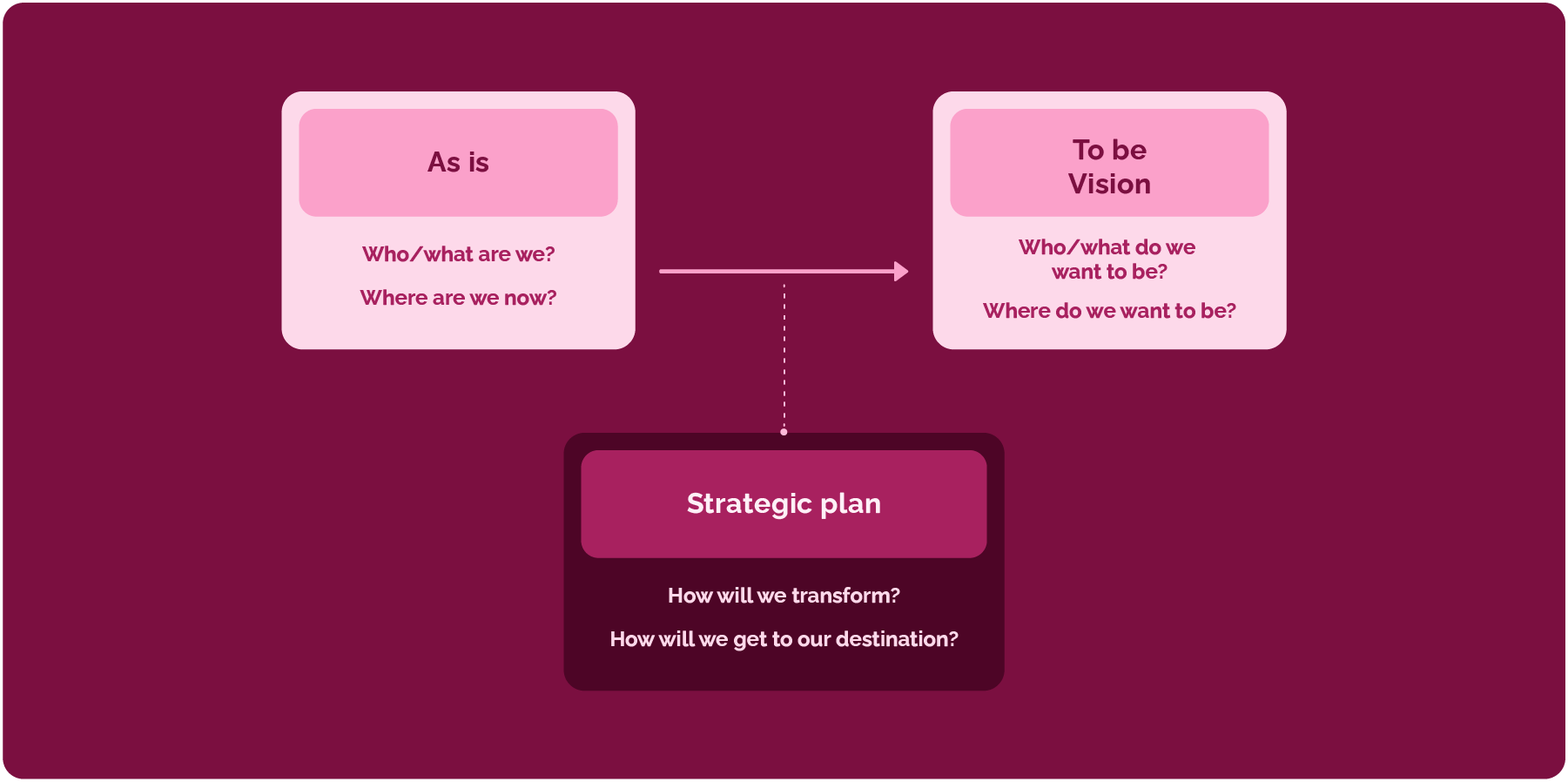
Figure: The concept of strategic planning
2. Continuum of strategic planning
Imagine a process in which a higher education institution continuously learns, adapts, and evolves—like navigating through unknown waters while constantly adjusting its course. This process represents the continuum of strategic planning, where analysis, formulation, implementation, and evaluation form an inseparable cycle. The key steps of the continuum are:
- Analysis of the current situation: Assessing the institution’s digital maturity using frameworks such as DigCompOrg [1], SWOT and PESTLE analyses [2], benchmarking, and user needs research.
- Defining strategic frameworks: Formulating the mission, core values, and vision that guide the entire process.
- Setting strategic initiatives: Identifying key investment areas and priorities based on a gap analysis between the current situation and the desired state.
- Defining strategic goals: Developing specific and measurable objectives following the SMART approach [3] within each initiative.
- Developing an action plan: Operationalizing strategic goals into specific activities, resources, and timelines.
- Implementation of the strategy: Executing planned activities with the engagement of relevant stakeholders and the support of institutional leadership.
- Monitoring and evaluation: Continuously collecting progress data, tracking indicators, and reporting on results every few months.
- Revision and adaptation: Based on evaluation findings and changes in the environment, updating the strategy to maintain its effectiveness.
This cycle repeats throughout the entire duration of the strategy, ensuring a living and adaptable document that responds to changes in the digital environment and the internal needs of the organization.
The vision, mission, core values, and strategic goals represent the central elements of strategic planning. In some cases, it is possible—after identifying the mission and vision— to define strategic areas and then formulate goals within each area. This step is not mandatory and is not always applied. These elements form the continuum of strategic management (see figure below).
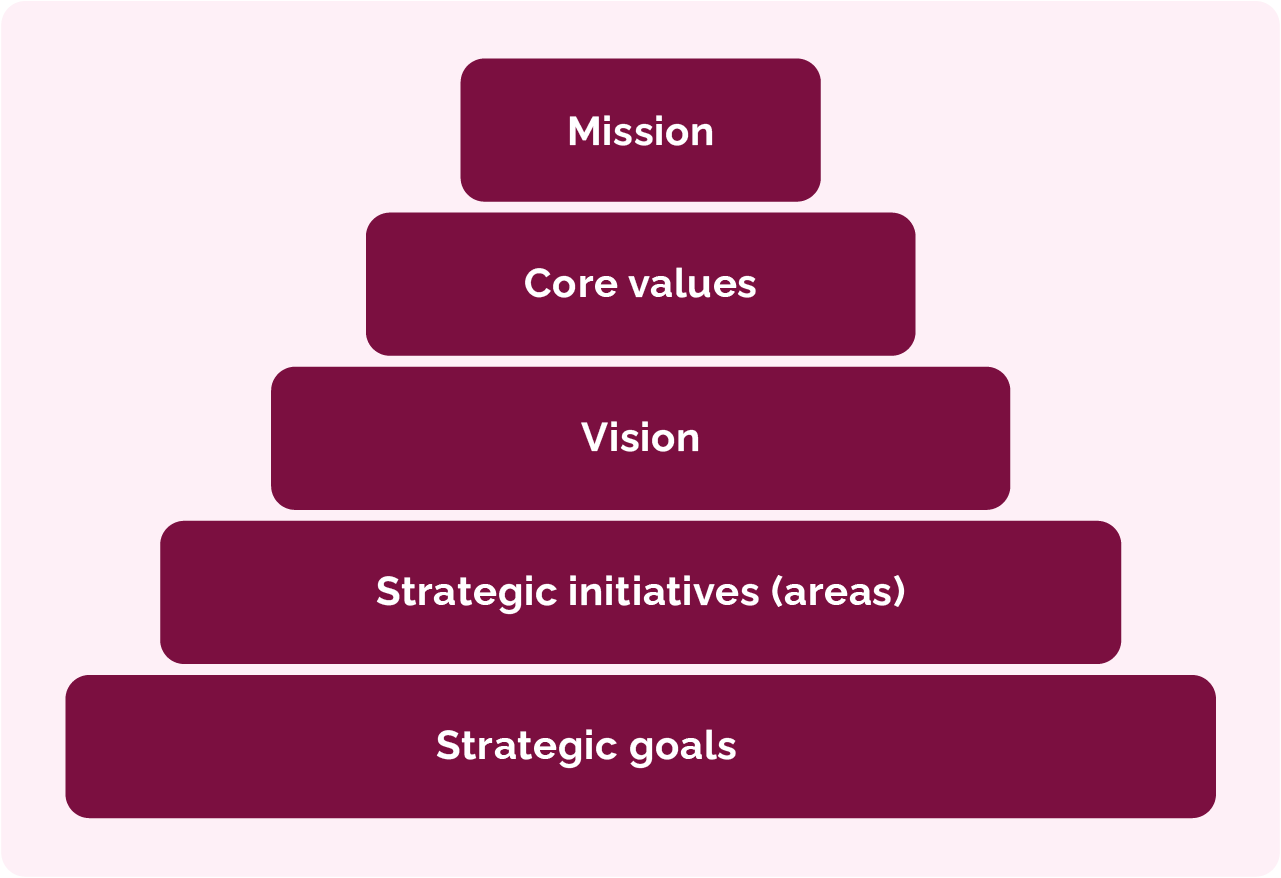
Figure: Continuum of strategic management
3. Methodology for defining strategy elements
The methodology for defining the elements of a strategy represents a set of structured steps and techniques through which a higher education institution ensures that its mission, core values, vision, strategic initiatives, and strategic goals are aligned with the results of the current state analysis, enabling effective implementation and monitoring of the strategy.
At the heart of every strategy lie five key elements:
Through specially facilitated workshops, leadership interviews, and methods such as the Delphi technique, the institution ensures consensus and motivation among key stakeholders.
4. Methods and techniques for situation analysis, strategy formulation and implementation
In the process of strategic management of digital technology implementation, situation analysis and strategy formulation require carefully selected methods and techniques. Each of these methods contributes to understanding internal and external factors and enables structured decision-making. The following section provides a detailed description of the steps for applying five key techniques for situation analysis, while the methods for strategy formulation will be covered in the next chapters, and the methods for strategy implementation in the following topic.
4.1. SWOT analysis
The SWOT analysis provides a systematic framework for identifying and understanding the internal strengths and weaknesses, and the external opportunities and threats of an organization, thereby supporting informed strategic planning.
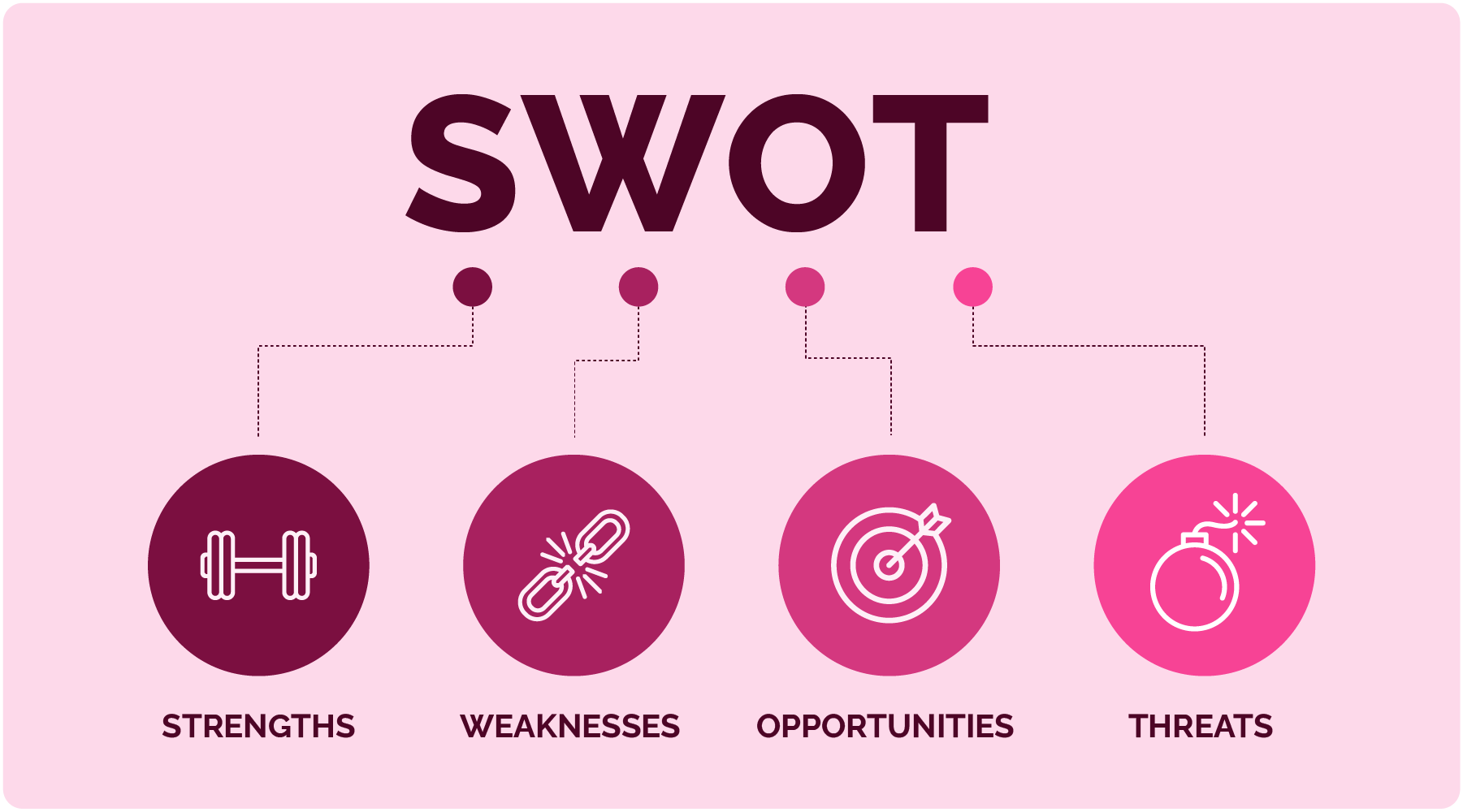
Steps:
- Define the purpose of the analysis.
- Collect relevant data.
- Identify strengths.
- Identify weaknesses.
- Identify opportunities.
- Identify threats.
- Analyze interrelationships.
- Develop the matrix and formulate recommendations [2].
Illustrative example demonstrating the steps of a SWOT analysis:
The organizational team of a higher education institution decided to conduct a SWOT analysis of its digital infrastructure:
4.2. KREDA analysis
The KREDA analysis is used for a detailed assessment of the quality of educational and management processes within a higher education institution. It links the results of the situational analysis with recommendations for improving institutional efficiency.
Steps:
- Define quality criteria.
- Collect relevant information.
- Evaluate the results.
- Diagnose problems.
- Recommend improvement measures.
- Prepare a report [8].
Illustrative example of the application of the KREDA analysis:
The university team defined quality criteria for teaching and administrative processes, including the timeliness of issuing certificates and the availability of digital teaching materials. Data were collected through surveys among students and staff (n=150), after which each dimension was rated on a scale from 1 to 5. The analysis revealed that the certificate issuance process had an average rating of 2.8, while the availability and quality of digital teaching materials received a score of 4.2. Based on these findings, the recommendation was to introduce an e-service for certificate issuance and to standardize the format of digital materials to improve their consistency and accessibility.
4.3. PESTLE analysis
The PESTLE analysis provides a systematic overview of the political, economic, social, technological, legal, and environmental factors that shape the external environment of an organization. It complements the internal situational analysis by offering a comprehensive picture of the factors that influence the established strategy.
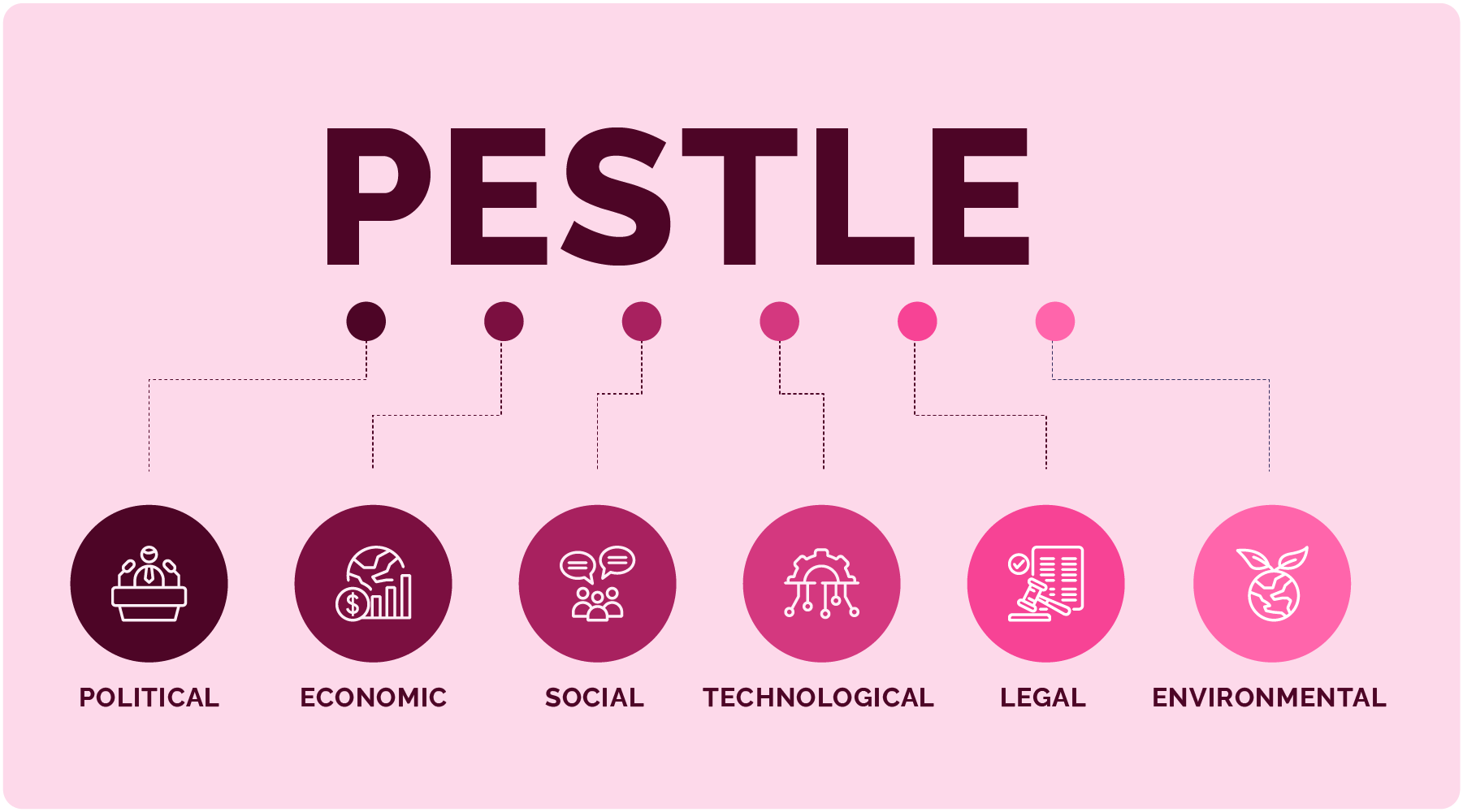
Steps:
- Political factors.
- Economic factors.
- Social factors.
- Technological factors.
- Legal factors.
- Environmental factors.
- Report preparation [2].
Illustrative example of the application of the PESTLE analysis:
The strategic planning team at the university in this example analyzed the external environment while developing the digital transformation strategy.
- Political factors: New national legislation encourages investment in STEM education.
- Economic factors: The faculty budget for ICT projects increased by 15 %.
- Social factors: Students increasingly prefer hybrid models of teaching.
- Technological factors: The institution plans to integrate AI tools for adaptive learning.
- Legal factors: Compliance with GDPR and national data protection guidelines.
- Environmental factors: The introduction of energy-efficient data centers reduces the carbon footprint.
Based on the analysis, the recommendation was to establish an advisory board for GDPR, increase investment in AI research, and regularly monitor social trends using survey tools.
4.4. Benchmarking analysis
Benchmarking analysis enables higher education institutions to identify best practices in digital transformation by comparing key performance indicators with comparable institutions, thereby facilitating the timing and direction of their own strategic initiatives.
Steps:
- Selection of institutions.
- Definition of performance indicators.
- Data collection.
- Gap analysis.
- Adoption and adaptation [9].
Illustrative example of the application of benchmarking analysis:
The university team selected three leading European universities known for their digital innovations. Indicators were defined, such as the number of e-courses, time required to implement new platforms, and user satisfaction (survey n=250). Data were collected from publicly available reports and academic publications. The analysis revealed that the benchmarked universities, on average, implemented new digital tools within six months of approval, while the home institution averaged twelve months. Based on these findings, the recommendation was to establish a rapid implementation team and to adopt pilot projects for testing new digital platforms.
4.5. User needs analysis
User needs analysis enables an understanding of the actual requirements and expectations of students, staff, and other stakeholders, ensuring that the digital transformation strategy is aligned with their needs and real conditions.
Steps:
- Identification of stakeholder groups.
- Design of the questionnaire.
- Implementation of the survey.
- Analysis of results.
- Recommendation of improvements.
- Preparation of the report [10].
Illustrative example of applying user needs analysis:
The Department for Digital Services Development at the university conducted a survey among students (n=300) and staff (n=50) to gather insights on existing digital tools. Through focus groups, the main needs were identified: an intuitive mobile interface, regular technical support, and the integration of virtual classrooms with the learning management system. Based on the results, the proposal was to develop a mobile application for course access, introduce weekly technical workshops, and integrate Zoom and Teams directly through the existing learning management system.
5. Characteristics of the mission and its formulation
The mission of an organization represents the fundamental purpose of its existence, describing what the organization does, for whom, and why. A well-formulated mission statement clearly communicates the organization’s key functions, its users, and the values it upholds. It serves as a solid foundation for strategic decision-making and resource allocation.
The structure of a mission statement usually includes three elements:
- target group (whom we serve),
- core activity or offering (what we do), and
- purpose or impact (why we do it).
When crafting a mission statement, it is recommended to use short and clear sentences, avoid technical jargon, and maintain an inspiring and motivating tone. The mission is generally a long-term statement, but may be revised as needed in different strategic planning cycles. A strong mission answers the questions “Why do we exist?”, “Whose needs do we meet?”, and “What is our contribution?”, while conveying reliability, professionalism, and innovation.
The following table presents examples of mission statements from four Croatian and four international higher education institutions.
Table: Examples of mission statement formulations
|
Higher Education Institution |
Mission |
Source |
|
Josip Juraj Strossmayer University of Osijek |
"The University of Osijek is an educational institution which, by connecting scientific research, artistic creation, study and teaching, develops science, professions and the arts; prepares students to perform professional activities based on scientific knowledge and methods as well as artistic values; educates the next generation of scientists and artists; participates in realizing the social interests of students; and promotes international—especially European—co-operation in higher education as well as in scientific and artistic activity." |
[11] |
|
Faculty of Electrical Engineering and Computing (FER), University of Zagreb |
"To educate and inspire students who will drive Croatia’s technological and social development through research-based teaching; to instill entrepreneurial courage and empower them to steer progress responsibly, for the benefit of people, nature and the community; to create new knowledge through internationally recognized research; to advance the economy and public sector through innovation; to be an institution of high academic and ethical values, a place of critical thinking and inquiry and of equality for all members; to be a driving force of the technological development of Croatian society." |
[12] |
|
Faculty of Education and Rehabilitation Sciences (ERF), University of Zagreb |
"The mission of the Faculty of Education and Rehabilitation Sciences is education based on scientific knowledge in educational rehabilitation, speech and language pathology, and social pedagogy with the aim of including vulnerable/at-risk groups in the community, acting towards the individual and the social environment, and influencing public policies and social well-being, while respecting the principles of professional ethics and responsibility." |
[13] |
|
Faculty of Economics, University of Osijek |
"The Faculty of Economics in Osijek is a higher education and scientific institution which creates competent individuals capable of meeting various environmental challenges through its educational process and scientific-research work in the field of economics and business economics. We adopt scientific achievements, evaluate them critically, and create new knowledge through scientific-research work in economics and related sciences with the aim of developing the environment. We are a socially responsible, innovative, and open institution of high academic values and ethical principles that ensures equality and prosperity for its staff, students, and society as a whole." |
[14] |
|
Illinois Institute of Technology (IIT), USA |
"To provide distinctive and relevant education in an environment of scientific, technological, and professional knowledge creation and innovation." |
[15] |
|
University College London (UCL), United Kingdom |
"Global University of London: a diverse intellectual community engaged with the wider world and committed to improving it; recognized for its radical and critical thinking and widespread influence; with an outstanding ability to integrate education, research, innovation, and enterprise for the long-term benefit of humanity." |
[16] |
|
University of Sheffield, United Kingdom |
No formal mission, but there is a substitute entitled “Our story,” which infers the university’s purpose. |
[17] |
|
The Ohio State University, USA |
"The university is dedicated to: - Creating and discovering knowledge to improve the well-being of our state, regional, national, and global communities; - Educating students through a comprehensive array of distinguished academic programs; - Preparing a diverse student body to be leaders and engaged citizens; - Fostering a culture of engagement and service." |
[18] |
Methods for defining a mission statement:
6. Characteristics of vision and its formulation
A vision represents an inspirational picture of the organization’s future state, answering the questions “Where do we want to be?” and “What transformations do we want to achieve?” A strong vision is inspiring, ambitious, yet realistic. The structure of a vision includes a time frame aligned with the strategic planning cycle.
Good practices for structuring a vision:
- clear definition of the time horizon;
- focus on societal impact;
- inclusion of technologies;
- emotive and motivating language.
The table below outlines examples of vision statements from four Croatian and four international higher education institutions.
Table: Examples of vision statement formulations
|
Higher Education Institution |
Vision |
Source |
|
Josip Juraj Strossmayer University of Osijek |
“Josip Juraj Strossmayer University of Osijek as a strong research, internationally oriented institution for the creation, sharing, and application of knowledge.” |
[11] |
|
Faculty of Electrical Engineering and Computing (FER), University of Zagreb |
“FER’s vision is to be a recognizable European higher education and research institution in electrical engineering, computing, and information & communication technology, shaping the futures of Croatia and Europe by educating excellent technological talents and responsible leaders .” |
[12] |
|
Faculty of Education and Rehabilitation Sciences (ERF), University of Zagreb |
“The vision of the Faculty is to become an internationally recognized higher education institution for excellence in teaching and research, with a strong professional impact on its wider environment.” |
[13] |
|
Faculty of Economics, University of Osijek |
“The vision of the Faculty of Economics in Osijek is to be an institution recognized for excellence, innovation, and creativity in education and research in economics and business, and for its contribution to the community at the regional, national, and international levels.” |
[14] |
|
Illinois Institute of Technology (IIT), USA |
“To provide distinctive and relevant education in an environment of scientific, technological, and professional knowledge creation and innovation.” — (Used by IIT as both mission and forward-looking framing, often functioning as a concise vision statement.) |
[15] |
|
University College London (UCL), United Kingdom |
“Our distinctive approach to research, education, and innovation will further inspire our community of staff, students, and partners to transform how the world is understood, how knowledge is created and shared, and the way that global problems are solved.” |
[16] |
|
University of Sheffield, United Kingdom |
“Our vision and 2020–27 strategic plan: We will deliver life-enhancing research, innovation, and education that not only transforms the lives of our graduates, but shapes the world we live in.” |
[17] |
|
The Ohio State University, USA |
“Ohio State University is the model 21st-century public, land-grant, research, urban, community-engaged institution.” |
[18] |
Methods for defining a vision (same approaches as for a mission): workshops, interviews, Delphi, future-back, scenario planning.
7. Definition of core values
Core values reflect an organization’s fundamental beliefs and principles, guiding member behavior and shaping culture. The structure of values consists of short, affirmative statements. Values are revised every 7–10 years. They answer the questions: “How will we work?” and “Which principles do we follow?”
The table contains examples of core values from four Croatian and four international higher education institutions.
Table: Examples of core values
|
Higher Education Institution |
Values |
Source |
|
Josip Juraj Strossmayer University of Osijek |
“Credibility, professionalism, responsibility, adaptability, collaboration, and openness.” |
[11] |
|
Faculty of Electrical Engineering and Computing (FER), University of Zagreb |
“Excellence, innovation, integrity, connectedness, and openness.” |
[12] |
|
Faculty of Education and Rehabilitation Sciences (ERF), University of Zagreb |
“Academic excellence, ethics and professionalism, inclusiveness and equality, social responsibility, collaboration and partnership, openness and transparency.” |
[13] |
|
Faculty of Economics, University of Osijek |
“High academic values and ethical principles, social responsibility, innovation and openness, equality and prosperity.” (not highlighted separately, but included within the mission statement) |
[14] |
|
Illinois Institute of Technology (IIT), USA |
“Focus on Students; Strengthen Faculty and Staff; Foster Leadership and Ethical Decision-Making; Commit to Diversity and Excellence; Focus on Resource Management; Enhance Reputation; Engage Alumni.” |
[15] |
|
University College London (UCL), United Kingdom |
“Integrity and mutual accountability; Openness and inclusion; Care and respect; Rigour and innovation.” |
[16] |
|
University of Sheffield, United Kingdom |
“Ambition, Excellence, Collaboration, Inclusivity, Responsibility, Transparency.” |
[17] |
|
The Ohio State University, USA |
“Excellence and Impact; Diversity and Innovation; Inclusion and Equity; Care and Compassion; Integrity and Respect.” |
[18] |
Methods for defining values: workshops, interviews, culture analysis, Delphi, organizational values card-sorting, storytelling.
8. Defining strategic initiatives and strategic goals
Strategic initiatives are the key areas of action for achieving the mission and vision, identified through gap analysis. Strategic goals are concrete, measurable intentions within each initiative and follow the SMART criteria to enable clear evaluation.
Good goals follow the SMART criteria (specific, measurable, achievable, relevant, and time-bound) to enable clear progress evaluation. In practice, institutions typically have 3–5 strategic initiatives, each containing 5–10 goals.
The table contains examples of strategic goals from four Croatian and four international higher education institutions.
Table: Examples of strategic initiatives and goals
|
Higher Education Institution |
Number of initiatives/areas |
Number of goals |
Example goals |
Source |
|
Josip Juraj Strossmayer University of Osijek |
7 |
40 |
Align the general objectives of all lifelong learning programs with the University’s mission and strategic goals, and with economic and social needs. Develop a stimulating multidisciplinary research environment to achieve scientific excellence and fully leverage the University’s research potential. |
[11] |
|
Faculty of Electrical Engineering and Computing (FER), University of Zagreb |
5 |
5 strategic and 25 specific goals |
Provide high-quality education and raise the standard of students. Increase scientific excellence and strengthen innovation activities. Encourage research collaboration with industry and entrepreneurship to transfer research results into innovative commercial activities. |
[12] |
|
Faculty of Education and Rehabilitation Sciences (ERF), University of Zagreb |
4 |
4 strategic and 13 specific goals |
Raise scientific excellence; strengthen collaboration with industry; increase the relevance, quality, and efficiency of studies; strengthen social responsibility. |
[13] |
|
Faculty of Economics, University of Osijek |
4 |
4 strategic and 17 specific goals |
Ensure high quality and recognizability of study programs in economics and business economics with learning outcomes that enable the development of competencies aligned with environmental demands and qualification standards. Strengthen research productivity and excellence by empowering and encouraging research and mentoring capacities, with the aim of generating new scientific insights and knowledge transfer. Develop the Faculty as an important factor in the economic and social development of the environment, and in improving the quality of life in the community, through cooperation with external stakeholders and the education of responsible and competent citizens sensitive to the needs of the community in which they live. |
[14] |
|
Illinois Institute of Technology (IIT), USA |
4 |
26 SMART goals |
Increase the number of undergraduate students to 4,000. Increase the total number of students on campus to 8,000. Increase first-year full-time student retention into the second year to 95 percent. |
[15] |
|
University College London (UCL), United Kingdom |
7 (Delivery areas) |
4 |
Increase interdisciplinary research excellence and enhance real-world impact on the key societal challenges selected by our community, through the creation and application of new knowledge. Equip our graduates to be leaders and agents of change in an uncertain future; make access to our education easier, more student-centered, easier to navigate, and less bureaucratic for all parties. |
[16] |
|
University of Sheffield, United Kingdom |
4 pillars |
12 priorities |
We will launch the University’s first multi-million-pound fundraising and engagement campaign to grow and diversify philanthropic income and help create a sense of belonging and participation among our staff, students, and alumni. We will create a positive environment that supports and encourages the well-being of our staff and students, while empowering individuals to take responsibility for their own well-being. |
[17] |
|
The Ohio State University, USA |
5 |
5 strategic and 16 sub-goals |
Develop and manage resources and relationships to attract and retain a diverse, excellent faculty, staff, student body, and alumni in support of the College’s educational, creative, and engagement goals. Foster an inclusive work and learning environment and promote respectful dialogue on pressing societal issues. |
[18] |
9. Conclusion
Through detailed narration and practical examples, this material has presented a comprehensive methodology for developing a strategy for the application of digital technologies in higher education. We showed how the strategic planning continuum links analysis, formulation, implementation, and evaluation into an ongoing process of adaptability and learning. We explained the key elements of strategy—mission, vision, core values, strategic initiatives, and SMART goals—their characteristics, and criteria for effective formulation. We demonstrated the use of SWOT, KREDA, PESTLE, benchmarking, and user needs analysis for precise diagnosis and decision-making. We presented participatory methods for defining mission and vision—including workshops, interviews, the Delphi method, and future-back approaches—as the foundation for collective consensus.
In this document, we also provided examples of basic strategic elements for four higher education institutions from Croatia and four from around the world. While these can serve as inspiration for creating our own strategic documents, at least two notes should be kept in mind. The first concerns the fact that, as there are different strategic planning systems on the one hand, and different historical practices of strategic planning in different geographical areas on the other, the understanding and semantics of vision and mission are not entirely the same across regions. While in Croatia (and much of Europe) we begin by defining the mission and consider it a permanent element (our long-term purpose) that may not change over several strategic planning cycles, in the U.S. context, the mission is defined after the vision and has a more short-term character, indicating the current state of what we do. The second note concerns the definition and organization of strategic goals. We have seen that SMART principles are rarely followed, which is not good practice because the ability to measure the realization of strategic goals that are not defined according to SMART principles is weaker and may lead to confusion. Therefore, in the next step of strategic planning, it is important to operationalize (instrumentalize) strategic goals into lower-level goals with associated measures, which will consequently enable the measurement of strategic goals.
10. References
[1] K. Kampylis, Y. Punie, and J. Devine, Europski okvir za digitalno kompetentne obrazovne organizacije (DigCompOrg): Zajednički istraživački centar Europske komisije, Luksemburg: Publikacija Ureda za publikacije Europske unije, 2015.
[2] I. Vardopoulos, "An Integrated SWOT-PESTLE-AHP Model Assessing Adaptive Reuse Strategies for Historic Buildings," Applied Sciences, vol. 11, no. 15, pp. 7134, 2021. [Accessed: Aug. 1, 2025]
[3] Z. Bahrami, J. Cranney, and A. Heidari, "Applying SMART Goal Intervention Leads to Greater Goal Attainment, Need Satisfaction and Positive Affect," International Journal of Mental Health Promotion, vol. 24, br. 6, str. 869–882, 2022. [Accessed: Aug. 1, 2025]
[4] S. Bartkus, M. Glassman, R. McAfee, "The real mission of the mission statement: A systematic review of the literature," Journal of Management & Organization, vol. 24, br. 4, str. 456–473, 2018. [Accessed: Aug. 1, 2025]
[5] Z. Yafang, W. Jing, "Relationship between Organizational Culture, Leadership Behavior and Job Satisfaction," BMC Health Services Research, vol. 11, br. 98, 2011. [Accessed: Aug. 1, 2025]
[6] M. W. Johnson, J. Suskewicz, "A Future-Back Approach to Breakthrough Growth," Innosight, 2020. [Accessed: Aug. 1, 2025]
[7] J. Hough, K. Liebig, "An Analysis of Strategic Alignment Tools," Corporate Ownership & Control, vol. 10, br. 2, str. 591–599, 2013. [Accessed: Aug. 1, 2025]
[8] M. Drvodelić & B. Vranković, "KREDA-analiza – Korak do spoznaje koliko je dobra naša škola," Zrno: časopis za obitelj, vrtić i školu, br. 107-108, str. 36–38, 2013. [Accessed: Aug. 1, 2025]
[9] K. Tasopoulou, G. Tsiotras, "Benchmarking towards excellence in higher education," Benchmarking: An International Journal, vol. 24, br. 3, str. 617–634, 2017. [Accessed: Aug. 1, 2025]
[10] J. Bravo-Jaico, G. L. E. Maquen-Niño, N. G. C. Valdivia, R. Alarcón, J. Aquino, O. Serquén, "Assessing digital transformation maturity in higher education institutions: a correlational analysis by actors and dimensions," Frontiers in Computer Science, vol. 7, 2025. [Accessed: Aug. 1, 2025]
[11] Josip Juraj Strossmayer University in Osijek, "Misija i vizija," 2022. [Accessed: Aug. 1, 2025]
[12] FER, "Misija, vizija i strategija," 2024. [Accessed: Aug. 1, 2025]
[13] ERF, "Misija, vizija i strategija," 2025. [Accessed: Aug. 1, 2025]
[14] Faculty of Economics in Osijek, "Strategija razvoja 2023.-2028.," 2022. [Accessed: Aug. 1, 2025]
[15] Illinois Institute of Technology, Strategic Plan 2020–2025, Chicago, 2020. [Accessed: Aug. 1, 2025]
[16] University College London, Strategic Plan 2022–2027, London, 2022. [Accessed: Aug. 1, 2025]
[17] University of Sheffield, Our vision and strategic plan 2020–27, Sheffield, 2024. [Accessed: Aug. 1, 2025]
[18] The Ohio State University, Glenn Strategic Plan, Columbus, 2024. [Accessed: Aug. 1, 2025]
[19] J. Bryson, B. Crosby, and M. Stone, "The Design and Implementation of Strategic Planning Workshops: Facilitating Stakeholder Engagement and Consensus Building," Public Administration Review, vol. 75, br. 2, str. 255-267, 2015. [Accessed: Aug. 1, 2025]
[20] C. C. Hsu and B. A. Sandford, "The Delphi Technique: Making Sense of Consensus," Practical Assessment, Research, and Evaluation, vol. 12, br. 1, 2007. [Accessed: Aug. 1, 2025]
[21] K. S. Cameron and R. E. Quinn, Diagnosing and Changing Organizational Culture: Based on the Competing Values Framework, 3rd ed., Jossey-Bass, San Francisco, 2011. [Accessed: Aug. 1, 2025]
[22] S. Denning, The Leader's Guide to Storytelling: Mastering the Art and Discipline of Business Narrative, 2nd ed., Jossey-Bass, San Francisco, 2011. [Accessed: Aug. 1, 2025]
[23] R. Xeqqc, "Enhancing Organizational Performance: Applying the Six Sigma 5 Whys," LinkedIn, 2024. [Accessed: Aug. 1, 2025]
[24] M. W. Johnson and J. Suskewicz, "Lead from the Future: How to Turn Visionary Thinking into Breakthrough Growth," Innosight, 2020. [Accessed: Aug. 1, 2025]
Background Colour
Font Face
Font Size
Text Colour
Font Kerning
Image Visibility
Letter Spacing
Line Height
Link Highlight
Paragraph Width
Text Alignment