Instructions for course participants
| Site: | Loomen za stručna usavršavanja |
| Course: | Learning Analytics |
| Book: | Instructions for course participants |
| Printed by: | Gost (anonimni korisnik) |
| Date: | Saturday, 19 September 2026, 6:03 AM |
Table of contents
- 1. General information about the e-course
- 2. E-course description
- 3. Teaching and learning approaches
- 4. Learning outcomes
- 5. E-course topics and structure
- 6. Topic descriptions and requirements for a badge
- 7. Technical information and minimum prerequisites for participation in the e-course
- 8. Activities and obligations of participants
- 9. Support and contacts
- 10. Rules of conduct
1. General information about the e-course
Course title: Learning Analytics
ECTS credits: 3
Number of participants: maximum 30
Mode of delivery: online
Target group: higher education instructors
2. E-course description
This e-course is designed for the professional development of teachers in higher education. It focuses on learning analytics, which includes the collection, analysis, interpretation, and communication of data about learners and their learning, providing theoretically relevant and applicable insights for improving learning and teaching.
The module topics include the definition, characteristics, and purpose of learning analytics; types of data and data sources; data collection, analysis, and reporting of analysis results; methods of interpreting and using analysed data; ethical aspects and personal data protection; and the application of learning analytics with the aim of improving learning and teaching (pedagogical interventions).
The e-course is designed according to innovative learning and teaching strategies. Problem-based learning, the flipped classroom, and inquiry-based learning are applied. Each topic includes a video lesson.
All activities take place online with the support of an instructor who acts as a facilitator.
3. Teaching and learning approaches
The e-course is based on an inquiry-based and problem-based approach, with instructor support throughout the course. Inquiry-based learning is applied, where participants independently formulate research questions and seek answers to them. The e-course also includes problem-based learning, in which participants solve problem-oriented tasks. It also incorporates elements of the flipped classroom, where each topic begins with an introductory video or reading material, followed by active learning. Participants mostly work individually, and to a lesser extent in teams, in order to take advantage of the benefits of collaborative learning.
4. Learning outcomes
The course design is learner-centered and based on learning outcomes, as shown in Table 1. The learning outcomes cover different levels of Bloom’s taxonomy and have different relative weights.
Table 1. Course learning outcomes
| Learning outcome |
Level |
Weight |
|
Explain the importance of learning analytics for improving the processes of learning and teaching |
Understanding |
12 |
|
Analyse ethical aspects, personal data protection aspects, and limitations in the use of learning analytics |
Analysing |
15 |
|
Apply digital technologies for collecting, analysing, and using data on student activities, performance, and progress |
Application |
23 |
|
Critically evaluate the sources, types, and quality of available data in order to gain more insights into student learning and teaching processes |
Analysing |
20 |
|
Evaluate and adapt learning design, teaching strategies, and assessment methods based on the results obtained through learning analytics |
Evaluation |
15 |
|
Apply learning analytics with the aim of improving learning and teaching, and implementing pedagogical interventions |
Application |
15 |
The highest weight and central role belong to the learning outcome: apply digital technologies for collecting, analysing, and using data on student activities, performance, and progress.
5. E-course topics and structure
The e-course includes six topics (Figure 1). The topics are divided into units with learning and teaching activities. All topics, units, and learning and teaching activities are aligned with the planned learning outcomes. For each activity, a type is defined according to the Balanced Design Planning (BDP) concept – acquisition, discussion, inquiry, practice, production, and assessment.
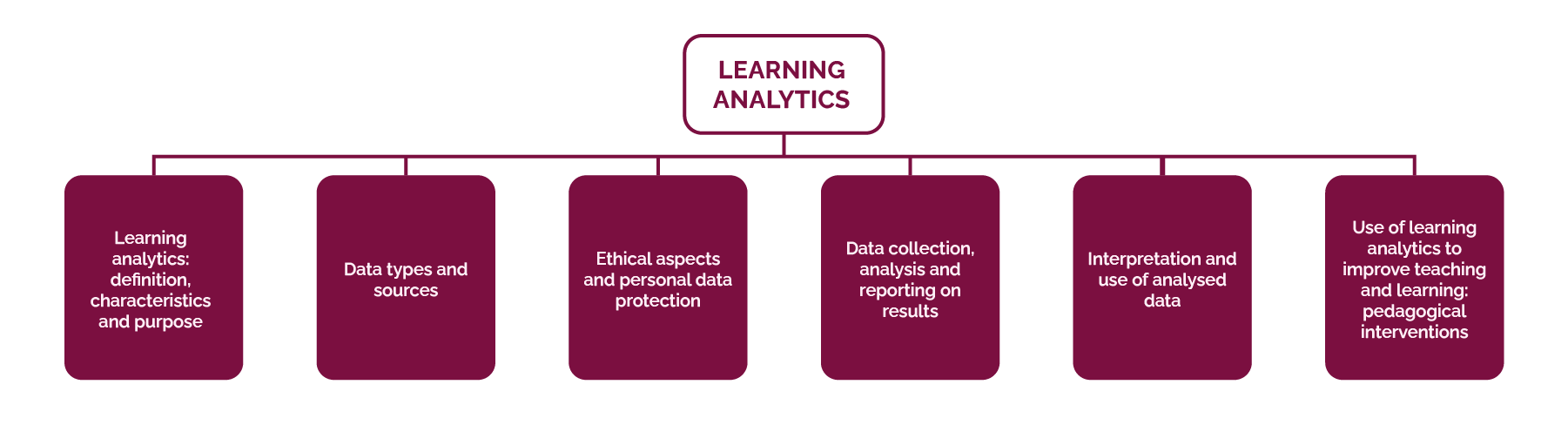
Figure 1. E-course topics
In addition, the estimated time required for each activity is specified. During the design of the e-course, special attention was paid to ensuring constructive alignment. All the topics are aligned with the learning outcomes as well as with the corresponding formative and summative assessment. The e-course was planned using the BDP learning design tool. The complete learning design of the e-course, along with detailed design analytics, is available at the link.
The previous link is available in Croatian only. Participants may use free AI-powered translation tools to access the provided materials.
6. Topic descriptions and requirements for a badge
Topic 1: Learning Analytics – Definition, Characteristics, Purpose of Application
In the introductory topic, you will become familiar with the definition of learning analytics, key areas of application, and the types of learning analytics. The topic also covers the boundaries with related fields (academic analytics, educational data mining), the place of learning analytics in the cycle of continuous improvement of learning and teaching processes, challenges in implementation, and the connection with learning design. You will examine specific examples of learning analytics and explore its application at your own institution.
Mandatory activities (requirement for the badge): In the first unit, it is essential to watch the video on learning analytics and participate in the quiz, and it is highly recommended to study the reading material as well. In the second unit, it is mandatory to conduct a mini-study on the implementation of learning analytics at your institution and present the findings in a short essay, followed by peer assessment. It is recommended to first review the examples and listen to podcasts on learning analytics.
Topic 2: Types of Data and Data Sources
The second topic focuses on data sources and types of data, including the LMS (assessment data, log data), learning design tools (e.g., data on learning outcomes, and learning and teaching activities), other information systems (e.g., student attendance records), as well as multimodal data (e.g., collected via sensors). The topic also addresses data access and data quality. You will independently explore the data available at your institution, collect available datasets, and evaluate them.
Mandatory activities (requirement for the badge): In the first unit, it is mandatory to watch the video on data sources in learning analytics, then explore the data available at your institution, and prepare a written overview considering possible insights and ideas for application. In the second unit, it is mandatory to evaluate the datasets collected in the previous activities from available information systems.
Topic 3: Ethical Aspects and Personal Data Protection
The third topic focuses on the ethical aspects of learning analytics. It begins with an overview of the broader concept of trustworthiness in learning analytics, followed by an emphasis on ethical aspects, including privacy and data protection, autonomy and control, and data and algorithmic bias.
Mandatory activities (requirement for the badge): In the first unit, it is essential to watch the video on the trustworthiness of learning analytics, and it is also desirable to study the reading material. After that, it is necessary to complete a questionnaire related to participants’ views on the prerequisites for implementing educational interventions based on trustworthy learning analytics. In the second unit, a mandatory essay is required in which participants present their vision of the key challenges related to ethics and connections with other aspects of the trustworthiness of learning analytics, supported by previous activities such as reading ethical guidelines for the ethical use of data in learning analytics.
Topic 4: Data Collection, Analysis, and Reporting of Data Analysis Results
The fourth topic is dedicated to methods of data collection and data analysis in learning analytics, followed by reporting and visualisation through dashboards. It includes teamwork within inquiry-based learning and the development of dashboard examples.
Mandatory activities (requirement for the badge): In the first unit, as part of inquiry-based team learning, it is mandatory to identify problems and formulate a research question related to your own educational context that can be addressed with the help of learning analytics, then conduct research on it and report the results. In the second unit, it is mandatory to watch the video on reporting methods in learning analytics and then submit and peer-assess the dashboard concepts created in teams.
Topic 5: Methods of Interpreting and Using Analysed Data
The fifth topic focuses on the interpretation of learning analytics results. It includes the study of guidelines for interpreting learning analytics as well as problem-based tasks focused on interpreting concrete examples of analyses. The topic also addresses the role of teachers in interpreting and applying learning analytics results.
Mandatory activities (requirement for the badge): In the first unit, it is mandatory to watch the video on the interpretation of learning analytics and then solve a problem-based task in which examples of concrete analyses from Moodle and the BDP learning design tool must be interpreted. In addition to the video, the basis for this task are the learning analytics interpretation guidelines from the previous activity. In the second unit, it is mandatory to participate in a discussion on the role of teachers in interpreting learning analytics and implementing educational interventions.
Topic 6: Application of Learning Analytics for the Improvement of Learning and Teaching – Pedagogical Interventions
The sixth topic focuses on educational interventions based on insights from learning analytics, including the creation of an intervention plan to improve the learning design of a selected course based on analytics insights. The topic also includes reflection on the possibilities of learning analytics in one’s own teaching practice.
Mandatory activities (requirement for the badge): In the first unit, it is essential to create an intervention plan for the learning design based on the learning design analytics of the selected course. In the second unit, it is mandatory to watch the video on interventions based on learning analytics and participate in a discussion on the potential for improving one’s teaching process through the use of learning analytics and the feasibility of implementation at one’s own higher education institution based on insights from previous activities.
7. Technical information and minimum prerequisites for participation in the e-course
Technical information about the system in which the e-course is delivered
This e-course is implemented in the Loomen system, which is based on the open-source Moodle platform, so anyone familiar with working in Moodle will quickly adapt to Loomen as well.
The homepage of the e-course is organised in accordance with the course structure, with links on the homepage leading to activities and resources in line with the course design.
The e-course can be accessed from a computer connected to the internet, a smartphone, or a tablet.
The e-course opens properly in all popular web browsers (Firefox, Opera, Chrome, Edge, etc.). The e-course is also available via a mobile application, which does not always function optimally.
Faster navigation through the course is possible using the menu on the left-hand side, while the right-hand side allows users to track upcoming activities, highlighted announcements, and course progress.
The Loomen system is intuitive, and in case of any difficulties in using the system, participants should contact the instructor.
Minimum technical requirements for attending the e-course
Types of content in the e-course:
- Educational multimedia (predominantly textual) materials (e.g., pages, books) are available in the Loomen system and open directly in a web browser. All materials can also be downloaded in PDF format. For this reason, users should have a PDF reader installed. However, if browsers such as Firefox or Chrome are used, a PDF reader is not necessary, as PDF files can be opened directly in the browser.
- Video lessons are originally hosted on CARNET’s multimedia portal Meduza and are integrated into pages on Loomen, allowing access without leaving the Loomen system. Watching video lessons requires an internet connection of at least 2 Mbit/s. In addition, the use of headphones or speakers is required.
- Assessment activities in the e-course are supported by the appropriate functionalities of the Loomen system, and there are no additional technical requirements. Quizzes and workshops open fully in the web browser, and there are no additional technical requirements.
- Synchronous course activities take place using the BigBlueButton platform, which is integrated into the Loomen system. Technical requirements for participation in synchronous activities include a microphone, headphones, and an internet speed of preferably 5 Mbit/s or higher.
8. Activities and obligations of participants
For successful completion of the course and earning the digital badge, participants need to:
- study the video lessons and textual materials
- participate in discussions
- complete the assigned quizzes
- participate in the questionnaire
- conduct independent research
- solve problem-based tasks
- prepare essays and other written assignments
- participate in teamwork
- engage in collaborative learning through peer assessment.
Table 2 presents the total points for formative and summative assessment of participants, as well as an overview of mandatory participant activities. As a rule, each topic includes one more demanding summative assessment (Figure 4).
Table 2. Overview of formative and summative assessment and mandatory participant activities
Topic |
Formative assessment (FA) |
Summative assessment (SA) |
Activities |
|
Learning analytics: definition, characteristics, and purpose of application |
3 |
10 |
Introductory video: Basics of learning analytics |
|
Types of data and data sources |
2 |
14 |
Video: Overview of data sources in learning analytics |
|
Ethical aspects and personal data protection |
6 |
10 |
Video: Trustworthiness of learning analytics |
|
Data collection, analysis, and reporting of data analysis results |
1 |
20 |
Conceptualisation: Research question |
|
Methods of interpreting and using the analysed data |
8 |
10 |
Video: Interpretation of learning analytics |
|
Application of learning analytics to improve learning and teaching: pedagogical interventions |
0 |
16 |
Intervention plan: Improving the learning design of selected courses (SA) |
|
Total |
20 |
80 |
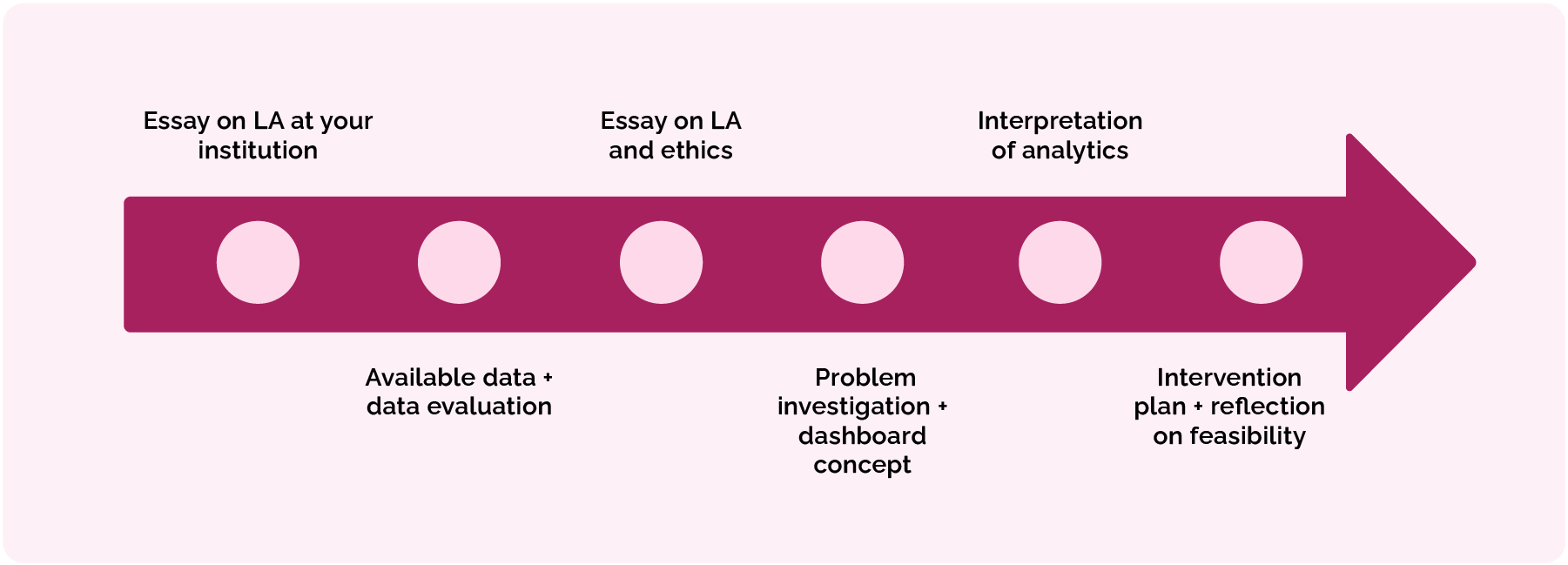
Figure 4. Overview of summative assessment
Participant activities are described under the heading 6. Description of topics and conditions for earning the badge. Details on the tasks and activities that participants must complete, as well as the thresholds applied, are specified in the e-course (Moodle) and in the learning design (BDP).
9. Support and contacts
For any questions about the course content or participation in the e-course, please contact your instructor.
For technical questions, please contact us at: x@carnet.hr or by phone at 01 xxxxxxx.
10. Rules of conduct
In order to ensure higher-quality collaboration, we have defined certain rules of conduct for the e-course.
- Respect other participants and instructors who are part of the e-course. Communicate in a way that shows respect for others and contributes constructively to a pleasant working environment and learning.
- Use professional and clear language. Strive to write grammatically correctly and use a professional writing style. Avoid writing entire words in capital letters (which may be interpreted as shouting). Inappropriate or offensive messages are not acceptable.
- Stay on topic and be concise. Your comments, responses, and messages should be related to the topic and structured in a way that is understandable to other participants and instructors.
- Respect deadlines and fulfil your obligations on time. Your activity contributes to the quality of shared learning in the e-course. Try to regularly check announcements, respond to tasks within the given deadlines, and participate in discussions. Pay special attention to group and teamwork, as all members are expected to contribute to achieving the results.
- Protect the privacy and confidentiality of information. Do not share personal data of other participants without their explicit consent, and be cautious when sharing your own data in public areas of the e-course. Do not share analyses that are not anonymised and for which you do not have informed consent.
- Do not publish promotional content or messages with inappropriate content. The e-course is not a place for advertising, chain messages, or political messages. It is necessary to focus on the course content and mutual learning.
- Express disagreement in a constructive and evidence-based manner. Direct criticism toward the content or idea, not toward the person. If you disagree, support your opinion with arguments while respecting different viewpoints. Provide references for your opinions and support them with professional arguments.
- Use appropriate communication channels. For technical and organisational questions, use the designated forums or contact the e-course mentors through official channels. Informal communication is welcome in the formats and groups intended for it, while respecting basic rules of politeness. When working in a group or team, agree in advance on communication rules and methods.
- Prepare for participation in virtual meetings. The e-course also includes synchronous sessions during which the use of a camera is recommended (when possible), being in a quiet environment, and speaking only when you have a comment or question. Respect other people’s time, do not interrupt activities, and prepare and test your presentations in advance.
- Act in accordance with ethical and legal standards. Respect copyright, institutional regulations, and applicable laws. Do not share course content outside designated channels and respect copyright and intellectual property. Unauthorised use of content, plagiarism, or sharing confidential information is not permitted.
Why these rules? The goal is to ensure a high-quality, inclusive, and professional learning environment in which everyone feels comfortable.
What if the rules are violated? In cases of non-compliance, the course leaders may issue a warning and, in serious situations, take further action in accordance with the institution’s regulations.
Who is responsible? All participants in the e-course share responsibility for maintaining a positive and professional atmosphere.
Background Colour
Font Face
Font Size
Text Colour
Font Kerning
Image Visibility
Letter Spacing
Line Height
Link Highlight
Paragraph Width
Text Alignment