Learning Design and Instructional Design: Similarities and Differences
| Site: | Loomen za stručna usavršavanja |
| Course: | Learning Design |
| Book: | Learning Design and Instructional Design: Similarities and Differences |
| Printed by: | Gost (anonimni korisnik) |
| Date: | Thursday, 17 September 2026, 12:39 PM |
Table of contents
- 1. Definitions
- 2. Introduction to Learning Design and Instructional Design Models
- 3. Student Workload and Constructive Alignment
- 4. Table of Comparison of Similarities and Differences Between Learning Design and Instructional Design
- 5. Comparison and Reflection
- 6. Questions and prompts for reflection
- 7. References cited in the text
- 8. References for the comparative table
1. Definitions
Learning design and instructional design are related but conceptually distinct approaches to planning and developing learning and teaching activities.
Instructional design refers to the systematic planning, development, and evaluation of teaching materials based on learning and teaching theories. Classical definitions, such as the one provided by Reigeluth (1999), emphasize the effectiveness, efficiency, and appeal of instruction.
Learning design is a more recent approach that focuses on shaping learning and teaching activities, as well as interaction during the learning process (Rienties et al., 2023). According to Gráinne Conole (2013), learning design should make use of visual and digital tools to enhance pedagogical practice and collaborative planning of learning and teaching. The emphasis is on student learning and the learning experience, including managing the overall student workload. Conole particularly highlights the significant technological possibilities (which are much greater today than when the book was written, note by author) that should be utilized, but she stresses that approaches to designing educational activities and content need to be reconsidered first.
Diana Laurillard (2012) emphasizes that planning learning and teaching is an iterative design process in which teachers use pedagogical patterns and technology to systematically plan and improve learning processes, with continuous reflection and adaptation according to students’ needs.
2. Introduction to Learning Design and Instructional Design Models
2. Introduction to Learning Design and Instructional Design Models
The aim of this chapter is to introduce five relevant models:
Three learning design models:
-
ABC Learning Design
-
OULDI (Open University Learning Design Initiative)
-
BDP (Balanced Design Planning)
Two instructional design models:
-
ADDIE (Analysis, Design, Development, Implementation, Evaluation)
-
Gagné’s model
Models of learning designs
ABC Learning Design (University College London)
The ABC Learning Design model was developed at University College London (UCL) and is based on six learning types defined by Diana Laurillard: acquisition, discussion, investigation, practice, collaboration, and production. The ABC model is primarily applied in a workshop format in which teachers collaboratively plan a course using visual cards that represent different learning activities. Its main advantages are speed, collaboration, and a strong focus on the student experience. A limitation is the reduced depth of analysis regarding assessment elements and the achievement of learning outcomes.
OULDI (Open University Learning Design Initiative)
OULDI is a model developed by The Open University in the United Kingdom. The model is based on representing learning and teaching through different forms (graphical, textual, network-based), which encourages reflection and an analytical approach to design. OULDI includes the use of tools such as CompendiumLD, which enables the visualization of the teaching process and the involvement of participants. The emphasis is on structuring content, selecting resources, and clearly defining the role of the teacher and the student at each step. OULDI is less suitable for rapid implementation but is a powerful tool for more complex learning designs.
Balanced Design Planning (BDP) (FOI, University of Zagreb)
BDP is a model developed in the European context (Rienties et al., 2023), led by the Learning Analytics Laboratory at the Faculty of Organization and Informatics, University of Zagreb. The model was developed by Divjak et al. (2022) and is based on student-centred design and constructive alignment aligned with the modalities of delivery. By using a free online collaborative tool (learning-design.eu), BDP enables the analysis and visualization of the alignment of design elements and identifies discrepancies that may affect the quality of implementation. A specific feature of this model is its systematic approach to integrating constructive alignment and assessment.
Models of Instructional Design
ADDIE (Analysis, Design, Development, Implementation & Evaluation) Model
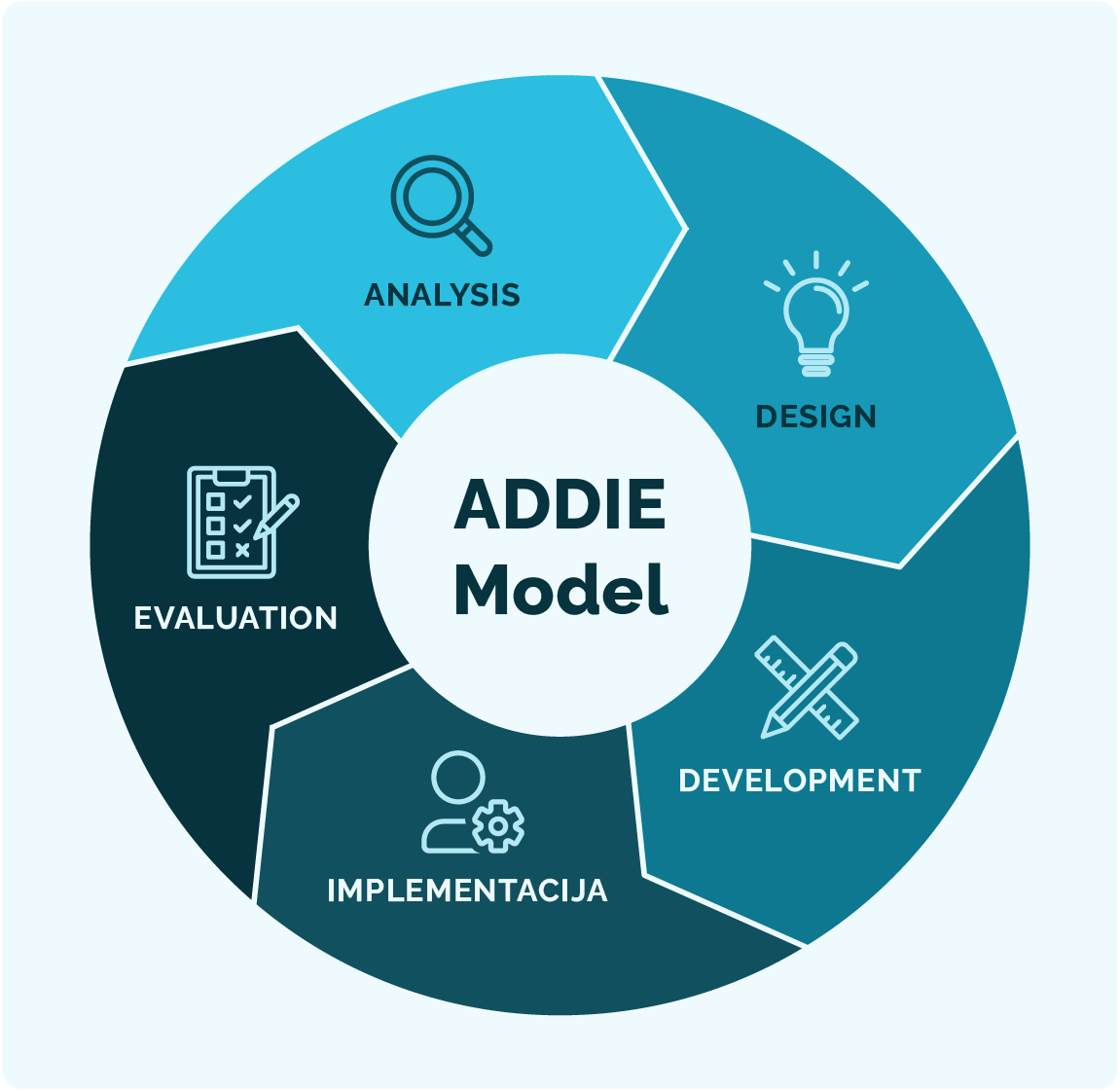
ADDIE is one of the most well-known models of classical instructional design, initially used in military training environments and later adopted in corporate training and education. The ADDIE model was developed by the Center for Educational Technology at Florida State University in the early 1970s, primarily for the training needs of the U.S. military. The name is an acronym for the five phases of instructional design: Analysis, Design, Development, Implementation, and Evaluation.
ADDIE is a process-oriented model that enables a systematic approach to creating educational materials. The focus is on needs analysis, formulating objectives, developing materials, and evaluating them. Its advantage is universality and structure, but a potential drawback is limited flexibility in rapidly changing educational contexts.
Gagné’s Nine Events of Instruction
Robert Gagné (Gagné, 1985; Gagné et al., 1992) developed a model of nine instructional events that correspond to the cognitive processes required for successful knowledge acquisition. The steps include gaining attention, informing learners of the objectives, stimulating recall of prior knowledge, presenting the content, providing learning guidance, eliciting performance, giving feedback, assessing performance, and ensuring transfer. Gagné’s model is highly precise and suitable for structured teaching, especially in STEM and technical subjects. However, in contemporary contexts, it may at times be considered too linear and inflexible.
3. Student Workload and Constructive Alignment
One of the key differences lies in the approach to student workload. Instructional design often plans teaching from the teacher’s perspective, asking what needs to be taught and how it will be assessed. As a result, it frequently does not explicitly take into account the time and effort a student must invest in understanding concepts, applying what they have learned, and reflecting on their own learning.
By contrast, learning design enables and encourages planning the duration of each activity and estimating the total weekly/module workload in terms of student effort.
Constructive alignment (Biggs & Tang, 2011) is a concept that refers to the alignment between learning outcomes, learning activities, teaching activities, and assessment.
Instructional design traditionally focuses on structuring teaching content and teaching activities in accordance with instructional goals, theoretically including outcome-based planning. However, in practice, the emphasis often remains on the content and the teacher’s goals, and less on the activities and the learning experience from the student’s perspective.
In contrast, learning design starts from the student and the learning process, explicitly incorporating constructive alignment between outcomes, activities, and assessment. It emphasises visual, reflective, and collaborative planning that enables teachers to see the learning experience as a whole.
Nevertheless, contemporary trends in instructional design show a convergence of these approaches - broadening the focus from content planning toward designing the entire learning experience (cf. Reiser, Carr-Chellman & Dempsey, 2025). In this way, learning design and instructional design are increasingly viewed as complementary approaches aimed at enhancing the quality and effectiveness of teaching.
The use of digital tools, such as Balanced Design Planning (BDP), enables alignment of learning outcomes, teaching activities, estimation of the time needed for each activity, and forms of assessment.
4. Table of Comparison of Similarities and Differences Between Learning Design and Instructional Design
Table 2. Comparison of Similarities and Differences Between Learning Design and Instructional Design
Element |
Instructional design |
Learning design |
Similarities |
|
Focus |
Efficient delivery of content¹ |
Learning activities and interactions² |
Improvement of the learning process |
|
Theoretical foundation |
Behaviorism, cognitivism¹ |
Constructivism, social constructivism² |
Reliance on educational theories |
|
Methodology |
ADDIE model, linear approach¹ |
Visual, flexible, and iterative planning² |
Systematic planning of education |
|
Role of technology |
Secondary or supportive³ |
Essential for planning and collaboration² |
Use of digital tools |
|
Student workload |
Generally not considered⁴ |
Actively included and transparent⁵ |
Both approaches may be extended to this aspect |
|
Constructive alignment |
Partially integrated⁶; contemporary approaches include it |
A fundamental principle of the approach⁷ |
Supports the alignment of instructional elements |
|
Application |
E-learning, formal education¹ |
All levels of education, flexible² |
Adaptable to context |
|
Target group |
Instructors, content designers¹ |
Teachers, teams—creators of e-courses or modules² |
Professionals in education and training |
5. Comparison and Reflection
The ABC, OULDI, and BDP models emphasize learning design with a strong focus on the student experience and learning activities. These models are grounded in constructivist and socioconstructivist pedagogy and often incorporate digital tools for planning and implementing learning design, while supporting collaborative and active learning. They place particular emphasis on the alignment of learning activities, learning outcomes, and assessment. Learning design in these models is student-centered, with the primary aim of enhancing the learning experience. As such, these learning design models are used predominantly in higher education, as well as in online and hybrid learning environments.
In contrast, the ADDIE and Gagné models originate in the tradition of instructional design and emphasize logical sequencing and control of the process, with roots in behaviourist and cognitivist learning theories. Instructional design is more oriented toward supporting teachers, focusing on planning and delivery of instruction. It emphasizes a linear and clearly structured approach and is often used in corporate training, business environments, and early forms of e-learning.
Although conceptually somewhat different, all these models hold value in different contexts. Instructional design remains relevant, especially in structured or content-intensive environments, while learning design is becoming the dominant approach in higher education and flexible learning settings. It enables greater pedagogical innovation, better integration of digital tools, and improved responsiveness to the diverse needs of students.
6. Questions and prompts for reflection
Self-assessment questions:
- How does learning design differ from instructional design according to Conole (2013) and Laurillard (2012)?
- What is the key difference in focus between learning design and instructional design?
a) methods of content delivery
b) learning activities and interaction
c) teacher evaluation
d) organization of the teaching space - What are the main phases of the ADDIE model, and what is the purpose of each?
- What does Gagné’s model of nine steps represent, and in which contexts is it most appropriately applied?
- In what ways do the ABC Learning Design, OULDI, and BDP models differ from one another?
- How does the Balanced Design Planning (BDP) model enable verification of constructive alignment?
Reflection prompts:
- Which approach - learning design or instructional design - aligns better with your current way of planning a course? Why?
- How do you take student workload into account when planning teaching (time, effort, cognitive load)?
- How might you use digital tools (e.g., learning-design.eu) for visualizing or collaboratively planning course design?
- How would applying constructive alignment change your approach to student assessment?
- Which idea from this material most strongly encouraged you to reflect on your own teaching practice, and why?
7. References cited in the text
Biggs, J., & Tang, C. (2011). Teaching for Quality Learning at University (4th ed.). McGraw-Hill Education.
Conole, G. (2013). Designing for Learning in an Open World. Springer.
Reigeluth, C. M. (1999). Instructional Design Theories and Models: A New Paradigm of Instructional Theory. Lawrence Erlbaum Associates.
Divjak, B., Grabar, D., Svetec, B., & Vondra, P. (2022). Balanced Learning Design Planning: Concept and Tool. Journal of Information and Organizational Sciences, 46(2), 361–375.
Laurillard, D. (2012). Teaching as a Design Science: Building Pedagogical Patterns for Learning and Technology. Routledge
Gagné, R. M. (1985). The Conditions of Learning and Theory of Instruction (4th ed.). Holt, Rinehart and Winston.
Gagné, R., Briggs, L. & Wager, W. (1992). Principles of Instructional Design (4th Ed.). Fort Worth, TX: HBJ College Publishers.
Reiser, R. A., Carr-Chellman, A. A., & Dempsey, J. V. (Eds.). (2025). Trends and Issues in Instructional Design and Technology (5th ed.). Routledge.
Rienties, B., Balaban, I., Divjak, B., Grabar, D., Svetec, B. & Vondra, P. (2023). Applying and Translating Learning Design and Analytics Approaches Across Borders. U: Viberg, O. & Grönlund, Å. (ur.) Practicable Learning Analytics. Advances in Analytics for Learning and Teaching. Cham, Springer, pp. 35–53.
8. References for the comparative table
Reigeluth, C. M. (1999). Instructional Design Theories and Models: A New Paradigm of Instructional Theory. Lawrence Erlbaum Associates.
Conole, G. (2013). Designing for Learning in an Open World. Springer.
Morrison, G. R., Ross, S. M., Kalman, H. K., & Kemp, J. E. (2012). Designing Effective Instruction (7th ed.). Wiley.
Kirschner, P. A., Sweller, J., & Clark, R. E. (2006). Why minimal guidance during instruction does not work: An analysis of the failure of constructivist, discovery, problem-based, experiential, and inquiry-based teaching. Educational Psychologist, 41(2), 75–86.
Divjak, B., Grabar, D., Svetec, B., & Vondra, P. (2022). Balanced Learning Design Planning: Concept and Tool. Journal of Information and Organizational Sciences, 46(2), 361–375.
Smith, P. L., & Ragan, T. J. (2005). Instructional Design (3rd ed.). Wiley.
Biggs, J., & Tang, C. (2011). Teaching for Quality Learning at University (4th ed.). McGraw-Hill Education.
Background Colour
Font Face
Font Size
Text Colour
Font Kerning
Image Visibility
Letter Spacing
Line Height
Link Highlight
Paragraph Width
Text Alignment