Learning outcomes at study programme and course level
| Site: | Loomen za stručna usavršavanja |
| Course: | Learning Design |
| Book: | Learning outcomes at study programme and course level |
| Printed by: | Gost (anonimni korisnik) |
| Date: | Thursday, 17 September 2026, 8:04 AM |
Table of contents
- 1. Introduction
- 2. Study programme quality assurance
- 3. Determining the weights of learning outcomes
- 4. Relationship between learning outcomes at the programme and course level
- 5. Practical application and tools
- 6. Constructive alignment
- 7. Conclusion
- 8. Questions and suggestions for reflection
- 9. Literature
1. Introduction
In contemporary higher education, learning outcomes (LOs) represent the foundation for planning, implementing, and evaluating the teaching and learning process. In the documents of the Bologna Process, the importance and central role of learning outcomes are particularly emphasized (Bologna documents 2003, 2012, 2024). Since Croatia joined the Bologna Process in 2001, learning outcomes have been incorporated into the educational regulations, especially those governing higher education in Croatia.
Clearly defined learning outcomes enable students to understand what is expected of them, while providing teachers with a framework for learning design within an appropriate learning design model and for evaluating student achievement.
The first major challenge is ensuring alignment between learning outcomes at the study program level and those at the level of individual courses, and the second is determining the relative importance of course-level learning outcomes, i.e., the weighting of learning outcomes.
At the course level, all learning outcomes must be linked to appropriate learning and teaching methods as well as assessment methods (constructive alignment).
2. Study programme quality assurance
In ESG (2015) – Standards and Guidelines for Quality Assurance in the European Higher Education Area (ESG) – learning outcomes play a central role in several standards related to quality assurance in higher education, both at the level of internal (institutional) and external evaluation (procedures for initial accreditation of study programmes and reaccreditation of higher education institutions).
In Standard 1.2, it is emphasised that programmes should be designed with clearly defined learning outcomes aligned with qualification frameworks.
Standard 1.3 highlights the importance of student-centred learning through teaching and assessment based on learning outcomes.
In Standards 1.4 and 1.9, learning outcomes serve as the basis for transparent processes of admission, recognition, and progress monitoring, as well as for the continuous improvement of study programmes.
The definition of learning outcomes in the ECTS Users’ Guide (2015) states: Learning outcomes are statements of what the learner knows, understands, and is able to do after completing the learning process.
3. Determining the weights of learning outcomes
Not all learning outcomes are equally important, nor do they require the same amount of time and cognitive effort from students. Therefore, it is important to determine priorities among them, that is, to assign their relative weight to ensure a fair distribution of learning activities and assessment tasks. According to the research by Divjak, Kadoić, and Žugec (2021), the application of multi-criteria decision-making methods, such as the Analytic Hierarchy Process (AHP), enables a systematic determination of learning outcome weights by considering various criteria, such as:
- the importance of the learning outcome and topic for the future profession
- the level of complexity according to the chosen taxonomy (e.g., Bloom's levels)
- the contribution to the development of 21st-century generic skills
- the student workload required to achieve the learning outcome
However, sophisticated methods are not always necessary for determining the weights of learning outcomes. Students and other stakeholders (e.g., employers) may participate in the process of determining the weights alongside teachers.
4. Relationship between learning outcomes at the programme and course level
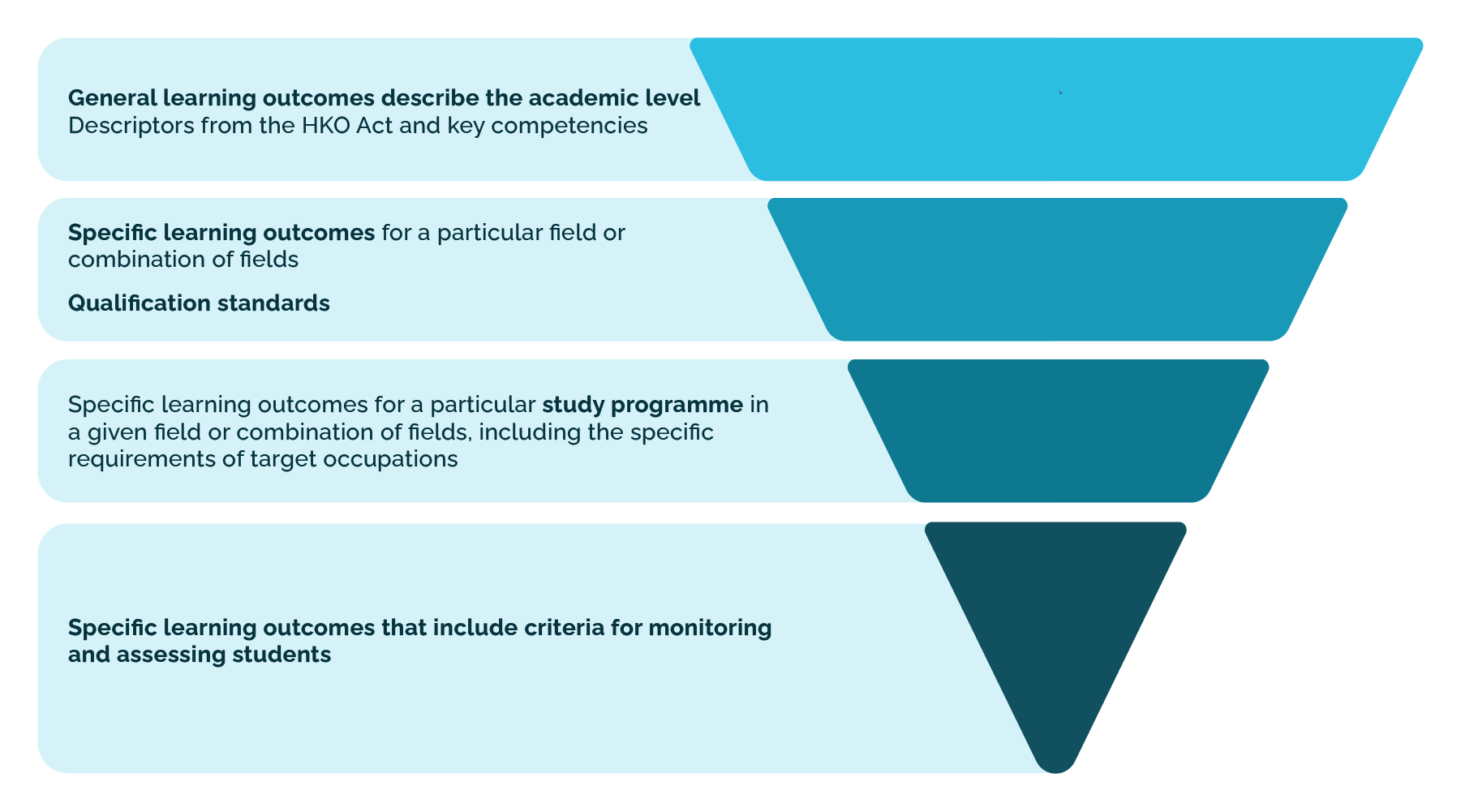
In contemporary higher education, learning outcomes (LOs) represent the foundation for planning, implementing, and evaluating the teaching and learning process. In the documents of the Bologna Process, the importance and central role of learning outcomes is particularly emphasized (Bologna documents 2003, 2012, 2024). Since Croatia joined the Bologna Process in 2001, learning outcomes have been integrated into education regulations, especially those concerning higher education in Croatia.
Clearly defined learning outcomes enable students to understand what is expected of them, while providing teachers with a framework for learning design using an appropriate learning design model and for evaluating student achievement.
The first major challenge is ensuring alignment between the learning outcomes at the study programme level and those at the level of individual courses, and the second challenge relates to determining the relative importance of course-level learning outcomes, that is, the weighting of learning outcomes.
5. Practical application and tools
In the work by Divjak et al. (2024), various approaches to determining the weights of learning outcomes are presented, adjusted to the context and complexity of the educational setting.
Approaches to prioritizing learning outcomes depending on the characteristics of the educational context, according to Divjak et al. (2024)
|
COMPLICATED |
COMPLEX |
|
SIMPLE |
STANDARD |
Example: The distribution of learning outcome weights for this Learning Design e-course in the BDP tool can be found at the following link.
6. Constructive alignment
Constructive alignment is an approach to course planning that ensures all elements of the teaching process – learning outcomes, learning and teaching activities, and assessment – are mutually aligned and directed toward achieving clearly defined goals. The concept was developed by Biggs and Tang (2011) and is based on constructivist learning theory, which emphasises the active role of students in building knowledge and acquiring skills.
In this approach, learning outcomes represent the foundation – clear statements of what a student should know, understand, and be able to do after completing a course or programme (ENQA et al., 2015).
Based on these outcomes, learning and teaching activities are selected to enable students to actively construct knowledge, whether through participation in discussions, research, practical work, or collaboration. In addition to established approaches, the use of innovative learning and teaching methods (iLeD, 2024) is recommended.
Finally, assessment must be aligned with the learning outcomes and measure exactly what the outcomes define, using appropriate methods (e.g., essays, presentations, practical tasks, quizzes).
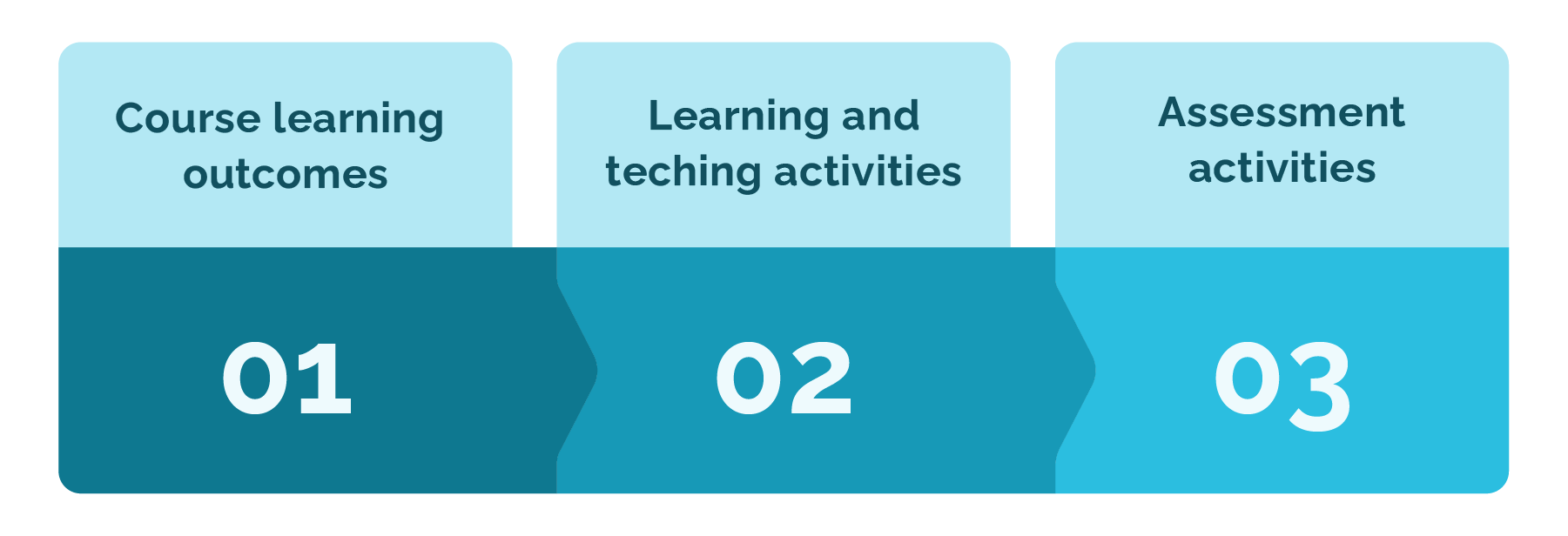
Figure 7. Constructive alignment
The advantages of constructive alignment include transparency, fairness, and pedagogical effectiveness. Students clearly understand what is expected of them, and teachers have a structured framework for planning and evaluation. This approach is increasingly important in the context of quality assurance, as it is aligned with ESG (2015) standards, particularly Standards 1.2 and 1.3.
A tool that supports reflection on constructive alignment is provided in the form of a table (Divjak, 2014).
7. Conclusion
Determining and aligning learning outcomes at the level of the study programme and individual courses (vertical alignment), with clearly defined weights, followed by horizontal constructive alignment of learning outcomes, learning and teaching activities, and assessment, is essential for ensuring the quality of education. The application of structured methods and tools enables a transparent and participatory approach, thereby increasing the effectiveness of the teaching process and the satisfaction of all stakeholders involved.
8. Questions and suggestions for reflection
Self-assessment questions
-
What is the definition of learning outcomes according to ESG (2015), and what does it aim to emphasise?
-
What is the main difference between learning outcomes at the study programme level and the course level?
-
Explain the concept of vertical alignment of learning outcomes and why it is important.
-
What does horizontal (constructive) alignment mean and what are its key elements?
-
Briefly explain the difference between various approaches to determining the weights of learning outcomes (simple, standard, complicated, complex).
Suggestions for reflection
-
How are the learning outcomes in your course currently aligned with the study programme learning outcomes?
-
Are there course learning outcomes that could be better aligned with the programme outcomes? How would you achieve this?
-
How do you currently determine the relative importance (weights) of learning outcomes? Could you apply any of the approaches described in the text?
-
Consider an example from your own course: Are the learning activities, teaching methods, and assessment methods aligned with the learning outcomes? Where do you see potential misalignments?
-
What specific changes would you introduce into the course design to achieve better constructive alignment?
-
Which data (e.g., from the learning management system) could you use to verify the actual implementation of constructive alignment during the semester?
9. Literature
Biggs, J., & Tang, C. (2011). Teaching for Quality Learning at University (4th ed.). McGraw-Hill Education / Open University Press.
Bologna documents: Berlin Communiqué (2003); Bucharest Communiqué (2012); Eurydice 2024 report
Divjak, B., Kadoić, N., & Žugec, B. (2021). The Use of Decision-Making Methods to Ensure Assessment Validity . Proceedings of the 2021 IEEE Technology & Engineering Management Conference – Europe (TEMSCON – EUR), 386–391.
Divjak, B., Svetec, B., Rienties, B., Astles, P., Matthews, C., Tillmann, A., Eichhorn, M., & Schmitt, J. (2024). Prioritizing Learning Outcomes in Different Learning Design Contexts . Proceedings of the Central European Conference on Information and Intelligent Systems (CECIIS), 333–338.
Divjak, B.; Barthakur, A.; Kovanović, V.; Svetec, B. (2025). The Impact of Learning Design on the Mastery of Learning Outcomes in Higher Education. LAK '25: Proceedings of the 15th International Learning Analytics and Knowledge Conference. Association for Computing Machinery, 2025. 726–737.
Divjak, B. (2014). Checking the Consistency and Achievement of Learning Outcomes . UNIQInfo, University of Zagreb, 2014.
European Association for Quality Assurance in Higher Education (ENQA), European Students’ Union (ESU), European University Association (EUA), & European Association of Institutions in Higher Education (EURASHE). (2015). Standards and Guidelines for Quality Assurance in the European Higher Education Area (ESG) . Brussels, Belgium.
European Commission. (2015). ECTS Users’ Guide . Luxembourg: Publications Office of the European Union.
iLed project (2024). Authentic learning scenarios .
Background Colour
Font Face
Font Size
Text Colour
Font Kerning
Image Visibility
Letter Spacing
Line Height
Link Highlight
Paragraph Width
Text Alignment