Designing assessments
| Site: | Loomen za stručna usavršavanja |
| Course: | Learning Design |
| Book: | Designing assessments |
| Printed by: | Gost (anonimni korisnik) |
| Date: | Thursday, 17 September 2026, 3:39 PM |
Table of contents
- 1. Introduction
- 2. The concept and purpose of assessment
- 3. Types of assessment
- 4. What do we assess?
- 5. Constructive alignment
- 6. Online assessment and the issue of cheating
- 7. Formative assessment and feedback to students
- 8. Summative assessment
- 9. Examples of assessment according to learning outcome levels
- 10. Assessment design in the BDP tool
- 11. Resources in Moodle for assessment
- 12. Conclusion: Assessment as a learning tool
1. Introduction
In the context of education, especially in the era of distance learning and now in relation to the challenges brought by artificial intelligence, the issue of assessment has become one of the key concerns. During the pandemic, many teachers for the first time began to ask themselves more intensively: How will we assess students, and will they cheat? This dilemma opened the need for deeper reflection on assessment, which can no longer be reduced to routine testing of knowledge, but must encompass the entire teaching and learning process.
This material describes the types of assessment and addresses the questions of what and how we assess, as well as how assessment can be aligned with the planned learning outcomes. Particular attention is paid to assessment methods in an online environment and to providing feedback to students. The material further elaborates on summative assessment and provides examples of assessment aligned with different levels of learning outcomes. Self-assessment quizzes are also integrated into the material.
2. The concept and purpose of assessment
Assessment represents the process of collecting information about students’ knowledge, skills, independence, responsibility, and attitudes. It can be carried out by the teacher or by the students themselves, and it can be:
- formal or informal
- planned or spontaneous
- summative or formative
In the traditional approach, assessment takes place at the end, after the content has been covered. However, in contemporary approaches, such as the flipped classroom (Flipped classroom) or problem-based learning (Problem-based learning), assessment may have different dynamics and function.
Grading, on the other hand, is the act of measuring the results of assessment - using grades, points, qualitative categories, or digital badges.
Assessment can be viewed through three approaches:
- assessment for learning – serves for the design and redesign of learning
- assessment as learning – active involvement of students in assessment
- assessment of learning – grading the level of achievement of learning outcomes
3. Types of assessment
The table below presents the concepts and purposes of assessment. Match the types of assessment with their purpose.
More detailed feedback
- A – III (Assessment for learning): Here, assessment is used as a tool to improve the learning process. Teacher comments on drafts enable students to improve their work before final submission – a typical form of formative assessment.
- TB – I (Assessment as learning): Involving students in peer assessment with reflection contributes to the development of their metacognitive skills. Assessment is integrated into the learning process, and through it students learn about quality and criteria.
- C – II (Assessment of learning): This example represents summative assessment – the final outcome (presentation and written assignment) is assessed based on defined criteria. It serves to determine the level of achievement of learning outcomes.
4. What do we assess?
In the assessment process, it is necessary to pay attention to different dimensions of student achievement, and not only to knowledge.
5. Constructive alignment
The foundation of successful assessment is constructive alignment – the alignment of learning objectives, teaching activities, and assessment methods. Assessment should measure what is planned to be taught and what students are expected to achieve.
|
Element |
Description |
|
Learning outcomes |
what the student should know and be able to do |
|
Teaching activities |
how the goal will be achieved |
|
Assessment methods |
how we know that the goal has been achieved |
Example of constructive alignment
|
Learning outcome |
Teaching method |
Assessment task |
Grading method |
Student workload in ECTS credits |
|
Prepare a development project proposal in accordance with the call documentation |
Using the flipped classroom approach, develop the theoretical foundation on the basic elements of a project proposal. Analysis of cases of similar successful and unsuccessful proposals. |
Preparation of a project proposal according to the call documentation in a team of three students. The completed project proposal is submitted in Moodle, using the assessment tool with a rubric. |
Using a rubric that follows the elements of project evaluation. Peer assessment is also possible. |
1.5 ECTS (40 hours of student workload) |
|
Evaluate a project proposal according to predefined criteria. |
Analyse cases of successful and unsuccessful proposals. Participate in the development and quantification of project assessment elements. |
Evaluate a project created by another team through peer assessment using the assessment tool in Moodle. |
Check the alignment of scores between the students who assessed the project and the teacher who assessed the same project using the same rubric. |
0.5 ECTS (15 hours of student workload) |
6. Online assessment and the issue of cheating
One of the challenges we encounter in online assessment is the possibility of cheating with the help of available online tools. There is a perception that students cheat more easily online, which can undermine trust in the assessment and grading process. However, cheating in exams is also present in physical environments when exams are conducted in classrooms. Therefore, it is necessary to understand why students cheat and which strategies can be applied to reduce cheating in exams.
Why do students cheat?
- They feel pressure to succeed.
- They do not see the purpose of the task.
- They believe that “everyone does it”.
Strategies to reduce cheating:
- complex tasks – require the application of knowledge rather than reproduction
- routine tasks – in an online context require increased supervision and large item banks
- developing awareness of ethics and academic integrity
7. Formative assessment and feedback to students
Assessment, especially formative assessment, also serves to provide students with feedback on their achievements, as well as advice on how and what to learn.
In formative assessment, particular emphasis is placed on assessment for learning and assessment as learning, as opposed to assessment of learning (summative assessment).
Formative assessment can contribute to the final grade (through points), but these contributions are usually significantly smaller than those from summative assessment. In this way, the role of formative assessment as support for learning is emphasized. At the same time, students are motivated to participate in formative assessment, as they can also accumulate points that affect the final course grade. However, formative assessment does not have to include points and can be exclusively focused on practice and providing feedback to students.
8. Summative assessment
The main question that every teacher must ask themselves in the context of summative assessment is:
What do I want students to take away from my course?
Summative assessment must be clearly linked to learning outcomes, as this is the way to ensure its validity (validity).
In mathematics, for example, this may include understanding mathematical language, the concept of algorithms, logical reasoning, and problem-solving, rather than only knowing formulas and solving routine tasks.
Similarly, in languages and communication, summative assessment should encompass the ability to express meaning, argue, and adapt a message to the context, rather than focus solely on the correctness of grammatical structures.
In natural sciences, the goal may be the application of concepts to real-life situations and the interpretation of experimental results, rather than mere reproduction of theoretical facts.
In computer science, assessment may include analytical thinking, problem-solving, and solution design instead of an exclusive focus on knowledge of programming language syntax.
9. Examples of assessment according to learning outcome levels
|
Level of learning outcomes |
Assessment task – example |
Measurement (grading method) – example |
|
Recall |
Fill in the blanks, multiple-choice answers |
Accuracy of answers |
|
Explain |
Oral/written answers to open-ended questions, in-class discussions, homework assignments, presentations |
Analysis of key characteristics of responses, rubric with essential criteria for levels |
|
Apply |
Non-routine tasks, problem-based tasks, laboratory exercises, prototypes, simulations |
Scoring the accuracy of parts of the solution |
|
Analyse |
Case studies, critiques, laboratory measurements, projects, debates |
Rubric, analysis of key characteristics of responses |
|
Check |
Learning journal, critique, evaluation report, portfolio (portfolio), systematic literature review |
Rubric, assessment committee (e.g. doctoral thesis proposal), analysis of key characteristics |
|
Create |
Research project, essay, prototype, musical performance, scientific paper |
Rubric, committee, analysis of key characteristics |
10. Assessment design in the BDP tool
Assessment is clearly linked to learning outcomes, divided into formative and summative assessment, and the provision of feedback is also foreseen.
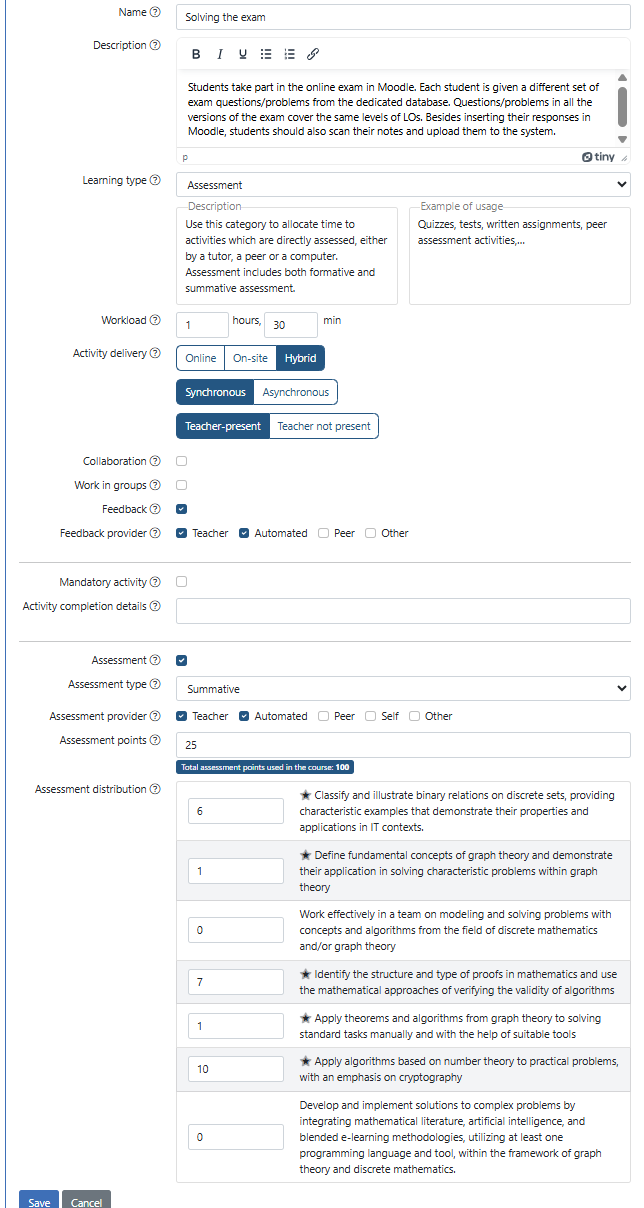
Figure 11: Example of summative assessment design in the BDP tool
11. Resources in Moodle for assessment
In the LMS Moodle, there are several resources that can be used for formative and summative assessment. The basic assessment resources in Moodle are described below.
Table 5. Comparative table of assessment resources in Moodle
|
Moodle activity |
Type of assessment |
Teacher’s role |
Student’s role |
Level of automation |
|
Quiz |
Formative and summative |
Creating questions, supervision, analysis of results |
Completing quizzes |
High |
|
Assignment |
Formative and summative |
Grading, providing feedback |
Submitting assignments |
Low to medium |
|
Workshop |
Formative and summative |
Setting criteria, monitoring and grading |
Submitting and assessing peers’ work |
Low |
|
Forum |
Formative |
Moderation, optional grading |
Participating in discussions |
Low |
|
Lesson |
Formative |
Creating content and questions, analysing responses |
Following the lesson, answering questions |
Medium |
|
Database |
Formative |
Setting tasks, grading contributions |
Adding entries |
Low |
|
Glossary |
Formative |
Setting entries, grading contributions |
Adding terms |
Low |
|
Survey |
Formative |
Reviewing responses, reflection |
Responding to questions |
Medium |
|
Choice |
Formative |
Analysing student choices |
Selecting an offered option |
High |
|
External tools (e.g. H5P) |
Formative and summative |
Tool integration, analysis of results |
Interaction with content |
Medium to high |
Moodle enables diverse approaches to assessment – from automated quizzes, through individual and group assignments, to peer assessment. The key lies in a strong focus on learning outcomes, clearly defined assessment criteria, and the provision of timely feedback.
12. Conclusion: Assessment as a learning tool
Assessment must not be the end of the learning process – it is a tool for encouraging and shaping learning. The real goal is not merely to grade, but to help students understand where they are and how they can progress. In this sense, formative assessment becomes a key aspect of everyday pedagogical practice.
References
University of Rijeka (2022) Guidelines for the Assessment of Learning Outcomes in Higher Education Teaching
Divjak, B. Checking the Consistency and Achievement of Learning Outcomes . UNIQInfo No. 5, September 2014, pp. 10–13.
Tomaš, S. Monitoring and Assessment Using Digital Tools . Edutorij CARNET.
Additional literature on assessment for those who want to learn more:
Moodle Documentation in English
Divjak, B., Rienties, B., Svetec, B., Vondra, P., & Žižak, M. (2024). Reviewing Assessment in Online and Blended Flipped Classroom . Journal of University Teaching and Learning Practice, 21(7).
Divjak, B., Svetec, B., & Horvat, D. (2024). How Can Valid and Reliable Automatic Formative Assessment Predict the Acquisition of Learning Outcomes? . Journal of Computer Assisted Learning, 2024;40:2616–2632.
Divjak, B., Svetec, B., Horvat, D., & Kadoić, N. (2023). Assessment Validity and Learning Analytics as Prerequisites for Ensuring Student-Centred Learning Design . British Journal of Educational Technology, 54, 313–334.
Divjak, B., Žugec, P., & Pažur Aničić, K. (2022). E-assessment in Mathematics in Higher Education: A Student Perspective . International Journal of Mathematical Education in Science and Technology, 55(8), 2046–2068.
Background Colour
Font Face
Font Size
Text Colour
Font Kerning
Image Visibility
Letter Spacing
Line Height
Link Highlight
Paragraph Width
Text Alignment