Instructions for Participants of the Open Education and Open Science E-Course
| Site: | Loomen za stručna usavršavanja |
| Course: | Open Education and Open Science |
| Book: | Instructions for Participants of the Open Education and Open Science E-Course |
| Printed by: | Gost (anonimni korisnik) |
| Date: | Thursday, 17 September 2026, 5:30 PM |
1. General Information about the E-Course
1. General Information about the E-Course
The e-course Open Education and Open Science explores the concept of openness in higher education and science. Within the e-course, participants will learn about open education and open science, focusing on their importance for the development of open access and a culture of sharing. The culture of openness and relevant national and European policies on open education and open science will also be covered in detail. Through this e-course, participants will learn to explain the characteristics of open access, implement open concepts into the institution's strategic documents, link the concept of open access and open educational materials when selecting and using materials for the purpose of continuous professional development, and apply copyright and Creative Commons licences in the use of existing materials and the creation of new, original educational content. They will also explore the use and creation of OERs, as well as the openness of scientific data and publications. This e-course is intended for everyone who wants to understand and apply the principles of openness in education and science.
Number of ECTS credits: 3
Participants: Teachers, higher education employees in leadership positions, and administrative staff
E-course learning outcomes:
-
Explain the importance of open access and the exchange and sharing of data.
-
Design teaching activities that include open educational resources as well as the use of open-access research data.
-
Implement the concept of open education and science into the institution's strategic documents.
-
Link the concept of open access and open educational materials when selecting and using materials for the purpose of continuous professional development.
-
Apply open access and Creative Commons (CC) licenses to existing and newly created educational materials.
-
Demonstrate how copyright and licenses apply to educational materials.
-
Apply open access principles when working with research data.
2. Course Methodology
The e-course consists of eight interconnected parts: an introductory section, six thematic modules, and a concluding section. Content is delivered sequentially, allowing participants to acquire theoretical knowledge and develop practical skills through individual and team tasks during the implementation of the e-course.
The e-course is not designed for self-paced study; rather, it is a mentored (tutored) e-course, and you will be under the active guidance of an instructor throughout the entire learning process. Your instructor will play a key role in ensuring the successful completion of the course within the set deadlines. They will provide active support by answering questions, offering clarifications, and giving timely feedback on your submitted assignments. The instructor will also actively moderate forums, set tasks and deadlines, respond to questions, and monitor your individual progress. You are also expected to participate actively in discussions and maintain continuous communication with the instructor and other participants.
Each module provides materials for independent learning: it includes books and/or lessons for self-study, as well as links to external sources and video lessons. Some modules also contain self-assessment quizzes, which are completed independently for self-checking knowledge. Practical tasks in the course are intended for individual work or work in three-member teams, whereby working with the same team members throughout the course is recommended to ensure continuity and efficiency. Collaboration with other participants will be encouraged through planned activities, including forum discussions, synchronous classes, and peer review.
Within the forums, participants will have the opportunity to discuss the development and challenges of open access, declarations, identifiers, and identification systems, as well as examples of good practice consisting of a set of platforms and repositories that support open access in Croatia. Furthermore, discussions will be facilitated regarding open research data, open metadata, open source, and open peer review, and it will be possible to ask the instructor questions. Copyright and licences, the creation of open educational resources, and digital badges will also be discussed via the forums. Synchronous classes will be organised to discuss these topics.
The practical task related to SWOT analysis is prepared according to a template to identify strengths and weaknesses within the organisation as well as opportunities and threats, whereby participants need to create either one unified or two separate SWOT analyses for open science and open education for their institution. As part of one of the practical tasks, participants will have to select a dataset, research, code, or other resource and make it publicly available by applying FAIR principles (Findable, Accessible, Interoperable, Reusable), which are crucial for effective open access to data. Participants will also have to protect a total of two examples/contents with licences: one piece of content must be created by the participant on the topic of openness in education and science (such as a PPT presentation, image, video, document, etc.) and protected with a CC licence of their choice, while for the second example, the participant can use one of their existing contents (such as a PPT presentation, image, video, document, etc.) and protect it with an appropriate licence. Within one of the practical tasks of the e-course, participants will have to design and describe in detail one teaching activity for their subject/teaching level that integrates the principles of open education.
Peer review is also included in the e-course, where participants will evaluate the designed activities of their fellow participants using peer assessment according to defined criteria and a rubric. Participants will also have to design a concept for an open digital badge that could recognise a specific skill or achievement of students in the teacher's subject, and the e-course also includes a self-evaluation of the badge according to the criteria prescribed in the rubric. One of the practical tasks for participants is to design a short research project or research proposal. This proposal must be built on the analysis and reuse of an existing, publicly available set of open research data. It will also be necessary to work in teams of two or three participants from the same higher education institution to determine the structure and identify, define, and describe the basic elements of an open education and science policy for the higher education institution.
The instructor will inform you of the detailed work schedule for the topics during the e-course.
3. E-Course Structure
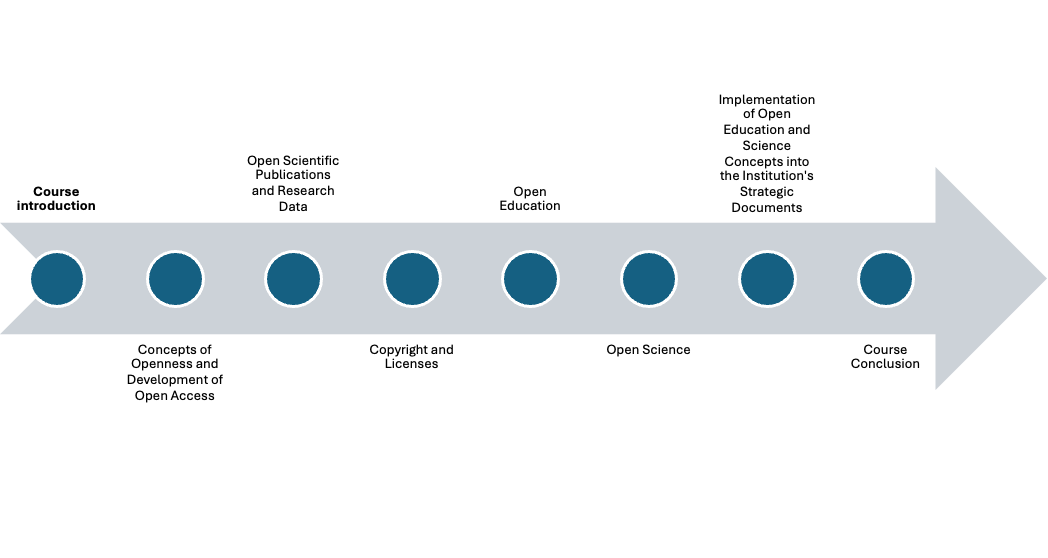
Picture: Display of summative assessment
4. Technical Information About the E-Course Platform
This e-course is delivered via Loomen, which is based on the open-source Moodle platform. The e-course homepage is organised according to the course structure, with links on the homepage directing participants to activities and resources in line with the course design.
The e-course can be accessed from a computer connected to the internet, a smartphone, or a tablet. It functions correctly in all popular web browsers (Firefox, Opera, Chrome, Edge…). It is also available through a mobile application, which may not always perform optimally.
Navigation through the e-course is quicker using the menu on the left-hand side, while on the right-hand side, participants can track upcoming activities, important announcements, and their progress in the course.
Loomen is user-friendly, and in case of any difficulties, participants should contact the instructor.
5. Minimum Technical Requirements for Attending the E-Course
Types of content in the e-course
Educational multimedia (predominantly textual) materials (for example, lessons and pages) are available through Loomen and can be opened directly in a web browser. It is also possible to download all materials in PDF format, so participants should have a PDF reader installed. If a browser such as Firefox or Chrome is used, a PDF reader is not necessary, as PDFs can be opened directly in the browser.
Video lessons are originally hosted on CARNET’s multimedia portal Meduza and are integrated into Loomen pages, allowing access without leaving Loomen. To watch the video lessons, an internet connection of at least 2 Mbit/s is required. Headphones or speakers are also necessary.
Practical tasks can be created in MS Word or another tool chosen by the participant.
Evaluation activities in the e-course are supported by the corresponding Loomen functions, and no additional technical requirements are needed. Quizzes open entirely within the web browser, so no extra technical prerequisites are required.
Synchronous activities in the course are conducted using the BigBlueButton platform, which is integrated into Loomen. Technical requirements for participating in synchronous activities include a microphone, headphones, and an internet connection with a speed of preferably 5 Mbit/s or higher.
6. Participant Responsibilities
Participants are encouraged to take part in as many activities as possible: reviewing and analysing video lessons and educational materials, practical activities, and more. During the implementation of the e-course, it is possible to earn up to 100 points. The following table provides a list of mandatory activities in the e-course by theme, delivery method, and possible points. The course is considered passed if a total of at least 50 points is achieved, with at least one-third of the points earned in each graded activity.
7. Contact Information
For all content-related questions and inquiries regarding e-course participation, please contact your instructor.
For technical questions, please contact the e-mail address x@carnet.hr or call 01 xxxxxxx.
8. E-Course Code of Conduct
To ensure better collaboration, we have defined certain rules of conduct for the e-course.
-
Respect other participants as if they were in the same room with you. Foster a culture of appreciation and constructive dialogue in your communication. Behind every username is a real person – kindness and empathy are key to a positive learning environment.
-
Use professional and clear language. Strive for correct grammar, avoid using all capital letters (which can be interpreted as shouting), and try to express your thoughts clearly. Inappropriate or offensive messages are not acceptable.
-
Stay on topic and be concise. Your comments, answers, and messages should be related to the topic and structured to be understandable to others. You help both yourself and your colleagues by expressing yourself clearly and purposefully.
-
Participate actively and timely. Your activity contributes to the quality of collective learning. Try to check announcements regularly, respond to assignments within set deadlines, and engage in discussions.
-
Protect privacy and information confidentiality. Do not share the personal data of other participants without their explicit consent. Also, be cautious when sharing your own data in public course spaces.
-
Do not post promotional content or unsolicited messages. The course is not a place for advertising, chain letters, or political messages. The focus should be on course content and mutual learning.
-
Express disagreement in a constructive way. Direct criticism toward the content or idea, not the person. If you disagree, argue your opinion while respecting different viewpoints.
-
Communicate through appropriate channels. For technical and organizational questions, use the designated forums or contact the e-course mentors through official channels. Informal communication is welcome in designated spaces, provided basic rules of politeness are followed.
-
Prepare for participation in virtual meetings. If the course includes video meetings, it is recommended to use a camera (whenever possible), stay in a quiet environment, and unmute only when you have a comment or question. Respect others' time and do not disrupt the workflow.
-
Act in accordance with ethical and legal norms. Respect copyrights, institutional regulations, and applicable laws. Unauthorized use of content, plagiarism, or sharing confidential information is not permitted.
Why these rules? The goal is to ensure a high-quality, inclusive, and professional learning environment where everyone feels comfortable.
What if the rules are violated? In case of non-compliance, course leaders may issue a warning, and in more serious situations, take further steps in accordance with the institution's regulations.
Who is responsible? All course participants share the responsibility for maintaining a positive and professional atmosphere.
9. Literature
Each theme includes a corresponding list of references used in the preparation of the course; therefore, depending on your particular interest in a topic, it is advisable to consult the literature related to that subject.
Here you can find the complete reference list:
Berlin Declaration on Open Access to Knowledge in the Sciences and Humanities. (2003, Oct 22). Max Planck Society.
Bethesda Statement on Open Access Publishing. (2003, Jun 20). Peter Suber's Open Access Project.
Budapest Open Access Initiative. (2002, Feb 14). Read the Budapest Open Access Initiative. E-Learning Center, University Computing Centre SRCE.
Cape Town Open Education Declaration. (2008, Jan 22). Unlocking the promise of open educational resources.
Creative Commons. (b.d.). About CC Licenses.
Pravilna upotreba tuđih i dijeljenje vlastitih obrazovnih sadržaja u e-kolegiju (Vodič). (2020). E-Learning Center, University Computing Centre SRCE.
Autorsko pravo. (2022). State Intellectual Property Office of the Republic of Croatia.
Open Science. European Commission. (b.d.).
Inamorato dos Santos, A. (2016). Practical Guidelines on Open Education for Academics: Modernising Higher Education via Open Educational Practices (based on the OpenEdu Framework), EUR 29672 EN, Publications Office of the European Union, Luxembourg, 2019, ISBN 978-92-76-00194-2, doi:10.2760/55923, JRC115663
Inamorato Dos Santos A., Punie Y., & Castaño Muñoz J. (2016). Opening up Education: A Support Framework for Higher Education Institutions. EUR 27938. Luxembourg (Luxembourg): Publications Office of the European Union; 2016. JRC101436
Autorska prava i licencije. Inicijativa Otvorena znanost. (b. d.).
Katulić, T. (2018). Što su i čemu služe Creative Commons? CARNET.
Končić, I. (2021). FAIR principi ili kako biti FAIR s istraživačkim podacima. Library of the Ruđer Bošković Institute.
Knešaurek, I., Matanovac Vučković, R., Petrović, V., & Sučić, T. (2015). Upravljanje intelektualnim vlasništvom na Sveučilištu. University of Zagreb, Center for Research, Development and Technology Transfer (CIRTT).
Melinščak Zlodi, I. (2013). Autorsko pravo i upotreba Creative Commons licencija u znanstvenom izdavaštvu. Medijska istraživanja, 19(1), 119–137.
Hrvatski plan za otvorenu znanost. (2025). Ministry of Science, Education and Youth.
Plan razvoja istraživačke infrastrukture u Republici Hrvatskoj 2023. – 2027. (2023). Ministry of Science, Education and Youth.
Making Open Science a Reality (OECD Science, Technology and Industry Policy Papers, No. 25). (2015). OECD. OECD Publishing, Paris.
Otvorena znanost. Otvorena znanost. (b.d.).
Otvorena istraživačka infrastruktura. Otvorena znanost u Hrvatskoj. (b.d.).
Otvoreni pristup. Otvorena znanost u Hrvatskoj. (b.d.).
Preporuka Radne skupine o autorskom pravu o upotrebi Creative Commons licencija i ostalih uvjeta korištenja dokumenata u repozitorijima u Dabru. (2018). Digital academic archives and repositories (Dabar). Copyright Working Group.
Inicijativa za Hrvatski oblak za otvorenu znanost (HR-OOZ). University Computing Centre SRCE. (b.d.).
Dabar - Digitalni akademski arhivi i repozitoriji. University Computing Centre SRCE. (b.d.).
Pohrana i upravljanje podacima Puh. University Computing Centre SRCE. (b.d.).
Politika otvorene znanosti Sveučilišta u Zagrebu. (2024). University of Zagreb.
UNESCO Recommendation on Open Science. (2021). UNESCO.
Zakon o autorskom pravu i srodnim pravima, NN 111/2021.
Background Colour
Font Face
Font Size
Text Colour
Font Kerning
Image Visibility
Letter Spacing
Line Height
Link Highlight
Paragraph Width
Text Alignment