Defining clear and measurable learning outcomes
| Site: | Loomen za stručna usavršavanja |
| Course: | Developing Digital Teaching Content |
| Book: | Defining clear and measurable learning outcomes |
| Printed by: | Gost (anonimni korisnik) |
| Date: | Thursday, 17 September 2026, 5:14 AM |
1. What are learning outcomes?
Learning outcomes are statements describing what an individual knows, understands, and is able to do upon completion of a particular learning process (European Commission, 2015). They focus on specific student achievements and enable clear and measurable assessment of acquired knowledge, skills, and competences. Learning outcomes form the basis for designing teaching content, activities, and assessment methods.
By achieving learning outcomes, students develop competences—the ability to apply knowledge, skills, and personal, social, and methodological abilities in different contexts (work, study, personal development).
What is the difference between learning objectives and learning outcomes?
Learning objectives are traditionally focused on what the teacher plans to cover during instruction, while learning outcomes describe what the student should be able to demonstrate upon completing an activity or course. The key difference lies in perspective:
-
Objectives reflect the teacher’s intention.
-
Outcomes represent the student’s measurable achievement.
|
Teaching objective |
Learning outcome |
|---|---|
|
explain the purpose and structure of learning outcomes and present examples of well-formulated learning outcomes in higher education |
define learning outcomes for a teaching topic, unit, or module within a course |
|
introduce the concept of constructive alignment and demonstrate the connection between learning outcomes, activities, and assessment methods in a digital environment |
connect learning outcomes with teaching and learning activities and tools for content delivery and performance assessment |
|
familiarise participants with pedagogically meaningful digital tools and criteria for their critical evaluation and selection |
critically evaluate tools for creating digital content, including tools for knowledge assessment |
|
teach participants how to apply digital tools in creating high-quality, functional, and accessible teaching content |
create digital teaching content using appropriate digital tools |
|
explain the basic ethical and legal standards, including copyright and Creative Commons licences, and how they are applied in teaching practice |
apply relevant regulations and standards, including licensing, when publishing digital teaching content |
|
demonstrate the process of publishing and distributing digital teaching content in an LMS, including accessibility and technical checks |
publish digital content in a selected learning management system and/or digital repository |
2. How to formulate learning outcomes?
Learning outcomes should be:
-
student-centred – they describe what the student will do, not what the teacher will cover;
-
measurable – they use observable and assessable action verbs (e.g., analyse, create, describe);
-
clear and specific – they avoid vague verbs such as understand, become familiar with, learn;
-
relevant and achievable – realistic within the timeframe and level of the course;
-
aligned with cognitive complexity – based on Bloom’s revised taxonomy.
Typical structure of a learning outcome
A well-constructed learning outcome usually contains:
-
Action verb – cognitive activity (e.g., apply, evaluate, design)
-
Content – knowledge, skill, or concept to be acquired
-
Context or condition of application (when needed)
Example of a learning outcomes:
"apply the rules of visual design when creating digital teaching content."
Why are learning outcomes important?
Learning outcomes enable:
-
teachers to plan content, learning activities, and assessment methods aligned with intended results;
-
students to understand expectations and criteria for success, which supports self-regulation and motivation;
-
educational institutions to ensure transparency, comparability, and adherence to quality standards.
3. Bloom's Taxonomy
Bloom’s Taxonomy is a classification of educational objectives originally developed by Benjamin Bloom and colleagues in 1956 (Bloom, 1956). Its purpose was to help teachers define and organise learning goals according to levels of cognitive complexity that students are expected to achieve. The original taxonomy included six levels:
-
knowledge
-
comprehension
-
application
-
analysis
-
synthesis
-
evaluation
In 2001, the taxonomy was revised by L. W. Anderson and D. R. Krathwohl. The revised version introduced several important changes:
-
nouns were replaced with verbs – the categories were reformulated into action verbs to emphasise what students do (e.g., “application” becomes “apply”)
-
the order of the highest levels was changed – creating is now the highest cognitive level, above evaluating
-
a two-dimensional structure was introduced, consisting of:
-
a cognitive process dimension (Remember, Understand, Apply, Analyse, Evaluate, Create),
-
a knowledge dimension, which distinguishes four types of knowledge: factual, conceptual, procedural, and metacognitive.
-
The revised taxonomy focuses on what students can do with acquired knowledge, making it a powerful tool for defining measurable and concrete learning outcomes, as well as for planning teaching activities and assessment.
Table 1. Revised Bloom’s Taxonomy
|
Level |
Definition |
Example of verbs |
|
Remembering |
recalling facts, concepts, and basic information from prior learning |
choose, define, identify, list, match, name, recall, relate, describe |
|
Understanding |
demonstrating comprehension by organising, comparing, translating, interpreting, or summarising main ideas |
classify, compare, contrast, demonstrate, explain, illustrate, interpret, outline, paraphrase, summarise |
|
Applying |
using knowledge in new situations; solving problems by applying previously learned material |
apply, construct, choose, develop, experiment, identify, interview, use, model, organise, plan, solve |
|
Analysing |
breaking information into parts to explore relationships, causes, or patterns |
analyse, hypothesise, categorise, classify, compare, differentiate, divide, examine, inspect, separate, investigate, test |
|
Evaluating |
making judgments about ideas, evidence, or methods based on established criteria |
evaluate, choose, compare, conclude, criticise, decide, defend, determine, justify, measure, explain, support, recommend, rank |
|
Creating |
combining elements and ideas into new wholes; designing new approaches, solutions, or products |
adapt, build, combine, compose, construct, create, design, develop, elaborate, formulate, propose, solve, test |
4. Revised Bloom’s Taxonomy
Examples of learning outcomes for each level of Bloom’s taxonomy:
|
Level |
Learning outcome |
|
remembering |
list tools for creating digital learning content |
|
understanding |
explain the advantages of using interactive elements in online learning |
|
applying |
apply accessibility guidelines when creating digital learning materials |
|
analysing |
compare two learning management systems based on predefined criteria |
|
evaluating |
assess the quality of a video lesson using a predefined assessment chart |
|
creating |
design a scenario for a digital lesson using the H5P tool |
5. Constructive alignment
Constructive alignment is a pedagogical approach that aligns all key elements of the teaching process: learning outcomes, learning activities, and assessment. Its goal is to encourage active and meaningful learning among students.
Constructive alignment (Biggs, 1996) refers to the alignment of three key elements of teaching:
- learning outcomes – what students are expected to achieve
- teaching activities – which enable the achievement of the outcomes
- assessment – which evaluates exactly what is defined in the learning outcomes.
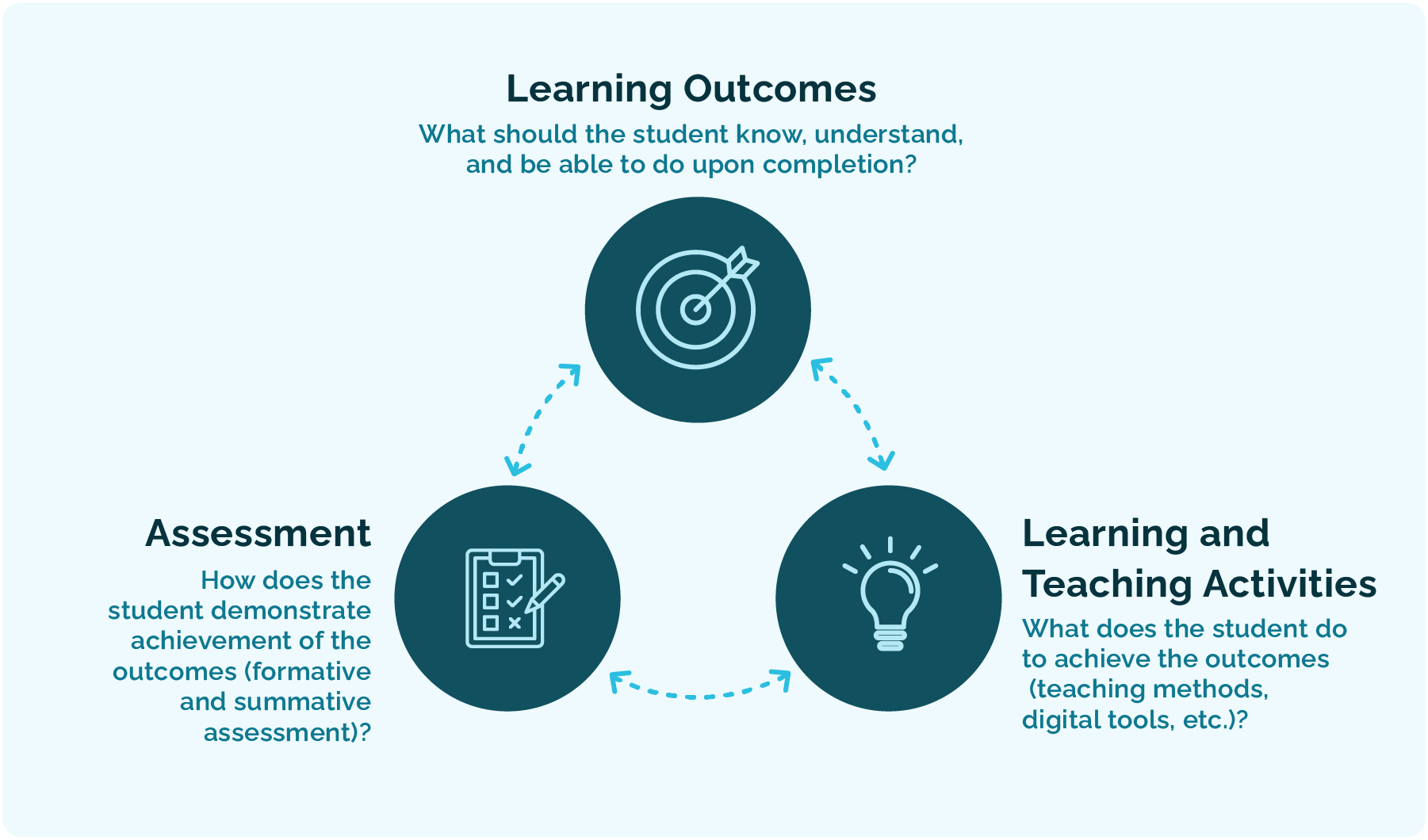
Figure 1. Conceptual design
Constructive alignment consists of two interrelated principles – the constructive approach to learning and the alignment of teaching elements – which together enable an effective and meaningful educational process.
Constructive:
- It is grounded in constructivist learning theory, according to which students actively construct knowledge through their own experience and engagement in meaningful tasks.
- Learning is not the passive reception of information, but active participation in problem-solving, discussions, projects, and other activities.
Alignment:
- It refers to coherence:
- between learning outcomes (what a student should know and be able to do)
- between teaching activities (what the student does during learning)
- between assessment methods (how we assess the achievement of those outcomes).
- All components should be consistent – for example, if the outcome is “analyse,” the student must have the opportunity to analyse, not just listen to a lecture, and the assessment should evaluate that analysis.
According to Biggs (1999): What and how students learn depends to a major extent on how they think they will be assessed. When activities and assessment are aligned with the achievement of learning outcomes, students are motivated to learn what truly matters, rather than simply studying for an exam.
By ensuring constructive alignment between learning outcomes, teaching activities, and assessment, teachers can create a more effective learning environment that responds to the diverse needs of students (Divjak et al., 2025).
Table 3. Examples of constructive alignment across all levels of Bloom’s taxonomy:
|
Level |
Learning outcome |
Teaching activity |
Assessment |
|
remembering |
list the basic characteristics of digital learning materials |
interactive presentation with a glossary and quiz |
multiple-choice quiz |
|
understanding |
explain the difference between declarative and functional knowledge |
pair discussion + comparison table |
a summary with explanations of the differences |
|
applying |
apply visual design principles in creating learning materials |
creating an infographic in Canva or Genially |
submission and rubric-based assessment (visual clarity, structure, message) |
|
analysing |
analyse examples of good practice in digital education |
analysis of three learning resources using predefined criteria |
reflection or a table with arguments and recommendations |
|
creating |
design an interactive digital learning resource |
group creation of content in H5P |
project assessed with a rubric (interactivity, didactic value) |
Adapting content to students
To ensure learning outcomes are achievable, content and activities should be adapted to the diverse needs and characteristics of students – their prior knowledge, interests, learning styles, and context.
This includes:
- using different formats (text, video, interactive exercises)
- enabling a choice of tools, examples, or tasks
- aligning content with students’ professional practice or experience
- monitoring progress through learning analytics and providing timely feedback.
Adapting does not mean lowering standards, but creating meaningful learning pathways towards the same learning outcomes.
You can learn more about learning outcomes and constructive alignment in the online e-course Learning Design.
6. Constructive Alignment Scenarios
Below are three constructive alignment scenarios that illustrate how to align a learning outcome, a learning activity, and an assessment across different courses and at various levels of Bloom’s taxonomy.
Checking Constructive Alignment – Three Key Questions
When designing each learning outcome, check whether:
-
the learning activity enables the student to do what the learning outcome requires
(alignment between learning outcomes and learning activities); -
the assessment measures exactly what is defined in the learning outcome
(alignment between learning outcomes and assessment); -
the assessment criteria are clearly communicated to students in advance
(transparency and focus on achievement).
7. Literature
Anderson, L. W., & Krathwohl, D. R. (Eds.). (2001). A taxonomy for learning, teaching, and assessing: A revision of Bloom's taxonomy of educational objectives. New York: Longman.
Bloom, B. S. (1956). Taxonomy of educational objectives: The classification of educational goals. McKay.
Biggs, J. (1996). Enhancing teaching through constructive alignment. Higher Education, 32(3), 347–364.
Biggs, J. (1999). Teaching for Quality Learning at University. Buckingham: Open University Press.
Divjak, B., Barthakur, A., Kovanović, V., & Svetec, B. (2025). The Impact of Learning Design on the Mastery of Learning Outcomes in Higher Education. In LAK25: The 15th International Learning Analytics and Knowledge Conference (pp. 1–12). ACM.
ECTS Users’ Guide. (2015). European Commission.
Background Colour
Font Face
Font Size
Text Colour
Font Kerning
Image Visibility
Letter Spacing
Line Height
Link Highlight
Paragraph Width
Text Alignment