Assessment Analysis: Concepts, Types, and Modern Approaches
| Site: | Loomen za stručna usavršavanja |
| Course: | Assessment Using Digital Technology |
| Book: | Assessment Analysis: Concepts, Types, and Modern Approaches |
| Printed by: | Gost (anonimni korisnik) |
| Date: | Friday, 18 September 2026, 5:00 AM |
1. Assessment and grading
Assessment in education involves a systematic process of collecting and interpreting information about student learning in order to make educational decisions, provide feedback, and support learning.
In the context of digital education, assessment includes the use of digital tools and platforms to enable effective, transparent, and personalized monitoring of progress.
Assessment is the process of making judgments about student learning using various methods that collect, analyze, and interpret data on their achievements.
Assessment is a broader concept than grading. It encompasses all procedures used to gather information about student learning and progress, and may be based on both qualitative and quantitative indicators.
Grading is a narrower term within assessment and refers to assigning a final grade (e.g., numerical or letter) that expresses a student’s level of achievement. Such achievement most often reflects the results of summative assessment. Grading has an administrative function—used for decisions on passing, awarding diplomas or certificates, and reporting on performance. The key purpose of grading is to express the level of attainment of learning outcomes in a standardized way.
2. Basic types of assessment
|
Type of Assessment |
When It Is Conducted |
Main Purpose |
Examples in a Digital Environment |
|---|---|---|---|
|
Diagnostic |
Before learning |
Identifying initial knowledge |
Google Forms entry test, LMS quiz |
|
Formative |
During learning |
Monitoring and guiding learning |
Interactive quiz, forum, reflections |
|
Summative |
At the end of learning |
Evaluating achievement of learning outcomes |
Online exam, video project, e-portfolio, Workshop project |
Example:
At the beginning of the semester, students participate in a diagnostic assessment of their prior knowledge so that the course design can be adjusted to their needs.
During the semester (e.g., on a weekly basis), students may engage in formative assessment through quizzes to give both themselves and the instructor feedback on their progress. The instructor can advise students on learning strategies based on quiz results. To reduce workload—especially in courses with a large number of students—quiz feedback can be automated.
Achievement of learning outcomes can be assessed through summative assessment, for example, through two midterm exams and one project assignment completed in teams.
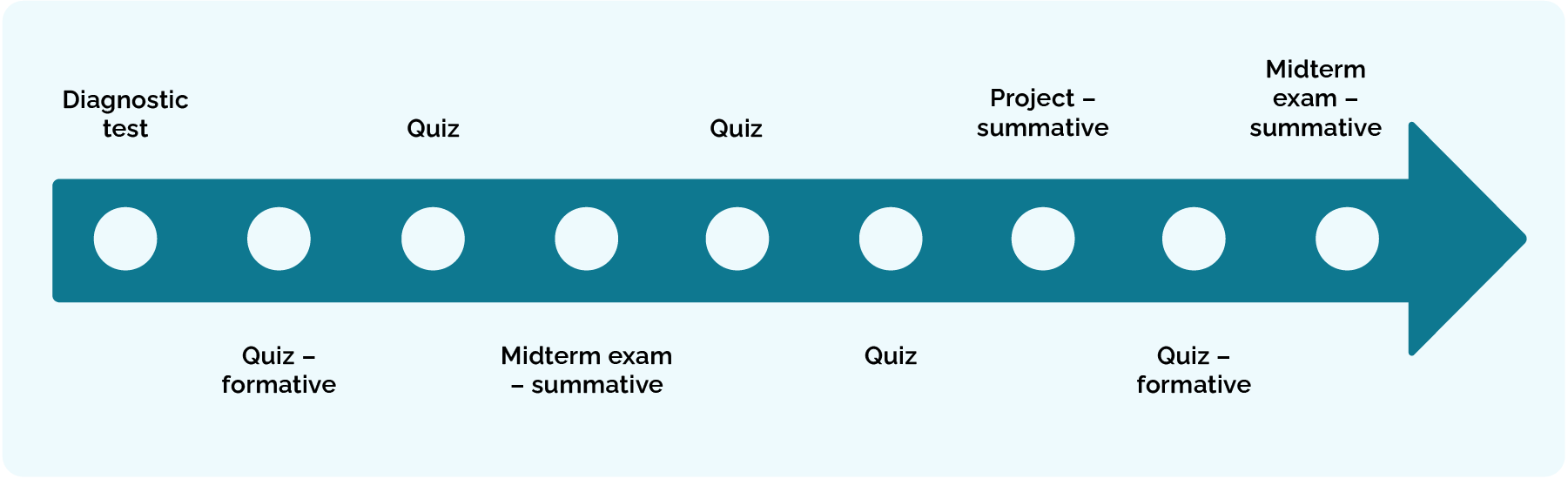
Figure 1. Timeline – illustration
3. Constructive Alignment
The concept of Constructive Alignment, developed by John Biggs (1999), emphasizes the alignment between:
-
learning outcomes – clearly defined knowledge, skills, and attitudes that students are expected to acquire after the learning process
-
learning and teaching activities – which enable students to actively construct knowledge and develop the competencies needed to achieve the learning outcomes
-
assessment – which evaluates exactly what the learning outcomes specify, using appropriate methods and criteria.
Such alignment ensures that all elements of the teaching process work together to promote active and meaningful student learning, as well as transparency and fairness in evaluating their achievements.
Application in digital education:
The use of digital tools must support the clearly defined learning outcomes of the course.
Example:
If the learning outcome is “to analyse data,” then digital assessment should not be limited to a multiple-choice test but should include analytical tasks supported by digital tools (e.g., Excel or another spreadsheet tool, analytics in the learning management system (LMS)).
4. Involving Students in Assessment Strategies
In contemporary approaches to digital assessment, the emphasis is on the active participation of students in co-creating the learning and teaching process, in line with constructivist learning theory. Students are not merely passive recipients of knowledge, but active participants in shaping success criteria, assessing their own progress, and understanding feedback.
According to Boud and Falchikov (2006), assessment should be an integral part of learning (assessment for learning, not only of learning). They highlight that the assessment process has the greatest value when it:
-
encourages reflection and self-regulation
-
empowers students for lifelong independent learning
-
includes high-quality feedback that promotes deeper understanding, not only the evaluation of performance.
Similarly, Entwistle (2009) emphasizes the importance of developing a deep approach to learning—students should be engaged in metacognitive activities that help them understand how and why they learn, not just what they need to learn. Participation in assessment processes enables students to connect success criteria with their own experiences and learning strategies.
Activities that involve students:
-
participating in discussions about assessment criteria and co-designing rubrics.
-
Self-assessment and peer assessment, including justification of evaluations.
-
Setting personal learning goals and reflecting on progress using digital portfolios or learning journals.
-
Using feedback to adjust learning strategies and plan next steps.
Pedagogical importance:
By involving students in the assessment process:
-
their metacognition is strengthened — awareness of their own thinking and learning processes
-
their responsibility for learning increases
-
intrinsic motivation grows because students take an active role in achieving learning outcomes
-
and assessment becomes a tool for learning, not merely a mechanism for grading.
5. Challenges and Adaptations in the Digital Environment
Risks:
- Possibilities of cheating and misuse of generative artificial intelligence (especially in summative assessments).
- Lack of direct interaction may make it more difficult to interpret students’ responses and understand their learning processes.
- Technical difficulties and the digital divide among students may affect the fairness and reliability of assessment.
Adaptations and Recommendations:
- Use a combination of different assessment methods and tools (e.g., quiz + forum + project + automated formative assessment) to reduce the risk of cheating and increase the authenticity of evaluation.
- Clearly communicate criteria, purpose, and expectations related to assessment, and involve students in understanding the criteria (transparent assessment) to support the development of self-regulation and the effective use of feedback. (Nicol–Macfarlane–Dick, 2006; Carless–Boud, 2018).
- Provide automated yet personalized feedback, for example, through tools with built-in learning analytics and AI support.
-
Integrate formative assessment into the learning process, encouraging student reflection and self-regulation rather than relying solely on summative assessments. (Divjak–Svetec–Horvat, 2024).
6. Digital Assessment – More Than Just Technology
Digital tools should not change the very purpose of assessment, but rather enable:
- faster collection and processing of data
- personalized feedback
- greater visibility of the learning process.
Effective assessment in digital education must be:
- pedagogically grounded – focused on learning outcomes and motivating learning processes
- technologically feasible – implementable using available tools that both teachers and students can use
- ethical and credible – conducted with respect for ethical standards and academic integrity.
7. Questions for Self-Assessment and Reflection
Questions for Self-Assessment
-
In one sentence, compare what assessment is and what grading is, and explain their relationship.
-
List the differences and purposes of diagnostic, formative, and summative assessment, and provide one example of an activity for each type.
-
Explain the principle of constructive alignment and describe how learning outcomes, activities, and assessment are connected in your course (provide one specific learning outcome and an appropriate assessment method).
-
What does transparent assessment in a digital environment entail, and how does it support student self-regulation?
-
List two major risks of digital assessment and one adaptation that can mitigate each risk.
Questions for Reflection
-
How would you meaningfully distribute diagnostic, formative, and summative assessment throughout the semester in your course (a short “timeline” with example activities)?
-
Choose one learning outcome from your course. Which digital assessment method would you use to better measure that outcome, and why (with a short explanation of constructive alignment)?
-
How will you involve students in developing criteria and support the development of a feedback culture?
-
What would you automate, and where is personalized feedback necessary? Justify your choices in relation to goals and available resources.
-
Given the rise of generative artificial intelligence, what measures and design decisions will you implement to preserve credibility and fairness?
8. Literature
Biggs, J. (1999). Teaching for Quality Learning at University: What the Student Does (1st ed.) . Open University Press.
Boud, D., Falchikov, N. (2006). Aligning assessment with long-term learning . Assessment & Evaluation in Higher Education, 31(4), 399–413.
Carless, D., Boud, D. (2018). The development of student feedback literacy: Enabling uptake of feedback . Assessment & Evaluation in Higher Education, 43(8), 1315–1325.
Divjak, B., Svetec, B., Horvat, D. (2024). How can valid and reliable automatic formative assessment predict the acquisition of learning outcomes? Journal of Computer Assisted Learning, 1–17.
Entwistle, N. (2009). Teaching for Understanding at University: Deep Approaches and Distinctive Ways of Thinking. Palgrave Macmillan.
Nicol, D. J., & Macfarlane‐Dick, D. (2006). Formative assessment and self‐regulated learning: A model and seven principles of good feedback practice . Studies in Higher Education, 31(2), 199–218.
Background Colour
Font Face
Font Size
Text Colour
Font Kerning
Image Visibility
Letter Spacing
Line Height
Link Highlight
Paragraph Width
Text Alignment