Role of Self-Assessment in Developing Self-Regulation
| Site: | Loomen za stručna usavršavanja |
| Course: | Assessment Using Digital Technology |
| Book: | Role of Self-Assessment in Developing Self-Regulation |
| Printed by: | Gost (anonimni korisnik) |
| Date: | Saturday, 19 September 2026, 4:01 PM |
Table of contents
- 1. Self-Assessment
- 2. Key Findings in Literature
- 3. Self-Assessment in Educational Practice
- 4. Self-Assessment in an Online Environment
- 5. Effectiveness of Self-Assessment
- 6. Recommendations for Practice
- 7. Self-Assessment in Moodle: Overview and Implementation
- 8. Activity Implementation in Moodle:
- 9. Self-Assessment and Reflection Questions
- 10. Sources and Literature for Further Reading:
1. Self-Assessment
This material covers the definitions of self-assessment, key findings from the literature, and ways in which student self-assessment functions in practice. It concludes with recommendations for implementing self-assessment in higher education.
Definition
Self-assessment refers to the involvement of students in assessing their own learning, particularly in relation to their achievements and learning outcomes. Self-assessment gives students an active role in their own learning (Boud, 1989) and is most commonly used in formative assessment to encourage reflection on their learning processes and outcomes.
According to Ifenthaler et al. (2023), self-assessment is defined as:
"A process in which students in a digital environment gather information about their own performance, assess and reflect on the quality of their learning processes and learning outcomes according to predefined criteria, often using a form of self-check with feedback."
2. Key Findings in Literature
Underestimation vs. overestimation: Higher-achieving students tend to underestimate their performance, whereas lower-achieving students are more likely to overestimate their work (Boud & Falchikov, 1989). This is also confirmed by Radović et al. (2023) in an online context.
Level of study and achievement: Students in earlier years of study more frequently overestimate their abilities (Celine et al., 2023).
Gender differences in accuracy: Male students are more likely to overestimate their work compared to female students (González-Betancor et al., 2019).
Rubrics and feedback: The accuracy of self-assessment increases when clear criteria and regular feedback are provided (Krebs et al., 2022; Nietfeld et al., 2006).
3. Self-Assessment in Educational Practice
Several instruments for self-assessment are used in educational practice.
Harrington (1995) proposes three approaches:
- checklists of competencies
- Likert scales
- descriptive examples
McNamara and Deane (1995) suggest activities such as:
- writing letters to the instructor
- keeping a language learning journal
- creating portfolios that help students identify their strengths and weaknesses, track their progress, and set goals for independent learning
Keith (1996) further proposes a variety of self-assessment tasks as tools for fostering reflection and responsibility:
- expressing prior beliefs about learning
- comparing learning goals
- encouraging collaborative learning
- stimulating reflective thinking
- self-assessment after exams
- co-assessing assignments
The effectiveness of these methods depends on students’ effort and their willingness to take responsibility for their own learning.
In contemporary higher education, self-assessment is increasingly implemented as a form of formative assessment aimed at strengthening metacognition, self-regulation, and responsibility for one’s own learning.
Successful self-assessment requires a developed ability to realistically assess one’s achievements, which is built through experience, clear criteria, and feedback. Beginning students often overestimate their work because they rely on subjective impressions rather than objective criteria, whereas more advanced students tend to demonstrate greater self-criticism. For this reason, instructors should scaffold the self-assessment process by demonstrating examples of good practice and discussing what constitutes “good performance” according to the rubric.
Example in practice: In the course “Research Methodology,” students complete a brief self-assessment form before submitting their essay, answering questions such as:
-
Which part of your work do you consider the strongest, and why?
-
Which part are you least confident about?
-
How would you assess your work according to the clarity-of-argumentation criterion?
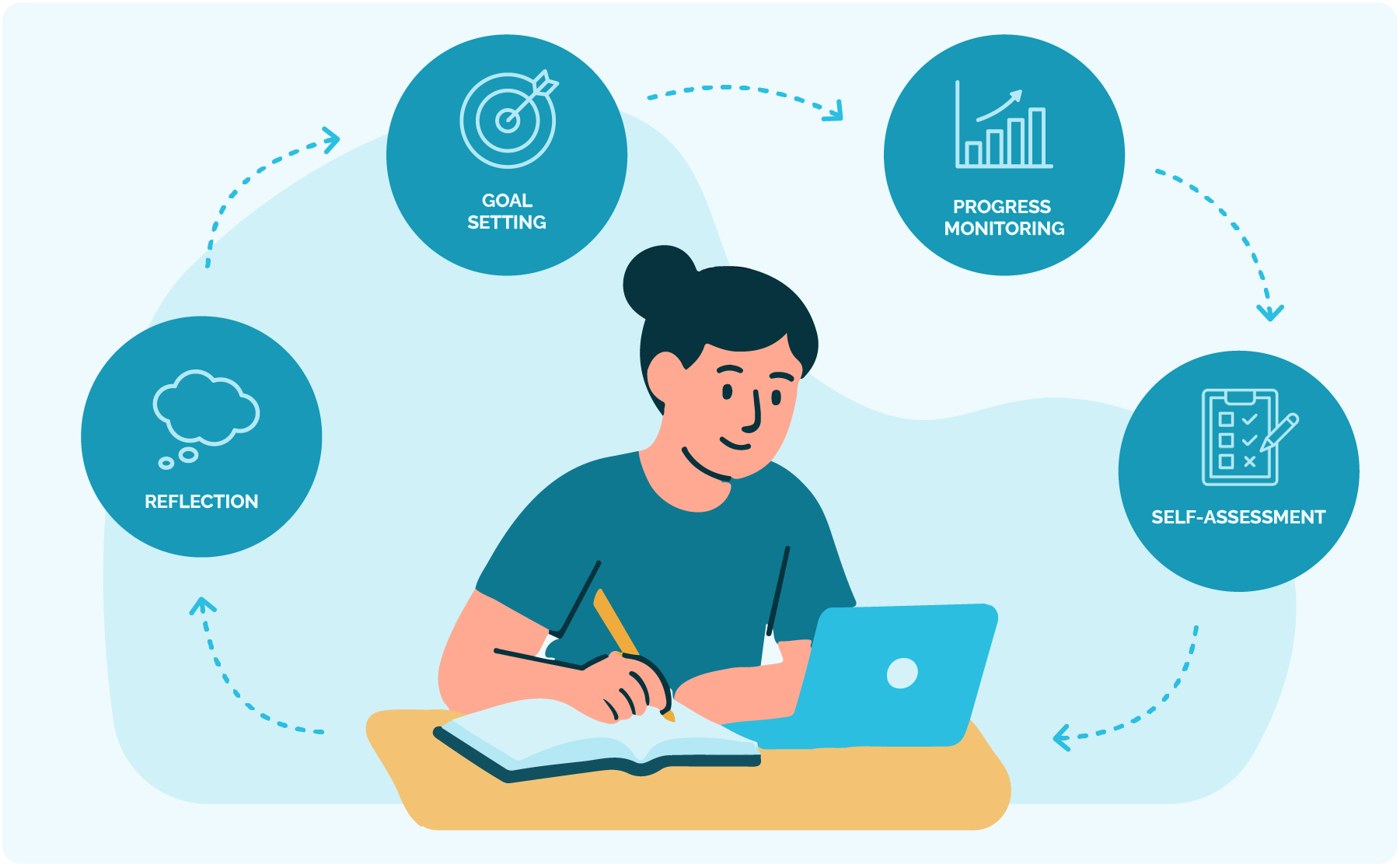
Figure 1. The self-regulated learning cycle
4. Self-Assessment in an Online Environment
Self-assessment in the online environment: Students learning in an online environment (or in distance education more broadly) often have difficulties recognizing their own mistakes and weaknesses because they lack immediate feedback from instructors and peers. The reasons include limited opportunities for social comparison, reduced self-reflection, and fewer chances to verbally articulate their understanding. (Radović et al., 2023).
Electronic learning journals: Increased metacognition and motivation have been confirmed as outcomes of keeping reflective journals (Ramadhanti et al., 2020).
Problem-based learning (PBL): The combination of self-assessment and feedback enhances self-regulation among medical students (Beck, 2025).
Tools based on large language models (LLM tools): The use of large language models supports students’ reflection and metacognitive thinking (Kumar et al., 2024). In higher education, tools such as ChatGPT, Copilot, and Gemini are widely used for self-assessment, as well as specialised platforms that prompt students to reflect on their own work (essays, programmes, projects, etc.), including FeedbackFruits, EduGPT, and LearnAI.
5. Effectiveness of Self-Assessment
In general, many years of research have demonstrated the positive effects of implementing self-assessment in education.
Gentle (1994) developed the Thesys system, which enabled higher education students to independently assess their own projects. Findings showed that these self-assessments were relatively accurate, even without direct instructor intervention.
This ability improves further when students receive feedback and gain experience in assessing work. In addition, research by Hassmén et al. (1996) found that students who practice self-assessment achieve significantly better test results.
Furthermore, the Falchikov & Boud (1989) meta-analysis confirms that self-assessment in higher education can be both reliable and valid. Moreover, Ross (2006) demonstrates through meta-analysis that, with adequate training and clear criteria, self-assessment can be reliable, valid, and contribute to improved academic achievement.
6. Recommendations for Practice
The following set of five practical recommendations for instructors on effectively and efficiently guiding the self-assessment process is taken from Radović et al. (2023):
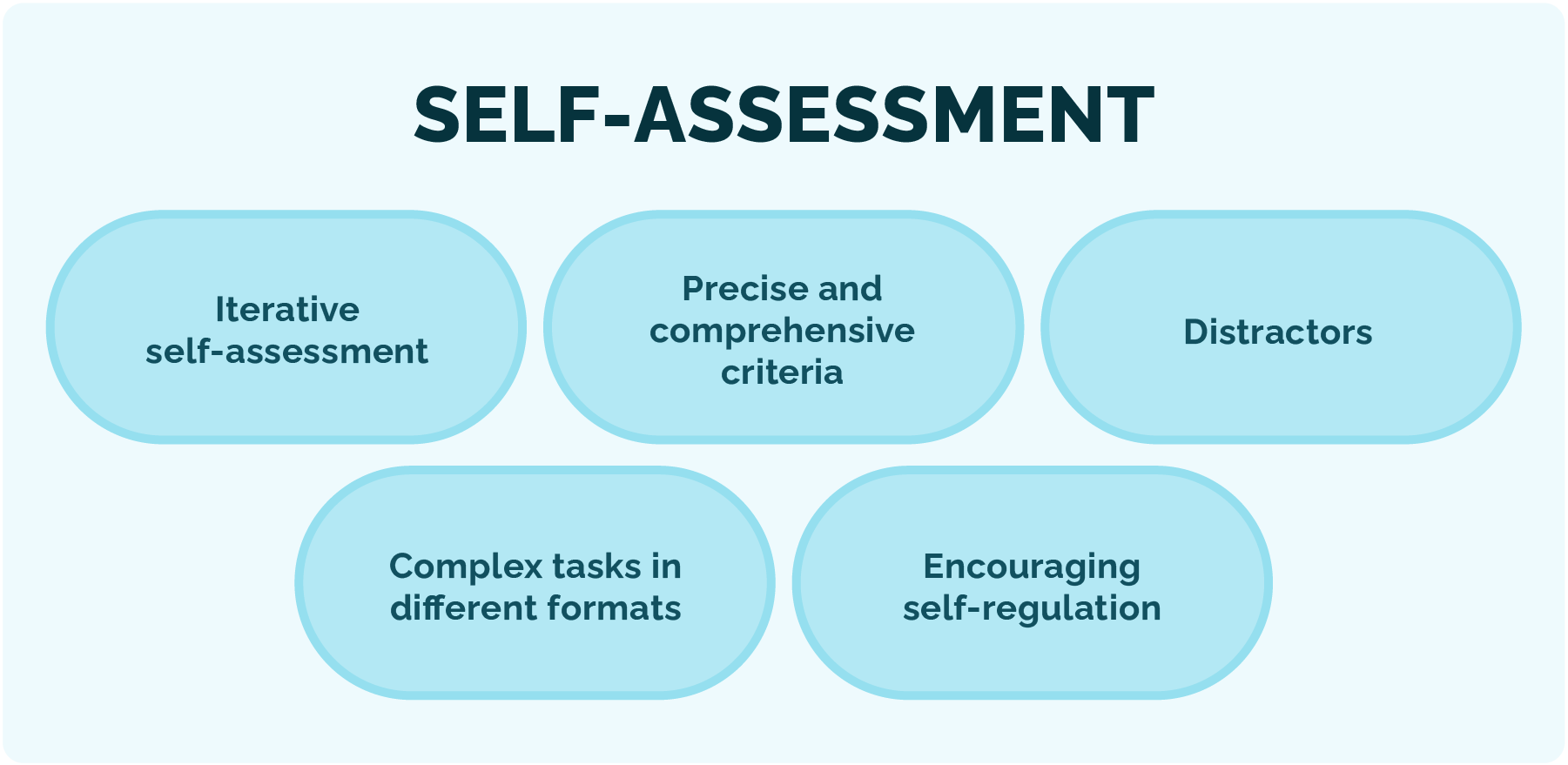
Figure 2. Recommendations summary
1. Enable iterative self-assessment
Ensure that students have the opportunity not only to assess their solutions using predefined criteria, but also to revise and resubmit their work for additional assessment. This iterative process encourages deeper engagement with course content and supports continuous refinement of understanding.
2. Use precise and comprehensive criteria
When designing self-assessment tasks, include clear, concrete, and well-defined criteria. Well-articulated criteria allow students to identify even subtle improvements in their learning. Such an approach increases both the accuracy and the overall value of the self-assessment.
3. Incorporate distractors to deepen understanding
Include distractors—responses that appear correct but are actually based on common errors or misconceptions. This approach encourages students to think critically about their own understanding and to distinguish between correct and incorrect options.
4. Balance task complexity using varied formats
Use a variety of task types—from numerical problems and short responses to multiple-choice items. Also consider the expected length of responses, as tasks requiring more elaborate explanations may pose a greater challenge for accurate self-assessment.
5. Encourage self-regulation through motivational mechanisms
Consider introducing motivational elements that promote active engagement in self-assessment. For example, awarding badges for participation or providing bonus points for accurately solved tasks can encourage students to engage in consistent self-assessment and reflection throughout the course.
Research (Panadero & Jonsson, 2013) confirms that the use of rubrics with explicit criteria and performance levels enhances the reliability and validity of self-assessment. Finally, the use of digital tools and LLM-based systems can effectively support student reflection and metacognitive development.
7. Self-Assessment in Moodle: Overview and Implementation
Instructors today use a variety of digital tools that support and facilitate the self-assessment process.
The most common methods include rubrics, journals, e-portfolios, and activities within LMS platforms such as Moodle (e.g., Assignment, Workshop, Journal).
The table below presents the uses and advantages of selected Moodle activities.
| Moodle Activity | Use When | Advantages |
|---|---|---|
| Assignment | When students submit individual work (essay, case analysis) and need to perform a rubric-based self-assessment | Simple to implement; easy to combine with instructor feedback |
| Lesson | When you want to embed reflective questions within the content | Encourages self-reflection during learning, without grading |
| Feedback | When you want to collect student self-assessment during a project or after an activity | Rapid collection of data on students’ perception of their own progress |
| Workshop | When you want to combine self-assessment with peer assessment | Systematic tracking of self-assessments and comparison with instructor ratings |
| Journal | When continuous reflection on learning is desired | Provides an individual space for written reflections and tracking progress |
AI-powered tools such as ChatGPT or GrammarlyGO also allow students to receive real-time feedback and engage more deeply in reflecting on the quality of their own work.
The latest trends include self-reflection supported by interaction with tools based on large language models (LLMs) and the use of digital quizzes for self-check and self-assessment.
8. Activity Implementation in Moodle:
1. “Assignment” activity with a self-assessment option
Step 1: Create an assignment in Moodle as usual (e.g., an essay, project, or case study analysis).
Step 2: In the assignment description, include a rubric or checklist with criteria for self-assessment.
Step 3: Ask students to complete a self-assessment document (e.g., a Word/PDF table, questionnaire, or Google Form) along with submitting their work.
Step 4: Enable the upload of additional files – students submit both their work and the completed self-assessment form.
Note: You may also include a comment field to allow students to reflect on their learning.
2. “Lesson” activity with self-assessment questions
Create an interactive lesson with content and embedded questions that are not graded (e.g., “How would you assess your contribution to this project?”).
At the end of the lesson, enable a text entry where students describe their own insights.
3. “Feedback” activity
Used for the structured collection of student self-assessment through a survey form.
You can use Likert scales, open-ended questions, and reflective scales.
Ideal for self-assessment during a project, after a presentation, or following a reflective task.
4. “Workshop” activity
Although primarily designed for peer assessment, it also enables self-assessment.
In the settings, enable self-assessment (student self-assessment).
Moodle then displays the student’s own work for assessment, using the same rubric as for other assessments.
Recommendations for using self-assessment in Moodle:
- always include clear assessment criteria or a rubric
- make the criteria and rubric available to students before submission and embed them in the assignment description
- encourage students to reflect: What did I do well? What could I improve?
- do not assign a grade to self-assessment – keep it formative
- combine self-assessment with instructor feedback and peer assessment to align perceptions.
9. Self-Assessment and Reflection Questions
Self-assessment questions
-
Explain the difference between self-assessment and peer assessment.
-
Describe how rubrics and clearly defined criteria can improve the accuracy and usefulness of self-assessment.
-
Provide an example of an activity in Moodle in which you could implement self-assessment.
-
Explain how self-assessment contributes to the development of students’ metacognition and self-regulation.
-
Explain why students may sometimes overestimate or underestimate their own work and how instructors can help reduce these discrepancies.
Reflection questions
-
Consider how you could integrate self-assessment as a formative activity in your course without creating excessive workload for students or instructors.
-
Describe how you would prepare students to understand the purpose and criteria of self-assessment.
-
Propose an example of combining self-assessment, peer assessment, and instructor assessment in your course.
-
Explain how AI tools could support students’ reflection while maintaining the authenticity of their work.
Reflect on ways you can encourage students to view self-assessment as a tool for their professional development rather than merely a course requirement.
10. Sources and Literature for Further Reading:
Andrade, H., Du, Y. (2007). Student responses to criteria-referenced self-assessment. Assessment and Evaluation in Higher Education, 32(2), 159–181.
Beck, A. P. (2025). Assessment of first-year medical student perceptions in the development of self-directed learning skills in a single medical school course. BMC Medical Education, 25, 340.
Bolívar-Cruz, A., Verano-Tacoronte, D., González-Betancor, S. M. (2015). Is university students’ self-assessment accurate? In M. Peris-Ortiz & J. Merigó Lindahl (Eds.), Sustainable Learning in Higher Education. Springer.
Boud, D. (2006). Aligning assessment with long-term learning. Assessment & Evaluation in Higher Education, 31(4), 399–413.
Boud, D., Lawson, R., Thompson, D. G. (2015). The calibration of student judgement through self-assessment: Disruptive effects of assessment patterns. Higher Education Research & Development, 34(1), 45–59.
Boud, D., Falchikov, N. (1989). Quantitative studies of student self-assessment in higher education: A critical analysis of findings. Higher Education, 18(5), 529–549.
Brown, G. T. L., Andrade, H., Chen, F. (2015). Accuracy in student self-assessment: Directions and cautions for research. Assessment in Education: Principles, Policy & Practice, 22(4), 444–457.
Busco, C., Dooner, C., d’Alencon, A. (2018). Universidad de Chile: Self-assessment and its effects on university’s management. Higher Education, 75, 431–447.
Clark, I. (2012). Formative assessment: Assessment is for self-regulated learning. Educational Psychology Review, 24(2), 205–249.
De Grez, L., Valcke, M., Roozen, I. (2012). How effective are self- and peer assessment of oral presentation skills compared with teachers’ assessments? Active Learning in Higher Education, 13(2), 129–142.
Dochy, F., Segers, M., Sluijsmans, D. (1999). The use of self-, peer- and co-assessment in higher education: A review. Studies in Higher Education, 24(3), 331–350.
Falchikov, N., Boud, D. (1989). Student self-assessment in higher education: A meta-analysis. Review of Educational Research, 59(4), 395–430.
Gentle, D. P. (1994). Self-assessment using a computer-based system. Journal of Educational Computing Research, 11(3), 343–358.
González-Betancor, S. M., Bolívar-Cruz, A., Verano-Tacoronte, D. M. (2019). Self-assessment accuracy in higher education: The influence of gender and performance of university students. Active Learning in Higher Education, 20(2), 101–114.
Hassmén, P., Sams, M., Hunt, D. P. (1996). Self-assessment of learning: The impact on test performance. Psychology Learning & Teaching, 1(2), 95–100.
Ifenthaler, D. (2023). Investigating self-assessment use in higher education with learning analytics. Journal of Computer Assisted Learning.
Keith, S. Z. (1996). Self-assessment materials for use in portfolios. Primus, 6(3), 234–256.
Krebs, M. C., Rothstein, D., Roelle, J. (2022). Rubrics enhance accuracy and reduce cognitive load in self-assessment. British Journal of Educational Psychology, 92(3), 1315–1335.
Kumar, H., Xiao, R., Lawson, B., Musabirov, I., Shi, J., Wang, X., Luo, H., Williams, J., Rafferty, A., Stamper, J., Liut, M. (2024). Supporting self-reflection at scale with large language models: Insights from randomized field experiments in classrooms.
McNamara, M. J., Deane, D. (1995). Self-assessment activities: Toward language autonomy in language learning. The Language Teacher, 19(4), 14–17.
Panadero, E., Jonsson, A. (2013). The use of scoring rubrics for formative assessment purposes revisited: A review. Educational Research Review, 9, 129–144.
Panadero, E., Brown, G. T. L., Courtney, M. (2022). Students’ strategies during self-assessment: Feedback and rubrics effects. Assessment in Education, 29(1), 23–43.
Radović, S., Seidel, N., Menze, D., Kasakowskij, R. (2023). Analysing students’ self-assessment practice in a distance education environment: Student behaviour, accuracy, and task-related characteristics. Journal of Computer Assisted Learning, 39(1), 168–181.
Ramadhanti, D., Ghazali, A. S., Hasanah, M., Harsiati, T., Yanda, D. P. (2020). The use of reflective journal as a tool for monitoring of metacognition growth in writing. International Journal of Emerging Technologies in Learning, 15(11), 162–187.
Background Colour
Font Face
Font Size
Text Colour
Font Kerning
Image Visibility
Letter Spacing
Line Height
Link Highlight
Paragraph Width
Text Alignment