Criteria for selecting artificial intelligence tools and systems for educational purposes
| Site: | Loomen za stručna usavršavanja |
| Course: | Artificial Intelligence in Education |
| Book: | Criteria for selecting artificial intelligence tools and systems for educational purposes |
| Printed by: | Gost (anonimni korisnik) |
| Date: | Thursday, 17 September 2026, 12:58 AM |
Table of contents
- 1. Introduction
- 2. Key Criteria
- 2.1. Relevance to educational goals
- 2.2. Support for specific learning outcomes
- 2.3. Efficiency and accuracy of artificial intelligence tools and systems
- 2.4. Evidence of effectiveness
- 2.5. Ethics and security
- 2.6. Adaptability and personalisation
- 2.7. Quality of support and available resources
- 2.8. Price and availability
- 2.9. Compatibility with existing systems
- 2.10. Adaptation to the needs of learners
- 3. Conclusion
- 4. Literature
1. Introduction
As it has been repeatedly emphasised in this e-course, artificial intelligence introduces new possibilities in education and enables the improvement of learning and teaching through personalised approaches, increased efficiency, and support for pedagogical decision-making.
The full potential of these solutions can be realised only with a thoughtful and responsible selection of tools and systems based on artificial intelligence.
An inadequately careful selection of artificial intelligence tools and systems can lead to various challenges, including technical difficulties, limited reliability of results, and risks related to privacy protection, algorithm transparency, and ethical issues. Therefore, it is necessary to establish clear and measurable criteria to assess the suitability, security, and pedagogical value of a particular tool or system in the educational context.
Carefully selected artificial intelligence tools and systems allow the alignment of technological functionalities with educational goals, ensure respect for ethical principles and legal requirements, and create an inclusive environment in which all participants have equal opportunities to learn and progress.
The following section defines and explains the key criteria that can serve as a basis for making informed decisions about the implementation and use of artificial intelligence tools in education.
2. Key Criteria
The following key criteria can help in selecting appropriate AI tools and systems for educational purposes:
- Relevance to educational goals
- Support for specific learning outcomes
- Effectiveness and accuracy
- Evidence of effectiveness and research
- Ethics and safety
- Adaptability and personalisation
- Quality of user support and available resources
- Price and availability
- Compatibility with existing systems
- Adaptability to participants' needs.
Each of these criteria is described below with examples of their importance in selecting the right choice of AI tools and systems for education.
2.1. Relevance to educational goals
It is essential that the selected AI tool and system support educational goals, such as developing critical thinking, creativity, or expertise in a specific field.
If the AI tool and system do not contribute to educational goals, their use becomes redundant and does not enhance the quality of learning.
Examples:
- Educational goal: Developing critical thinking through problem-solving
- How does the AI tool Socratic by Google contribute to this educational goal?
- Socratic recognises questions posed via images or text and offers explanations, links to relevant resources, and step-by-step guides. Since it does not simply provide final solutions but also encourages understanding of concepts and consideration of solution strategies, it actively involves students in the learning process and the development of an analytical approach, rather than leaving them as passive recipients of information.
- Teaching Application:
- Interactive exercises: Instructors can demonstrate different approaches to problem-solving during class, with explanations provided by the tool.
- Independent student activities: Students can use the tool to check and understand the solution process, while instructors monitor their progress through feedback.
- Assistance in learning: Provides additional explanations and support for independent work to students who have difficulty understanding the content.
- How does the AI tool Socratic by Google contribute to this educational goal?
- Educational goal: Developing creativity, argumentation, and analytical thinking
- How does the artificial intelligence tool ChatGPT (OpenAI) contribute to this educational goal?
- ChatGPT is used to support learning, research, and writing. It provides suggestions for ideas, text structures, and feedback, which encourages students to creatively design content. By asking guiding and probing questions, it supports the development of arguments and a deeper understanding of the topic, thereby contributing to a high level of cognitive engagement.
- Application in teaching:
- Interactive exercises: Use in group discussions to generate different perspectives and arguments.
- Independent student activities: Support in writing essays, projects, and other written works.
- Assistance in learning: Provides additional explanations and clarifications of complex material as needed.
- How does the artificial intelligence tool ChatGPT (OpenAI) contribute to this educational goal?
Pedagogical note:
The way a tool is used directly determines its educational value. If a tool is used only to obtain a ready-made answer, it does not contribute to the development of competencies. When it is used to support thinking, creating, and arguing, it becomes a powerful resource for encouraging active and independent learning.

Image source: Shutterstock
2.2. Support for specific learning outcomes
Every AI tool and system should have a clearly defined role in achieving specific learning outcomes, whether these involve acquiring new skills or gaining a deeper understanding of certain concepts. For example, tools that simulate practical exercises can help learners better understand real-world situations through experiential learning.
Examples:
- Learning outcome: Create functional code and apply it to solve practical problems.
- Example of how the GitHub Copilot AI system helps achieve this learning outcome:
- GitHub Copilot generates real-time code suggestions during the writing process, supporting learning through practice and encouraging critical thinking about possible solutions. This directly contributes to the development of practical programming skills.
- Example of how the GitHub Copilot AI system helps achieve this learning outcome:
-
Learning outcome: Interpret a mathematical model and perform a numerical solution to a given problem while verifying the accuracy of the results.
-
Example of how the artificial intelligence tool Photomath can help achieve this learning outcome:
-
Photomath provides detailed explanations for each step in solving a mathematical problem, allowing students to better understand both basic and advanced mathematical techniques. It enables independent exploration and problem-solving, encouraging the development of critical thinking and analytical skills. Quick access to solutions and explanations increases efficiency in learning and exam preparation.
-
Application of Photomath in teaching:
-
Interactive exercises: Instructors can use the application to demonstrate different methods for solving mathematical problems during class.
-
Independent student activities: Photomath can support independent problem-solving, with the option for subsequent checking and feedback from the instructor.
-
Learning assistance: For students who have difficulty with certain mathematical concepts, the application provides additional explanations and individualised support.
-
-
In addition to Photomath, the artificial intelligence tool Math Now offers similar functions. As a conversational assistant, it allows users to enter a mathematical problem in text form and provides a step-by-step solution with explanations. This further supports the interpretation of mathematical models, numerical solutions, and verification of results. An example of the application of this tool is shown in the picture.
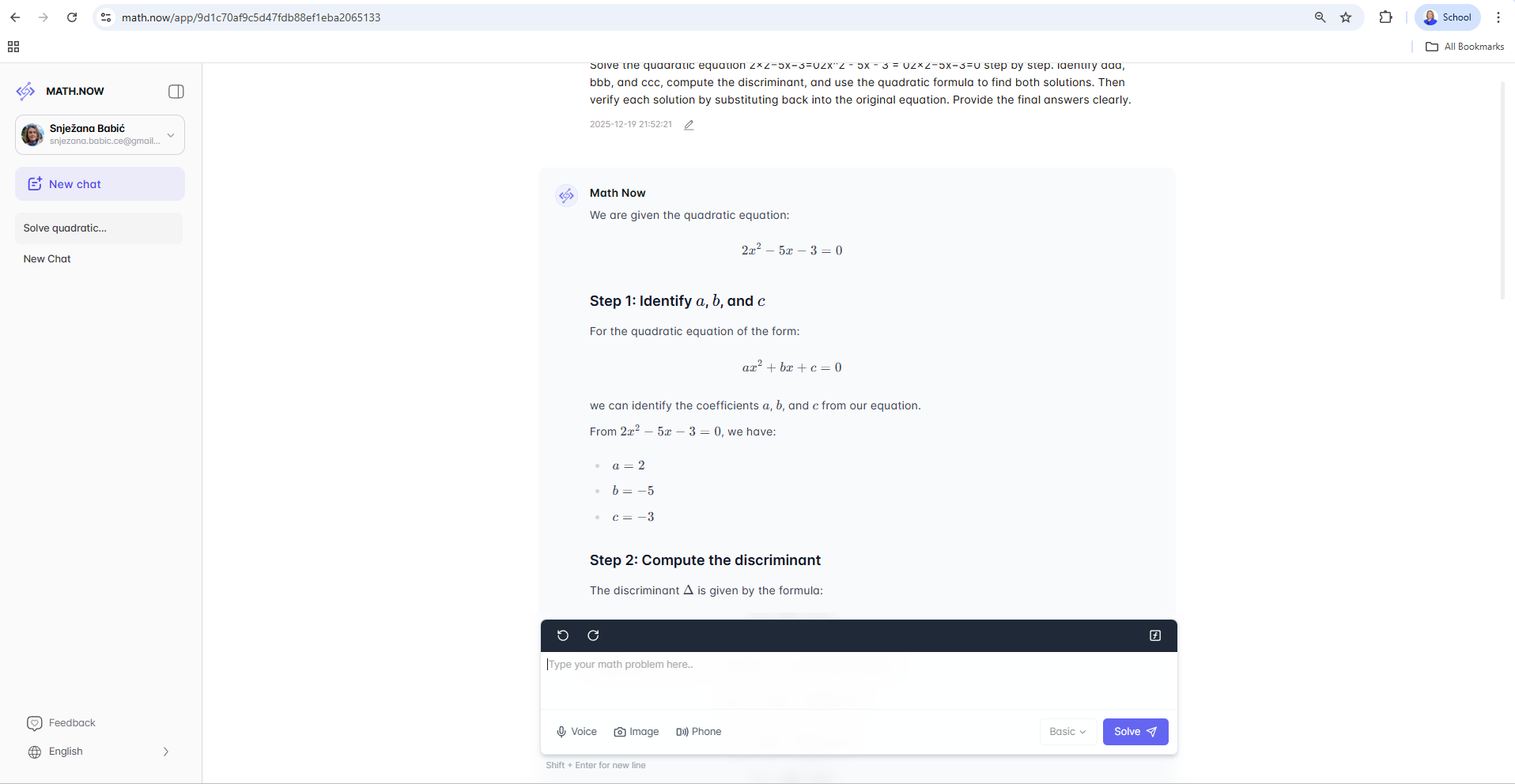
Figure: The interface of the Math Now web tool while solving a math problem (source: author, screenshot).
2.3. Efficiency and accuracy of artificial intelligence tools and systems
A quality AI tool or system must be efficient, reliable, and accurate. If these tools frequently provide incorrect information or inaccurate results, they can confuse or discourage students, negatively affecting their understanding of the material and their trust in the technology. It is important to emphasise that any error in an educational context also has pedagogical consequences, as it can impact students’ motivation and sense of achievement.
Examples:
- An automated essay grading system, such as Gradescope, uses AI to analyse student work and assign grades. If such a system provides inaccurate or unreliable assessments – for example, due to poorly defined metrics, an inappropriate training dataset, or inadequate rubric management – students may become confused or discouraged because they perceive the grades as unfair. Therefore, the AI model must be thoroughly trained and its results regularly reviewed.
- An automated originality checking tool, such as Turnitin, uses AI to detect plagiarism in student work. If the system frequently generates false positives or false negatives – for example, unfairly accusing a student because their writing style is similar to another’s, or missing a real case of plagiarism – trust in the process and the sense of fairness can be significantly undermined. Therefore, such tools must ensure a high level of accuracy, regular review, and clear communication about the system's potential limitations.
2.4. Evidence of effectiveness
Before introducing AI-based tools and systems into teaching, it is necessary to consider whether research and evidence support their effectiveness and contribution to learning. AI tools that have already been evaluated in real educational settings are a safer choice, as their functionality and pedagogical value are based not only on marketing claims but also on results from testing and application in educational practice. Such validation reduces the risk of inadequate implementation and allows teachers to make informed decisions about how much the tool can enrich the learning experience.
Example:
- Duolingo is one of the most well-known examples of AI-based educational tools whose effectiveness has been confirmed in numerous studies. By using adaptive algorithms that respond to individual user progress, it enables systematic vocabulary acquisition and the development of language comprehension. Because of these pedagogical advantages, it is increasingly integrated into school and university curricula as an additional and easily accessible tool for learning foreign languages.
- Gradescope is widely accepted in educational practice as a reliable system for automated grading and providing structured feedback to students, especially in STEM fields. Research and teaching experience confirm that it facilitates consistent and transparent evaluation for teachers while providing students with faster insight into their own mistakes and opportunities for improvement. As a result of these benefits, Gradescope has been integrated into many university programmes, including those at Harvard University and the Massachusetts Institute of Technology (MIT).
2.5. Ethics and security
Any AI tool or system used in education must uphold the principles of privacy and transparency while avoiding bias in its results. Students have the right to safe and ethically responsible technology use, which includes protecting their personal data, ensuring anonymity where possible, and providing clear communication about how data is collected, processed, and used to improve learning. Failure to comply with these principles can lead to a loss of trust in the education system and may result in technology indirectly creating inequality among students.
Example:
- Turnitin, a system for checking the originality of student work, uses artificial intelligence methods to detect plagiarism. It emphasises maintaining confidentiality and data security. The student's identity remains protected, and all data processing is conducted in accordance with the applicable legislative framework for personal data protection, such as the General Data Protection Regulation (GDPR) in Europe. Additionally, the system's transparency allows students and teachers to understand how the algorithm works and to access the results of the analysis, reducing the risk of injustice and helping maintain trust in the evaluation process.
- Khan Academy uses artificial intelligence in its personalised learning system, with clearly defined procedures for protecting user privacy. Data is processed in a way that prevents the identification of individuals and is not shared without explicit consent. The system is designed to minimise bias in recommendations, ensuring equal opportunities for all educational stakeholders to access and progress in learning, regardless of their initial conditions or specific circumstances.
Special attention is given to the responsible use of technology to prevent the creation or deepening of existing differences in educational outcomes among different groups of students. This helps create a more equitable and inclusive educational environment.
This approach strengthens the trust of all educational stakeholders in the use of artificial intelligence in education, as higher education institutions, teachers, and students can be confident that the technology serves their interests and is a pedagogically responsible tool that enhances teaching and learning processes.
2.6. Adaptability and personalisation
Effective AI tools and systems in education are defined by their ability to adapt to different learning styles and the individual needs of students. Personalising learning in this way can positively influence motivation, confidence, and success in mastering material, as it allows students to progress at their own pace with content that matches their interests and prior knowledge. Platforms that dynamically adjust activities for each student contribute to greater engagement and a higher-quality educational experience.
Examples:
- The Curipod tool uses artificial intelligence to generate interactive teaching content, such as quizzes, surveys, and problem-solving tasks, that adapt to students' knowledge and interests. Teachers can further tailor activities to the specific needs of their group, increasing pedagogical effectiveness and student engagement. The system also provides real-time feedback, helping students recognise and correct errors more quickly and enabling teachers to better monitor progress.
- Knewton is a platform that supports personalised learning in higher education. The system continuously analyses student progress, identifies areas of strength and those needing additional support, and adjusts educational content accordingly. Because of this flexibility, Knewton easily integrates with existing educational materials and learning environments, making it a valuable tool to support students throughout their studies.
2.7. Quality of support and available resources
The successful implementation of AI-based systems in education depends not only on their technical capabilities but also on the level of support available to educational stakeholders. Without clear instructions and well-organised user support, advanced tools can be difficult to use and cause frustration. This highlights the need to ensure reliable assistance mechanisms, such as guides, tutorials, educational resources, and access to expert support when needed, alongside technology development. The availability of support greatly affects the acceptance and effectiveness of the tool in the educational process.
Examples:
- The Copilot for Microsoft 365 tool uses artificial intelligence to support writing and text analysis in applications such as Word, Excel, and PowerPoint. The tool is accompanied by a wide range of resources for students and teachers, including integrated instructions within the applications, interactive demonstrations, detailed guides, and video materials. In addition, community forums and official technical support are available, allowing users to master new functionalities more quickly and reducing dependence on prior technical knowledge. This ensures that educational stakeholders can effectively use Copilot in educational tasks without unnecessary obstacles.
- Khan Academy provides support for the use of the virtual assistant Khanmigo (AI tutor Khanmigo) developed in collaboration with OpenAI. This system allows users to ask questions and receive feedback in real time, encouraging active learning and timely clarification of ambiguities. The platform also offers manuals, video tutorials, answers to frequently asked questions, and advice for educational stakeholders. High-quality documentation and ongoing support contribute to greater acceptance of the tool and its effectiveness in the educational environment.
2.8. Price and availability
The cost of AI-based tools and systems should be affordable and fit within the educational institution’s budget. Technical availability is equally important. AI tools and systems must be usable on various devices so all students have equal opportunities to use their features, regardless of the type or quality of equipment they have. This reduces the risk that financial or technical barriers will limit access to educational content.
Examples:
- ChatGPT is available for free in its basic version and can be used on computers, tablets, and mobile devices through a web browser or application. Since it does not require additional equipment or advanced technical settings, it is easy to integrate into educational activities and thus increases the availability of digital tools for a wide range of educational stakeholders.
- Google Socratic is a free AI-based system, particularly useful in higher education. For example, students can take a photo of a question or task, and the system recognises the content and provides explanations and links to relevant educational resources. Its availability on most mobile devices at no additional cost removes barriers to knowledge access and supports more inclusive education.
2.9. Compatibility with existing systems
AI tools and systems should be compatible with other digital solutions used in education, such as e-learning systems, learning management platforms, and assessment tools. Effective integration reduces technical difficulties, facilitates daily use, and provides access to all functionalities within a single digital environment. This increases work efficiency and enhances the quality of the educational experience for all participants in the teaching process.
Example:
- Gradescope is a system for automatically grading student assignments in programming, mathematics courses, and short-answer quizzes. Because it can be directly integrated with Moodle, students receive assignments, grades, and feedback within the same interface they use for other teaching activities. The AI-based system supports teachers in grouping similar answers and maintaining consistency in assessment, while providing students with fast and clear feedback. A high level of compatibility reduces technical difficulties and facilitates the implementation of evaluation in a digital environment.
2.10. Adaptation to the needs of learners
It is important to emphasise that AI-based tools and systems must be intuitive and useful for learners to truly support learning. If they are too complex to understand or not aligned with the users' needs, their application can cause frustration, reduce motivation, and negatively affect the educational process. Effective educational solutions are based on clarity, ease of use, and a focus on the real challenges learners face.
Examples:
- Khanmigo, a virtual assistant developed by Khan Academy, is especially useful for students without a strong background in STEM fields. It explains complex mathematical and scientific concepts at a level appropriate to each learner's prior knowledge, often using examples from everyday life. This increases content comprehensibility, reduces discomfort, and encourages confidence in learning, as the tool does not require a high level of technical expertise.
- GitHub Copilot is a virtual assistant that helps students write and understand programming code. It generates suggestions in real time and allows students to make their own decisions, supporting the development of critical thinking and analytical skills. The tool's flexibility is evident in its ability to adapt to different knowledge levels: it offers clear, simple suggestions to beginners and provides more advanced solutions and optimisations to experienced users.
-
QuillBot is a tool that assists students in writing academic texts, such as essays and research papers. Using artificial intelligence, it helps with sentence reformulation, grammatical accuracy, and stylistic design while adapting to each student's individual expression. In this way, students receive valuable support in developing precise and clear writing, making it easier to articulate ideas and improving the quality of their written work. With a simple interface and availability on various devices, the tool is easy to integrate into everyday academic activities.
3. Conclusion
Investing in the careful selection and regular evaluation of AI-based technologies provides long-term benefits and supports the sustainable development of educational processes aligned with modern technological changes. The effective use of such solutions in teaching requires a systematic approach and clearly defined criteria. Efficiency, ethics, adaptability, and alignment with educational goals are particularly important.
When considering the introduction of AI in education, it is essential to remember that technology should not become an end in itself. Its primary purpose is to support real educational needs and goals while enhancing the quality of learning and teaching.
Well-chosen and responsibly applied AI-based tools can improve learning outcomes and help create a safe, inclusive, and motivating environment for all participants in the educational process. Although these criteria form the basis for decision-making, it is important to recognise that each educational environment has its own specific characteristics. Many additional factors must be considered depending on the needs of each institution and the context of application. These aspects will be discussed in more detail in the remainder of this e-course.

Image source: Shutterstock
4. Literature
-
Chen, L., Chen, P., & Lin, Z. (2020). Artificial Intelligence in Education: A Review. IEEE Access, 8, 75264-75278.
Description: Reviews key criteria for selecting and implementing AI technologies in education, including effectiveness, ethics, and adaptability. -
Holmes, W., Bialik, M., & Fadel, C. (2019). Artificial Intelligence in Education: Promises and Implications for Teaching and Learning. Center for Curriculum Redesign.
Description: Discusses criteria such as ethics, security, effectiveness, and alignment with educational goals. -
Dignum, V. (2019). Responsible Artificial Intelligence: How to Develop and Use AI in a Responsible Way. Springer Nature.
Description: Discusses ethical guidelines and security requirements in the development and implementation of AI systems. -
Mittelstadt, B. D., et al. (2016). The ethics of algorithms: Mapping the debate. Big Data & Society, 3(2), 1-21.
Description: Emphasises the importance of transparency and impartiality in AI systems. -
Brusilovsky, P., & Millán, E. (2007). User Models for Adaptive Hypermedia and Adaptive Educational Systems. In The Adaptive Web (pp. 3-53). Springer.
Description: Describes criteria related to adaptability and personalisation of AI tools in education. -
Woolf, B. P. (2010). Building Intelligent Interactive Tutors. Morgan Kaufmann.
Description: Provides guidelines for evaluating the effectiveness and personalisation of AI systems. -
Luckin, R., Holmes, W., Griffiths, M., & Forcier, L. B. (2016). Intelligence Unleashed: An Argument for AI in Education. Pearson.
Description: Presents practical criteria for evaluating AI tools before implementation in classes. - Aljohani, A. (2025). Data-Driven Pedagogy: Empowering Educational Excellence in Saudi Higher Institutions Through the Integration of AI and ML. In International Conference on Mathematical Modeling and Computational Science (pp. 11–21). Cham: Springer Nature Switzerland.
Description: Analyses the contribution of artificial intelligence and machine
learning to the modernisation of higher education.
- Alkhateeb, A., Hezam, A. M. M., & Almuraikhi, A. A. (2025). Assessing the use of AI tools for EFL exam preparation at Saudi universities: efficiency, benefits, and challenges. Cogent Education, 12(1), 2507553.
Description: Analyses the efficiency, benefits, and challenges of using AI tools in English as a Foreign Language (EFL) exam preparation at Saudi universities, focusing on the real-world impact on learning and technology accessibility.
- Selwyn, N. (2019). Should Robots Replace Teachers? AI and the Future of Education. Polity Press.
Description: Discusses financial and accessibility aspects when choosing AI technologies in education.
Background Colour
Font Face
Font Size
Text Colour
Font Kerning
Image Visibility
Letter Spacing
Line Height
Link Highlight
Paragraph Width
Text Alignment