Examples of successful implementation of artificial intelligence tools and systems in education – organisational aspect
| Site: | Loomen za stručna usavršavanja |
| Course: | Artificial Intelligence in Education |
| Book: | Examples of successful implementation of artificial intelligence tools and systems in education – organisational aspect |
| Printed by: | Gost (anonimni korisnik) |
| Date: | Thursday, 17 September 2026, 9:36 AM |
Table of contents
- 1. Introduction
- 2. Key organisational factors
- 2.1. Technical infrastructure
- 2.2. Education and support for staff
- 2.3. Adaptation to end users
- 2.4. Ethical issues and data security
- 2.5. Evaluation of effectiveness and feedback
- 2.6. Timing and planning
- 2.7. Institutional strategy and leadership
- 2.8. Good practice examples
- 2.9. Arizona State University (ASU)
- 2.10. University of Michigan
- 2.11. British University Vietnam
- 3. Conclusion
- 4. Literature
1. Introduction
The introduction of artificial intelligence into the education system offers numerous opportunities to enhance the learning process, personalise instruction, and optimise administrative and assessment tasks. Artificial intelligence tools and systems can help tailor teaching content to individual student needs, enable automated progress monitoring and identification of learning patterns, and provide instructors with deeper insights into data that support pedagogical decision-making. Additionally, artificial intelligence can significantly reduce instructors' administrative workload by automating routine tasks, generating feedback, and assisting in the development of teaching materials.
However, the successful implementation of these tools depends not only on their technical capabilities but also on the organisational conditions within the institution. Technological innovations in education require systematic institutional support, clearly defined strategies, and long-term planning. Instructors and teachers also play a crucial role in this process; their understanding, motivation, and digital competencies largely determine the extent to which artificial intelligence will improve teaching and learning. Therefore, the application of artificial intelligence should not be seen as an isolated technical process, but as part of a broader transformation of educational practice and institutional culture.
Without a clearly defined strategy, adequate infrastructure, systematic training of teaching and professional staff, and stable institutional support, artificial intelligence may remain only a potential that is never fully realised. This topic focuses on the organisational aspects of implementing artificial intelligence in education – specifically, the factors within educational institutions that enable, encourage, or hinder its successful adoption and practical application.

Image source: Shutterstock
2. Key organisational factors
The successful integration of AI tools and systems into an educational environment must be considered within the broader institutional context. Coordination is required at multiple levels, from strategic planning and leadership to technical and human support. The following key organisational factors form the foundation of any sustainable application of AI in education.

Image source: Shutterstock
2.1. Technical infrastructure
Without a reliable and modern technological infrastructure, applying artificial intelligence in teaching or supporting educational stakeholders remains technically unfeasible. To establish this infrastructure, the following key components must be ensured:
-
A stable internet connection that allows continuous access to digital tools and platforms.
-
Computer equipment and devices capable of supporting tools and systems based on artificial intelligence.
-
Security and data management systems that protect personal and institutional information.
-
Servers or access to cloud technologies, for example, to host artificial intelligence models or store data.
Example:
Arizona State University (ASU) is one of the first universities to systematically implement ChatGPT Edu in its teaching, research, and administrative processes. The platform supports academic writing, data analysis in research, healthcare simulations, and personalised learning and communication with students. The College of Health Solutions has developed a chatbot called Sam, based on ChatGPT technology, which allows students to practice communication between patients and healthcare professionals through simulated role-playing conversations. This approach helps students develop motivational and communication skills and makes it easier for teachers to provide qualitative feedback based on automatically generated interaction transcripts. ASU has established clear guidelines for the responsible and safe use of artificial intelligence that protect student privacy, ensure research data security, and safeguard intellectual property. This comprehensive approach makes this university a leader in the ethical, institutionally supported, and technically viable use of artificial intelligence in higher education.
ChatGPT Edu is a special version of the ChatGPT system, developed for higher education institutions to enable the safe, ethical, and educationally relevant use of artificial intelligence. Unlike the publicly available version, as highlighted in an analysis on the OnlineEducation.com portal, ChatGPT Edu operates in a closed system with advanced security and privacy mechanisms. Data shared by students and teachers is not used to train future models, further ensuring the protection of privacy and the integrity of institutional information. The system provides administrative access control, user account management, and data storage within the institution, and can be integrated with educational platforms such as Moodle, Canvas, or Blackboard Learn Ultra. Based on the GPT-4o model, ChatGPT Edu enables text and image analysis and the use of advanced data processing and visualisation tools, making it useful in various disciplines and contexts in higher education.
The example of the Arizona State University shows that the successful application of artificial intelligence in higher education depends not only on the technical sophistication of the tools but also on institutional infrastructure, security protocols, and a culture of responsible and thoughtful use. This case can serve as a model for other higher education institutions because it combines a stable and secure technological foundation, clearly defined ethical standards, and the active involvement of teachers and students in the implementation process. Such an approach enables the development of sustainable, safe, and meaningfully integrated use of artificial intelligence in higher education, supporting innovation while preserving academic integrity.
2.2. Education and support for staff
A key challenge in introducing AI into the education system is training teaching and technical staff. AI tools and systems are not intuitive for everyone, so institutions must provide the following:
One of the biggest challenges in implementing AI in education is preparing teachers and technical staff for its practical use. Although most teachers today use digital tools, AI-based systems require new knowledge, skills, and an understanding of their capabilities and limitations. To use these tools meaningfully and responsibly, institutions must invest in education and provide support to employees at multiple levels, including:
- Structured training and workshops
- Mentoring and technical support
- Manuals and guides for using AI tools and systems.
Example:
An example comes from British University Vietnam (BUV), which launched the AI Tutor Initiative to develop competencies and empower teachers and students professionally. BUV encourages responsible and thoughtful use of AI, enabling its application in assignments, research projects, and assessments. Instead of imposing bans, the University developed a system that combines professional guidance, mentoring, and technical support, fostering a learning culture in which AI is explored rather than avoided.
According to a report by Vietnam.vn, teachers at the Center for Research and Innovation regularly conduct workshops and provide students with instructions on the appropriate and ethical use of AI tools in teaching and research. Different levels of AI use have also been introduced – from partial to full – to encourage experimentation and critical reflection on the role of technology in the learning process.
The results are encouraging: students who used AI tools in their research showed higher engagement, better quality work, and greater satisfaction with learning, while teachers developed confidence in using new technologies and gained experience to share with colleagues. BUV has shown that education and continuous support for staff are not only technical prerequisites but also the foundation for creating a culture of responsible, creative, and sustainable application of artificial intelligence in higher education.
2.3. Adaptation to end users
AI and education systems must be accessible, understandable, and useful to all students, including those with different educational needs and varying levels of digital literacy. The right to equal access to education implies that artificial intelligence must not become a barrier, but rather a tool that facilitates learning and participation.
To achieve this, institutions should ensure:
- Accessibility and Intuitive Interface
- Language Adaptation, Levels of Complexity, and Users’ Digital Literacy
- Learn the testing process, scoring, and required information.
Understanding what is needed to improve your intelligence allows you to allocate the necessary time and resources to meet your personal needs. This creates a strong connection between these two aspects and has the potential to motivate individuals.
Foundation:
London Metropolitan University has developed an AI-based approach to teaching with the aim of increasing accessibility and inclusion in higher education. Rather than a one-size-fits-all solution, the university is developing tools and pedagogical practices tailored to different levels of digital literacy and student needs, ensuring that technology remains accessible to all. According to the QAA-e report, AI is also being used to increase access to digital skills and to promote education for sustainable development. Students are involved in testing, evaluating, and adapting interfaces, and the feedback they provide directly shapes future versions of teaching tools.
This approach illustrates how AI can be applied in a way that does not widen the digital divide, but rather reduces it. Results show higher engagement and achievement among students who participated in AI-based programmes, particularly those who have previously been underrepresented in digital learning. Such practices demonstrate how the responsible use of AI can both improve the quality of education and contribute to the creation of a sustainable, inclusive academic environment.
2.4. Ethical issues and data security
The use of AI in education requires careful consideration of ethical issues, especially those related to privacy, transparency, and algorithmic fairness. Because AI systems process sensitive personal data from students – including papers, results, and learning habits – institutions must develop clear policies that define how this data is collected, stored, and used.
Such policies typically address:
- Privacy and processing of personal data, in accordance with applicable data protection regulations
- Transparency of AI systems, ensuring that users understand how the system works and on what basis it makes decisions
- Avoidance of bias and discrimination through ongoing testing and evaluation of algorithms to ensure fairness and ethical outcomes.
Example:
The University of Michigan has developed its own set of generative AI tools within a closed, security-controlled infrastructure.
This ensures that all processes – from data analysis to automated evaluation of written assignments – occur within the framework of strictly defined ethical guidelines and under teacher supervision.
The system is designed to support, not replace, teachers in the assessment process and to provide feedback to students. All algorithms are checked for bias and accuracy, and each result can be manually reviewed before it becomes final. In this way, academic accountability and student trust in the fairness of the evaluation process are maintained.
The University of Michigan’s practice exemplifies responsible institutional use of AI, demonstrating how technical innovation can align with ethical standards and principles of academic integrity. Others can adopt this model, in which AI is not viewed as an autonomous decision-making system but as a tool that supports human oversight, ethics, and transparency in the educational process.

Image source: Shutterstock
2.5. Evaluation of effectiveness and feedback
The successful introduction of AI in education requires continuous evaluation of its effectiveness to ensure that the tools and systems truly contribute to improving the learning and teaching process. Such evaluation must include not only technical indicators but also pedagogical aspects, user experiences, and real effects on the quality of education.
Implementation monitoring includes three interrelated goals:
- Pedagogical effectiveness – measures the extent to which the use of AI improves students’ understanding, motivation, and achievement
- User satisfaction – assesses the usefulness, accessibility, and support for all educational stakeholders
- Identification of problems and opportunities for improvement – based on collected feedback, proposals for adaptation and system improvement are formulated
Example:
Arizona State University (ASU) is one of the first universities to introduce ChatGPT Edu into teaching, research, and administration.
As part of the implementation, ASU systematically collects data on user experience, monitors tool usage, and evaluates its effects on learning outcomes. The data is analysed at multiple levels – from individual student engagement to the effectiveness of pedagogical models – to understand where AI truly adds value.
According to the university’s reports, the results show increased student engagement and a greater willingness among teachers to experiment with new teaching methods. It is emphasised that teacher feedback is key to further improving the system and developing ethically sustainable practices for AI application.
This example shows that AI in education is not a static tool but a dynamic system that requires constant reflection, measurement, and adaptation. Other universities can learn from ASU’s experience with an evaluation model that combines quantitative and qualitative data, involves all stakeholders, and builds a learning culture based on feedback.
2.6. Timing and planning
Successful implementation of AI in the education system requires a strategic, realistic, and phased approach. Rather than rapidly introducing tools into the classroom, it is essential to ensure gradual testing and evaluation of each implementation phase, with clearly defined goals and measurable success indicators. This approach reduces the risk of technical and pedagogical challenges and allows the system to be adapted to the actual needs of all educational stakeholders.
Institutions that follow this model typically develop:
- Realistic timelines that allow for thorough preparation and user training.
- Phased introduction (project approach), where the technology is first applied in a limited environment and then expanded to the entire system.
- Pilot projects whose results are used to evaluate effectiveness and adjust the strategy before broader implementation.
Example:
In its online undergraduate and graduate programs, the University of London Worldwide conducted a pilot project integrating the generative chatbot “Walter” into law courses.
The study measured students’ perceptions of the tool before and after use and found that about 85% of students had a positive experience with the chatbot after the pilot phase.
This example is relevant because it demonstrates how a faculty first introduces AI on a limited scale (a pilot project in one discipline) to test user experience and pedagogical effects before broader implementation. Characteristics of good practice include: 1) user testing and evaluation (“before” and “after”), 2) adaptation of the tool (chatbot) to the specific needs of students in an online environment, and 3) collection of quantitative and qualitative data on the tool’s impact. The results show a significant number of users with positive perceptions, which can encourage further, broader implementation. Institutions considering introducing AI can adopt a pilot model with clearly defined evaluation phases, involving end users and collecting data on experience and perception.

2.7. Institutional strategy and leadership
Without a clear strategy for introducing AI, it remains disconnected from the vision of the educational institution. Therefore, the following should apply to every education system.
Without a clearly defined strategy, the use of AI in education often remains a collection of unrelated initiatives that do not contribute to the institution’s long-term goals. For the technology to have a real impact on the quality of teaching and learning, it must be aligned with the vision and mission of the educational institution, as well as with national and European education policies. A successful strategic framework involves several key steps.
First, each institution should:
- Develop strategic documents that clearly define the areas of AI application – from teaching and research to administrative support and the development of digital competences.
- Ensure administrative support and investment in necessary resources, including teacher education, technical infrastructure, and an ethical framework for data use.
- Align with national and European guidelines (e.g., Digital Education Action Plan 2021–2027, EU AI Act 2024), which encourage the responsible and transparent use of AI in education.
Practical example:
A growing number of European universities are systematically incorporating artificial intelligence into their development strategies – whether through applications in personalised learning, improvement of administrative processes and student support systems, or the establishment of interdisciplinary centers dedicated to research and the ethical application of artificial intelligence in education.
According to the Gitnux Market Data report (2025), the trend of integrating artificial intelligence into higher education is growing rapidly:
- 67% of higher education institutions worldwide integrate artificial intelligence tools into their curricula.
- 70% of teachers believe that artificial intelligence can significantly improve personalised learning.
- 45% of students in higher education have used an artificial intelligence system for learning or teaching at least once.
The said data confirm that artificial intelligence is becoming an integral part of the educational ecosystem, but also that its successful application is possible only where there is a clear strategy, institutional support, and ongoing evaluation of its effects.
Source: Gitnux Market Data, AI In The Educational Industry Statistics (2025).

Image source: Shutterstock
2.8. Good practice examples
The following are three good practice examples that illustrate different approaches to implementing AI in higher education. Each example demonstrates how organisational, technical, and pedagogical factors influence the success of AI implementation and how institutions can develop sustainable models for integrating AI into the education system:
-
Arizona State University (ASU): ChatGPT Edu and personalised student support,
-
University of Michigan: AI-powered student assessment,
-
British University Vietnam: AI-powered student support system.
2.9. Arizona State University (ASU)
Application Description:
Arizona State University is among the first universities to implement the ChatGPT Enterprise AI system institutionally, later renamed ChatGPT Edu. The goal of this initiative is to enhance personalised support for students in their learning and increase access to digital resources, especially in large courses with limited mentoring capacity.
Organisational Aspects:
- Strategic Decision: The initiative began at the university leadership level, which, in collaboration with OpenAI, defined the institutional framework and security standards for AI application.
-
Support and Education: A series of workshops and digital guides were developed to train faculty, staff, and students in the responsible and effective use of the ChatGPT Edu system.
-
Security and Ethics: The ChatGPT Edu system operates within a closed institutional environment, preventing the sharing of student personal data with external service providers and ensuring compliance with privacy regulations.
-
Evaluation: The University continuously collects and analyses data on user engagement and satisfaction to improve existing AI services and develop new forms of digital learning support.
Read more: Arizona State University (ASU): ChatGPT Edu and personalised student support
2.10. University of Michigan
Application description:
The University of Michigan has developed a system based on artificial intelligence models to provide students with fast and relevant feedback on their written work. The system analyses the structure, argumentation, and style of essays, encouraging students to learn independently and continuously improve their academic writing. The main purpose of the system is not to replace teachers, but to offer an additional tool that supports the teaching process and reflective learning in writing.
Organisational Aspects:
- Strategy: The system was developed within the University in collaboration with Information Services (ITS) and faculty from the Department of Pedagogy and Linguistics, ensuring that the use of artificial intelligence aligns with the institution’s academic goals, ethical principles, and pedagogical standards.
- Training: Workshops and pilot phases were conducted with teachers who tested the capabilities and limitations of the artificial intelligence system in analysing written assignments, with special emphasis on interpreting the results and applying them in teaching.
- Ethics and transparency: Special attention was given to ethical issues and the role of teachers. AI does not provide final grades but generates feedback to support teachers in evaluating and guiding student learning, thus preserving the principle of human judgment in education.
- Monitoring: The effectiveness of the system is continuously monitored through student surveys and pedagogical analytics. Evaluation results are used to assess the accuracy and usefulness of the feedback and to further improve the system.
Read more:
-
University of Michigan: AI-powered Student Assessment (18.7.2025)
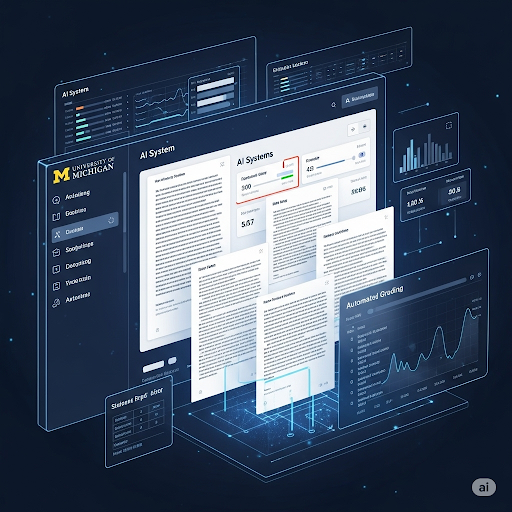
Image. Automated grading of student essays using artificial intelligence (Source: created using Google Gemini AI, 2025)
2.11. British University Vietnam
Application Description:
British University Vietnam (BUV) has developed AI-based systems that provide personalised learning support to students, especially those with additional educational needs or language barriers. The system enables asynchronous communication by answering questions, offering explanations, and providing guidance to help students understand educational content. This approach encourages independent learning and helps reduce disparities in access to educational resources among students from diverse backgrounds and abilities.
Organisational Aspects:
- Focus on Inclusion: The AI system is designed to support students with learning disabilities and those for whom English is not their first language, thereby increasing accessibility and equity in education.
- Technical Integration: The AI tool is embedded within the university’s existing e-learning system and enables real-time interaction, enhancing the learning experience and connectivity between teachers and students.
- Data and Security: The University has established clear protocols to protect personal data and user rights, ensuring that technology is used responsibly and in accordance with ethical standards.
- Evaluation: Student feedback is regularly collected and analysed to improve system functionality and adapt it to user needs. Research conducted over several semesters has shown that students who use the system produce higher quality work and report greater satisfaction with their learning.
Read more: British University Vietnam: Artificial Intelligence-Based Student Support System.
3. Conclusion
The successful application of AI tools and systems in education depends not only on technological solutions but also on a holistic approach that includes strategic planning, institutional support, and a culture of responsible technology use. AI can enhance learning, teaching, and research, but only if it is integrated into clearly defined processes, with adequate resources, staff training, and systematic evaluation of outcomes.
Examples from universities such as Arizona State University, the University of Michigan, and British University Vietnam demonstrate that the most successful institutions are those that thoughtfully combine technological innovations with organisational changes – from developing infrastructure and security protocols to strengthening teacher competencies and involving students in the process.
Without institutional readiness and a clear governance framework, even the most advanced AI tools remain underutilised. Organisational factors, therefore, form the foundation of any sustainable, ethical, and pedagogically sound application of AI in higher education.

Image source: Shutterstock
4. Literature
Luckin, R., Holmes, W., Griffiths, M., & Forcier, L. B. (2016). Intelligence unleashed: An argument for AI in education. Pearson.
A comprehensive analysis of the role of teachers, technical infrastructure and ethical issues in the application of artificial intelligence in education, with emphasis on organisational challenges and system adaptation.
• OECD (2021). Artificial intelligence in education: Promises and implications for teaching and learning.
A detailed analysis of institutional and organisational challenges, including staff training, planning, and evaluation of AI systems in education.
• Selwyn, N. (2020). Should robots replace teachers? AI and the future of education. Polity Press.
A critical review of the social and organisational implications of AI technologies in educational institutions, with special emphasis on higher education.
• UNESCO (2021). AI and education: Guidance for policy makers.
A guide to implementing artificial intelligence in educational systems, including strategic and ethical guidelines important for the organisation of education.
• Holmes, W., Bialik, M., & Fadel, C. (2019). Artificial intelligence in education: Promises and implications for teaching and learning. Center for Curriculum Redesign.
This work examines how AI affects educational institutions and what conditions are necessary for successful and ethical integration into the organisation of teaching.
Background Colour
Font Face
Font Size
Text Colour
Font Kerning
Image Visibility
Letter Spacing
Line Height
Link Highlight
Paragraph Width
Text Alignment