The difference between traditional and artificial intelligence supported learning analytics
| Site: | Loomen za stručna usavršavanja |
| Course: | Artificial Intelligence in Education |
| Book: | The difference between traditional and artificial intelligence supported learning analytics |
| Printed by: | Gost (anonimni korisnik) |
| Date: | Thursday, 17 September 2026, 12:58 AM |
Table of contents
- 1. Introduction
- 2. Learning analytics - General
- 3. Traditional learning analytics
- 4. Learning analytics powered by artificial intelligence
- 5. Example: AI-powered analytics in Moodle
- 6. Key differences between traditional and AI-enhanced learning analytics
- 7. Conclusion: Challenges and future developments
- 8. Literature
1. Introduction
Today, education systems generate vast amounts of data about learners’ activities and progress. This data can be analysed to better understand learners’ needs and adjust the learning process.
The main difference between traditional analytics and AI-based analytics lies in their capabilities and opportunities. Traditional analytics uses data about what a learner did and how they did it. In contrast, AI-based analytics relies on predictive analysis in three areas: forecasting future outcomes, producing personalised recommendations for each learner, and providing automatic, immediate feedback. This significantly improves the efficiency and quality of education.
2. Learning analytics - General
Learning analytics is a systematic approach to collecting, processing, and analysing data related to the learning process to better support learners and improve educational outcomes.
3. Traditional learning analytics
Traditional learning analytics involves collecting and analysing data about learners' past activities during the educational process. This includes information such as grades, test scores, number of assignments completed, time spent on the platform, and other quantifiable activities.
This approach is primarily used to track and report past events – for example, how successfully a learner completed assignments or how much time they spent learning. The goal is to provide instructors and learners with an overview of progress and to identify potential problems in monitoring learning.
While traditional analytics are mostly descriptive, some methods also include basic predictive analytics, such as using statistical models to predict outcomes based on past performance. However, these predictions are often limited and do not account for the broader range of data that artificial intelligence can process.
4. Learning analytics powered by artificial intelligence
AI-powered learning analytics uses advanced techniques such as machine learning, deep learning, and natural language processing to analyse large and complex sets of learning data. The goal is not only to understand what has happened, but also to predict future learning outcomes and provide personalised recommendations for each learner.
Key features of AI-powered learning analytics:
-
Advanced big data processing
-
AI systems use powerful algorithms to process large and complex data sets that include both quantitative information about outcomes and qualitative data such as text, speech, and learner behaviour.
-
What this means for teachers: AI gives teachers deeper insight into learning processes – how students work, where they get stuck, and how they respond to different forms of support. Based on this data, teachers can identify difficulties in a timely manner, adjust instruction, and target help to those who need it most. This approach encourages evidence-based teaching, as decisions are no longer based solely on intuition but on real learning data.
-
-
Predictive models
-
Using machine learning and deep learning, analytics can predict future learning outcomes, such as the likelihood of failing exams or dropping out of a course, enabling timely interventions.
-
What this means for teachers: Artificial intelligence provides teachers with timely and specific information about students who may need additional support. Instead of noticing at the end of the semester that someone is struggling, teachers can receive early warnings that a student is rarely accessing materials, not participating in discussions, or experiencing a drop in grades. This allows for real-time intervention – through an encouraging message, additional explanation, one-on-one meeting, or assignment adjustments.
- Case study:
-
At Georgia State University in the US, a predictive analytics system was introduced that tracks more than 800 indicators of student success – from previous course grades to participation in online activities. When the model identifies a risk, it notifies an advisor or teacher, who can contact the student and offer support. Thanks to this approach, the number of students who successfully complete their studies has increased significantly, and the dropout rate has decreased.
-
Such systems do not replace teachers but help them make decisions based on data rather than assumptions. This turns analytics into a tool that supports a more empathetic and personalised approach to teaching, in line with the principles of modern higher education pedagogy.
-
-
Personalisation of content and recommendations
-
AI systems analyse students’ learning patterns and preferences to customise educational materials and recommendations, thereby increasing efficiency and motivation.
-
What this means for teachers: AI allows teachers to more effectively manage different levels of knowledge and motivation within the same group. Instead of manually adapting content to each student, teachers can use analytics to identify topics that are challenging for students and plan additional activities, clarifications, or assignments.
This evolves the teacher’s role from traditional lecturer to mentor and learning designer, who uses data and recommendations from AI systems to create a stimulating, flexible, and personalised environment for all students.
-
-
Automated Feedback
-
Enables fast and accurate grading of assignments and tests, and provides personalised feedback that helps students continuously monitor their progress.
-
What does this mean for teachers? AI-powered learning analytics offer three key benefits for teachers:
-
-
-
- Time savings – AI handles routine tasks such as grading and identifying error patterns, allowing teachers to focus more on analysis and counseling.
- Better insight into student progress – The system gives an overview of learning patterns for the entire group and highlights common difficulties, helping teachers adjust instruction in a timely manner.
- Targeted support for students – With analytics data, teachers can provide additional explanations, materials, or activities to those who need them most.
- In this way, AI does not replace teachers but empowers them as reflective experts who make evidence-based decisions and provide better, individualised support to students.
-
-
Social and Communication Analysis
-
AI systems monitor interactions in online forums, teamwork and communication patterns, tracking engagement and the emotional dimension of learning.
-
What does this mean for teachers? AI-powered learning analytics give teachers deeper insight into group dynamics and communication among students. The system can alert teachers if individual students rarely participate in discussions, if teams are not collaborating evenly, or if communication becomes one-sided. This allows teachers to:
- Respond promptly – encourage discussion, change team composition, or introduce new collaborative activities.
- Recognise patterns of support and exclusion within the group.
- Develop more inclusive and empathetic teaching based on real data about student interactions.
- In this sense, AI acts as a teacher’s assistant – helping them observe what is difficult to see in large online groups, summarising communication data, and highlighting important signals about engagement and relationships among students.
-
Such insights help teachers better understand the social dynamics of learning and create a collaborative, supportive environment that encourages active engagement from all students.
-
Scalability and Flexibility
-
AI-powered analytics can be applied across various educational settings and to large numbers of users, adapting to different types of content and learning styles.
-
For teachers, this means easier customisation of instruction for many students while maintaining an individualised approach. AI can automate progress tracking, generate personalised recommendations, and identify common learning patterns, enabling teachers to plan activities and resources more effectively.
-
For example, in large online courses, AI can group students with similar interests or challenges, generate customised assignments, and highlight content that best meets their needs.
-
5. Example: AI-powered analytics in Moodle
Moodle is continually enhancing its capabilities by integrating AI and learning analytics to offer more effective and personalised support to students and teachers. Moodle is widely used in thousands of educational institutions and organisations worldwide. As an open-source platform, its community is constantly developing new plugins available in the Moodle Plugins Directory (image).
The main development of AI-powered analytics focuses on improving personalisation, automation, and progress tracking. It is increasingly incorporating advanced machine learning and natural language processing tools.
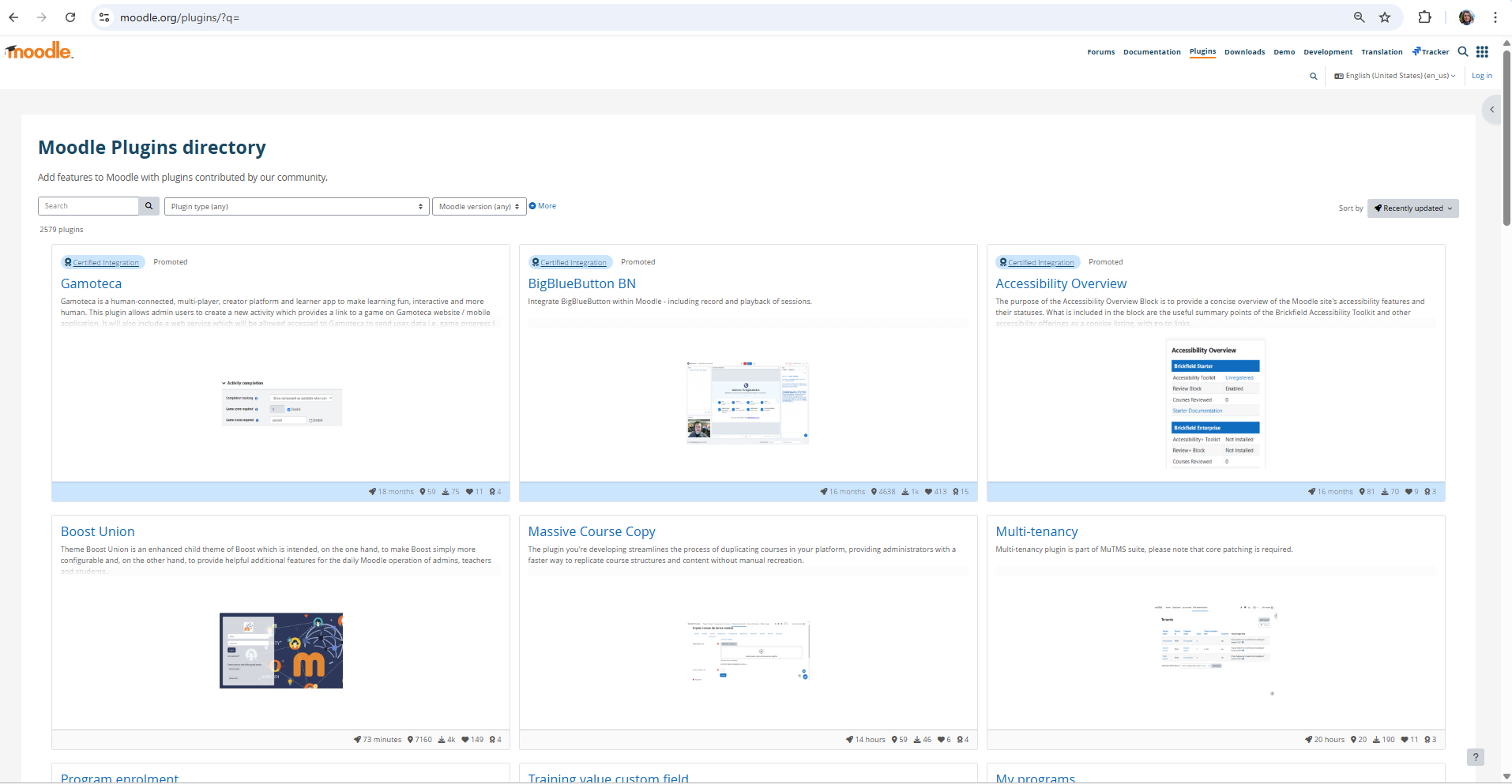
Image: Interface for viewing Moodle plugins (Source: author, 2025)
6. Key differences between traditional and AI-enhanced learning analytics
The table below highlights the key differences between traditional learning analytics and AI-enhanced learning analytics. Traditional analytics rely on a limited set of quantitative data and mainly provide descriptive insights into completed activities. In contrast, AI-enhanced analytics use large and diverse data sets, enable predictive analysis, and offer automated, personalised feedback. Advanced machine learning and deep learning methods allow AI-based systems to provide more scalable and timely support in identifying risks, behavioural patterns, and student needs. It is especially important to note that the educational process can be adjusted in real time based on the results of AI analysis.
Table: Key differences between traditional and AI-powered learning analytics
| Aspect | Traditional learning analytics | AI-supported learning analytics |
|---|---|---|
| Type of data | Primarily quantitative data (grades, tests, time) | Large and complex data sets, including text, speech, and behaviour |
| Approach to analysis | Descriptive analysis – what happened | Predictive and prescriptive analysis – what will happen and what to do |
| Personalisation | Limited or non-existent | High, content, and recommendations tailored to the individual |
| Automation of feedback | Minimal or manual | Automatic and fast feedback on tasks and tests |
| Analysis of social interactions | Rare or non-existent | Tracking and analysis of communicative and emotional aspects |
| Scalability | Limited, requires manual work by the instructor | High, can be applied to a large number of learners |
| Complexity of technology | Simpler, often static analysis | Complex, uses machine learning, deep learnin,g and NLP |
| Response to risks and problems | Subsequent identification of problems |
Timely prediction and interventions |
7. Conclusion: Challenges and future developments
While AI-powered learning analytics offers many benefits, it also presents challenges:
- Data privacy and security
Collecting and analysing large amounts of personal data requires strict privacy and security standards. - Ethics and fairness
It is essential to ensure that algorithms do not discriminate against certain groups and remain transparent and understandable to users. - Technical complexity
Implementing and maintaining AI tools and systems requires expertise and resources, which can be challenging for smaller educational institutions.
Despite these challenges, the development of AI-powered analytics in education is progressing rapidly and creating new opportunities to improve the quality and accessibility of education.

Image source: Shutterstock
8. Literature
Literature:
- Alifah, N. & Hidayat, A. R. (2025). Effectiveness of Artificial Intelligence-Based Learning Analytics Tool in Supporting Personalized Learning in Higher Education. Jurnal Pendidikan Progresif, 15(1), 74-84. Description: This study examines the effectiveness of artificial intelligence-based learning analytics tools in supporting personalised learning in higher education.
- Paradiso Solutions. (2025). AI-powered learning analytics shaping the future of education.
Description: Explains the main benefits of AI analytics in real-time personalisation, automated assessment, and interventions.
- Baker, R. S. & Siemens, G. (2024). Educational data mining and learning analytics.
Description: A detailed review of methods, models, and applications in the field of learning analytics. - Digital Learning Edge. (2024). Role of AI in learning analytics.
Description: A review of tools and approaches that use AI to track student progress, engagement, and predict success. - Restack.io. (2024). AI vs traditional analytics: A comparison.
Description: A detailed comparison of traditional and AI-supported data analytics methods. - Inisoft Global. (2024). AI-powered data analytics vs traditional analytics in education.
Description: Explains the technical and functional advantages of AI analytics in education compared to classical methods, with an emphasis on efficiency, scalability, and more accurate prediction of educational outcomes. - Dev.to. (2024). AI analytics vs traditional analytics: Which is right for you?
Description: A brief guide to the key differences and applications of both types of analytics, with practical advice for choosing the appropriate approach. - Times of India. (2024). Beyond screen time: 10 smart ways AI can revolutionise your studying.
Description: Award-winning article on the benefits of AI analytics in understanding and driving emotional engagement.
Background Colour
Font Face
Font Size
Text Colour
Font Kerning
Image Visibility
Letter Spacing
Line Height
Link Highlight
Paragraph Width
Text Alignment