Risks of implementing digital technologies in education and their impact on well-being
| Site: | Loomen za stručna usavršavanja |
| Course: | Impact of Digital Technologies on Well-being |
| Book: | Risks of implementing digital technologies in education and their impact on well-being |
| Printed by: | Gost (anonimni korisnik) |
| Date: | Thursday, 17 September 2026, 8:52 AM |
1. Instruction
Within this book, examine the prepared materials on the advantages, disadvantages, and risks of applying digital technologies and their impact on the well-being of teachers, students, management, and administrative staff.

Image source: Shutterstock
We will also reflect on teaching materials, and learning and teaching methods in the context of achieving well-being.
The estimated time for studying this book is 2.5 hours.
2. Advantages of implementing digital technologies and the connection to well-being
Digital technologies are bringing a revolution to education, offering significant advantages that reshape the way we learn, teach, and access knowledge.
QUESTION
Think about which advantages of using digital technologies you recognise.
Below, we describe some of the recognised advantages of digital technologies.
Digital technologies, in the context of the advantages they offer, are a transformative force that makes education more accessible, flexible, personalised, and interactive.

Figure 4. Advantages of digital technology – created with the help of the AI Gemini tool
3. Disadvantages and Risks of Implementing Digital Technologies and the Connection to Well-being
In addition to all the advantages, it is important to be aware of the potential disadvantages and risks of applying digital technologies.
QUESTION
What disadvantages and risks of using digital technologies do you recognise?
Below, we describe some of the recognised disadvantages and risks of applying digital technologies.
One of the more important risks is the digital divide, i.e., unequal access to technology and the development of digital skills among students, teachers, and staff of higher education institutions. If equal conditions in the application of digital technologies are not ensured, this can deepen social inequalities. Individuals with limited resources may feel marginalised and deprived of educational opportunities, negatively affecting their self-confidence and sense of belonging to the academic community.
Improper integration of digital technologies can encourage excessive use, leading to addiction. This can result in the neglect of important aspects of life such as sleep, physical activity, live social interactions, and off-screen learning, thereby impairing physical and mental health.
Online platforms can become venues for cyberbullying, harassment, and other forms of negative online behavior. Students, teachers, and other staff of higher education institutions can become victims and experience significant stress, anxiety, depression, and a sense of insecurity within the academic community.
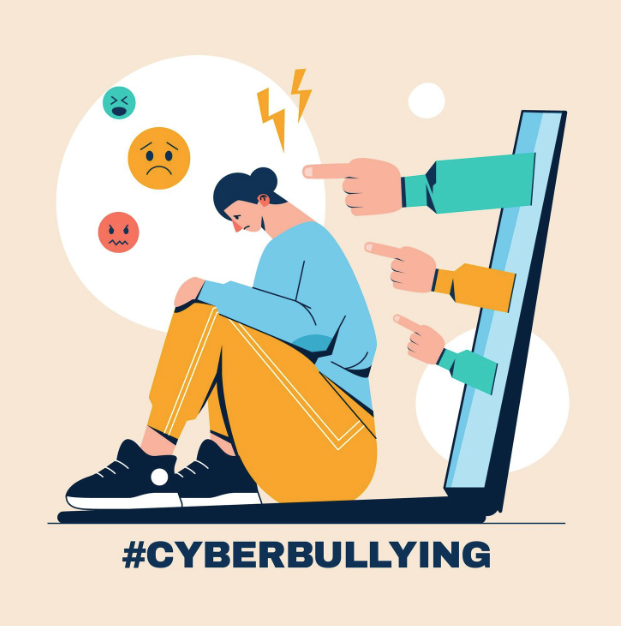
Image source: Shutterstock
Distractions in the digital environment can make concentration and deep understanding of the material more difficult. Consequently, superficial learning and a reduced ability for critical thinking can lead to frustration and a sense of incompetence among students. Also, ready-made solutions do not develop the required skills in students, such as problem-solving, decision-making, critical thinking, communication, presentation, teamwork, etc.
In this context, it is crucial to emphasise the impact of artificial intelligence (AI) on learning and teaching. AI models are subject to the phenomenon of "hallucinations", which means that they can generate convincing but completely incorrect information not based on real data. Due to the rise of misinformation and AI "hallucinations", the necessity of developing critical thinking skills becomes an absolute priority in learning and teaching. Users of generative artificial intelligence – teachers and students – should be educated as to how to critically evaluate content generated by artificial intelligence. They must be able to analyse, evaluate, and verify information regardless of the source. Equally important is strengthening problem-solving skills so that students can effectively deal with new ethical, social, and technical challenges brought by the increasingly complex digital age dominated by artificial intelligence. You can find more about hallucinations in the application of artificial intelligence in the article "AI hallucination: towards a comprehensive classification of distorted information in artificial intelligence-generated content".
The digital environment can also encourage the creation of "echo chambers", where algorithms isolate users within closed circles of like-minded people, thereby preventing exposure to different opinions and potentially polarising society. There are several definitions of "echo chambers", and one of the best-known definitions points out that it is an environment in which individuals encounter only opinions and beliefs similar to their own and therefore do not consider alternatives. You can read more about this in this article on echo chambers.
Furthermore, there are various risks associated with media posts, such as clickbait headlines. Sensationalist posts manipulate user attention and, for the sake of getting clicks, undermine the credibility of media content. Clickbait is a sensationalist headline phrased to entice the reader to click on a link, often promising shocking or exclusive content that is not delivered. Its main purpose is to increase the number of visitors to a website to increase advertising revenue. Examples include headlines like: "You won't believe what happened next!" Addressing these types of risks is crucial for protecting well-being and fostering critical literacy.
The use of various online tools and platforms carries the risk of privacy breaches and the insecurity of personal data. A sense of insecurity regarding one's own data can cause anxiety and distrust in the online environment for all users.

Image source: Shutterstock
Although it offers flexibility, excessive reliance on online interactions can reduce opportunities for real social contacts. Long-term isolation negatively affects the mental health of students and teachers and undermines the sense of belonging to the academic community. Excessive use of digital technology reduces face-to-face social interaction, which is key to developing relationships, networking, and collaboration.
Digital transformation has an exceptional impact on the well-being of stakeholders in higher education. While it can facilitate work and learning, it can simultaneously lead to increased stress, blurring of boundaries between private and professional life, and a sense of isolation. Therefore, it is important to promote a balance between digital and real-world interactions and encourage care for one's own health, safety, and relationships in the digital environment.
To mitigate these risks, it is crucial for higher education institutions to promote a balance between digital and physical interactions. This includes education on healthy technology use, individual counselling for dealing with stress and addiction, and strategies for ensuring well-being and preserving mental and physical health.
Higher education institutions must ensure an ethical and secure digital environment, protect data privacy, and fight against cyberbullying, while simultaneously attempting to reduce the digital divide to ensure equal access for all.

Figure 5. Created with the help of the AI Gemini tool
4. Artificial Intelligence (AI)
Of all digital trends, artificial intelligence (AI) has the greatest impact on education, enabling personalised learning, adapting content, and automating administrative tasks. This technology brings a significant reduction in stress for students as they can learn at their own pace, receive rapid and targeted feedback, and feel greater control over their educational path. Such an approach fosters motivation and reduces academic anxiety, which is crucial for their psychological well-being.
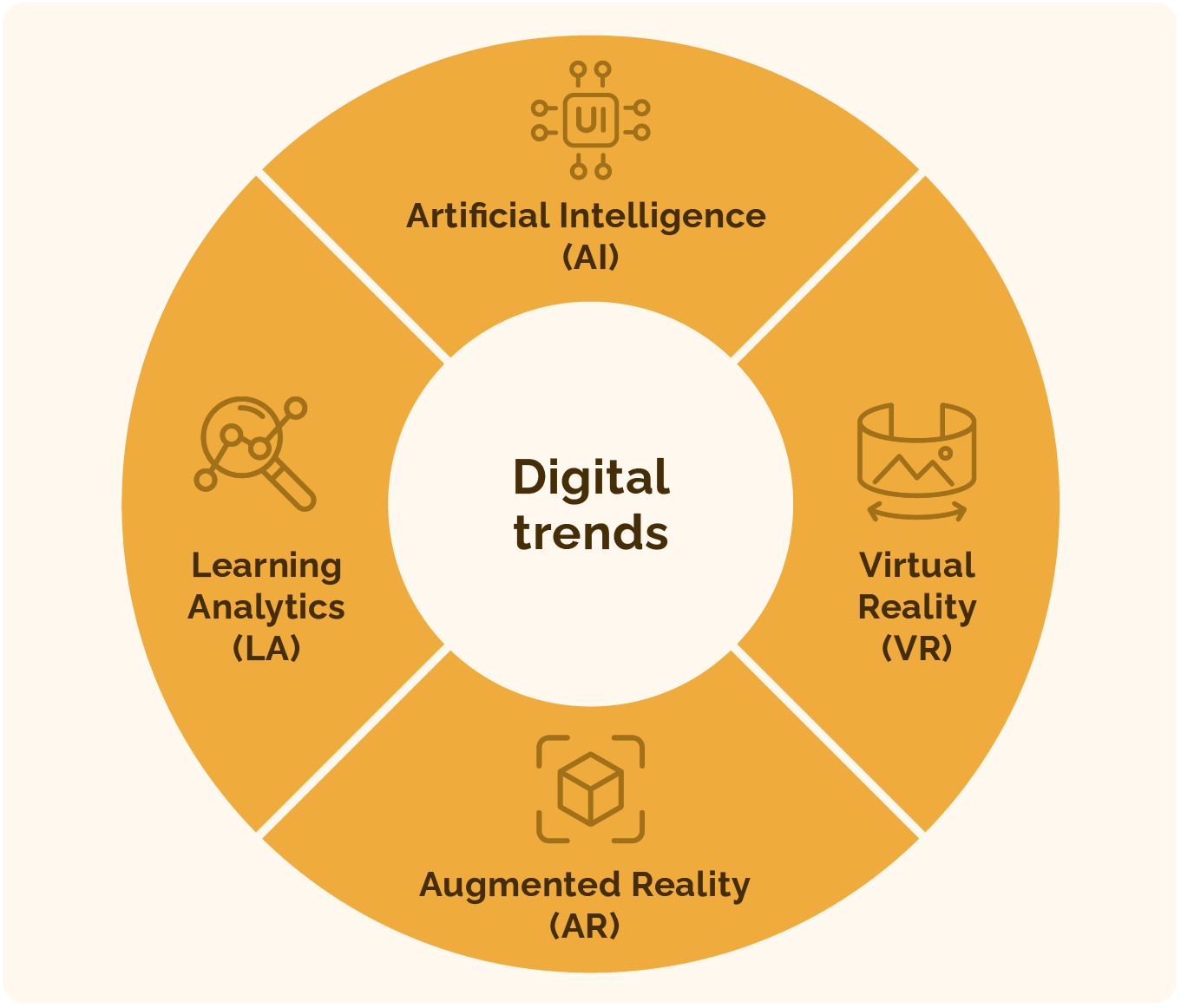
Figure 6. Digital trends
On the other hand, by using AI, teachers and management staff can drastically reduce the administrative burden, such as grading and data processing, freeing up time for creative and strategic activities like mentoring and curriculum development. This increases their professional well-being and job satisfaction.
However, it is important to be aware of the challenges of applying AI, such as the problem of "hallucinations" in AI models, and to ensure ethical and responsible implementation. For students, the main risks include a potential reduction in critical thinking due to over-reliance on AI tools, issues with academic dishonesty (plagiarism), the transfer of bias from AI models, the risk of misinformation (AI "hallucinations"), and the compromising of data privacy.
Teachers face an increased workload due to the need to detect misuse. Some show resistance to change due to insufficient preparation, and another issue is the possible reduction in direct interaction with students. Questions regarding copyright on AI-generated content also remain open.
Additionally, higher education institutions must deal with the cybersecurity challenges of complex AI systems, the complexity of managing such systems, and unresolved issues of responsibility in the event of AI errors.

Image source: Shutterstock
5. Virtual Reality (VR) and Augmented Reality (AR)
Virtual Reality (VR) and Augmented Reality (AR) technologies create realistic and interactive learning environments, which further increase student engagement. These technologies can reduce anxiety associated with practical exercises by providing a safe simulated environment for refinement before facing real-world challenges.
For teachers and management staff, VR and AR bring a sense of innovation and engagement, but also require the adoption of new digital skills and the adaptation of pedagogical approaches. Although they may initially pose a challenge, in the long term, they contribute to professional growth and greater well-being. It is important to simultaneously monitor potential risks such as digital fatigue and physical discomfort associated with the prolonged use of these technologies.

6. Literature
ALL DIGITAL. (2023). Digital Well-Being Report.
Brkljača, K., Načinović Prskalo, L. & Brkić Bakarić, M. (2024). Overview of advantages and disadvantages of digitalization, digital solutions, technologies, and applications used during the pandemic. Journal of the Polytechnic of Rijeka, 12 (1), 375-393.
Buda, András & Kovács, Klára. (2024). The digital aspects of the wellbeing of university teachers. Frontiers in Education.
Organisation for Economic Co-operation and Development. (2024). The impact of digital technologies on well-being. OECD Publishing.
Oztosun, Latif & Gonzo, Faithfull & Nadda, Vipin. (2023). The Impact of Digital Learning Technology on Higher Education Students' Mental Health.
Background Colour
Font Face
Font Size
Text Colour
Font Kerning
Image Visibility
Letter Spacing
Line Height
Link Highlight
Paragraph Width
Text Alignment