Development of guidelines for ensuring the well-being of employees and students of higher education institutions
| Site: | Loomen za stručna usavršavanja |
| Course: | Impact of Digital Technologies on Well-being |
| Book: | Development of guidelines for ensuring the well-being of employees and students of higher education institutions |
| Printed by: | Gost (anonimni korisnik) |
| Date: | Thursday, 17 September 2026, 8:52 AM |
1. Instruction
Study the prepared materials containing a proposal for strategies for ensuring well-being in educational institutions and a framework for improving student well-being at universities. An integral part of the materials will be content that will help you define a proposal for strategic areas, goals, activities, and determine indicators.
The estimated time for studying the book is two hours.
2. Introduction
The development of guidelines for the mental health and well-being of employees and students of higher education institutions is exceptionally important since it directly affects academic success, personal development, and the overall experience of students and employees.
In today's dynamic environment, facing academic pressures, social challenges, and personal problems can significantly affect mental health; therefore, a proactive and systematic approach is crucial for creating a supportive and inclusive environment within the higher education institution.
Guidelines should serve as a foundation for providing comprehensive support and strengthening resilience to challenges, which ultimately contributes to a healthier and more productive academic community and ensures the well-being and mental health of students and employees.
In the introductory part of this book, you can also view the document titled STRATEGIC FRAMEWORK FOR THE DEVELOPMENT OF MENTAL HEALTH UNTIL 2030, prepared by the Ministry of Health of the Republic of Croatia and adopted in November 2022. It defines measures at the national level for the preservation and improvement of mental health in preschools, schools, and the academic community.
3. Framework for creating Guidelines for ensuring the well-being of employees and students of higher education institutions
For the preparation of Mental Health and Well-being Guidelines at a higher education institution, it is recommended to rely on The Stepchange: Mentally Healthy Universities Framework. This comprehensive framework was developed in the United Kingdom and is designed to serve as a template for developing guidelines aimed at ensuring the well-being of employees and students. The framework is adaptable to different contexts and needs and is aligned with best practices.
Using this framework can ensure a systematic and effective approach to implementing mental health support measures within your institution.
It contains four core domains: Learn, Support, Work, and Live. It emphasises the integration of well-being into the academic experience, the availability of support, the importance of employee well-being, and creating a healthy environment.
Such a comprehensive structure enables higher education institutions to create their own guidelines and to approach the promotion of mental health and well-being of the entire academic community in a holistic way.
See more information about the four core domains: Learn, Support, Work, and Live.
The following document is available in Croatian only. Participants may use free AI-powered translation tools to access the provided materials.
More about work-based learning models can be found in the manual for designing and implementing work-based learning models in higher education, "Work-Based Learning Models," which was created as a result of the Study4Career project.
4. Conclusion
Achieving the vision of mentally healthy and well-being-dedicated higher education institutions requires that higher education institutions adopt mental health and well-being as a strategic priority and develop guidelines for the well-being of employees and students.
This framework emphasises the key importance of developing concrete guidelines tailored to each higher education institution. These guidelines should clearly define areas, goals, activities, and indicators of progress in promoting the mental health and well-being of employees and students. Through a systematic and planned approach, a supportive environment can be created that ensures the well-being of the entire academic community.
5. Operationalisation of goals
Operationalisation breaks down goals into specific activities that need to be undertaken to achieve that goal, while indicators provide concrete, measurable signs of success. Once activities are defined, it is easier to determine responsibilities for their implementation (who is in charge of which activity and within what timeframe). Without clear activities and responsibilities, strategic goals can remain at the level of plans without actual implementation.
Table 3. Template for the operationalisation of goals
Activity Plan
| Strategic goal code and name | Implementation activity | Monitoring mechanisms / KPI | KPI target value | Deadline for one-time activities Measurement frequency |
Responsible person | Activity leader | Required resources |
|---|---|---|---|---|---|---|---|
| GOAL 1 |
Operationalisation of strategic goals should be carried out following these steps:
1. determining activities to achieve the strategic goal;
2. determining monitoring mechanisms for the level of goal achievement (key performance indicators, KPIs);
3. setting deadlines within which activities are to be carried out;
4. determining the responsible person and the activity leader for achieving each goal;
5. allocating or forecasting resources needed to achieve the activities.
Table 4. Example of goal operationalisation
Activity Plan
| Strategic goal code and name | Implementation activity | Monitoring mechanisms / KPI | KPI target value | Deadline for one-time activities Measurement frequency |
Responsible person | Activity holder | Required resources |
|---|---|---|---|---|---|---|---|
| GOAL 1 Establish and ensure the operability of the Student Counselling Centre by the end of the academic year 2026/2027 |
|
|
|
30 September 2026 (for working group formation and work plan development). 31 December 2026 (for staff training and space equipping). Monthly monitoring of activity progress. Annual measurement of the number of users after launch. |
Vice-Rector for Students / Higher Education Institution Management | Working group for the establishment of the counselling centre | Human resources (working group, counsellors), financial resources (for training, equipping), space. |
Conclusion
As we have seen, strategic planning provides a structured approach to creating guidelines for ensuring the well-being of our academic community. By defining strategic areas, clear goals, concrete activities, and measurable indicators, we lay the foundations for the systematic improvement of the quality of life of our employees and students. In addition to goals, we determine activities, deadlines, responsibilities, and assign resources to them. Also, we monitor and measure the set indicators, and in this way, the goals are achieved.
This process represents a continuous cycle of planning, implementation, monitoring, and evaluation that will enable us to adapt to the needs of our academic community and work on creating a better and more supportive environment.
6. Example of guidelines according to The Open University
One of the excellent examples of guidelines was developed by The Open University under the title Student and Staff Mental Health and Wellbeing Strategy 2020–2023: Promoting a Whole Institution Approach.
Strategic Planning
The goal of strategic planning is to make fundamental decisions and undertake fundamental activities in accordance with the set goals, mission, and vision. Through the strategic planning process, an organisation determines its goals, priorities, and strategies, and defines measures to assess the success of achieving those goals.
Characteristics of strategic planning:
- systematically focused on goal realisation and the productivity of actions;
- includes choosing priorities, which involves making decisions about strategic goals and resources;
- responds to the circumstances of a dynamic, turbulent environment;
- means building the commitment of all stakeholders in the same process.
Determining strategic areas is a key step in the strategic planning process. Strategic areas represent thematic units or focuses on which areas the organisation will concentrate to achieve its vision and mission. Once strategic areas are defined, they serve as a framework for setting concrete strategic goals. Goals should be aligned with strategic areas and contribute to their achievement.
Given the theme of guidelines for ensuring the well-being of employees and students of higher education institutions, mental health and psychological support would be an excellent example of a strategic area. Mental health is a fundamental aspect of an individual's overall well-being. Ensuring support in this area directly contributes to a happier, healthier, and more productive academic environment.
Strategic Goals
Strategic goals are desired states or outcomes and represent what the organisation wants and plans to achieve in a certain period. They are focused on results and are followed by activities. Strategic goals are defined based on identified strategic issues and represent the central element of the strategic planning process.
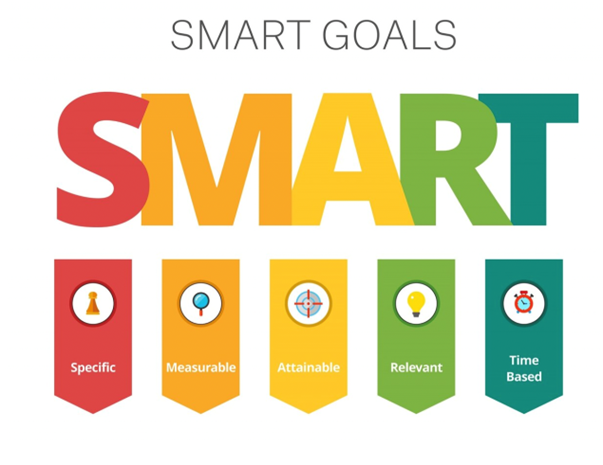
Figure 10. SMART Goals Diagram
Strategic goals should be determined according to the SMART principle, which means they should be Specific, Measurable, Achievable, Relevant, and Time-bound.
Given a specific strategic area, an example of a goal could be: Establish a full-time university/faculty counselling centre by the beginning of the academic year 2026/2027.
Examples of goals defined in the aforementioned guideline document "Student and Staff Mental Health and Wellbeing Strategy 2020 – 2023: Promoting a Whole Institution Approach" by The Open University, focused on promoting mental health and well-being within the university community, are:
- implement a whole-institution approach to mental health and well-being across the entire institution, integrating support for students and staff;
- empower students and staff with the skills, tools, and sense of belonging that foster positive mental health behaviors and an inclusive culture;
- act proactively in supporting students and staff who are at risk of poor mental health, actively reducing the stigma associated with these challenges;
- provide a diverse and effective range of support services that meet the specific needs of students throughout their entire studies;
- support students in successfully navigating key transitions in their studies to achieve success and maximise potential, while maintaining good mental health and well-being;
- ensure proactive identification and addressing of the needs of all categories of staff regarding mental health and well-being;
- use data, learning analytics, and research for the systematic evaluation of the effectiveness and impact of interventions and support for mental health and well-being;
- establish strong collaboration within the university and influential external partnerships to inform and provide effective support for the mental health and well-being of students and staff.
The document also defines activities and sets indicators.
7. Literature
Baik, C., Larcombe, W. & Brooker, A. (2016). A framework for promoting student mental wellbeing in universities. Melbourne Centre for the Study of Higher Education (MCSHE), The University of Melbourne.
Student Support and Career Development Center (CPSRK). Faculty of Organization and Informatics (FOI). (2023). Work-Based Learning Models.
Klačmer Čalopa, M., Tomičić-Pupek, K. & Begičević Ređep, N. (2018). Strategic Plan for the Application of Information and Communication Technologies in Schools. Croatian Academic and Research Network - CARNET.
The Open University. (2020). Student and staff mental health and wellbeing strategy 2020-2023: Promoting an institutional approach.
Universities UK. (2021). StepChange: Mentally healthy universities.
University of York. (2021). Student mental health and wellbeing strategy 2021–2025.
Background Colour
Font Face
Font Size
Text Colour
Font Kerning
Image Visibility
Letter Spacing
Line Height
Link Highlight
Paragraph Width
Text Alignment