Contemporary Definition of the Concepts of Diversity and Inclusivity in the Context of Persons with Disabilities
| Site: | Loomen za stručna usavršavanja |
| Course: | Ensuring Inclusive Access Through the Use of Assistive Technology |
| Book: | Contemporary Definition of the Concepts of Diversity and Inclusivity in the Context of Persons with Disabilities |
| Printed by: | Gost (anonimni korisnik) |
| Date: | Thursday, 17 September 2026, 11:17 PM |
1. Introduction
The concepts of diversity and inclusivity in the contemporary context of persons with disabilities (PwD) are now regarded as the foundation for exercising human rights and the social model of disability.
Disability is recognised as a natural aspect of human diversity.
Inclusivity is the active process of creating an environment where diversity is valued and where all individuals, including persons with disabilities, are given equal opportunities for full participation and a sense of belonging.
2. Concept of Inclusion
The concept of inclusion has evolved significantly throughout history, influenced by changes in social attitudes, educational philosophies, and legal frameworks. Initially, persons with disabilities were often excluded from society. Over time, however, awareness of inclusion grew, promoting the rights of all individuals to participate fully in all aspects of society, including education.
3. United Nations (UN) Convention on the Rights of Persons with Disabilities
The United Nations (UN) Convention on the Rights of Persons with Disabilities was adopted in 2006 (the Republic of Croatia signed it in 2007).
Purpose (Article 1)
The purpose of the Convention is to promote, protect, and ensure the full and equal enjoyment of all human rights and fundamental freedoms by all persons with disabilities, and to promote respect for their inherent dignity.
Principles of the Convention
The Convention is guided by the following principles:
- Respect for inherent dignity, personal autonomy, including the freedom to make one's own choices, and the independence of persons.
- Non-discrimination.
- Full and effective participation and inclusion in society.
- Respect for difference and acceptance of persons with disabilities as part of human diversity and humanity.
- Equality of opportunity.
- Accessibility.
- Equality between men and women.
- Respect for the evolving capacities of children with developmental difficulties and respect for the right of children with developmental difficulties to preserve their own identity. (Source: Law on the Ratification of the Convention on the Rights of Persons with Disabilities and the Optional Protocol to the Convention on the Rights of Persons with Disabilities, 2007)
4. The 2030 Agenda for Sustainable Development
Inclusion is a priority of the 2030 Agenda for Sustainable Development (Agenda 2030). It not only emphasizes the obligation that "no one will be left behind" but also the agreement "to reach those in greatest need first."
The 2030 Agenda for Sustainable Development, adopted in 2015, contains 17 Sustainable Development Goals (SDGs) that all countries are required to achieve by 2030.
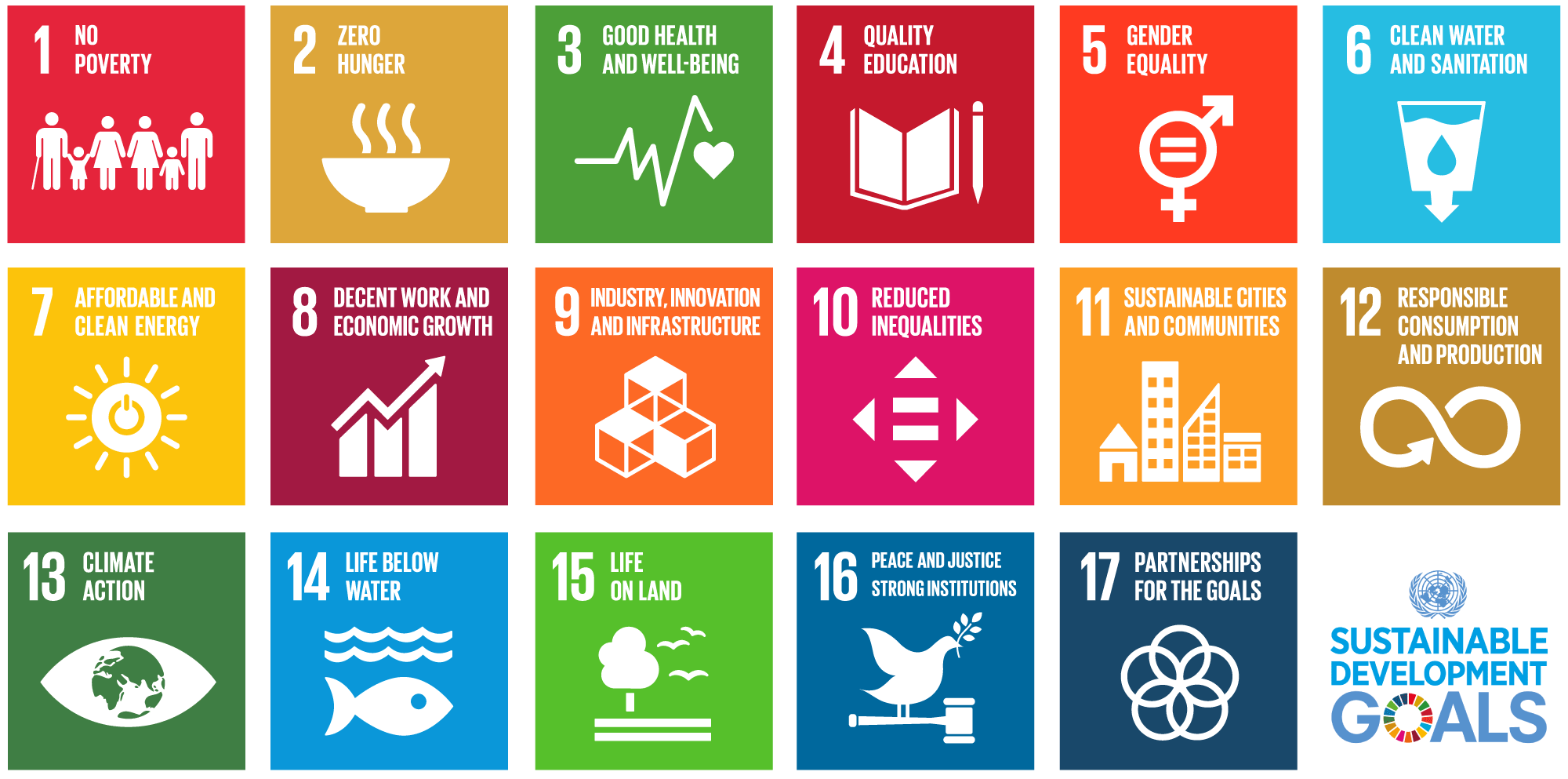
The 2030 Agenda for Sustainable Development’s 17 Sustainable Development Goals (SDGs)
To achieve the goals, cooperation is needed between the government, civil society, the private sector, organizations of persons with disabilities, and citizens.
5. Challenges Faced by Persons with Disabilities
Despite numerous laws, regulations, rulebooks, guidelines, and similar documents adopted at both international and national levels, which should ensure an inclusive environment for persons with disabilities (PwD), they continue to face many difficulties in daily life as a result of non-compliance with the regulations governing their rights. This is also evident from the 2024 Report on the Work of the Ombudsman for Persons with Disabilities of the Republic of Croatia (POSI, 2024).
Buljevac (2024) highlights the following: "(...) The World Bank Group (2023) states that barriers to the full inclusion of persons with disabilities include an inaccessible physical environment and transport, unavailability of assistive technologies, information and communication inaccessibility, shortcomings in the support system, and discrimination and stigmatisation... The community's lack of awareness and education regarding the needs, rights, capabilities, wishes, and obligations of persons with disabilities forms the basis for generating new obstacles to inclusion. This lack of education is most often the responsibility of the formal support system, which should work not only with persons with disabilities but also for their benefit. Finally, it must not be forgotten that sometimes barriers can also be related to persons with disabilities themselves, and that sometimes the responsibility lies with persons with disabilities, individually and collectively, to fight for a more inclusive society."
6. References
Buljevac, M. (2024). How inclusive is our society, truly? Insights on inclusion in the 21st century / Koliko smo zapravo inkluzivno društvo? Spoznaje vezane uz inkluziju 21. stoljeća. In A. Malkoč Bišćan, & V. Šolc (Eds.). Proceedings of Inclusive and Accessible Libraries. Zagreb: Croatian Library Association, pp. 2–3.
European Disability Forum (2019). People with disabilities are crucial to the success of the Sustainable Development Goals! / Osobe s invaliditetom od ključne su važnosti za uspjeh ciljeva održivog razvoja!
POSI (2024).Report on the Work of the Ombudsperson for Persons with Disabilities for the Year 2024 / Izvješće o radu Pravobranitelja za osobe s invaliditetom za 2024. godinu.
Act on the Ratification of the Convention on the Rights of Persons with Disabilities and the Optional Protocol to the Convention on the Rights of Persons with Disabilities / Zakon o potvrđivanju Konvencije o pravima osoba s invaliditetom i Fakultativnog protokola uz Konvenciju o pravima osoba s invaliditetom, Official Gazette 6/2007
Background Colour
Font Face
Font Size
Text Colour
Font Kerning
Image Visibility
Letter Spacing
Line Height
Link Highlight
Paragraph Width
Text Alignment