Transdisciplinary Cooperation in Assistive Technology
| Site: | Loomen za stručna usavršavanja |
| Course: | Ensuring Inclusive Access Through the Use of Assistive Technology |
| Book: | Transdisciplinary Cooperation in Assistive Technology |
| Printed by: | Gost (anonimni korisnik) |
| Date: | Thursday, 17 September 2026, 11:19 PM |
1. Transdisciplinary approach
In media and professional communication, it is often stated that a multidisciplinary approach to clients or patients is necessary, with the benefits of this approach frequently emphasised. However, it is important to understand that multidisciplinary and transdisciplinary approaches are not synonymous, and that the scientifically based application of transdisciplinary principles provides the greatest benefit to clients, their families, and professionals.
In the system and literature, three approaches are distinguished: multidisciplinary, interdisciplinary, and transdisciplinary.
In the multidisciplinary approach, the client receives care from different specialists, but these specialists work separately without mutual communication. All decisions are made by the specialist without involving the parent, guardian, or client, and in this approach, the gap in the parent or client–specialist relationship is actually pronounced.
The interdisciplinary approach introduces changes in both directions. Although specialists also work separately here, there is occasional exchange of information about methods of working with clients and parents or guardians, but only at the informational level. Thus, the specialists provide information and explanations, but they remain the primary decision-makers and planners.
The transdisciplinary approach, by contrast, can be visualised as a single chain in which every link is equally important in all aspects – decision-making, planning, and execution. All links operate in an integrated manner. Specifically, parents or guardians and clients, together with specialists, make decisions, participate in planning, and act as a unified team (Marinić, 2024). This approach requires professionals to develop communication skills, as well as interaction and cooperation among team members (Figure 44).
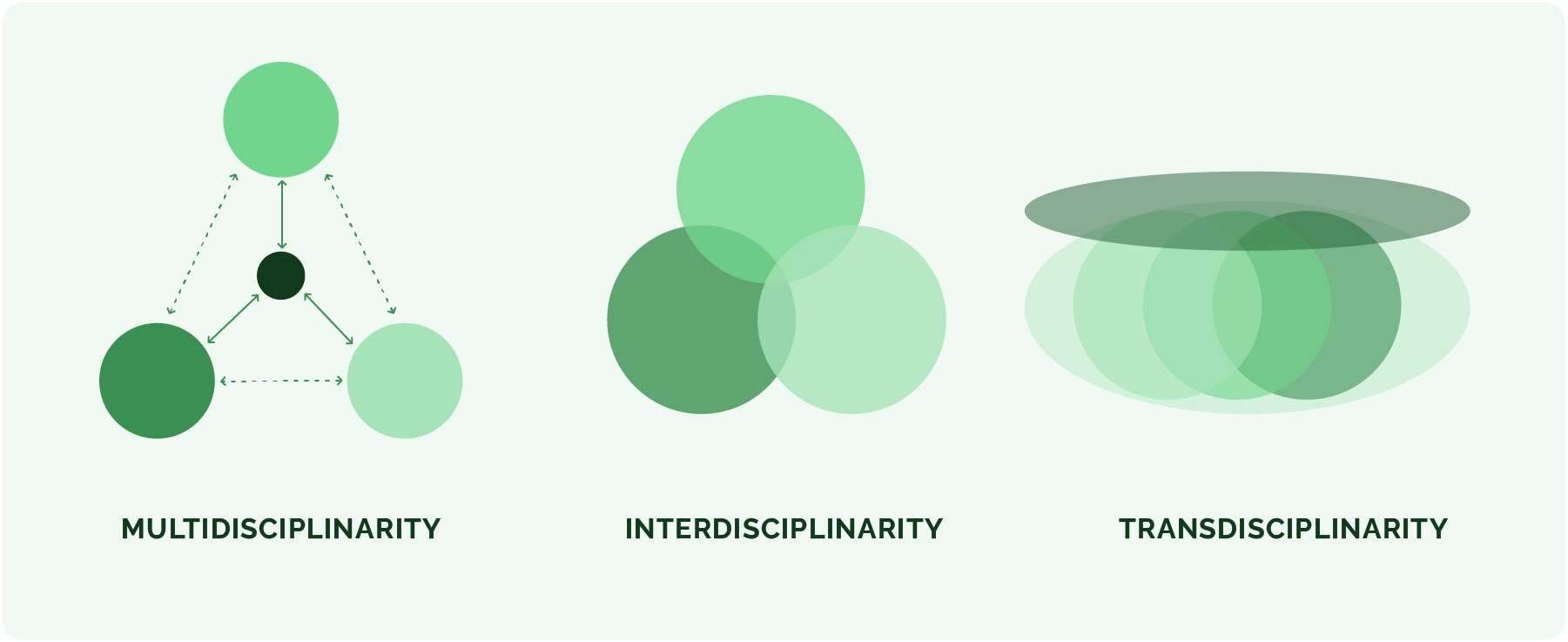
Figure 44. Visual presentation of the multidisciplinary, interdisciplinary, and transdisciplinary approach (according to Didham et al., 2024)
Assistive Technology (AT) includes devices and services. Some AT services are:
- assessment of AT needs, including functional assessment in the user's everyday environment
- selection and design of AT
- procurement
- implementation
- use
- adjustment
- evaluation of AT effectiveness
- education on the use of AT for users, family members or guardians, educators, and service providers
- technical support.
To deliver these services, transdisciplinary cooperation among experts from various fields is necessary. The transdisciplinary approach to providing AT services also needs to be developed in Croatia, involving experts from different disciplines: educational rehabilitation specialists, speech therapists, electrical engineers, computer science engineers, mechanical engineers, biomedical experts, psychologists, and others. Competencies related to AT are acquired at several higher education institutions, with some examples listed in the work of Z. Stančić and R. Pinjatela (2023). Several examples of project cooperation between experts from different disciplines are also presented, which can serve as a foundation for achieving a transdisciplinary approach in this field.
The transdisciplinary approach in AT involves bridging disciplinary boundaries and collaborating with partners, including AT users, to promote new ways of thinking and implementing AT-related services, including research, development, and implementation, thereby expanding the applicability and commercial viability of AT (Boger et al., 2017).
2. References
Boger, J., Jackson, P., Mulvenna, M., Sixsmith, J., Sixsmith, A., Mihailidis, A., Kontos, P., Miller Polgar, J., Grigorovich, A., & Martin, S. (2017). Principles for fostering the transdisciplinary development of assistive technologies. Disability and rehabilitation: Assistive technology, 12(5), 480–490.
Didham, R. J., Fujii, H., & Torkar, G. (2024). Exploring Interdisciplinary Approaches to Education for Sustainable Development. Nordic Journal of Comparative and International Education (NJCIE), 8(2).
Marinić, D. (2024). Application of the principles of transdisciplinarity. (Unpublished text, part of a lecture, provided to the e-course author). Educational platform of the Center for Early Development.
Stančić, Z. & Pinjatela, R. (2023). Assistive Technology from a Professional Perspective / Asistivna tehnologija iz perspektive stručnjaka. In M. Mirić 6 D. Miholić (Eds.) Assistive Technology in the 21st Century – State of the Art and Perspectives. Zagreb: Faculty of Education and Rehabilitation Sciences, University of Zagreb, pp. 45–70.
Background Colour
Font Face
Font Size
Text Colour
Font Kerning
Image Visibility
Letter Spacing
Line Height
Link Highlight
Paragraph Width
Text Alignment