Areas of the Digital Technology Implementation Strategy
| Site: | Loomen za stručna usavršavanja |
| Course: | Strategic Planning for Digital Technology Implementation |
| Book: | Areas of the Digital Technology Implementation Strategy |
| Printed by: | Gost (anonimni korisnik) |
| Date: | Thursday, 17 September 2026, 4:57 PM |
1. Introduction
Digital transformation is becoming the foundation of development for educational institutions in the 21st century [1].
The integration of digital technologies into higher education has the potential to improve the quality of the education process, administrative efficiency, and research work [2]. The areas of the digital technology application strategy represent the categories of business processes within a higher education institution. Since the goal is to achieve maximum efficiency and effectiveness of business processes—which can be achieved by introducing digital technologies through strategic planning and implementation—these categories of business processes have become the core areas within the strategy. It is therefore possible to strategically plan the digital transformation of just one area, several areas, or all of them. In other words, the areas of the digital technology application strategy are categories of business processes that have an initial level of maturity and that we aim to improve through the implementation of a strategic plan.
Researchers have analysed and defined categories of higher education business processes differently in their models [4][5]. In this learning material, we will focus on seven strategic areas and explain how they are represented in selected digital maturity models.
The learning outcomes of this material are:
- i. explain the main idea of relevant frameworks for assessing the digital maturity of educational institutions (2/understanding);
- ii. categorize the business processes of a higher education institution into the corresponding areas of the digital technology implementation strategy (4/analysis);
- iii. describe current development trends of higher education institutions in different areas of the digital technology implementation strategy (2/understanding);
- iv. evaluate the digital maturity of a higher education institution (6/evaluation).
2. Digital maturity frameworks
Previous research has identified more than 20 frameworks for the digital maturity of educational institutions [4]. They define different areas of digitalization that identify specific indicators describing the level of maturity. Many also offer quantitative instruments that can be used to measure digital maturity levels. Most are tailored to schools – for example, the Croatian e-Škole framework, intended for assessing digital competences and infrastructure.
For higher education, specific models have been developed, such as:
- Higher Education Digital Competence Framework (HeDiCom) – contains 4 dimensions; focused on teachers’ digital competences in higher education [6].
- Higher Education Digital Capability Framework (HEDC) – also with 4 dimensions, it includes 16 domains and over 70 capabilities [7].
- HEInnovate, developed by the European Commission (part of the DigComp/HEInnovate portfolio), which contains 8 areas [8].
- DigCompOrg, focused on organisational strategic planning [5].
In Croatia, a new model was developed, the Digital Maturity Framework for Higher Education Institutions (DMFHEI). It was created by Valentina Đurek, PhD, through projects of the Croatian Science Foundation at the University of Zagreb, Faculty of Organization and Informatics [5]. This framework defines 7 areas and 42 elements of digital maturity.
In addition to the above frameworks, it is worth highlighting several other significant models and tools used in education to analyse and enhance digital maturity:
- SELFIE (Self-reflection on Effective Learning by Fostering the use of Innovative Educational Technologies) – a European Commission tool that enables schools to independently analyse their level of digital maturity [5].
- DigComp – the European framework of digital competences for all citizens, defining five core areas of digital skills [3].
- DigCompEdu – a specialized framework for the digital competences of education professionals, focused on teaching practices and professional development [3].
- OpenEdu – a European Commission framework for promoting open education in higher education, including 10 dimensions of openness divided into two categories [5].
- Jisc Digital Capability Framework – developed in the United Kingdom, with a particular focus on staff competences and organisational support for developing digital maturity [5].
These frameworks further enrich the understanding of digital maturity in educational institutions and enable the adaptation of approaches to suit different educational contexts. Since most are based on DigComp or DigCompOrg principles, there is a high degree of compatibility among them.
Table: Comparative overview of selected frameworks
Framework |
Purpose |
Dimensions / Areas |
Instrument |
|
e-Škole |
primary education |
5 areas and 37 elements |
quantitative instruments (self-assessment) |
|
HeDiCom |
higher education, teachers |
4 dimensions |
qualitative, no quantitative instrument |
|
HEDC |
higher education, institutions |
4 dimensions, 70+ competences |
qualitative instrument |
|
DMFHEI |
higher education, organisations |
7 areas, 42 elements |
qualitative instrument |
|
DigComp |
citizens |
5 areas of digital competence |
qualitative instrument |
|
DigCompEdu |
education professionals |
6 competence areas |
self-assessment, reflective tools |
|
DigCompOrg |
educational organisations |
7 dimensions of organisational maturity |
foundation for tools such as SELFIE |
|
OpenEdu |
higher education |
10 dimensions of openness |
qualitative guide, without a formal instrument |
|
SELFIE |
schools, higher education |
based on DigCompOrg |
quantitative and visual self-assessment (self-evaluation) |
|
Jisc Digital Capability |
higher education |
individual and organizational competences |
self-assessment questionnaire |
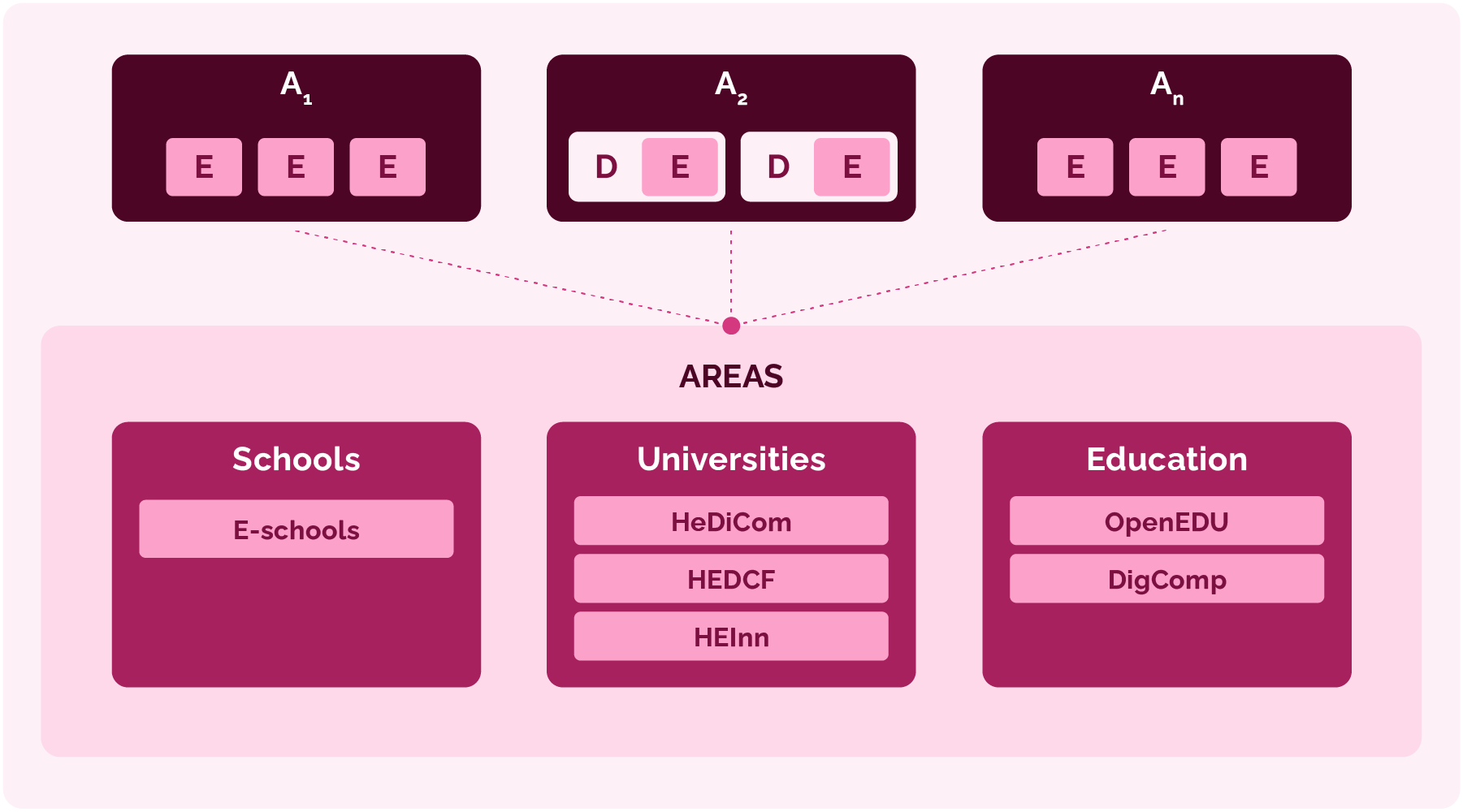
Figure: Digital maturity frameworks and their structures
The figure shows a general representation of digital maturity frameworks, consisting of n areas. The areas then consist of elements (E), which may be grouped into organizational dimensions.
3. Seven areas of the digital technology implementation strategy
The following document provides detailed descriptions of seven areas: Teaching, Digital Competences, Digital Culture, Digital Content, Infrastructure, Research, and Engagement. These areas will be compared within the areas of two frameworks applicable to the context of higher education institutions, DigCompOrg and DMFHEI (Digital Maturity Framework for Higher Education Institutions).
A comparative table of the strategy areas, DigCompOrg, and DMFHEI is given in the table below.
Table: Representation of the strategy areas in the DigCompOrg and DMFHEI frameworks.
|
Area of digital technology application strategy |
Related dimensions of the DigCompOrg framework |
Related areas of the DMFHEI framework |
|
Teaching, learning, and assessment in a digital environment |
Curriculum and pedagogy, Learning and teaching, Assessment, Professional development |
ICT-supported learning and teaching, Quality assurance |
|
Digital competences |
Professional development, Learning and teaching |
ICT culture, ICT-supported learning and teaching, Quality assurance |
|
Digital culture |
Leadership and management, Collaboration and networking, Professional development |
ICT culture, Leadership, planning, and management |
|
Digital content |
Curriculum and pedagogy, Learning and teaching |
ICT-supported learning and teaching, Technology transfer, and community engagement supported by ICT |
|
Infrastructure and services |
Infrastructure |
ICT infrastructure |
|
Research in a digital environment |
Leadership and management, Collaboration and networking |
Scientific research supported by ICT |
|
Stakeholder engagement and communication in a digital environment |
Leadership and management, Collaboration and networking |
Technology transfer and community engagement supported by ICT, Leadership, planning, and management |
3.1. Teaching, learning and assessment in a digital environment
The area of teaching, learning, and assessment in a digital environment encompasses how digital technologies are integrated into teaching processes. The strategy in this area defines how technologies are used to enhance teaching methods, encourage active and individualized learning, and ensure continuous and objective monitoring of student achievement.
Examples:
- The University of Zagreb uses the Moodle system for managing e-courses and e-exams, enabling the digital delivery of teaching and assessment [9].
- The University of Edinburgh implements e-portfolios so that students can track and document their progress throughout their studies [10].
- Vrije Universiteit Amsterdam uses MOOCs as a form of open education and distance digital teaching [11].
In the current strategic plans of renowned universities, this area is being developed through several key initiatives. First, learning analytics systems are being intensively developed, providing real-time insight into educational data. You can learn about learning analytics in the course titled Learning Analytics within the program Managing the Digitalization of an Educational Institution. Second, there is a growing focus on the development of adaptive learning that adjusts to individual student needs. Third, the integration of virtual and augmented reality into teaching is used for simulations and hands-on learning in a digital environment [30].
3.2. Digital competences
Digital competences include the knowledge, skills, and attitudes required for the effective, ethical, and responsible use of digital technologies. The strategy in this area should encompass the development of digital competences among both teaching and non-teaching staff, as well as students. Special emphasis is placed on digital literacy, the pedagogical use of technology, and lifelong learning.
Examples:
- The Faculty of Organization and Informatics, University of Zagreb, conducts training sessions and workshops for teachers within Erasmus+ projects focused on developing digital competences [12].
- The University of Ljubljana has implemented the Digital Academic Competence (DAK) program, which systematically develops the digital skills of teaching staff through structured courses and mentoring [13].
- Universitat Oberta de Catalunya uses a comprehensive system for mapping teachers’ digital competences based on the DigCompEdu framework, which includes assessment, training, and progress monitoring [14].
In the context of strategic initiatives, universities are increasingly developing systems for self-assessment and personalized development of teachers’ digital competences. Mandatory digital training is also being introduced as part of professional development. The third trend involves the creation of certification programs based on international frameworks such as DigCompEdu [31].
3.3. Digital culture
Digital culture refers to the values, beliefs, and practices that promote openness, collaboration, innovation, and the responsible use of digital technologies. The strategy in this area focuses on creating an environment that fosters digital inclusion, ethical use of technology, and a culture of knowledge sharing.
Examples:
- Digital resources and technology-supported learning spaces are being developed within the national project e-University, coordinated by CARNET in cooperation with the University Computing Centre (Srce), the Agency for Science and Higher Education (ASHE), and the National and University Library in Zagreb (NSK) [15].
- University College Dublin has a well-developed Centre and team for digital pedagogy and innovation, which serve as central hubs for supporting and developing digital teaching and innovation [16].
- ETH Zurich organizes a series of events called the Digital Culture Exchange, where experiences and best practices in digital education are shared [17].
Current university strategic plans in the field of digital culture include initiatives to strengthen digital ethics and security, promote open science and open education, and build communities of practice that support knowledge sharing and collaboration among staff [30].
3.4. Digital content
Digital content includes educational materials and resources in digital form – whether produced within the institution, adapted, or sourced externally. The strategy defines the ways in which digital content is developed, curated, and used in accordance with pedagogical goals and accessibility standards.
Examples:
- The University of Rijeka publishes open digital textbooks through its digital library, thereby increasing the accessibility of educational resources [18].
- The Massachusetts Institute of Technology (MIT) offers the OpenCourseWare platform with thousands of freely available courses and materials [19].
- The University of Helsinki uses WikiLectures as an open platform for the creation and sharing of teaching materials by lecturers and students [20].
Main trends include the digitalization of teaching materials in line with accessibility principles, the use of artificial intelligence for content generation and adaptation, and the implementation of open educational resource repositories within institutional systems [31]. Open science is discussed in the third course of the Managing the Digitalization of Educational Institutions program, entitled Open Education and Open Science.
3.5. Infrastrucure and services
The area of infrastructure and digital services encompasses the technical resources, digital platforms, and services that enable the efficient and secure operation of a higher education institution in a digital environment. This includes network infrastructure, cloud services, user support, data protection, and technical system maintenance. The strategy in this area sets goals related to the availability, reliability, and security of digital systems.
Examples:
- CARNET, in cooperation with higher education institutions, continuously improves the national network infrastructure that ensures high bandwidth and secure connectivity for higher education institutions [21].
- An example of a modern international initiative in the field of infrastructure and services in higher education is the national project for the development of digital competences and infrastructure at Danish universities (2020–2024). Several Danish universities, including Aarhus University, participated in the project “Digital competence development in the digital age from the perspective of the curriculum.” This initiative included the joint development and implementation of digital infrastructure to support digital services in teaching, the integration of digital tools and platforms at the national level, the development of systems supporting the digital competences of teachers and students, the organization of conferences and workshops for exchanging experiences and best practices, and the adaptation of curricula for the digital age, including the introduction of new services based on generative artificial intelligence [22].
- The University of British Columbia uses IBM Cloud infrastructure to support various teaching and research systems, ensuring scalability and high availability [23].
Strategic initiatives include the transition to hybrid cloud infrastructure, the implementation of cybersecurity across all layers of the network system, and the development of unified digital identities and access points for all users [32].
3.6. Research in the digital environment
This area encompasses the promotion of scientific activity through the development and use of digital tools, open science, and collaborative platforms. The strategy in this area defines approaches to open access to data and publications, digital repositories, data analysis tools, and international collaboration.
Examples:
- A team of experts from the University of Zagreb, Faculty of Organization and Informatics, developed an online tool to support the course design process, based on the results of several projects funded by the Croatian Science Foundation and Erasmus+ [24].
- The University of Edinburgh operates the Centre for Research Data, which supports researchers in using open science practices to manage research data efficiently before, during, and after projects [25].
- TU Delft launched the Data Science Initiative, bringing together research teams and enabling collaborative work on complex projects [26].
Strategic priorities include establishing interoperable repositories for scientific papers and data, promoting open science through researcher training, and implementing tools for automated search, processing, and visualization of scientific data [33–35].
3.7. Stakeholder engagement and communication in the digital environment
The area of stakeholder engagement and communication encompasses the ways in which a higher education institution involves various interest groups — students, teachers, administrative staff, partners, and the general community — through the use of digital tools and platforms. The strategy in this area defines goals related to two-way communication, stakeholder participation in decision-making, and promoting collaboration.
Examples:
- The University of Zagreb, Faculty of Electrical Engineering and Computing, conducts online stakeholder panels on digital projects to engage the academic community in shaping strategic initiatives [27].
- The University of Melbourne uses chatbots and digital platforms to communicate with alumni and students, providing support and collecting feedback [28].
- Lund University developed the CampusConnect app, which encourages student and staff participation in the academic community through notifications, surveys, and forums [29].
Current strategic trends include the development of comprehensive digital communication channels, the use of analytics to monitor user engagement, and the introduction of participatory digital tools for community involvement in strategic decision-making [38].
4. Instruments for measuring digital maturity
As we can see from the framework comparison table in the last column, only a few frameworks have a developed quantitative instrument for measuring the digital maturity of higher education institutions. Below, we briefly explain the DMFHEI instrument, which was developed in Croatia in the doctoral research of Dr. Valentina Đurek [5]. Since it has been validated in Croatia for 33 higher education institutions, we can consider it the most useful for use in Croatian higher education.
The framework has 7 areas and 42 elements (Table), though these do not fully correspond to the areas from the previous chapter. There are differences, yet all business processes of a higher education institution are still covered—the only difference is how they are grouped. Each of these 7 areas contains several elements. As not every area and element is equally important, they have been weighted. Furthermore, each element in the framework is described with descriptors of possible maturity using a rubric across five maturity levels: digitally unaware, digitally nascent, digitally empowered, digitally capable, and digitally mature.
Table: Areas and elements of the digital maturity framework for higher education institutions
This instrument is intended for self-evaluation or for evaluation by a person (or several people) well acquainted with the state of the higher education institution being evaluated. It is advisable that two people evaluate the HEI and then compare the results and discuss conflicting assessments.
In practical terms, for each of the 42 elements in the framework, the evaluator must read five short descriptors that describe each of the five maturity levels and choose the descriptor that best matches the state at the HEI. Finally, using a composite index approach, the products of the area weights, element weights, and priorities based on the descriptors are summed to determine the overall digital maturity of the area and of the institution.
Once an area with an insufficient maturity level is identified, a strategic plan can be drafted for the application of digital technologies for that area.
The list of areas and elements is provided in the table, and the entire instrument is implemented in the Excel file linked to the practical task of this topic (Worksheet 3 of the Excel file in which the project for the e-course is developed). That Excel file contains implemented functionalities for evaluating the digital maturity of the HEI by implementing the procedure briefly described earlier.
The Excel file also contains qualitative definitions of each area and element to help the evaluator better understand what is being evaluated. In addition, it contains the implementation of the rubric used to evaluate the HEI. The figure shows a radar chart of a higher education institution’s digital maturity by DMFHEI areas.
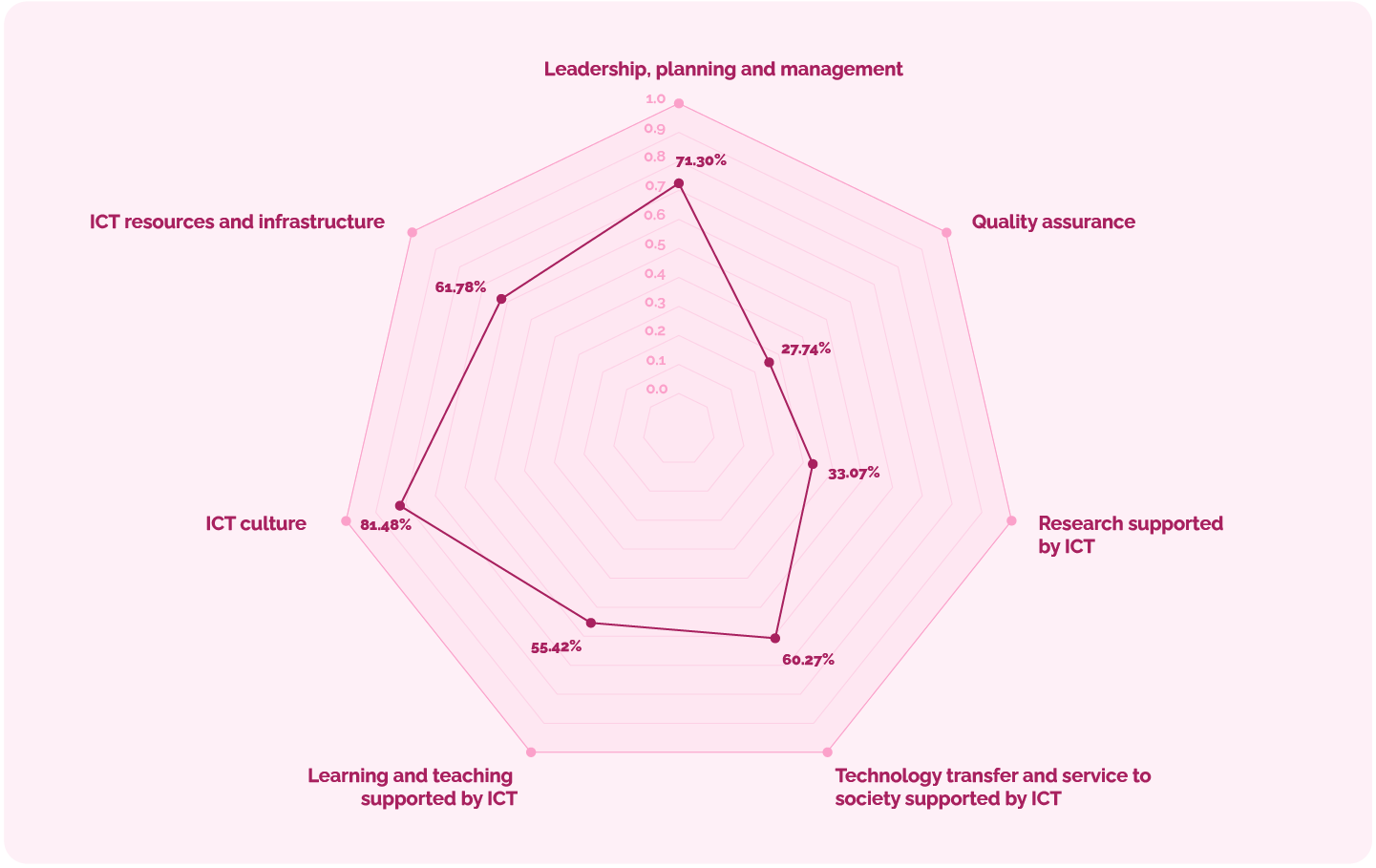
Figure: Digital maturity of a higher education institution by DMFHEI areas
5. Conclusion
The digital transformation of higher education institutions is becoming imperative in a modern educational environment that demands agility, innovation, and inclusiveness.
Through systematic strategic planning, defining areas of digital maturity, and the application of proven instruments, institutions can achieve a higher level of efficiency, improve the quality of education, and connect more effectively with the scientific and social community.
The seven key strategic areas provide the foundation for a comprehensive approach to digital transformation. Their understanding and evaluation through frameworks such as DigCompOrg and DMFHEI offer a concrete tool for assessing the current state and planning future development. Examples from practice show that measurable progress is achievable through well-designed and strategically focused initiatives.
The introduction of digital technologies is not just a technical challenge, but a cultural change that requires the engagement of all stakeholders. Investment in professional development, infrastructure, digital culture, and open science lays the foundations for a sustainable and resilient educational community.
The implementation of the instrument for measuring the digital maturity of higher education institutions (Valentina Đurek) is available in worksheet 2 of the Excel file used to develop the project and must be used for the practical assignment.
6. References
[1] J. Hattie and G. Yates, Visible Learning and the Science of How We Learn, Routledge, 2014.
[2] G. Siemens and R. S. J. d. Baker, “Learning Analytics and Educational Data Mining: Towards Communication and Collaboration,” Proc. 2nd Int. Conf. Learning Analytics and Knowledge, pp. 252–254, 2012. [Accessed: Aug. 1, 2025]
[3] C. Redecker, European Framework for the Digital Competence of Educators (DigCompEdu), Publications Office of the European Union, 2017.[Accessed: Aug. 1, 2025]
[4] European Commission, Promoting Effective Digital-Age Learning: A European Framework for Digitally-Competent Educational Organisations, 2015. [Accessed: Aug. 1, 2025]
[5] V. Đurek, Okvir za digitalnu zrelost visokih učilišta i instrument za njezinu procjenu, Sveučilište u Zagrebu Fakultet organizacije i informatike, 2022. [Accessed: Aug. 1, 2025]
[6] J. Tondeur, S. Howard, M. Van Zanten, P. Gorissen, I. Van der Neut, D. Uerz, and M. Kral, "The HeDiCom framework: Higher Education teachers’ digital competencies for the future," Educational Technology Research and Development, vol. 71, no. 1, pp. 33–53, 2023, doi: 10.1007/s11423-023-10193-5
[7] HolonIQ, "Higher Education Digital Capability (HEDC) Framework," 2024. [Accessed: Aug. 1, 2025]
[8] European Commission and OECD, "HEInnovate: Self-assessment tool for innovative and entrepreneurial higher education institutions," 2024. [Accessed: Aug. 1, 2025]
[9] Z. Martinović, S. Kučina Softić, and V. Mušica, "Creating Virtual Learning Environment for Higher Education Institutions," University of Zagreb, University Computing Centre SRCE, EUNIS 2016. [Accessed: Aug. 1, 2025]
[10] Institute for Academic Development, "Portfolios," University of Edinburgh, 2024. [Accessed: Aug. 1, 2025]
[11] Vrije Universiteit Amsterdam, "Education at the Centre of Global English," 2023. [Accessed: Aug. 1, 2025]
[12] Fakultet organizacije i informatike, Sveučilište u Zagrebu, "FOI započeo s provedbom pet novih projekata," 2021. [Accessed: Aug. 1, 2025]
[13] J. Stare, M. Klun, M. Dečman, "A case study on the development of digital competences of teachers at the University of Ljubljana," 2023. [Accessed: Aug. 1, 2025]
[14] M. Peters, A. Elasri-Ejjaberi, M.-J. Martínez-Argüelles, S. Fàbregues, "Teacher digital competence development in higher education: Overview of systematic reviews," Australasian Journal of Educational Technology, vol. 38, no. 6, pp. 121–140, 2022. [Accessed: Aug. 1, 2025]
[15] CARNET, "Projekt e-Sveučilišta," 2025. [Accessed: Aug. 1, 2025]
[16] University College Dublin, "UCD Educational Technologies," 2024. [Accessed: Aug. 1, 2025]
[17] ETH Zurich, "Learning from each other," 2025. [Accessed: Aug. 1, 2025]
[18] Sveučilište u Rijeci, "Digitalna knjižnica Sveučilišta u Rijeci," 2024. [Accessed: Aug. 1, 2025]
[19] Massachusetts Institute of Technology, "MIT OpenCourseWare," 2025. [Accessed: Aug. 1, 2025]
[20] University of Helsinki, "University of Helsinki Wiki - XWiki," 2024. [Accessed: Aug. 1, 2025]
[21] CARNET, "CARNET Infrastructure," 2025. [Accessed: Aug. 1, 2025]
[22] European Commission, "Denmark – Digital Public Administration Factsheet 2024," 2024. [Accessed: Aug. 1, 2025]
[23] UBC ARC, "Cloud Computing," University of British Columbia, 2025. [Accessed: Aug. 1, 2025]
[24] B. Divjak, D. Grabar, B. Svetec, and P. Vondra, “Balanced Learning Design Planning: Concept and Tool,” Journal of Information and Organizational Sciences, vol. 46, no. 2, pp. 361–375, 2022. [Accessed: Aug. 1, 2025]
[25] University of Edinburgh, “Research Data Service,” Library - The University of Edinburgh. [Accessed: Aug. 1, 2025]
[26] TU Delft, "TU Delft AI Initiative," 2025. [Accessed: Aug. 1, 2025]
[27] Fakultet elektrotehnike i računarstva Sveučilišta u Zagrebu, "FER Global Connect: Technological Trends in Croatian Science and Industry," 2025. [Accessed: Aug. 1, 2025]
[28] University of Melbourne, "Student support | Current students," 2025. [Accessed: Aug. 1, 2025]
[29] "UL CampusConnect," Google Play Store, 2024. [Accessed: Aug. 1, 2025]
[30] Educause, "2025 EDUCAUSE Horizon Report: Teaching and Learning Edition," 2025. [Accessed: Aug. 1, 2025]
[31] European Commission, "Digital Competence Framework for Educators (DigCompEdu)," 2024. [Accessed: Aug. 1, 2025]
[32] Gartner, "Hybrid Cloud Computing: What You Need to Know," 2024; European Union Agency for Cybersecurity (ENISA), "Cybersecurity for SMEs: Challenges and Recommendations," 2023; ENISA, "Digital Identity: Security and Privacy Issues," 2024. [Accessed: Aug. 1, 2025]
[33] RDA Research Data Repository Interoperability Working Group, "Research Data Repository Interoperability Primer," 2017. [Accessed: Aug. 1, 2025]
[34] The Working Group on Education and Skills under Open Science, "Providing researchers with the skills and competencies they need to practise Open Science," European Commission, 2017. [Accessed: Aug. 1, 2025]
[35] DigitalOcean, "10 AI Data Visualization Tools to Present Insights in 2025," 2025. [Accessed: Aug. 1, 2025]
[36] EHL Hospitality Insights, "Shaping Corporate Communications: 10 Trends To Watch in 2025," 2025. [Accessed: Aug. 1, 2025]
[37] Superagi, "Future of Customer Engagement: Trends and Predictions for Customer Journey Analytics in 2025 and Beyond," 2025. [Accessed: Aug. 1, 2025]
[38] Visible Network Labs, "40+ Community Engagement Tools for Building Connected Communities," 2025. [Accessed: Aug. 1, 2025]
Background Colour
Font Face
Font Size
Text Colour
Font Kerning
Image Visibility
Letter Spacing
Line Height
Link Highlight
Paragraph Width
Text Alignment