Instructions for Participants in the E-course "Assessment Supported by Digital Technology"
| Site: | Loomen za stručna usavršavanja |
| Course: | Assessment Using Digital Technology |
| Book: | Instructions for Participants in the E-course "Assessment Supported by Digital Technology" |
| Printed by: | Gost (anonimni korisnik) |
| Date: | Thursday, 17 September 2026, 1:42 PM |
Table of contents
- 1. General Information about the E-course
- 2. E-course Description
- 3. Approaches to Learning and Teaching
- 4. Learning Outcomes
- 5. Course Topics and Structure
- 6. Topic Description and Badge System
- 7. Technical Information and Minimum Entry Requirements
- 8. Participant Activities and Obligations
- 9. Etiquette
- 10. Support and Contacts
- 11. Literature
1. General Information about the E-course
Course Title: Assessment Using Digital Technology
ECTS Credits: 3
Number of Participants: 20
Mode of Delivery: Online
Target Group: Higher Education Teachers
Use the arrow in the upper right corner to navigate through this book.
2. E-course Description
The course “Assessment Supported by Digital Technology” is designed to provide participants with insight into an important aspect of education and to assist them in assessing students and monitoring their progress.
Using digital technology for assessment can offer a deeper understanding of students’ learning processes and provide targeted support. In addition, digital technology enables automatic or semi-automatic grading, which can significantly save teachers’ time and resources. Digital technology–supported assessment systems allow fast and accurate grading while simultaneously providing real-time feedback. By developing various types of assignments, tests, quizzes, and projects, the use of digital technology allows assessment to be adapted to individual needs and encourages critical thinking.
The course will emphasize the importance of assessment using digital technology. Different methods and tools that can be used will be considered, and the advantages, disadvantages, and challenges of digital technology–based assessment will be explored.
Assessment using digital technology can offer numerous benefits to participants in the educational process, contributing to their better understanding and success in education.
3. Approaches to Learning and Teaching
From a methodological-pedagogical perspective, the course is guided by an inquiry-based and problem-based approach, as well as collaborative learning with mentor support throughout its implementation.
Elements of the flipped classroom have been introduced, as most modules begin with a short video or material that participants review independently as an introduction.
During the implementation of problem-based instruction, participants will solve problem tasks and make use of the advantages of collaborative learning and project-oriented instruction.
4. Learning Outcomes
The course design is based on learning outcomes, which serve as the foundation for any student-centered learning design.
Upon completion of this e-course, participants will be able to:
- Analyze data on student activity in the teaching and learning process within a digital environment.
- Develop strategies for formative and summative assessment in a digital environment.
- Connect learning outcomes with assessment and the use of digital tools.
- Use an e-learning system (LMS / LCMS) to provide feedback to students during formative and summative assessment.
- Conduct the assessment process in a digital environment.
- Create rubrics for criteria-based assessment in a digital environment.
- Identify potential risks to the credibility and security of assessment in a digital environment.
The most significant and central learning outcome is: Develop strategies for formative and summative assessment in a digital environment.
5. Course Topics and Structure
The course is structured into six topics (Figure 1), which are divided into units containing teaching and learning activities (Figure 2). For each of them, the corresponding learning outcomes, the types of learning activities applied, and the estimated time required for participants to achieve the outcomes and complete the topics are provided (Figure 2). The coverage of learning outcomes by topic and the distribution of formative and summative assessment across topics are shown in Figure 3. All these figures were exported from the learning design tool.
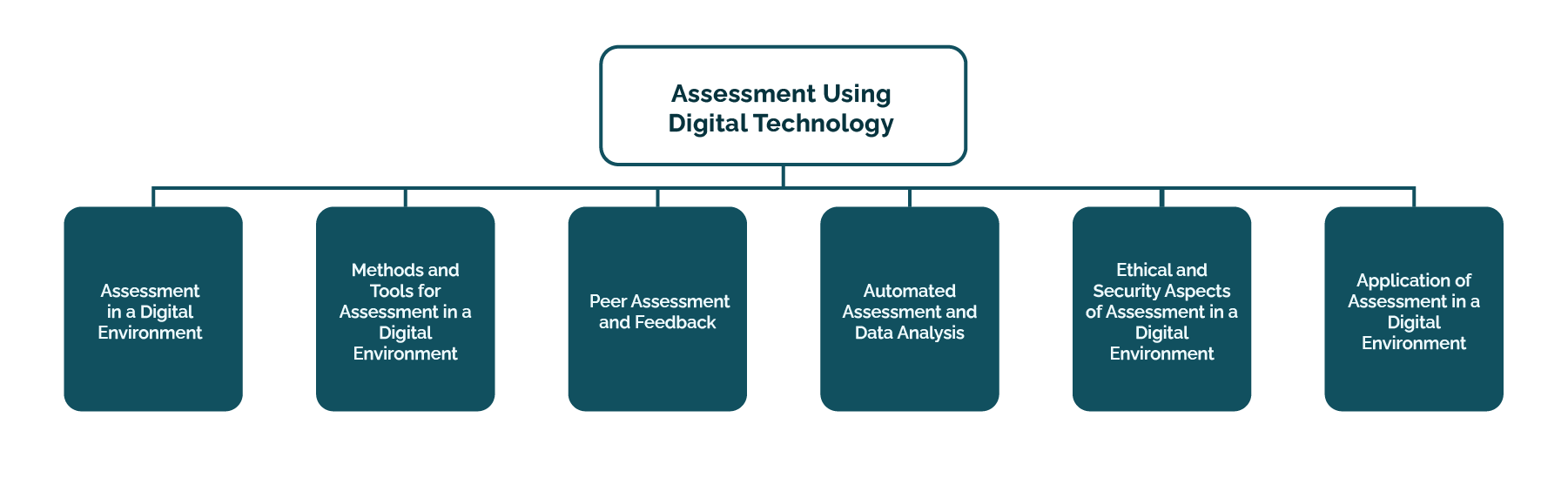
Figure 1. Topics in the e-course Assessment Using Digital Technology
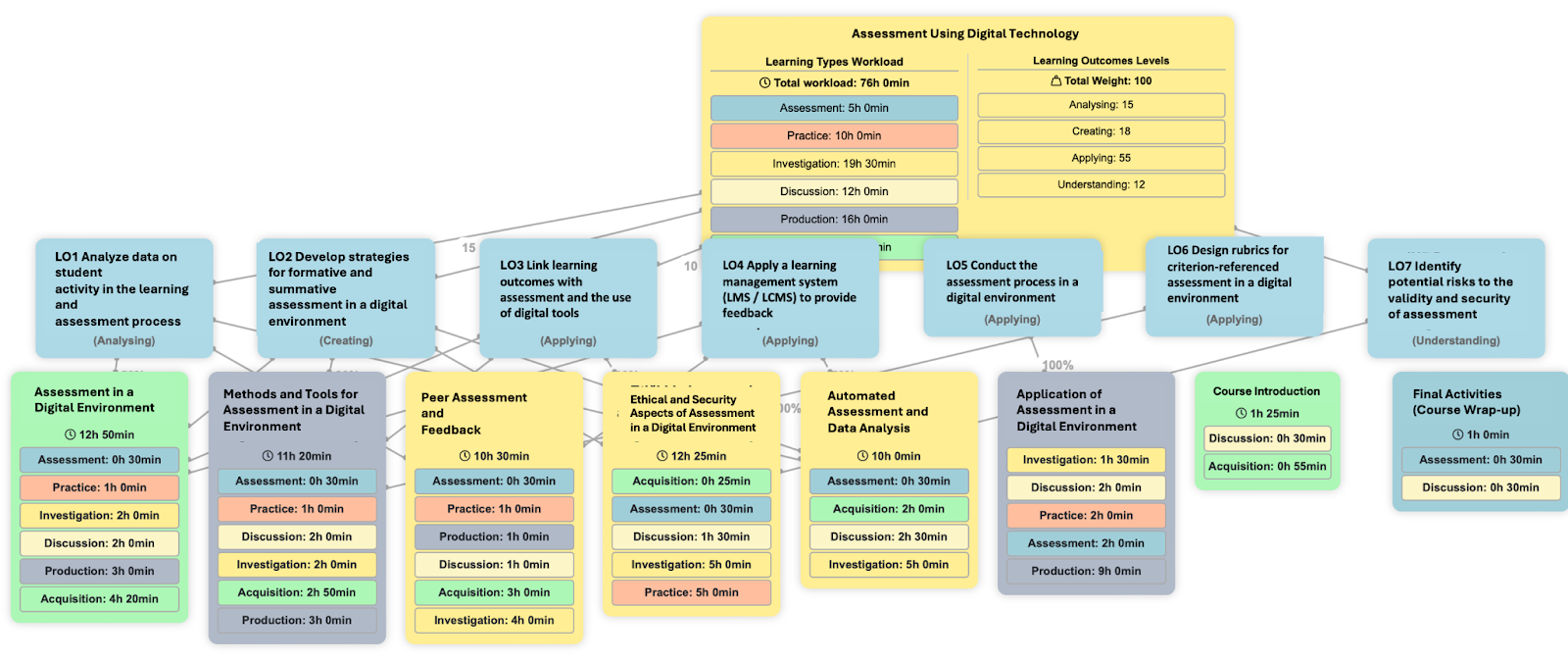
Figure 2. Learning outcomes, topics, types of learning activities, and estimated participant time (Export from the BDP tool)
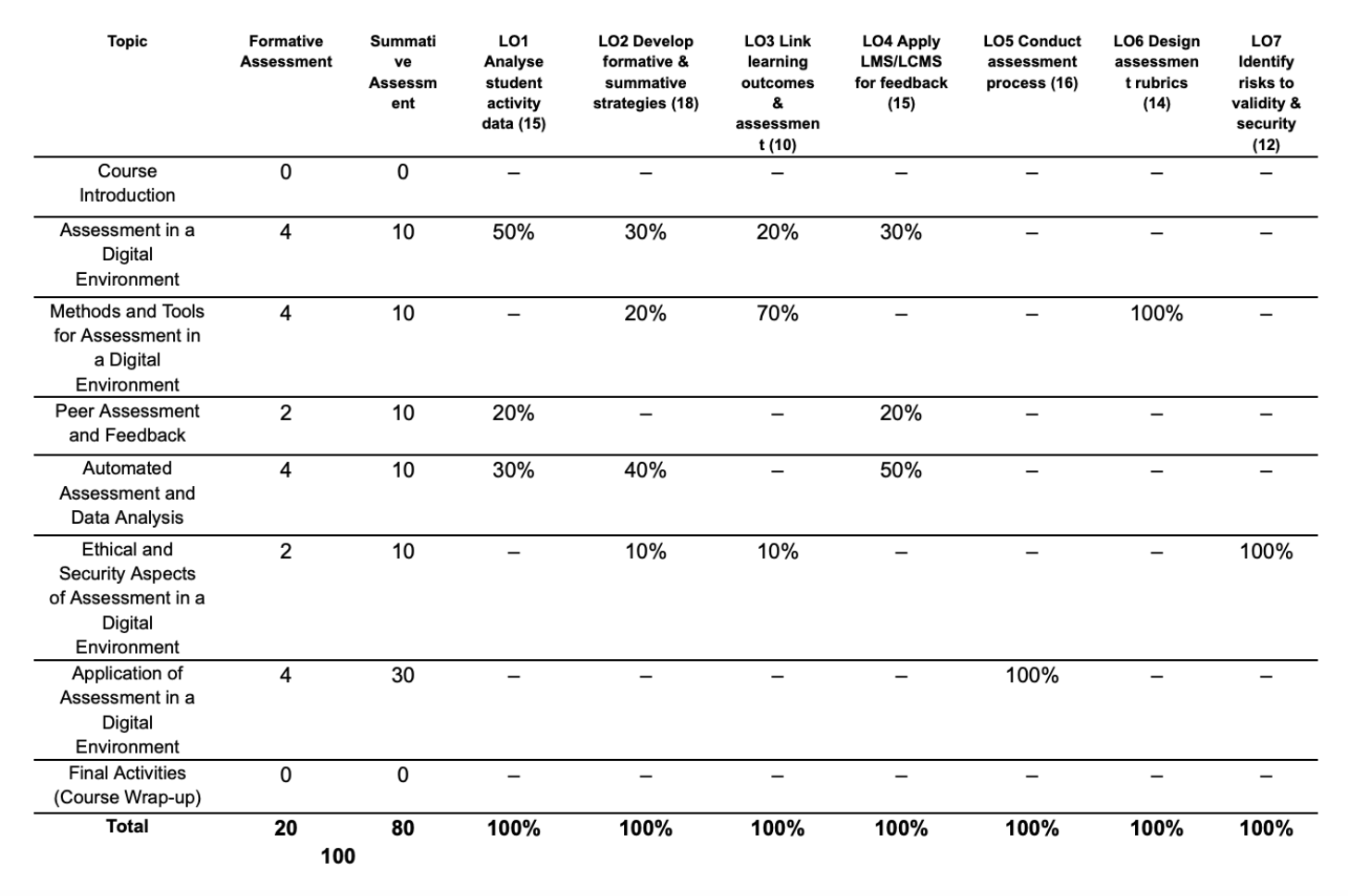
Figure 3. Coverage of learning outcomes by topic and distribution of assessment across topics.
The following link is available in Croatian only. Participants may use free AI-powered translation tools to access the provided materials.
The learning design for this course is available at the following link.
6. Topic Description and Badge System
Topic 1: Assessment in a Digital Environment
This topic covers the key aspects of assessment in a digital environment, with a special emphasis on its conceptual definition and the impact of technology on educational processes. The first part addresses basic definitions and types of assessment, as well as their role and importance in contemporary education. The second part focuses on the changes introduced by digital technologies in assessment approaches—from the possibilities offered by digital tools to challenges such as ensuring objectivity and addressing ethical considerations. The lecture aims to encourage understanding and critical reflection on how assessment is transformed in the digital age.
Mandatory activities (required for the badge): Participants will watch a video and study materials introducing the fundamental types of assessment in education, with a particular focus on their application in a digital environment. Based on this, they will take part in a discussion and quiz. Finally, participants will create an infographic about the impact of technology on assessment and participate in a peer review of the infographics.
Topic 2: Methods and Tools for Assessment in a Digital Environment
This topic focuses on planning assessment in an online environment, with an emphasis on specific tools and methods that facilitate monitoring and evaluating progress. It covers assessment rubrics—their creation, adaptation, and practical application in a digital context—as well as the use of various methods such as digital quizzes, infographics, online presentations, and reflection journals, which enable creative and comprehensive assessment in a virtual environment. The goal of this topic is to provide concrete guidelines and examples that can be applied in everyday teaching.
Mandatory activities (required for the badge): Participants begin with a video on methods and tools for assessment. They then discuss the topic, create a draft assessment strategy, and complete a summative quiz on assessment methods and tools. This is followed by activities leading to the creation of rubrics for criteria-based assessment.
Topic 3: Peer Assessment and Feedback
This topic explores strategies for involving participants in assessment within an online environment through peer assessment and self-assessment. Participants will learn how to encourage active student engagement in the assessment process, develop skills for giving and receiving constructive feedback, and use tools for digital peer assessment. The importance of self-regulation and reflection through self-assessment is also addressed, with the aim of strengthening autonomy and responsibility for one’s own learning.
Mandatory activities (required for the badge): Participants first study a video and accompanying written material on peer assessment. This is followed by a discussion on the challenges of peer assessment and an overview of the basics of designing effective feedback. As a summative assessment, participants complete a quiz. They also explore and discuss self-assessment and design a concrete example of a self-assessment activity.
Topic 4: Automated Assessment and Data Analytics
This topic focuses on automated forms of assessment in digital education and on the role of analytics in monitoring and enhancing learning. It includes an overview of available digital tools for automated testing and assessment, their capabilities and limitations, and ways to interpret the data these tools generate. Special emphasis is placed on the use of analytics in making pedagogical decisions and personalizing learning.
Mandatory activities (required for the badge): Participants first study a video and then read articles on automated assessment, after which they join a discussion on various aspects of automated assessment. Next, they create their own example of assessment with automated feedback (in the LMS), based on what they learned in earlier activities. This is followed by studying materials on learning analytics for assessment and participating in a discussion on the challenges of data analysis in education.
Topic 5: Ethical and Security Aspects of Assessment in a Digital Environment
This topic addresses ethical and security issues related to digital assessment. It covers the protection of participant data privacy, ensuring fairness in online assessment, and challenges associated with academic dishonesty and cheating. Emphasis is placed on developing awareness of responsible use of digital tools and creating a safe, ethically grounded online assessment environment.
Mandatory activities (required for the badge): The topic begins with an educational video on ethics and security in digital assessment, followed by a practical workshop in which participants design tools for ensuring assessment integrity and engage in discussion. At the end, participants complete a quiz on integrity, ethics, and privacy in digital assessment.
Topic 6: Applying Assessment in a Digital Environment
This topic is prepared as a Capstone Project. Its aim is for participants to apply what they have learned to their own courses.
Mandatory activities (required for the badge): Participants will begin by studying a video and written materials on available assessment tools and on designing an assessment strategy. Based on these, they will create or refine a draft assessment strategy for a course of their choice. Participants will work in pairs or small groups to review and assess the created strategies. Based on the feedback received, they will produce and submit the final version of the assessment strategy and the rubrics for their course.
7. Technical Information and Minimum Entry Requirements
Technical Information About the System Used for the E-course
This e-course is implemented on the Loomen system, which is based on the open-source Moodle platform. Therefore, all users familiar with Moodle will quickly adapt to Loomen.
The course homepage is organized according to the course structure, with links leading to activities and resources in accordance with the course design.
The e-course can be accessed from an Internet-connected computer, smartphone, or tablet. It opens properly in all popular web browsers (Firefox, Opera, Chrome, Edge…). The course is also available through a mobile application, which may not always function optimally.
Faster navigation through the course is possible using the menu on the left side, while the right side allows users to track upcoming activities, highlighted announcements, and progress through the course.
The Loomen system is intuitive, and in case of difficulties using the system, participants should contact the instructor.
Minimum Technical Requirements for Attending the E-course
Types of content used in the e-course:
Educational multimedia (mostly text-based) materials (e.g., lessons and pages) are accessible directly within Loomen by opening them in a web browser, and all materials can also be downloaded in PDF format. For this reason, users should have a PDF reader installed. If using Firefox or Chrome, an additional PDF reader is not required, as the browser can open PDF files.
Video lessons are originally hosted on CARNet’s multimedia portal Meduza and integrated into Loomen pages, so they can be accessed without leaving the system. To watch video lessons, an Internet connection of at least 2 Mbit/s is required. In addition, headphones or speakers are needed.
The practical part of the assignments is mostly completed within the BDP learning design tool, which is free, online, and collaborative. It does not require any special technical setup (alternative: MS Excel).
Assessment activities in the e-course are supported by the functionalities of the Loomen system, and no additional technical requirements are needed. Quizzes open entirely within the web browser and require no extra tools.
Synchronous activities in the course take place via the Big Blue Button platform, integrated within Loomen. Technical requirements for participating in synchronous sessions include a microphone, headphones, and an Internet connection (preferably 5 Mbit/s or higher).
8. Participant Activities and Obligations
For successful completion of the course and earning the digital badge, participants are required to:
- Study the video and written materials
- Participate in discussion forums
- Complete the assigned quizzes
- Conduct independent research based on the recommended literature
- Participate in team project work
- Create an example of an assessment strategy design in the BDP tool
- Evaluate the implementation using basic learning analytics
- Engage in collaborative learning through peer assessment and self-assessment
In the following table, total points for formative and summative assessment are provided, along with an overview of mandatory participant activities (Table 1). Generally, each topic includes one more demanding summative assessment (Figure 4).
|
Topic |
Formative Assessment (FA) |
Summative Assessment (SA) |
Mandatory Activities |
|
1. Assessment in a Digital Environment |
4 |
10 |
video – assessment materials – assessment discussion quiz – SA discussion – FA infographic on the impact of technology on assessment peer assessment of infographic – FA |
|
2. Methods and Tools for Assessment in a Digital Environment |
4 |
10 |
video – methods and tools for assessment discussion – FA draft of assessment strategy quiz – SA video – rubrics workshop – rubric creation – SA |
|
3. Peer Assessment and Feedback |
2 |
12 |
video – peer assessment materials – peer assessment discussion materials – feedback quiz – SA research – self-assessment – FA elements of self-assessment |
|
4. Automated Assessment and Data Analysis |
4 |
12 |
video – automated assessment articles discussion – FA application of automated assessment – SA materials – data analysis discussion on data analysis in education – FA |
|
5. Ethical and Security Aspects of Assessment in a Digital Environment |
2 |
10 |
video – ethics and security in digital assessment practical workshop – designing tools for assessment integrity discussion – FA quiz on integrity, ethics, and privacy – SA |
|
6. Applying Assessment in a Digital Environment |
4 |
30 |
video – tools for assessment and strategy design written material – assessment tools and strategy design draft assessment strategy for the selected course assessment of drafted strategies Project: assessment strategy and rubric – SA |
| Total | 20 | 80 |
Table 1. Overview of formative and summative assessment and mandatory participant activities
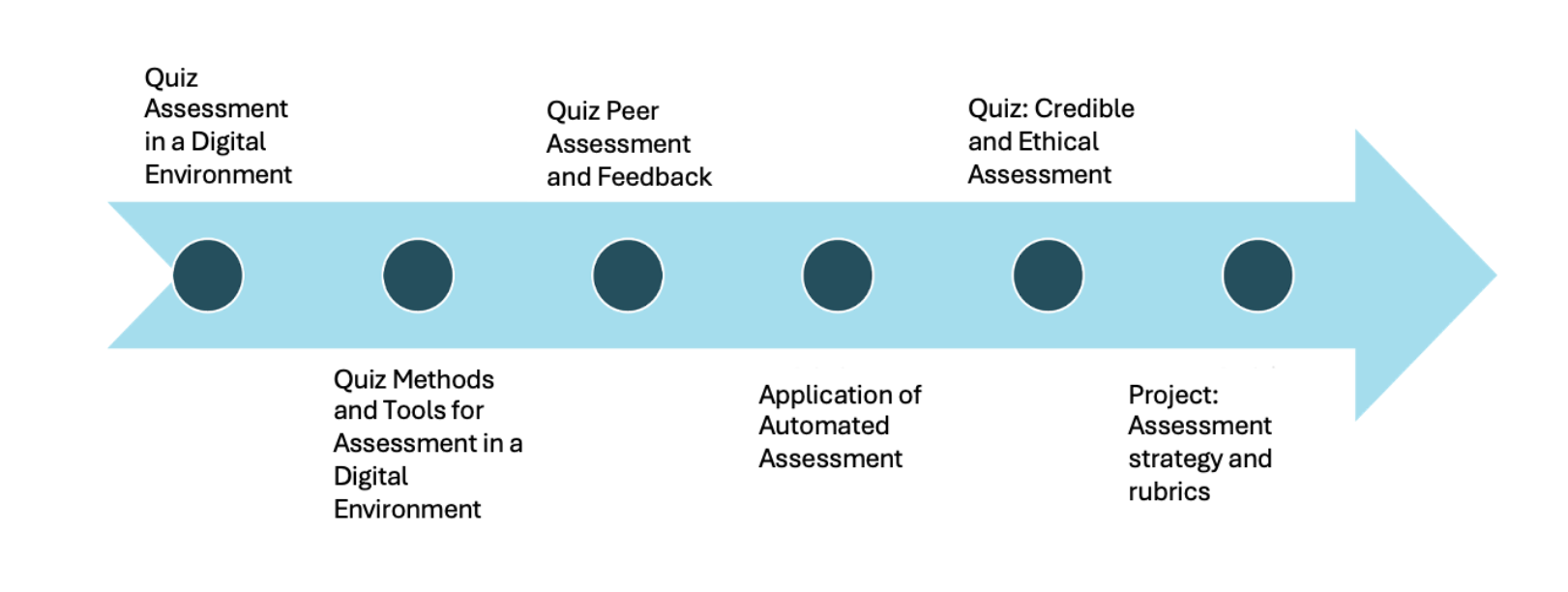
Figure 4. Overview of summative assessment
The descriptions of participant activities are provided in 6. Topic Description and Badge Requirements. Details about tasks and requirements, as well as thresholds applied, are specified in the e-course (Moodle) and in the learning design (BDP).
9. Etiquette
To ensure better collaboration, we have defined certain rules of conduct for the course.
Respect other participants and instructors who are in the course with you. Communicate in a way that acknowledges others and contributes constructively to a pleasant working and learning environment.
Use professional and clear language. Strive to write grammatically correctly and use a professional writing style. Avoid writing entire words in capital letters (which may be interpreted as shouting). Inappropriate or offensive messages are not acceptable.
Stay on topic and be concise. Your comments, responses, and messages should relate to the topic and be structured in a way that is understandable to other participants and instructors.
Respect deadlines and complete your obligations on time. Your activity contributes to the quality of shared learning in the course. Check announcements regularly, complete tasks within deadlines, and participate in discussions. Pay special attention to group and team work, as all members are expected to contribute to achieving results.
Protect the privacy and confidentiality of information. Do not share personal data of other participants without their explicit consent, and be cautious when sharing your own data in public course spaces. Do not share analyses that are not anonymized or for which you do not have informed consent.
Do not post promotional content or inappropriate messages. The course is not a place for advertising, chain messages, or political content. The focus should remain on course content and mutual learning.
Express disagreement in a constructive and well-reasoned manner. Direct criticism at the content or idea, not the person. If you disagree, explain your viewpoint respectfully and support it with arguments. Provide references and professional justification for your claims.
Communicate through appropriate channels. For technical and organizational questions, use designated forums or contact course mentors through official communication channels. Informal communication is welcome in spaces intended for it, provided basic etiquette is respected. When working in groups or teams, agree on rules and communication methods in advance.
Prepare for participation in virtual meetings. The course includes synchronous sessions where the use of a camera is recommended (when possible), as well as staying in a quiet environment and unmuting only when you have a comment or question. Respect others' time, avoid disruptions, and prepare and test your presentations in advance.
Act in accordance with ethical and legal standards. Respect copyright, institutional policies, and applicable laws. Do not share course materials outside the intended channels and respect intellectual property rights. Unauthorized use of materials, plagiarism, or sharing confidential information is not permitted.

This e-course is provided under the Creative Commons Attribution-NonCommercial-ShareAlike 4.0 International license. When using this work, we suggest acknowledging authorship in the following way:
Bađari J. & Divjak B. (2025) Assessment Supported by Digital Technology. 1st edition of CARNET’s e-course. Retrieved from the link.
Why these rules? The aim is to ensure a high-quality, inclusive, and professional learning environment in which everyone feels comfortable.
What if the rules are violated? In cases of non-compliance, course facilitators may issue a warning, and in more serious situations, take further steps in accordance with institutional policy.
Who is responsible? All course participants share responsibility for maintaining a positive and professional atmosphere.
10. Support and Contacts
For all content-related questions and questions regarding participation in the e-course, please contact your instructor.
For technical questions, please contact us at the email address x@carnet.hr or by phone at 01 xxxxxxx.
11. Literature
Each topic contains learning materials in Croatian, as well as a list of recommended literature for further study. Below is an overview of the key references used in the course.
AAC&U VALUE Rubrics – internationally recognized rubrics for 16 key areas of learning.
Andrade, H. & Du, Y. (2007). Student responses to criteria-referenced self-assessment. Assessment and Evaluation in Higher Education, 32(2), 159–181.
Assessment Design and Strategies for Student Learning (Cambridge CCTL)
Bacchus, R., Colvin, E., Knight, E. B., & Ritter, L. (2020). When rubrics aren’t enough: Exploring exemplars and student rubric co-construction. Journal of Curriculum and Pedagogy, 17(1), 48–61.
Bandura, A. (1999). Moral disengagement in the perpetration of inhumanities. Personality and Social Psychology Review, 3(3), 193–209.
Biggs, J. & Tang, C. (2011). Teaching for Quality Learning at University (4th ed.). McGraw-Hill.
Bretag, T., Harper, R., Burton, M., Ellis, C., Newton, P., Rozenberg, P., Saddiqui, S., & van Haeringen, K. (2019). Contract cheating: A survey of Australian university students. Studies in Higher Education, 44(11), 1837–1856.
Chen, I.-C., Hwang, G.-J., Lai, C.-L., & Wang, W.-C. (2020). From design to reflection: Effects of peer-scoring and comments on students’ behavioural patterns and learning outcomes in musical theater performance. Computers and Education, 150, 103856.
Clark, I. (2012). Formative assessment: Assessment is for self-regulated learning. Educational Psychology Review, 24(2), 205–249.
Divjak, B. (2014). Provjera konzistentnosti i postizanja ishoda učenja. UNIQInfo, 5, 10–13.
Divjak, B., Svetec, B., Horvat, D. (2025). Generative AI in Mathematics Education: Analysing Student Performance and Perceptions over Three Academic Years. International Journal of Technology Enhanced Learning.
Divjak, B., Svetec, B., Horvat, D., & Kadoić, N. (2023). Assessment validity and learning analytics as prerequisites for ensuring student-centred learning design. British Journal of Educational Technology, 54, 313–334.
Divjak, B., Žugec, B., & Pažur Aničić, K. (2022). E-assessment in mathematics in higher education: A student perspective. International Journal of Mathematical Education in Science and Technology.
Fernández-Sánchez, A., Lorenzo-Castiñeiras, J. J., & Sánchez-Bello, A. (2025). Navigating the Future of Pedagogy: The Integration of AI Tools in Developing Educational Assessment Rubrics. European Journal in Education, Research, Development and Policy, 60(1).
Flodén, J. (2025). Grading exams using large language models: A comparison between human and AI grading of exams in higher education using ChatGPT. British Educational Research Journal.
Ifenthaler, D. (2023). Investigating self-assessment use in higher education with learning analytics. Journal of Computer Assisted Learning, 39(1), 222–233.
Ifenthaler, D. & Yau, J. Y.-K. (2020). Utilising learning analytics to support study success in higher education: A systematic review. Educational Technology Research and Development, 68(4), 1961–1990.
Khasawneh, M. A. S., Aladini, R., Assi, N., & Rawashdeh, H. (2025). The effect of using artificial intelligence-based feedback in electronic portfolios on EFL students’ academic emotion regulation and mindfulness. Language Testing in Asia, 15(1), 10.
Kumar, H., Xiao, R., Lawson, B., Musabirov, I., Shi, J., Wang, X., Luo, H., Williams, J., Rafferty, A., Stamper, J., & Liut, M. (2024). Supporting self-reflection at scale with large language models: Insights from randomized field experiments in classrooms. arXiv preprint.
Lancaster, T. (2021). Contract cheating in higher education: Global perspectives, policy, and prevention. Routledge.
Noorbehbahani, F., Mohammadi, A., & Aminazadeh, M. (2022). A systematic review of research on cheating in online exams from 2010 to 2021. Education and Information Technologies, 27, 8413–8460.
Oravec, J. A. (2022). AI, biometric analysis, and emerging cheating detection systems: The engineering of academic integrity?. Education Policy Analysis Archives, 30, 175.
Panadero, E., Brown, G. T. L., & Courtney, M. (2022). Students’ strategies during self-assessment: Feedback and rubrics effects. Assessment in Education, 29(1), 23–43.
Panadero, E. & Jonsson, A. (2013). The use of scoring rubrics for formative assessment purposes revisited: A review. Educational Research Review, 9, 129–144.
Panadero, E., Jonsson, A., Pinedo, L., et al. (2023). Effects of Rubrics on Academic Performance, Self-Regulated Learning, and Self-Efficacy: A Meta-analytic Review. Educational Psychology Review, 35, 113.
Ramesh, D. & Sanampudi, S. K. (2021). An automated essay scoring systems: A systematic literature review. Artificial Intelligence Review, 55, 2495–2527.
Rüth, M., Jansen, M., & Kaspar, K. (2024). Cheating behaviour in online exams: On the role of needs, conceptions and reasons of university students. Journal of Computer Assisted Learning, 40(5), 1987–2008.
Sevnarayan, K. & Maphoto, M. (2024). Academic dishonesty in a first-year English module in open distance e-learning (ODeL). Journal of Academic Ethics, 22(2), 357–374.
Siemens, G. & Long, P. (2011). Penetrating the fog: Analytics in learning and education. EDUCAUSE Review, 46(5), 30–40.
Slade, S. & Prinsloo, P. (2013). Learning analytics: Ethical issues and dilemmas. American Behavioral Scientist, 57(10), 1510–1529.
Valızadeh, M. (2022). Cheating in online learning programs: Learners’ perceptions and solutions. Turkish Online Journal of Distance Education, 23(1), 195–209.
Background Colour
Font Face
Font Size
Text Colour
Font Kerning
Image Visibility
Letter Spacing
Line Height
Link Highlight
Paragraph Width
Text Alignment