Exploring Assessment Rubrics
| Site: | Loomen za stručna usavršavanja |
| Course: | Assessment Using Digital Technology |
| Book: | Exploring Assessment Rubrics |
| Printed by: | Gost (anonimni korisnik) |
| Date: | Thursday, 17 September 2026, 3:51 PM |
1. Design and examples of assessment rubrics
Rubrics are tools that enable teachers and students to clearly define expectations and performance criteria in assessment activities. A rubric generally contains a set of described criteria, and often levels of their achievement, according to which student work will be assessed. Since each assignment is different and involves different criteria for evaluating student work, rubrics should be prepared or at least adapted for each individual assignment.
The term rubric is used to describe analytic and holistic assessment rubrics, but also marking sheets, assessment/grading guides, scoring schemes, guides for awarding grades, etc. Moodle uses the term rubric for an empty and customisable template that becomes an assessment rubric once it is filled with criteria, standards, and descriptions, and sometimes with performance levels.
Basically, it is a grading scheme for a given assignment that combines assessment criteria and standards and provides details on how performance in each of the criteria will be graded. Clearly defined and publicly available assessment criteria and grading schemes/rubrics are key to ensuring fair and consistent assessment of all work and across all disciplines.
Although assessment rubrics are not a universal solution for completely precise assessment and grading, they still provide a number of important advantages, as they can offer:
- a reference point for teaching staff at the faculty and department level with regard to assessment expectations
- a shared understanding and language for talking about assessment expectations between teachers and students
- confidence and guidance for beginners in assessment, helping them to engage more quickly with the community of teachers who are expected to assess and grade
- a degree of standardisation in assessment among multiple markers, which increases the reliability of assessment and grading
- a structure that can justify and support the assessments and grades awarded
- more transparent assessment and grading results for students
- a diagnostic opportunity for students, as rubrics provide guidance for learning and improving achievement
- a framework for writing feedback
- a framework for providing automated feedback.
2. Types of Rubrics
In higher education, the most commonly used are holistic and analytic rubrics.
A holistic rubric allows for a quick, overall assessment of a student’s work. Evaluation is based on the general impression of the quality of the work in relation to predefined performance levels. The assessment is not broken down into individual criteria, so the feedback provided is general.
Example:
Holistic rubric for essay assessment – Topic: Causes of the First World War
|
Performance Level |
Description of Achievement |
|
5 – Excellent |
The essay clearly and precisely explains multiple causes of the First World War, offering in-depth analysis and connecting political, economic, and social factors. Arguments are well structured, clearly presented, and supported with relevant sources. The writing style is academic and grammatically accurate. The essay demonstrates exceptional understanding of the topic. |
|
4 – Very Good |
The essay covers the main causes of the First World War with understandable analysis and examples. Argumentation is logical and supported by basic sources. The writing style is good, with minor linguistic errors. The essay shows very good understanding of the topic. |
|
3 – Good |
The essay lists the basic causes of the First World War, but the analysis is superficial or partly unclear. Structure and arguments are present, but uneven. Occasional lack of sources and more frequent linguistic mistakes. The essay shows basic understanding of the topic. |
|
2 – Satisfactory |
The essay deals with the topic superficially and/or omits key causes. Argumentation is weak or unclear, lacking logical coherence. Insufficient use of sources and a larger number of language and grammatical errors. The essay shows limited understanding of the topic. |
|
1 – Unsatisfactory |
The essay does not address the assigned topic or is extremely superficial. Argumentation and analysis are absent, and sources are not used. Numerous grammatical errors are present. The essay does not demonstrate understanding of the topic. |
An analytic rubric assesses student work using several clearly defined criteria. Each criterion is evaluated according to multiple performance levels. This type of rubric offers students clear information about what they did well and where they can improve.
Analytic rubric for an essay – Topic: Causes of the First World War
|
Criterion |
4 – Excellent |
3 – Good |
2 – Satisfactory |
1 – Unsatisfactory |
|
1. Content and Understanding |
All main causes of the war are covered with clear analysis and connections. Demonstrates deep understanding of the historical context. |
Main causes are addressed with basic analysis and partial connections. Demonstrates good understanding of the topic. |
Some causes are listed, but the analysis is superficial or partly incorrect. Connections are limited. |
Themes are incorrect or extremely superficial. Demonstrates insufficient or inaccurate understanding. |
|
2. Argumentation and Structure |
Clear, logical, and well-structured argumentation with introduction, development, and conclusion. Each claim is supported by examples. |
Mostly clear structure. Most arguments are logical, although some parts are less developed. |
Structure is present but uneven. Arguments are often unclear or unconvincing. |
The essay is disorganised. Arguments are inconsistent or absent. There is no clear connection between text sections. |
|
3. Use of Sources and Literature |
Relevant academic sources are used and correctly cited. Demonstrates the ability to use sources critically. |
Appropriate sources are used and mostly correctly cited. |
Some sources are used, but not cited consistently. Occasional incorrect citation. |
Lack of sources or inadequate use of them. Sources are not cited or incorrectly referenced. |
|
4. Language and Writing Style |
Academic style, clear and precise language. No grammatical or spelling errors. |
Mostly academic style, with some minor inconsistencies. A few language errors. |
Language is occasionally unclear, with more frequent grammatical and spelling errors. |
Language and style are inappropriate for academic writing. Numerous language and spelling errors. |
Comparison table: Holistic vs. Analytic Rubric
|
Feature |
Holistic Rubric |
Analytic Rubric |
|
Structure |
Single overall assessment |
Assessment by multiple criteria and levels |
|
Number of criteria |
Not presented separately |
Each criterion is evaluated separately |
|
Level of detail |
Low |
High |
|
Feedback |
General |
Detailed and targeted |
|
Time required for use and evaluation |
Shorter |
Longer |
|
Purpose |
Mainly summative assessment |
Formative and summative assessment |
3. Rubric Design
Steps in Creating Rubrics:
- linking assessment with learning outcomes
- defining assessment criteria based on the planned learning outcomes
- evaluating the relative weights of individual criteria
- establishing performance levels for each criterion and assigning score ranges for each level
- writing descriptors for each criterion and its performance levels
- piloting the rubric using examples of student work
- reflecting on and adapting the rubric.
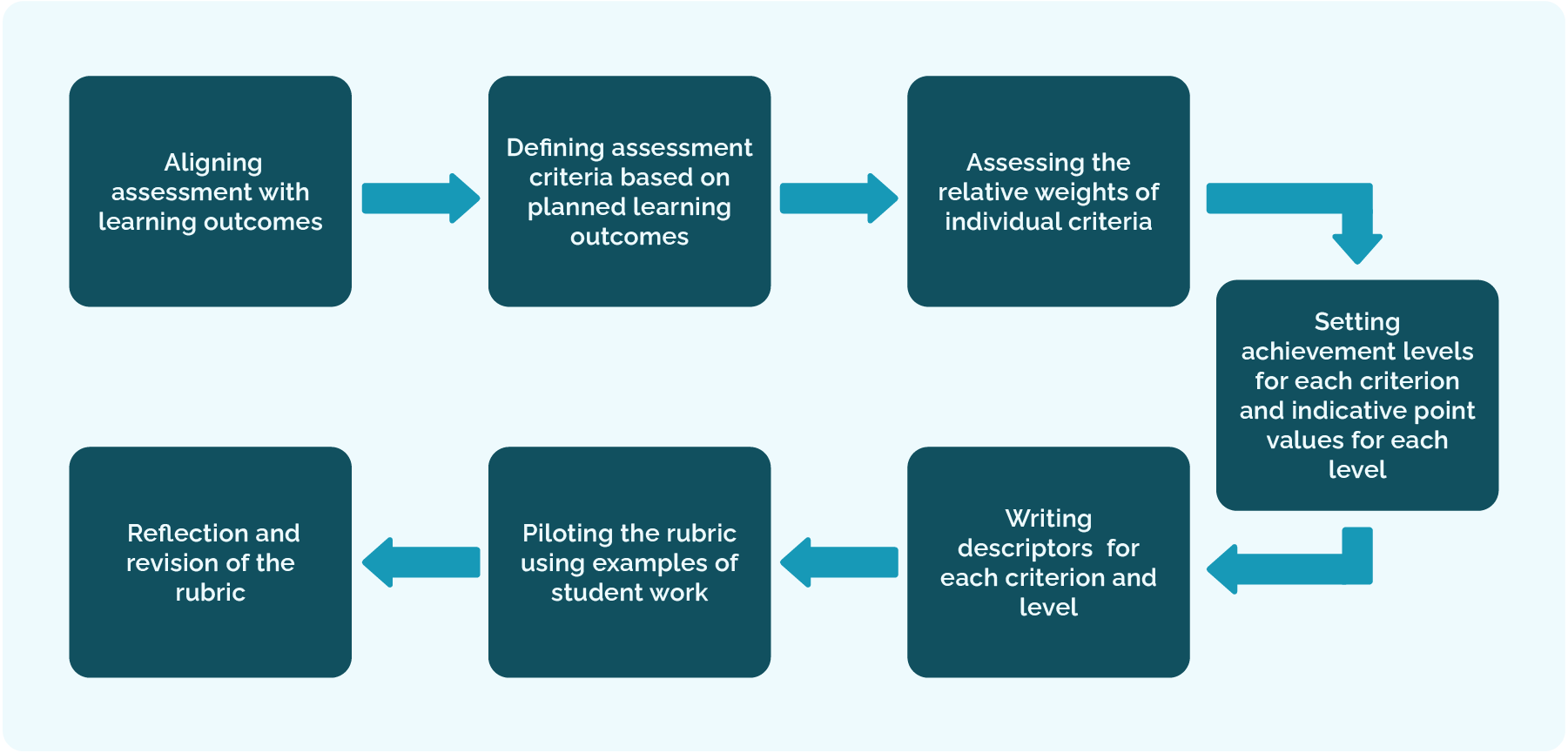
Figure 1: Rubric creation process
4. The Role of Students in Rubric Development
Rubrics can be created independently by the teacher or co-constructed with students in order to encourage their engagement and raise awareness of the specific criteria (Bacchus et al., 2020).
In addition to supporting the personal development of metacognition and self-regulated learning, this knowledge and the involvement of students are important for peer assessment, in which students evaluate the work of their colleagues. The process of making a judgement about a peer’s work is complex; there are multiple aspects that the evaluator must take into consideration. Therefore, students must have a functional understanding of the rubric itself, consider and acknowledge all comments provided by the teacher, read and reread their peers’ work, and finally make a final judgement on the value of the work in relation to the given criteria (Chen et al., 2020). This process is complex even for an experienced expert, so it is not surprising that students require training and multiple opportunities to improve their judgements in peer assessment.
More on the influence of rubrics on academic achievement and self-regulated learning can be found in the paper by Panadero et al. (2023).
5. AI-Supported Rubrics
The aim of the study by Fernández-Sánchez et al. (2025) was to explore how generative artificial intelligence (particularly ChatGPT) can support teachers in creating assessment rubrics within the course Curriculum Design, Development and Evaluation at the University of A Coruña (academic year 2023/2024). The study concludes that generative artificial intelligence can significantly enhance the process of rubric design in higher education.
AI tools make it possible to define assessment criteria more quickly and accurately, improve alignment with the curriculum, and provide support to teachers, especially those with less experience. Although artificial intelligence is not a substitute for pedagogical insight and expert work, it is nevertheless a valuable tool that, with appropriate training and a critical approach, can enrich and professionalise assessment practices in education.
6. Template for an Analytic Assessment Rubric
The generic rubric below is intended for evaluating student work in accordance with defined learning outcomes. Add the assessment criteria in the rows and the performance levels in the columns. Criteria may include the content of the work, the organisation of delivery, as well as the student’s creative approach to addressing the topic or solving a problem.
Edit this rubric according to the type of assignment and the defined learning outcomes. You can also download the template in MS Word format.
|
Learning outcome(s) addressed by the work |
||||
|---|---|---|---|---|
|
Criterion |
Low level |
Partial level |
Satisfactory level |
Excellent level |
In her scholarly work, Divjak (2014) presents a rubric for evaluating projects for graduate students in the field of informatics.
7. Self-Assessment and Reflection Questions
Self-Assessment Questions
-
What is the primary purpose of a rubric in the assessment process, and how does it contribute to transparency and fairness in grading?
-
Explain the difference between holistic and analytic rubrics, and provide an example of a situation in which each would be more appropriate.
-
What are the key components of an analytic rubric, and in what order are they created during the development process?
-
How do rubrics support students in developing metacognition and self-regulated learning?
-
What role can artificial intelligence play in the rubric creation process, and what are its pedagogical limitations?
Reflection Questions
-
How could you involve students in the process of creating a rubric in your course, and what benefits might this have for their learning and motivation?
-
Which criteria would you include in a rubric for evaluating a complex task (e.g., project, essay, presentation) in your course, and why?
-
In which situations would you select a holistic rubric instead of an analytic one, and how would you explain the difference in feedback to your students?
-
How could you combine rubrics with AI tools (e.g., ChatGPT) in a way that enhances efficiency and consistency while maintaining pedagogical quality and human judgement?
-
When would you introduce rubrics into your course, and how would you evaluate their effectiveness?
8. Sources and Links to Tools and Portals
AAC&U VALUE Rubrics – internationally recognised rubrics for 16 key learning domains.
Assessment Design and Strategies for Student Learning (Cambridge CCTL)
Bacchus, R., Colvin, E., Knight, E. B., and Ritter, L. (2020). ‘When rubrics aren’t enough: Exploring exemplars and student rubric co-construction’, Journal of Curriculum and Pedagogy, 17 (1): 48-61.
Chen, I.-C., Hwang, G.-J., Lai, C.-L., and Wang, W.-C. (2020). ‘From design to reflection: Effects of peer- scoring and comments on students’ behavioural patterns and learning outcomes in musical theater performance’, Computers and Education, 150: 103856.
Divjak, B. Provjera konzistentnosti i postizanja ishoda učenja. UNIQInfo no. 5 Sept. 2014. 10-13.
Fernández-Sánchez, A., Lorenzo-Castiñeiras, J.J., Sánchez-Bello, A. (2025). Navigating the Future of Pedagogy: The Integration of AI Tools in Developing Educational Assessment Rubrics. European Journal in Education, Research, Development, and Policy. 60(1)
Panadero, E., Jonsson, A., Pinedo, L., et al. Effects of Rubrics on Academic Performance, Self-Regulated Learning, and self-Efficacy: a Meta-analytic Review. Educ Psychol Rev 35, 113 (2023).
9. Task
In this activity, you will independently explore different examples of rubrics using digital resources. Analyse the content, structure, and criteria of individual rubrics, and take notes on the elements you observe, examples of good practice, and potential applications in your own context. You will use these notes later to create your own rubrics.
Background Colour
Font Face
Font Size
Text Colour
Font Kerning
Image Visibility
Letter Spacing
Line Height
Link Highlight
Paragraph Width
Text Alignment