Instructions for participants of the e-course “Artificial Intelligence in Education”
| Site: | Loomen za stručna usavršavanja |
| Course: | Artificial Intelligence in Education |
| Book: | Instructions for participants of the e-course “Artificial Intelligence in Education” |
| Printed by: | Gost (anonimni korisnik) |
| Date: | Thursday, 17 September 2026, 1:39 PM |
Table of contents
- 1. Course format
- 2. General information about the e-course
- 3. E-course structure
- 4. Technical information about the system where the e-course is hosted
- 5. Minimum technical requirements for attending the e-course
- 6. Course requirements for participants
- 7. Contact information
- 8. Rules of conduct on the course
- 9. Literature
1. Course format
The e-course is organised into five logically connected thematic units that participants complete through the study of theoretical content and practical activities. Throughout the e-course, participants engage in lectures, debates, discussions and other activities aimed at understanding and applying artificial intelligence (AI) in educational settings. Practical tasks are designed so that participants can complete them independently or in small groups (3–4 participants), with cooperation encouraged throughout the e-course to promote the exchange of knowledge and educational experiences. Participants also develop individual plans for applying artificial intelligence in the educational process, with continuous support from the instructor. They consider these plans from technical, pedagogical and organisational perspectives, ultimately consolidating their work into a final paper. The schedule and workflow will be clearly defined and presented at the beginning of each thematic unit, and additional information and instructions will be available throughout the e-course.
2. General information about the e-course
The e-course Artificial Intelligence in Education is a mentored online course designed to provide educators, primarily higher education teachers, with the basic knowledge and practical skills necessary to apply artificial intelligence in educational processes. The course develops the ability to critically evaluate, select and use artificial intelligence (AI) tools and systems in education, with special emphasis on personalising learning, differentiating teaching content and encouraging active student participation. It also explores how these AI tools and systems can improve the planning, implementation and evaluation of teaching, stimulate creativity and support an individualised approach to learning from technical, pedagogical and organisational perspectives. By analysing available AI technologies and their application methodologies, including prompt engineering as a key skill for effective use of AI tools and systems, students develop their own strategies for using AI in personalised educational practices. Special emphasis is placed on the responsible and ethical use of artificial intelligence to ensure adaptation to the changing needs of learners and the educational environment.
Number of ECTS credits: 3
Students: Primarily teachers and management staff in higher education institutions and other educational stakeholders.
E-learning outcomes of the e-course:
- Identify, through analysis, the potential advantages and challenges of applying artificial intelligence in education.
- Critically select artificial intelligence tools and systems that meet specific educational needs.
- Apply artificial intelligence tools and systems to personalise teaching, encourage active learning and adapt to student needs, while respecting the specificities of the subject, educational environment and the credibility and reliability of sources.
- Propose concrete improvements to educational practices by applying artificial intelligence tools and systems to a selected example.
3. E-course structure
The e-course consists of five thematic units. The table below shows how each unit contributes to achieving the e-course learning outcomes and the distribution of points for summative and formative assessment by topic. Points from the formative assessment are used only to monitor your progress and provide feedback; they are not included in the calculation of your final result in the e-course. The final result is calculated solely based on the total number of points from the summative assessment.
|
Thematic units/learning outcomes |
Identify, through analysis, the potential advantages and challenges of applying artificial intelligence in education.
|
Critically select artificial intelligence tools and systems that meet specific educational needs.
|
Apply artificial intelligence tools and systems to personalise teaching, encourage active learning and adapt to student needs, while respecting the specificities of the subject, educational environment and the credibility and reliability of sources. |
Propose concrete improvements to educational practices by applying artificial intelligence tools and systems to a selected example.
|
Formative assessment |
Summative assessment |
|
1. Artificial intelligence and data literacy in the digital society |
40 % |
|
|
|
19 |
10 |
|
2. Education and artificial intelligence: differentiation, personalisation and active learning |
60 % |
|
|
|
15 |
13 |
|
3. Artificial intelligence tools and systems in education |
|
90 % |
10 % |
|
15 |
17 |
|
4. Creating and adapting educational activities with artificial intelligence tools and systems while respecting the credibility and reliability of sources |
|
10 % |
80 % |
10 % |
21 |
27 |
|
5. Practical guidelines for the successful application of artificial intelligence in education with an emphasis on teachers and management staff |
|
|
10 % |
90 % |
30 |
33 |
|
TOTAL: |
100 % |
100 % |
100 % |
100 % |
100 |
100 |
E-course structure:
1. Thematic unit: Artificial Intelligence and Data Literacy in the Digital Society
In theoretical terms, this thematic unit introduces participants to the fundamental concepts of artificial intelligence (AI) and data literacy in the context of education and the digital society. It covers basic concepts, the historical development and types of artificial intelligence, and data literacy, with particular attention to ethics, privacy, bias and data reliability. Special emphasis is placed on understanding the relationship between data literacy and the responsible use of AI in education.
In practical terms, participants analyse digital educational content through interactive lessons and tests and participate in structured debates and discussions. By using AI tools and systems and engaging in reflective tasks, they develop the ability to critically analyse the advantages, challenges and limitations of applying artificial intelligence in educational settings.
2. Thematic unit: Education and artificial intelligence: differentiation, personalisation and active learning
In theoretical terms, this unit provides knowledge about the application of artificial intelligence in education, emphasising differentiation and personalisation of learning, identification of student needs, encouragement of active learning, and broader implications and challenges in applying artificial intelligence technologies. Participants will analyse the technical, ethical, security and legislative aspects of artificial intelligence use, including current regulations such as the EU AI Act. By studying case studies and theoretical materials, they will develop the ability to critically analyse the application of artificial intelligence in educational systems.
In practical terms, participants will analyse the use of artificial intelligence tools and systems in differentiated and personalised learning. They will participate in group work and discussions, evaluate specific examples and challenges, and make presentations that critically demonstrate the advantages and disadvantages of applying artificial intelligence in education. Through this, they will develop skills to apply theoretical knowledge in real educational situations.
3. Thematic unit: Artificial intelligence tools and systems in education
In theoretical terms, in this unit, participants will gain insight into the various categories of available AI tools and systems for use in education. The focus is on critically analysing and selecting AI tools and systems based on specific educational needs, as well as understanding the organisational, technical and pedagogical challenges involved in their implementation. Participants will be introduced to types of tools (generative, adaptive, analytical, administrative), criteria for their selection, and examples of successful implementations in educational institutions.
In practical terms, participants will engage in research and hands-on activities to select an AI tool or system with educational potential, analyse its technical and pedagogical aspects, and prepare and present their analysis results. Through group work, using AI tools and systems to create presentations and videos, participants will assess challenges and propose solutions for introducing the selected tool into the educational system, with an emphasis on organisational aspects. Additionally, reflection and self-assessment questions will help participants evaluate their progress and encourage further exploration of the topic.
4. Thematic unit: Creating and adapting educational activities with artificial intelligence tools and systems while respecting the credibility and reliability of sources
In theoretical terms, this thematic unit focuses on understanding and practical application of artificial intelligence tools and systems to create and adapt educational activities. Participants will explore the potential of artificial intelligence for personalising teaching, encouraging active learning and addressing the diverse needs of students. Special emphasis is placed on selecting reliable and credible sources when working with artificial intelligence tools, as well as considering the specific requirements of different subjects and educational environments. The unit will also examine how artificial intelligence can assist instructors and university teachers in designing, implementing and adapting the educational process.
In practical terms, participants will use artificial intelligence tools and systems to create and adapt educational content through hands-on activities, applying principles of query engineering to improve the relevance and quality of outputs from artificial intelligence systems. Through workshops, group tasks and simulations, they will design educational scenarios and content that address real educational needs. Participants will evaluate the authenticity of sources and adapt content to specific educational settings and the individual needs of students or other learners. Additionally, reflection and self-assessment questions will help learners monitor their own progress and encourage further exploration of the topic.
5. Thematic unit: Practical guidelines for the successful application of artificial intelligence in education with an emphasis on teachers and management staff
In theoretical terms, this thematic unit aims to develop concrete guidelines for the effective, responsible and sustainable application of artificial intelligence in higher education institutions, with an emphasis on the roles of higher education teachers and management staff. Participants will be introduced to instructional design models (such as the ADDIE model extended with artificial intelligence components), examples of best practices for integrating artificial intelligence into curricula, and the impact of both the narrower (teaching content, participant/student characteristics) and broader (institutional policies, legislative frameworks) educational environments on the implementation of artificial intelligence in the educational process. Guidelines and reflective activities will also analyse the ethical, pedagogical, technical and organisational aspects of applying artificial intelligence tools and systems.
In practical terms, participants will develop critical thinking skills and apply artificial intelligence in education through activities such as analysing and evaluating case studies, discussions, questionnaires and project tasks. They will participate in forums and use AI tools and systems for research, summarisation and reflection. For the final assignment, participants will create their own proposal for applying AI in a real educational environment, including the creation of digital educational content using AI tools and systems, and a proposal for evaluating the acquired knowledge. They are encouraged to connect the knowledge, skills and abilities gained throughout the module to their own educational environments.
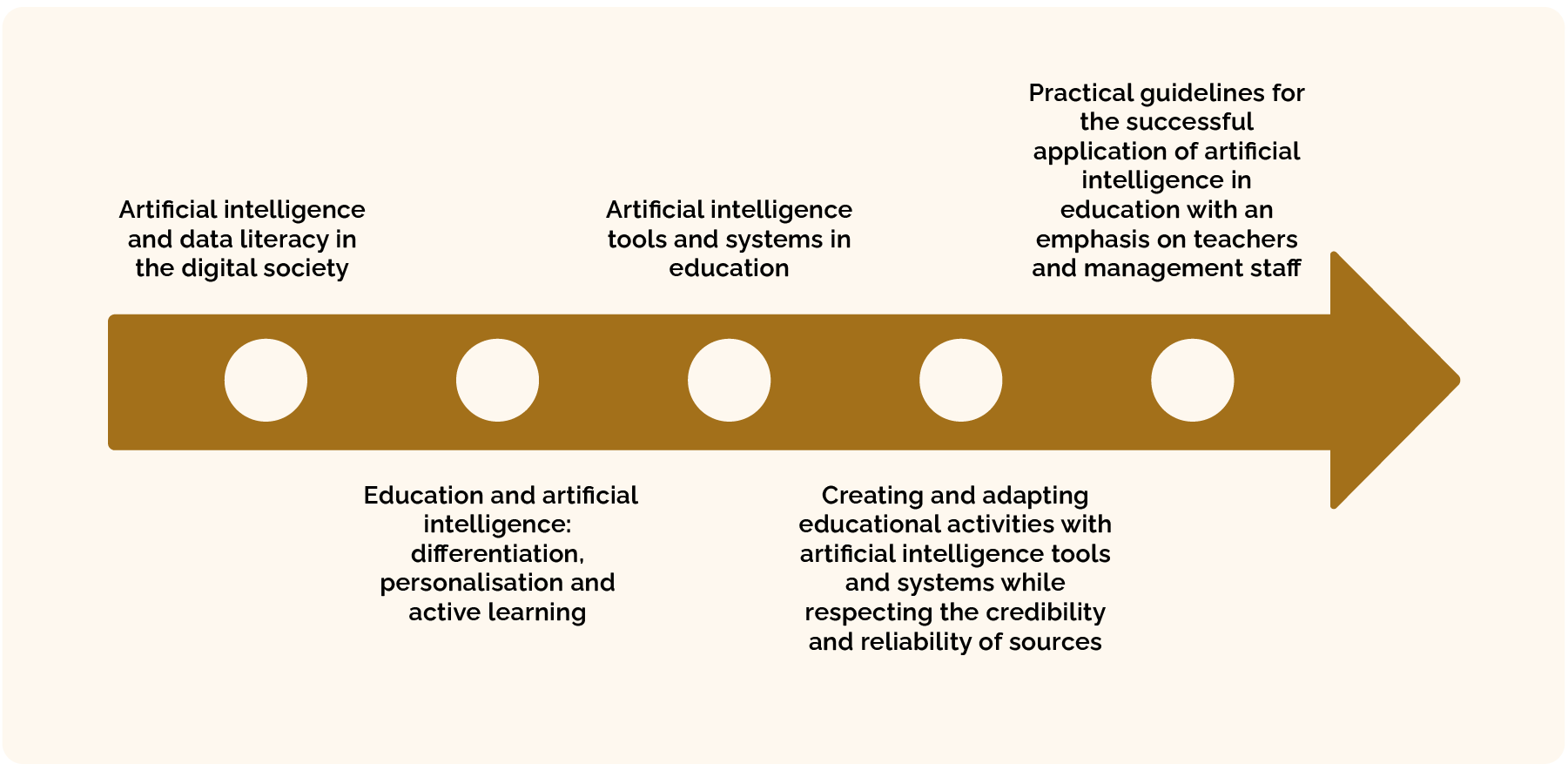
Figure: Presentation of summative evaluation
4. Technical information about the system where the e-course is hosted
This e-course is implemented on the Loomen e-learning system, which is based on the open-source Moodle platform. The e-course homepage is organised according to the course structure, with links leading to activities and resources as designed.
The e-course can be accessed from any computer with an Internet connection, as well as from smartphones and tablets. It functions properly in all major web browsers (Firefox, Opera, Chrome, Edge, etc.). The e-course is also available through a mobile application, although the app does not always function optimally.
You can navigate the e-course more quickly using the menu on the left, while the right side allows you to monitor upcoming activities, highlighted notifications and your progress throughout the course.
The Loomen e-learning system is intuitive, but if you experience any difficulties, you should contact the instructor.
5. Minimum technical requirements for attending the e-course
Types of content in an e-course:
Educational multimedia materials, primarily textual (such as lessons and pages), are available in the Loomen e-learning system and can be accessed directly through a web browser. All materials can also be downloaded in PDF format. Therefore, users must have a PDF reader installed. However, if using browsers like Firefox or Chrome, a PDF reader is not required, as PDFs can be opened directly in the browser.
The video lessons are originally hosted on the CARNET's multimedia portal Meduza and are integrated into the Loomen e-learning system pages, allowing access without leaving Loomen. To view the video lessons, an internet connection of at least 2 Mbit/s is required, as well as headphones or speakers.
The practical tasks are completed using various tools and artificial intelligence systems (e.g., Curipod, Media.io AI Avatar Generator, Nero AI, Litmap, SciSpace AI, Gamma.app, Canva Magic Design / Magic Presentation, Tome, Beautiful.ai). Students must be able to access the selected tools and AI systems with their user accounts. Additionally, the practical tasks require the use of the Turnitin tool, which students must access using their AAI@Edu.hr electronic identity (e.g. faculty electronic identity).
Evaluation activities in the e-course are supported by the appropriate functionalities of the Loomen system, and no additional technical prerequisites are required. Tests are accessed entirely through a web browser, with no further technical requirements.
Synchronous course activities are conducted using the BigBlueButton videoconferencing platform, which is integrated into the Loomen e-learning system. The technical requirements for participating in synchronous activities include a microphone, headphones and an internet connection (preferably 5 Mbit/s or higher).
6. Course requirements for participants
Participants are encouraged to participate in as many activities as possible, including reviewing and analysing video lessons and educational materials, practical activities, and more. During the e-course, participants can earn up to 200 points (100 summative and 100 formative). Formative scoring is included to systematically encourage participants to reflect on their learning and monitor their progress throughout the course. The following table lists the mandatory activities in the e-course by topic, method of implementation and possible points. Some activities are marked with an * next to the points, indicating that they are summatively assessed, but the points are awarded at the end of the course rather than immediately. The e-course is considered complete if at least 50 points are earned in total.
Grading scheme
|
Topic |
Mandatory activity or activity for points |
Individual / Group |
Points (S*, F) |
|
0. Welcome and orientation |
Creating an avatar Forum |
I |
5 |
|
|
Survey questionnaire |
I |
4 |
|
1. Artificial intelligence and data literacy in the digital society
|
Self-assessment of knowledge |
I |
5 |
|
|
Self-assessment of knowledge |
I |
5 |
|
|
Participation in a debate on artificial intelligence and data literacy in the digital society |
GR |
5* |
|
|
Participation in an asynchronous online forum discussion reflecting on the impact of artificial intelligence on everyday life and broader social change |
I |
5* |
|
2. Education and artificial intelligence: differentiation, personalisation and active learning |
Self-assessment of knowledge |
I |
5 |
|
|
Development of a case study on the use of artificial intelligence in differentiated education; presentation of the work (BBB) |
I/GR |
5* |
|
|
Self-assessment of knowledge |
I |
5 |
|
|
Participation in the debate Challenges and limitations of artificial intelligence in fostering active learning |
GR |
3* |
|
|
Self-assessment of knowledge |
I |
5 |
|
|
Participation in the analysis of the potential of artificial intelligence in teaching on a selected example and presentation of the work |
I/GR |
5* |
|
3. AI tools and systems in education |
Analysis and presentation of the technical aspects of a freely chosen artificial intelligence tool or system |
I |
5* |
|
|
Self-assessment of knowledge |
I |
5 |
|
|
Analysis and presentation of the pedagogical aspects of the selected artificial intelligence tool or system |
I/GR |
6* |
|
|
Self-assessment of knowledge |
I |
5 |
|
|
Analysis using an artificial intelligence tool or system in education (organisational aspect) and creation of a video with the support of an AI tool |
I/GR |
6* |
|
|
Self-assessment of knowledge |
I |
5 |
|
4. Designing and adapting educational activities using AI tools and systems, with attention to credibility and reliability of sources |
Participation in synchronous classes – demonstration of selected AI tools and systems for adapting educational materials for students with different prior knowledge levels and for generating feedback according to defined assessment criteria (ChatGPT, Copilot) |
I/GR |
0 |
|
|
Creation of an educational content presentation using an AI tool or system |
I |
6* |
|
|
Self-assessment of knowledge |
I |
5 |
|
|
Using an AI tool to generate adapted educational materials for students with different prior knowledge levels |
I |
5* |
|
|
Using two available tools (Turnitin and GPTZero) to check the authenticity of the essay from the previous task |
I |
3* |
|
|
Analysis of prompts |
I |
1 |
|
|
Creation of prompts |
I |
3* |
|
|
Reflection and exchange of ideas on prompt creation |
I |
10 |
|
|
Self-assessment of knowledge |
I |
5 |
|
|
Application of a selected AI tool (e.g. ChatGPT) to generate feedback according to defined assessment criteria |
I |
7* |
|
|
Participation in an online debate Can an AI tool replace the teacher in the assessment process? |
GR |
3* |
|
5. Practical guidelines for the successful use of artificial intelligence in education, with a focus on teachers and management staff |
Self-assessment of knowledge |
I |
20 |
|
|
Participation in the forum The environment (narrower and broader) as support or barrier to the use of AI tools and systems in education? Using AI tools and systems for literature search, answer generation, summarising key positions and writing a reflective text (200 words) on: How could you use AI tools in your own teaching context? |
I |
3* |
|
|
Completion of a survey questionnaire |
I |
10 |
|
|
Development and presentation of the Final Project Artificial Intelligence in Education
|
I |
30* |
|
Total (summative assessment): |
100* |
||
|
Total (formative assessment): |
100 |
||
7. Contact information
For all content-related questions and questions about attending the e-course, please contact your instructor.
For technical questions, please email: x@carnet.hr or call 01 xxxxxxx.
8. Rules of conduct on the course
To enhance the quality of our collaboration, we have defined a set of rules for behaviour in this course.
Treat other participants as if they were in the same room with you. Foster a culture of respect and constructive dialogue in your communication. Remember, there is a real person behind every username – kindness and empathy are essential for a positive learning environment.
Use professional and clear language. Write grammatically correct, avoid using capital letters (which can be interpreted as shouting) and express your thoughts clearly. Inappropriate or offensive messages are not acceptable.
Stay on topic and be concise. Your comments, replies and messages should relate to the topic and be structured so that they are understandable to others. You help both yourself and your colleagues when you communicate clearly and stay focused.
Participate actively and in a timely manner. Your engagement contributes to the quality of shared learning. Check notifications regularly, respond to assignments by the given deadlines and engage in discussions.
Protect privacy and confidentiality. Do not share personal information about other participants without their explicit consent. Be cautious when sharing your own information in public areas of the course.
Do not post promotional content or spam. The course is not a place for advertising, sending chain letters or political messages. The focus should remain on course content and mutual learning.
Express disagreement constructively. Direct criticism toward the content or idea, not the person. If you disagree, present your opinion respectfully and acknowledge different points of view.
Communicate through appropriate channels. For technical and organisational issues, use the designated forums or contact e-course mentors through official channels. Informal communication is welcome in designated areas, while respecting basic rules of decency.
Prepare to participate in virtual meetings. If the course includes video meetings, it is recommended to use a camera when possible, stay in a quiet environment and join only when you have a comment or question. Respect others' time and do not disrupt the flow of work.
Act in accordance with ethical and legal standards. Respect copyright, institutional regulations and applicable laws. Unauthorised use of content, plagiarism or sharing confidential information is not permitted.

This e-course is available for use under the Creative Commons Attribution-NonCommercial-ShareAlike 4.0 International License. When using the work, we suggest attributing the work as follows:
Babić, S. (2025) Artificial Intelligence in Education. 1st edition of the CARNET e-course.
Why are these rules in place? The goal is to ensure a quality, inclusive and professional learning environment in which everyone feels comfortable.
What if the rules are broken? In case of non-compliance, the course leaders may warn you and, in more serious situations, take further steps in accordance with the institution's regulations.
Who is responsible? All course participants share the responsibility for maintaining a positive and professional atmosphere.
9. Literature
Each topic includes a list of literature used in preparing the e-course. Depending on your specific interest, you should consult the literature related to the topic of interest.
Background Colour
Font Face
Font Size
Text Colour
Font Kerning
Image Visibility
Letter Spacing
Line Height
Link Highlight
Paragraph Width
Text Alignment