Instructions for participants of the e-course: Impact of Digital Technologies on Well-being
| Site: | Loomen za stručna usavršavanja |
| Course: | Impact of Digital Technologies on Well-being |
| Book: | Instructions for participants of the e-course: Impact of Digital Technologies on Well-being |
| Printed by: | Gost (anonimni korisnik) |
| Date: | Thursday, 17 September 2026, 5:14 AM |
1. General information about the e-course
The e-course Impact of Digital Technologies on Well-being will explore well-being in the information society, with an emphasis on the benefits and challenges of using digital technologies for all stakeholders in the educational process. Within the e-course, participants will analyse current trends and the future of digital technologies in education and their impact on the well-being of students, teachers, and management staff. Special attention will be paid to identifying the risks of applying digital technologies and their impact on well-being, as well as developing guidelines for the responsible use of digital technologies. By analysing the fields of application and the methodology for creating guidelines and strategies, participants will design and apply strategies to promote the responsible, safe, and ethical use of digital technologies and materials within an educational institution, develop guidelines and strategies that ensure the physical and psychological well-being of all employees and students in the digitised educational process, and create and adapt teaching content using digital technologies to encourage individual student progress and ensure their well-being.
Number of ECTS credits: 3
Participants: teachers, employees at higher education institutions in management positions, and administrative staff
E-course Learning Outcomes:
- analyse potential risks and challenges associated with the use of digital technologies in education;
- develop strategies and guidelines for the responsible use of digital technologies in the educational environment to ensure safe, stimulating, and ethical digital experiences;
- develop strategies and guidelines for ensuring the physical and psychological well-being of students, teachers, and management staff;
-
create teaching content using digital technologies to support student progress on an individual level and ensure their well-being.
2. Method of work
This e-course consists of seven units (an introduction, five topics, and a conclusion) that build upon each other in the theoretical and practical sense through individual and team tasks during the course implementation.
Some tasks in the e-course are designed to be completed exclusively independently, while some are intended for teamwork in teams of three members. It is preferable to work with the same team members throughout the entire e-course. Collaboration with other participants will be possible through planned activities (discussions and peer assessment). The practical task related to SWOT analysis is conducted according to a template with the aim of identifying strengths and weaknesses within the organisation, as well as opportunities and threats outside the organisation; this task helps participants systematically assess the application of digital technologies in their higher education institution and demonstrate how it affects the well-being of students, teachers, and staff. Furthermore, based on the studied materials and example guidelines, participants will need to create a proposal for strategies for the responsible application of digital technologies in their higher education institution. They will also need to define strategic areas and objectives and, in teams, develop specific guidelines and strategies for ensuring the well-being of employees and students, with an emphasis on the integration and impact of digital technologies. Participants will identify and describe in detail a specific example of evaluating the application of one of the well-being strategies. Additionally, they apply the acquired knowledge of well-being guidelines and strategies in the context of digital technologies when creating their own teaching content within their field of expertise. A detailed work schedule by topic will be presented by the instructors during the course.
3. Structure of the e-course
The e-course consists of an introduction, five topics, and a course conclusion. The following table shows the percentage to which each topic contributes to an individual learning outcome.
Table 1. Contribution of topics to the achievement of individual outcomes
Topic |
Formative assessment |
Summative assessment |
Analyse potential risks and challenges associated with the use of digital technologies in education. (20) |
Develop strategies and guidelines for the responsible use of digital technologies in the educational environment to ensure safe, stimulating, and ethical digital experiences. (30) |
Develop strategies and guidelines for ensuring the physical and psychological well-being of students, teachers, and management staff. (30) |
Create teaching content using digital technologies to support student progress on an individual level and ensure their well-being. (20) |
|
Introduction to the e-course |
0 |
0 |
5 % |
|||
|
Introduction to the impact of digital technologies on well-being |
10 |
0 |
25 % |
|||
|
Risk analysis of digital technologies in education and their impact on well-being |
5 |
10 |
70 % |
|||
|
Development of guidelines for the responsible use of digital technologies |
0 |
20 |
100 % |
|||
|
Development of guidelines for ensuring the well-being of employees and students of higher education institutions |
0 |
30 |
100 % |
|||
|
Implementation and evaluation of developed guidelines |
5 |
20 |
95 % |
|||
|
Course conclusion |
0 |
0 |
5 % |
|||
|
Total |
20 |
80 100 |
100 % |
100 % |
100 % |
100 % |
Structure of the e-course
Topic 1: Introduction to the impact of digital technologies on well-being
-
- In the theoretical sense, within this topic, participants will become familiar with the basic concepts related to well-being and the impact of digital technologies on well-being. The concept of well-being in the information society will be analysed, and digital well-being will be explored in more detail, including its relationship with mental health. Furthermore, trends and the future of digital technologies in education, such as artificial intelligence (AI), learning analytics, augmented and virtual reality, and their direct impact on the well-being of students, teachers, and other staff of higher education institutions, will be analysed. Potential risks and challenges associated with the application of digital technologies in education will be examined. Participants will need to study the prepared external sources on well-being in the information society, examine the designated strategic documents, and selected sources consisting of reports, guidelines, an overview of challenges, and recommendations for ensuring well-being.
Topic 2: Risk analysis of digital technologies in education and their impact on well-being
-
- Within this topic, the advantages and disadvantages of applying digital technologies in education will be analysed, and associated risks identified. Special attention will be paid to the security aspects of digital technologies, with an emphasis on privacy and personal data protection. Furthermore, ethical issues arising from the use of digital technologies in education and the challenges associated with fake news and digital information chaos will be explored. The topic will also include an analysis of digital addiction and its impact on the mental health of students, teachers, management, and administrative staff.
- In a practical sense, based on the studied materials, participants will need to create a SWOT analysis of the impact of digital technologies on well-being in their own higher education institution, covering strengths, weaknesses, opportunities, and threats. As part of the practical part of the unit, participants will need to find an article or study to analyse, in which the results of research on the impact of digital technologies on the well-being of stakeholders in higher education are presented and interpreted. On the forum, they will need to share a link to the article/study and provide their own reflection in the form of a short review of the article/study, and express a critical opinion on the content and results. Given that this is a Forum resource, the teacher and participants will be able to discuss the aforementioned critical review. Topic 3: Development of guidelines for the responsible use of digital technologies
- This unit will cover the development of guidelines for the responsible use of digital technologies, setting standards and rules for the use of technologies with an emphasis on supporting the well-being of everyone involved in education. This includes rules for using tools within teaching, rules for using tools within the organisation, and rules for the responsible use of digital tools. Also, ethical aspects in the creation and use of digital content, including the definition of ethical guidelines in the use of digital tools, will be analysed. A special part of the topic is dedicated to the sustainable use of digital tools and resources, with an emphasis on resource efficiency and the sustainability of tools and resources.
- In the practical part, participants will discuss legal guidelines and responsibility in the use of digital materials with a focus on the well-being of students, teachers, administrative, and management staff. In the first part of the synchronous activity, participants should reflect on the document they selected and studied as part of the previous activity of studying external sources, present the basic strategies they identified as important and that should be applied in their higher education institution, and conduct a discussion on it. In the second part of the synchronous activity, participants talk about their own experiences and observed trends in their environment relating to the responsible and safe use of digital technologies. The discussion is moderated by a mentor. The mentor evaluates the participants' presentation and the exchange of their own experience and presentation of examples. Also, within this topic, a discussion is planned in such a way that the participants themselves choose an ethical challenge to discuss in the form of a debate, asynchronously on the forum, to make the discussion as interesting as possible and to include all participants. As part of the practical part, participants will need to create a proposal for strategies for the responsible application of digital technologies in their higher education institution based on the studied materials and examples of guidelines. The strategies should be focused on the safety, responsibility, legal, and ethical aspects of the application of digital technologies and are an integral part of the guidelines. They can be defined based on an analysis of example guidelines, and in this way, strategies suitable for one's own higher education institution can be selected and defined. Strategies are those that will ensure the acceptance of guidelines in higher education institutions. The participant submits a document, "Guidelines for the Responsible Use of Digital Technologies," which contains defined strategies for their higher education institution.
Topic 4: Development of guidelines for ensuring the well-being of employees and students of higher education institutions
-
-
-
- In the theoretical part, the focus is on an in-depth analysis and understanding of the key elements necessary for creating strategic guidelines. This part includes determining strategic areas, objectives, activities, and indicators that are essential for ensuring the well-being of employees and students of higher education institutions. Participants will study the prepared materials, which will contain proposals for strategies for ensuring well-being in educational institutions and a framework for improving student well-being at universities. An integral part of these materials will also be content that will help participants define proposals for strategic areas, objectives, activities, and indicators. The purpose of this theoretical framework is to provide participants with a solid foundation of knowledge and tools needed for the subsequent creation of comprehensive strategic guidelines for ensuring the well-being of all stakeholders in higher education institutions.
- In the practical part, participants will discuss, exchange experiences, and ideas in a virtual room based on the current situation at the higher education institution, the lessons learned, articles, strategic documents, and reviewed video materials on the topic of guidelines for ensuring the well-being of employees and students of higher education institutions. By participating in the discussion, participants present an initiative for ensuring well-being according to the areas, objectives, and activities of the guidelines. The practical part also includes the definition of key strategic areas, objectives, activities, and indicators important for ensuring the well-being of employees and students. Based on theoretical findings and defined elements, participants will need to create a guideline document with a special emphasis on defining areas, objectives, and proposed activities and indicators for improving well-being. To successfully complete the task, they will first need to form teams of three participants. It is recommended that the teams consist of participants from the same faculty or university to facilitate collaboration on the creation of the guidelines. The goal of these practical tasks is twofold. The first step is identifying strategic areas and defining objectives for ensuring the well-being of stakeholders in higher education institutions, especially in the context of digital technologies. These initial proposals for areas and objectives will form the basis of the guidelines for ensuring well-being that participants elaborate on in greater detail in the next task. After that, based on already defined strategic areas and objectives, the teams will create specific guidelines and strategies for ensuring the well-being of employees and students with an emphasis on the integration and impact of digital technologies. It is important that the proposal includes specific activities, a resource allocation plan, and measurable indicators of success. Teams will need to complete the task and submit the finished guidelines to the system. Evaluation of the strategic guidelines will be conducted through peer assessment. Participants will evaluate the strategic guidelines of other teams according to the given criteria, where each team will be obliged to evaluate at least one set of guidelines from another team. The mentor will also evaluate the submitted guidelines.
-
-
Topic 5: Implementation and evaluation of developed guidelines
-
-
-
-
- In the theoretical part of the topic "Implementation and evaluation of developed guidelines," the focus will be on the comprehensive process of ensuring well-being in higher education institutions, with a special emphasis on the implementation of strategies and guidelines and the creation of teaching content that contributes to ensuring digital well-being.
- In the practical part, participants will first need to analyse how data are collected with the aim of monitoring and evaluating strategies. This includes finding and describing a specific example of evaluation, applying a well-being strategy within their higher education institution. The goal is to understand and critically analyse the existing processes of monitoring and evaluation, including determining who is responsible for collecting and analysing data. After that, participants will need to create teaching content. The goal of this task is to apply the acquired knowledge of guidelines and strategies for well-being, especially in the context of digital technologies, by developing a short piece of teaching content (e.g., task, presentation). The content must be designed according to the principles of well-being and use digital technologies in a reliable, safe, and responsible manner. The use of generative artificial intelligence for creating content or images is allowed, with mandatory critical review of the generated material. Finally, participants will need to participate in a virtual room where they will discuss and exchange experiences and ideas. The discussion will be based on the current situation at their university/faculty, the studied lessons, articles, and video materials. The main topics will be how to prepare and implement guidelines in one's own institution and how to create teaching content that contributes to ensuring digital well-being.
-
-
-
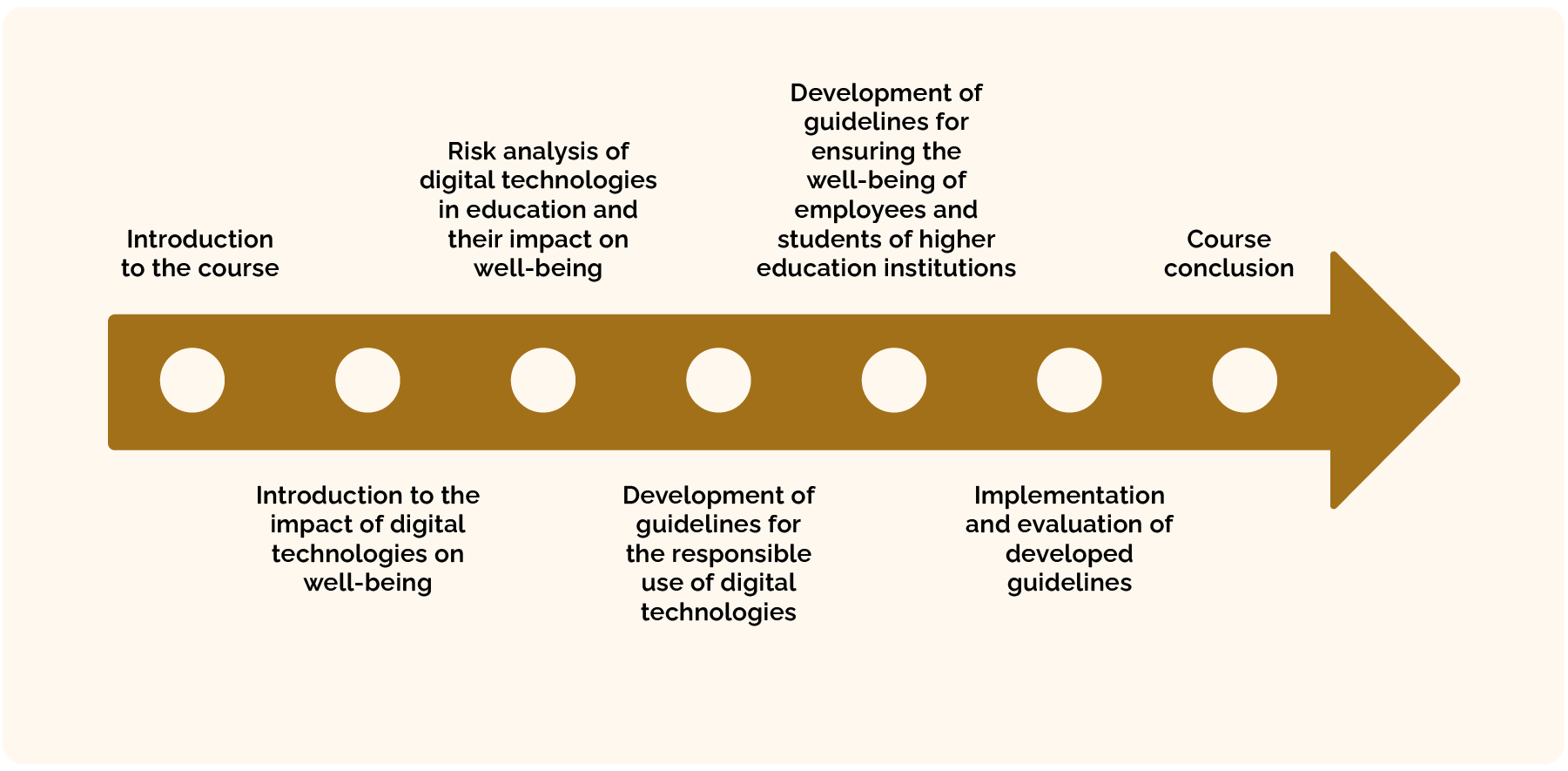
Figure: Display of summative assessment
4. Technical information about the e-course system
This e-course is implemented on the Loomen system, which is based on the open-source Moodle system. The e-course home page is organised in accordance with the course structure, with links on the home page leading to activities and resources according to the e-course design.
The e-course can be accessed from a computer connected to the internet, a smartphone, or a tablet. The e-course opens correctly in all popular web browsers (Firefox, Opera, Chrome, Edge…). The e-course is also available via a mobile application, which does not always function optimally.
Faster navigation through the e-course is possible by using the menu on the left side, while on the right side, it is possible to track upcoming activities, highlighted notifications, and progress throughout the e-course.
The Loomen system is very intuitive, and in case of any difficulties using the system, you should contact the instructor.
5. Minimum technical requirements for attending the e-course
Types of content in the e-course
- Educational multimedia (predominantly textual) materials (e.g., lessons and pages) are available in the Loomen system by opening them directly in a web browser, and it is also possible to download all materials in PDF format. For this reason, the user should have a PDF reader installed. If using, for example, Firefox or Chrome, a PDF reader is not required as PDFs can also be opened within the web browser.
- Video lessons are originally hosted on CARNET's multimedia portal Meduza and are integrated into pages on Loomen, so they can be accessed without leaving the Loomen system. To watch video lessons, an internet connection of at least 2Mbit/s is required. In addition, it is necessary to use headphones or a speaker.
- Practical tasks can be created in MS Word or in another tool of the participant's choice.
- Assessment activities in the e-course are supported by the corresponding functionality of the Loomen system, and no other technical prerequisites are required. Quizzes open entirely in the web browser, and no other technical prerequisites are needed.
-
Synchronous activities in the course take place on the BigBlueButton platform, which is integrated into the Loomen system; technical prerequisites for participating in synchronous activities include a microphone, headphones, and an internet connection (preferably 5Mbit/s or higher).
6. Participant obligations
Participants are recommended to participate in as many activities as possible: reviews and analyses of video lessons and educational materials, practical activities, and others. During the implementation of the e-course, it is possible to collect points (up to 100 points). The following table provides a list of mandatory activities in the e-course by topic, delivery method, and possible points earned. The e-course is considered passed if a total of at least 50 points is achieved.
Table 2. List of mandatory activities in the e-course
Topic |
Mandatory activity or activity for points |
Individual (I) / Team (T) (number of members) |
Points |
|
Introduction to the impact of digital technologies on well-being |
Test – Well-being in the information society Test – The impact of digital technologies on the well-being of stakeholders in higher education |
I I |
5 5 |
|
Risk analysis of digital technologies in education and their impact on well-being |
Test – Risks of applying digital technologies in education and their impact on well-being SWOT analysis and risk identification – individual participant work / problem-solving task |
I I |
5 10 |
|
Development of guidelines for the responsible use of digital technologies |
Discussion on aspects of responsible and safe application of digital technologies – synchronous activity Creation of strategy proposals and guidelines for the responsible application of digital technologies – problem-solving task |
I
I |
5 15 |
|
Development of guidelines for ensuring the well-being of employees and students of higher education institutions |
Identification of strategic areas and goals for ensuring well-being in the context of digital technologies Creation of guideline proposals for ensuring the well-being of employees and students of higher education institutions in the context of digital technologies – problem-solving task Peer assessment |
I T (3) T (3) |
5 20 5 |
|
Implementation and evaluation of developed guidelines |
Test – Implementation and evaluation of guidelines in a higher education institution Analysis of data collection methods for monitoring and evaluating strategies Creation of teaching content |
I I I |
5 5 15 |
|
Total |
100 |
7. Contact Information
For all content-related questions and inquiries regarding e-course attendance, please contact your instructor.
For technical questions, please contact the e-mail address x@carnet.hr or call 01 xxxxxxx.
8. Code of Conduct in the e-course
To ensure better collaboration, we have defined certain rules of conduct for the e-course.
- Respect other participants as if they were in the same room with you. Foster a culture of appreciation and constructive dialogue in your communication. Behind every username is a real person – kindness and empathy are the keys to a positive learning environment.
- Be professional and use clear language. Aim to write with correct grammar and spelling, avoid using ALL CAPS (which can be interpreted as shouting), and try to express your thoughts clearly. Inappropriate or offensive messages are not acceptable.
- Stay on topic and be concise. Your comments, answers, and messages should be related to the topic and structured so that they are understandable to others. You help both yourself and your colleagues when you express yourself clearly and with focus.
- Participate actively and in a timely manner. Your activity contributes to the quality of collaborative learning. Try to regularly check notifications, respond to tasks within set deadlines, and engage in discussions.
- Protect the privacy and confidentiality of information. Do not share the personal data of other participants without their explicit consent. Also, be cautious when sharing your own data in the public spaces of the e-course.
- Do not post promotional content or spam. The e-course is not a place for advertising, sending chain letters, or political messages. The focus should be on the e-course content and mutual learning.
- Express disagreement in a constructive way. Direct criticism toward the content or the idea, not the person. If you disagree, argue your opinion while respecting different viewpoints.
- Communicate through appropriate channels. For technical and organizational questions, use the designated forums or contact the e-course mentors through official channels. Informal communication is welcome in the spaces provided for it, while respecting basic rules of politeness.
- Prepare for participation in virtual meetings. If the e-course includes video meetings, it is recommended to use a camera (when possible), stay in a quiet environment, and join in only when you have a comment or question. Respect others' time and do not disrupt the workflow.
- Act in accordance with ethical and legal norms. Respect copyrights, institutional regulations, and applicable laws. Unauthorised use of content, plagiarism, or sharing confidential information is not allowed.

This e-course is made available under a Creative Commons Attribution-NonCommercial-ShareAlike 4.0 International license. When using the work, we suggest citing it as follows: Begičević Ređep N. (2025). The Impact of Digital Technologies on Well-being. 1st edition of the CARNET e-course.
Why these rules? The goal is to ensure a high-quality, inclusive, and professional learning environment where everyone feels comfortable. What if the rules are violated? In case of non-compliance, e-course moderators may issue a warning, and in more serious situations, take further steps in accordance with the institution's regulations. Who is responsible? All e-course participants share the responsibility for maintaining a positive and professional atmosphere.
9. Literature
The literature used is listed with each topic. A summary overview of the literature is available here.
ALL DIGITAL. (2023). Digital Well-Being Report.
Baik, C., Larcombe, W. & Brooker, A. (2016). A framework for promoting student mental wellbeing in universities. Melbourne Centre for the Study of Higher Education (MCSHE), The University of Melbourne.
Brkljača, K., Načinović Prskalo, L. & Brkić Bakarić, M. (2024). Overview of the advantages and disadvantages of digitalization, digital solutions, technologies, and applications used during the pandemic. Gazette of the Polytechnic of Rijeka, 12 (1), 375–393.
Buda, András & Kovács, Klára. (2024). The digital aspects of the wellbeing of university teachers. Frontiers in Education.
Student Support and Career Development Center (CPSRK). Faculty of Organization and Informatics (FOI). (2023). Work-based learning models.
Cuppen, J., Muja, A., & Geurts, R. (2024). Well-being and mental health among students in European higher education (EUROSTUDENT 8 Topical Module Report). EUROSTUDENT.
Dodge, R., Daly, A. P., Huyton, J. & Sanders, L. (2012). The challenge of defining wellbeing. International Journal of Wellbeing, 2(3), 222–235.
European University Association. (2023). Needs and wellbeing of students and staff (Learning & Teaching Paper No. 20).
European Commission. (2024). Well-being at school. European Education Area.
Croatian Institute of Public Health. (2024). Do you know what mental health is? Mental health glossary.
Hughes, G. Heriot Watt University. Learning + Teaching Academy. Supporting student wellbeing through curriculum design and delivery.
Klačmer Čalopa, M., Tomičić-Pupek, K. & Begičević Ređep, N. (2018). Strategic plan for the application of information and communication technologies in schools. Croatian Academic and Research Network - CARNET.
Organisation for Economic Co-operation and Development. (2024). The impact of digital technologies on well-being. OECD Publishing.
Oztosun, Latif & Gonzo, Faithfull & Nadda, Vipin. (2023). The Impact of Digital Learning Technology on Higher Education Students' Mental Health.
Pugh, V. (2021). A curriculum for wellbeing: Improving all aspects of wellbeing in curricula & schools. British Educational Research Association (BERA).
The Open University. (2020). Student and staff mental health and wellbeing strategy 2020-2023: Promoting an institutional approach. University of Bath, Centre for Learning and Teaching. (2023). Designing your curriculum to help support student wellbeing. Learning and Teaching Hub.
University of York. (2021). Student mental health and wellbeing strategy 2021–2025.
Universities UK. (2021). StepChange: Mentally healthy universities.
Universities UK. (2023). StepChange: Mentally healthy universities self-assessment tool.
Council of the European Union. (2022). Council conclusions on supporting well-being in digital education (2022/C 469/04). Official Journal of the European Union, C 469, 12–15.
Background Colour
Font Face
Font Size
Text Colour
Font Kerning
Image Visibility
Letter Spacing
Line Height
Link Highlight
Paragraph Width
Text Alignment