2. Digital maturity frameworks
Previous research has identified more than 20 frameworks for the digital maturity of educational institutions [4]. They define different areas of digitalization that identify specific indicators describing the level of maturity. Many also offer quantitative instruments that can be used to measure digital maturity levels. Most are tailored to schools – for example, the Croatian e-Škole framework, intended for assessing digital competences and infrastructure.
For higher education, specific models have been developed, such as:
- Higher Education Digital Competence Framework (HeDiCom) – contains 4 dimensions; focused on teachers’ digital competences in higher education [6].
- Higher Education Digital Capability Framework (HEDC) – also with 4 dimensions, it includes 16 domains and over 70 capabilities [7].
- HEInnovate, developed by the European Commission (part of the DigComp/HEInnovate portfolio), which contains 8 areas [8].
- DigCompOrg, focused on organisational strategic planning [5].
In Croatia, a new model was developed, the Digital Maturity Framework for Higher Education Institutions (DMFHEI). It was created by Valentina Đurek, PhD, through projects of the Croatian Science Foundation at the University of Zagreb, Faculty of Organization and Informatics [5]. This framework defines 7 areas and 42 elements of digital maturity.
In addition to the above frameworks, it is worth highlighting several other significant models and tools used in education to analyse and enhance digital maturity:
- SELFIE (Self-reflection on Effective Learning by Fostering the use of Innovative Educational Technologies) – a European Commission tool that enables schools to independently analyse their level of digital maturity [5].
- DigComp – the European framework of digital competences for all citizens, defining five core areas of digital skills [3].
- DigCompEdu – a specialized framework for the digital competences of education professionals, focused on teaching practices and professional development [3].
- OpenEdu – a European Commission framework for promoting open education in higher education, including 10 dimensions of openness divided into two categories [5].
- Jisc Digital Capability Framework – developed in the United Kingdom, with a particular focus on staff competences and organisational support for developing digital maturity [5].
These frameworks further enrich the understanding of digital maturity in educational institutions and enable the adaptation of approaches to suit different educational contexts. Since most are based on DigComp or DigCompOrg principles, there is a high degree of compatibility among them.
Table: Comparative overview of selected frameworks
Framework |
Purpose |
Dimensions / Areas |
Instrument |
|
e-Škole |
primary education |
5 areas and 37 elements |
quantitative instruments (self-assessment) |
|
HeDiCom |
higher education, teachers |
4 dimensions |
qualitative, no quantitative instrument |
|
HEDC |
higher education, institutions |
4 dimensions, 70+ competences |
qualitative instrument |
|
DMFHEI |
higher education, organisations |
7 areas, 42 elements |
qualitative instrument |
|
DigComp |
citizens |
5 areas of digital competence |
qualitative instrument |
|
DigCompEdu |
education professionals |
6 competence areas |
self-assessment, reflective tools |
|
DigCompOrg |
educational organisations |
7 dimensions of organisational maturity |
foundation for tools such as SELFIE |
|
OpenEdu |
higher education |
10 dimensions of openness |
qualitative guide, without a formal instrument |
|
SELFIE |
schools, higher education |
based on DigCompOrg |
quantitative and visual self-assessment (self-evaluation) |
|
Jisc Digital Capability |
higher education |
individual and organizational competences |
self-assessment questionnaire |
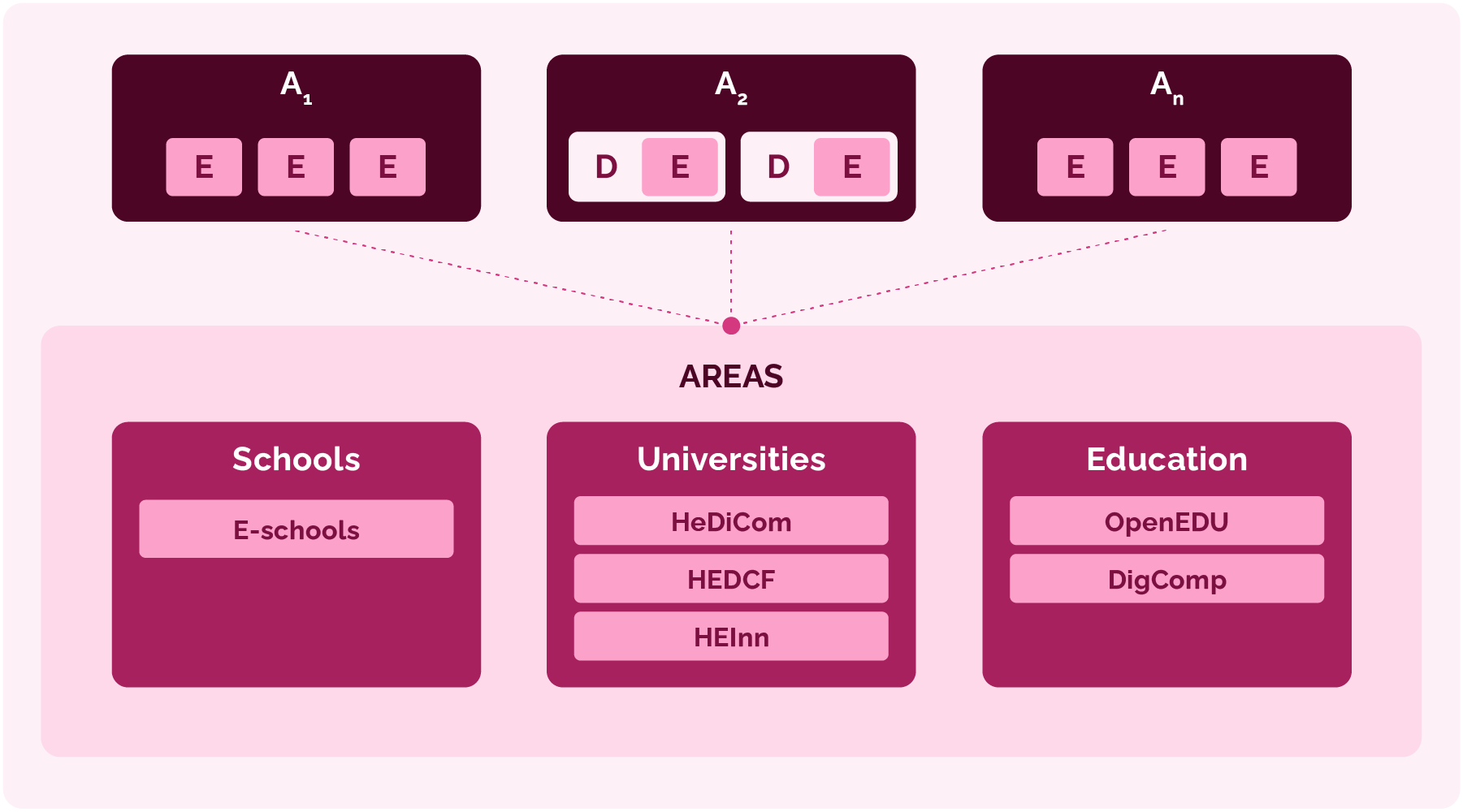
Figure: Digital maturity frameworks and their structures
The figure shows a general representation of digital maturity frameworks, consisting of n areas. The areas then consist of elements (E), which may be grouped into organizational dimensions.
Background Colour
Font Face
Font Size
Text Colour
Font Kerning
Image Visibility
Letter Spacing
Line Height
Link Highlight
Paragraph Width
Text Alignment