7. The flow and stages in the process of strategic planning
The sequential flow of strategic planning consists of activities that create the core components of a strategy. In the classical model, the strategic planning process goes through several key phases that are both methodologically and substantively interconnected.
Activities in the sequential flow of strategic planning:
- Analysis of the current state – Through SWOT (Strengths, Weaknesses, Opportunities, Threats) and PESTLE (Political, Economic, Social, Technological, Legal, Environmental) analyses, higher education institutions identify internal strengths and weaknesses, and external opportunities and threats.
Example: The Faculty of Organization and Informatics at the University of Zagreb used SWOT analysis. [10]
Example: The Universities of Rijeka and Zadar conducted environmental analyses [12, 22], which, although not explicitly stated, essentially implemented a PESTLE approach. - Defining the desired future state – In this phase, the institution’s vision, mission, and core values are formulated. Common methods include strategic workshops, storytelling, focus groups, and the Delphi technique.
Example: The University of Split engaged staff and students in formulating its mission and values through a series of strategic workshops and focus groups. [16]
- Formulation of strategic goals – This phase defines exactly what is to be achieved. Goals are designed following the SMART principles, and methods such as group decision-making, dialogue-based techniques, and scenario analysis are often applied.
Example: The Faculty of Electrical Engineering and Computing of the University of Zagreb defined five key areas, each with one strategic goal and several specific objectives. [28]
- Operationalization of goals – The strategy is translated into specific action plans, timelines, and responsibilities. Creativity techniques and logical framework methods can help connect goals with realistic capabilities.
Example: University North uses task matrices and Gantt charts to support implementation. [35]
- Monitoring and evaluation – Key performance indicators (KPIs) are defined, reporting and evaluation methods are established, and mechanisms for adjusting the strategy are introduced.
Example: The University of Ljubljana publishes annual reports on strategic progress. [5]
For developing measurement tools and monitoring systems, the following are often used [36]:
- Balanced Scorecard;
- Total Quality Management (TQM);
- European Quality Assurance Framework (EQAR, ESG standards).
In a broader sense, strategic planning also includes the implementation of the strategy and continuous monitoring of its realization, followed by a final analysis of the cycle. The final analysis determines the extent to which the strategic goals and vision have been achieved, and often serves as the starting point for a new planning cycle.
By explaining the sequential flow of strategic planning, we have also described its phases. In most cases, the phases of strategic planning and the strategic planning cycle occur sequentially, where the output of one phase becomes the input for the next. It is also worth noting that mission and core values are often permanent elements of strategic planning—they do not change in every cycle.
The mission may change when the organization significantly alters its activities, experiences a major environmental shift (e.g., merger with another organization), or when there is a discrepancy between the mission and actual practice. Core values change even less frequently; in most cases, they are refined or expanded—for example, to reflect new priorities (such as sustainability, inclusiveness, or innovation) or when the organization undergoes digital transformation or internationalization processes.
The continuous process of strategic planning is shown in the figure below.
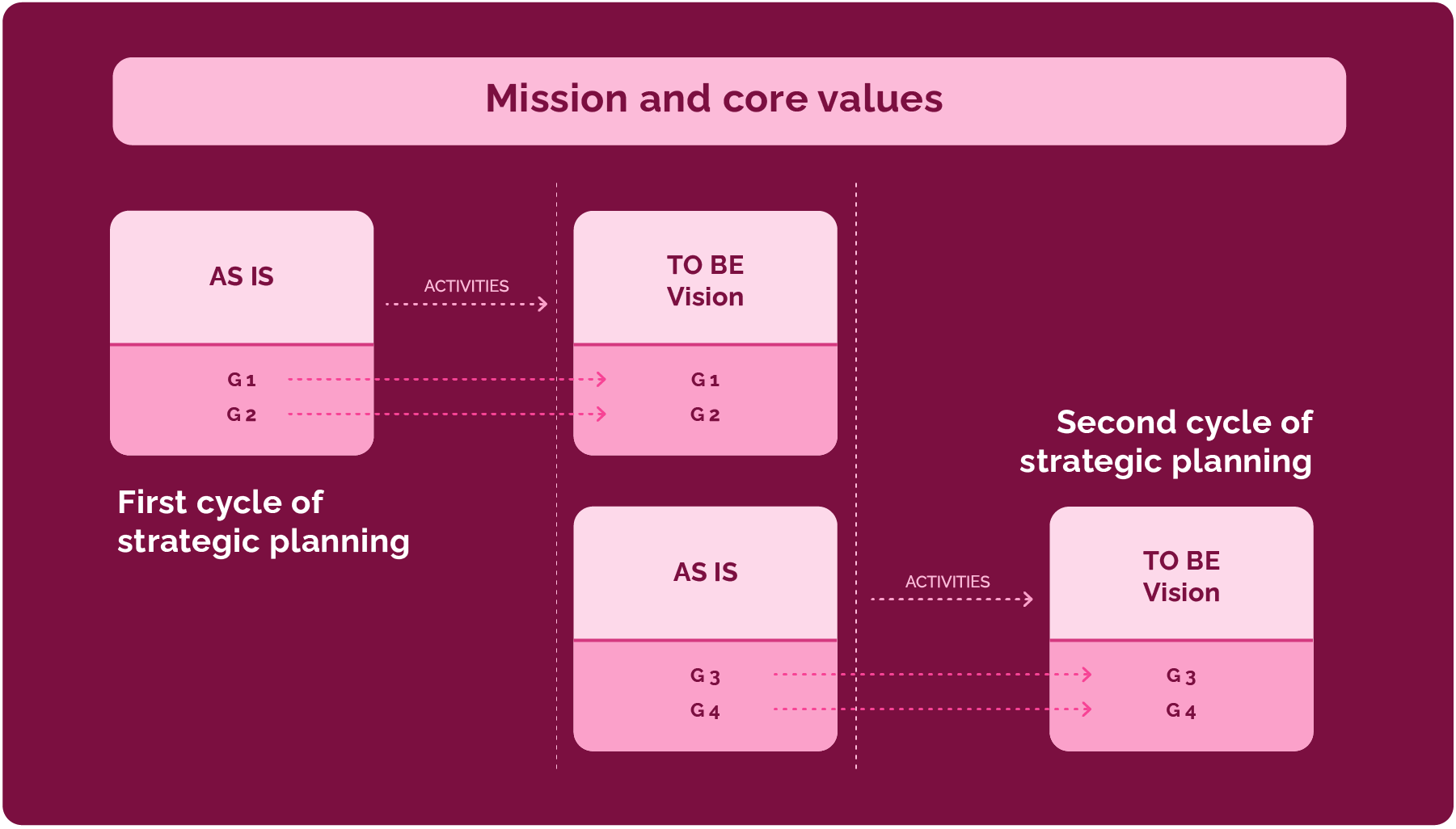
Figure: Strategic Planning Process
Background Colour
Font Face
Font Size
Text Colour
Font Kerning
Image Visibility
Letter Spacing
Line Height
Link Highlight
Paragraph Width
Text Alignment