Using Multimedia for Microlearning
In microlearning, where content is broken down into short, targeted chunks, the use of multimedia has a major impact on learning quality. Research shows that students learn more effectively when on-screen text is combined with relevant visuals than when text alone is presented. Images, graphs, and illustrations can enhance understanding and support memory, but they must be carefully integrated to genuinely reinforce the message.
One of the key principles is coherence: unnecessary elements such as redundant text, images, or sounds should be avoided, as they can distract learners and strain their cognitive resources. In this context, less is more. Attention should also be paid to spatial and temporal coherence: related text and images should be presented together and in close proximity, rather than being separated across screens or displayed at different times. This reduces the cognitive effort required to connect related information.
Redundancy should likewise be minimized. For example, combining animation, voiceover, and on-screen text can place excessive demands on learners. It is often more effective to pair animation with narration alone, without duplicating the same information in text form. This allows the visual and auditory channels to complement each other rather than become overloaded.
To further reduce cognitive load, it is helpful to provide learners with background information or introductory content before presenting the main material. This establishes a foundation that facilitates subsequent understanding. In addition, segmentation is essential: content should be divided into small, manageable units that learners can progress through at their own pace, rather than being presented as a long, continuous sequence.
Several additional guidelines apply to multimedia design. Highlighting key information (signaling) helps learners quickly identify what deserves their attention. Human voice narration is generally more effective than synthetic voices or text alone, as it is perceived as more natural and easier to understand. In video-based microlearning, visuals are often more beneficial than continuously displaying the speaker’s image, which typically adds little to learning outcomes. Finally, adopting a more personal and conversational tone in both text and narration has been shown to improve knowledge retention, as learners engage more easily with the material than with an overly formal style.
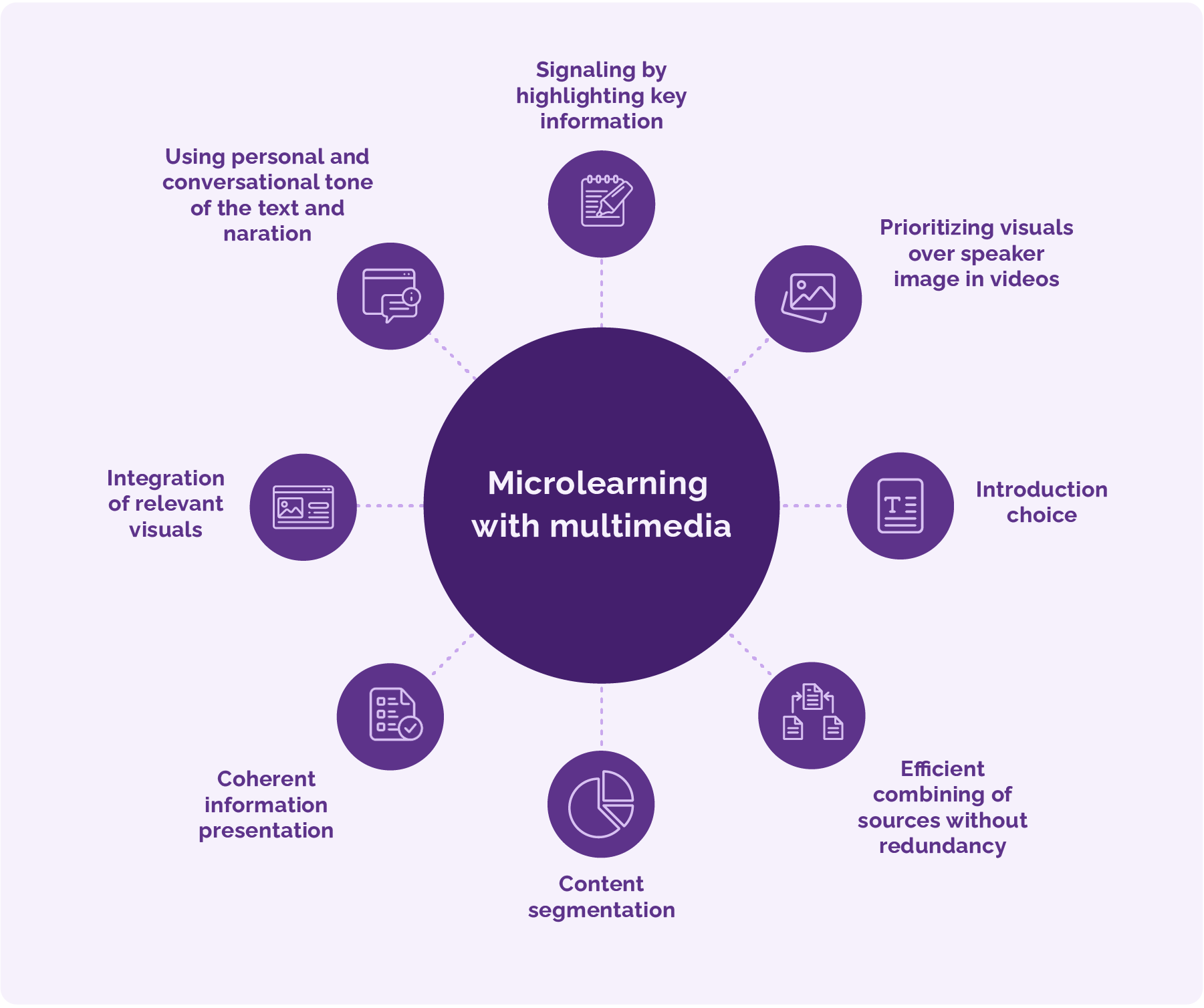
Figure 1. Microlearning with multimedia
Copyright in the context of microlearning
When teachers create materials for microlearning, it is essential to consider copyright and intellectual property protection. All texts, images, audio recordings, and videos are subject to legal protection, making it necessary to verify whether their use in teaching is permitted. In many cases, materials available on the internet cannot be freely modified or redistributed without the author’s permission. Copyright violations may lead to legal consequences and also conflict with the ethical standards of the academic community. For this reason, teachers are encouraged to use their own materials or resources for which they have obtained explicit permission.
A practical solution for creating high-quality and legally compliant materials can often be found in open educational resources and works published under Creative Commons (CC) licenses. CC licenses allow authors to clearly define the terms under which their works may be used, such as whether adaptation, sharing, or only personal use is permitted. For teachers, this means they can safely use images, music, or educational videos, provided they respect the specific license conditions, such as mandatory attribution or restrictions on commercial use. Incorporating CC-licensed materials into microlearning not only ensures legal security but also supports a culture of knowledge sharing within the academic community.
Advantages of Multimedia in Microlearning
Flexibility and accessibility:
The use of multimedia in microlearning enables students to learn at times and in ways that best suit their individual needs. Rather than being limited by fixed schedules or physical classroom locations, learners can access digital content, such as short videos, interactive presentations, or audio materials, whenever it is most convenient for them. This approach is particularly effective in online and hybrid learning environments, where students can progress at their own pace.
Lower costs and simpler organization:
Digital multimedia content simplifies the preparation and distribution of teaching materials by reducing reliance on printed manuals and additional physical resources. Once created, these materials can be reused, shared with multiple student groups, and updated as needed, contributing to both the sustainability and efficiency of the teaching process.
Increased learning efficiency:
A multimedia approach that integrates text, images, audio, and video promotes active student engagement and supports deeper understanding and long-term retention of information. By addressing different learning styles, such content enhances motivation and facilitates the practical application of knowledge. As a result, the integration of multimedia into microlearning contributes not only to improved learning outcomes but also to the development of students’ digital competencies.
Background Colour
Font Face
Font Size
Text Colour
Font Kerning
Image Visibility
Letter Spacing
Line Height
Link Highlight
Paragraph Width
Text Alignment