Introduction
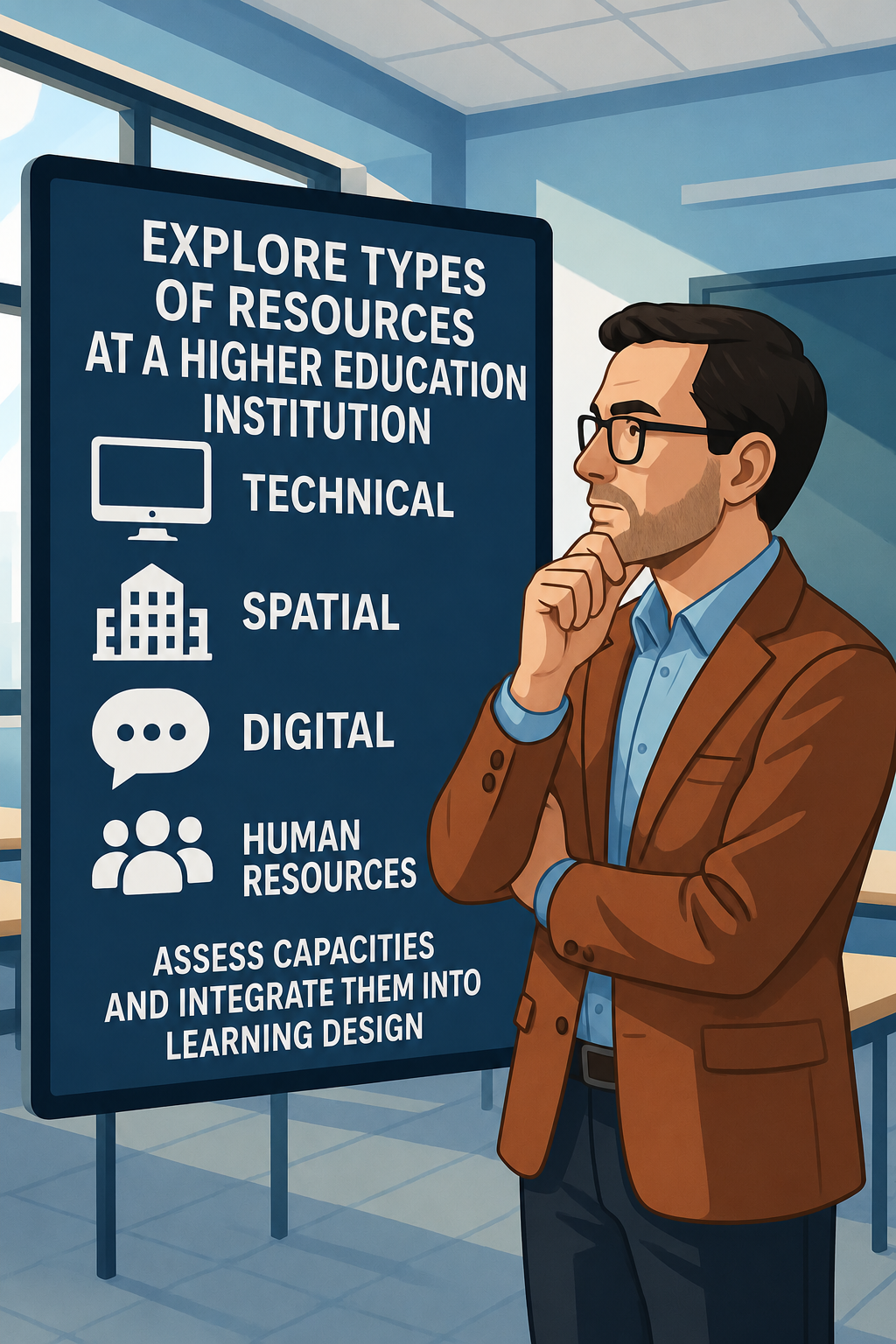
The availability and effective integration of resources – digital, physical, and human – are essential for the successful implementation of teaching activities and innovative learning design. Each higher education institution offers different types of support for teachers and students, but the level of support is not the same everywhere. This activity helps teachers identify what resources are available to them and how to make the best use of these resources to create a well-designed learning experience and, ultimately, support higher-quality teaching and learning.
Working with this material contributes to achieving the learning outcome: to design a learning experience for specific learning outcomes and teaching topics.
Task Objective
To explore which types of resources are available at your higher education institution (technical, spatial, digital, human), at the national level, or at the EU level; to assess your own and your institution’s capacities; and to consider how these resources can be integrated into learning design.
What to Explore?
Conduct the analysis through three interconnected aspects:
1. Digital tools and platforms
-
Which digital tools are officially available (e.g., learning management systems (LMS) such as Moodle, videoconferencing tools such as MS Teams, Zoom, BBB; tools for checking the authenticity of student work such as Turnitin; assessment tools such as Kahoot and Mentimeter; interactive content tools such as H5P; learning design tools such as BDP, etc.)?
-
Are there specialised tools for collaboration, evaluation, learning analytics, or multimedia production?
-
Is there access to licensed software or open educational resources?
-
How well are these tools integrated into the existing LMS or other systems?
-
How does your institution approach tools that use artificial intelligence? Are there lists of AI-based tools whose use is recommended or not recommended?
2. Physical and infrastructural support
-
What teaching spaces are available (traditional classrooms, computer labs, laboratories, rooms equipped for hybrid teaching)?
-
Is there technical support for hybrid/online teaching?
-
Are resources available for recording, editing, and sharing teaching materials?
3. Human resources and competence development
-
What types of professional support exist (e.g., e-learning center, technical services, library)?
-
Are there training opportunities for developing digital, pedagogical, and didactic skills?
-
What is your current level of digital and pedagogical competence?
-
Is there an opportunity for mentoring support, teamwork, or collaboration with colleagues?
-
Does your institution have policies and training on the use of artificial intelligence?
How to Gather Information?
-
Websites and repositories of your higher education institution and university (e-learning center, IT services, library, teaching support center, student support center).
-
Direct communication with technical support, IT services, or mentors.
-
Discussions with colleagues who use innovative methods or tools.
-
Self-assessment: fill in a brief reflection on your own digital skills.
How to Structure the Analysis?
In your short report, consider the following:
-
Which resources do I have available – and am I using them?
-
Are there resources I could integrate more effectively into my course?
-
How do the available resources influence the potential for innovation in my learning design?
-
What barriers exist in integrating available resources – and how can I overcome them?
What Comes After the Analysis?
Based on your analysis, you can:
-
plan to incorporate new tools or approaches into your course
-
connect with existing forms of professional support
-
adapt learning activities to the resources that are realistically available to students and teachers
-
identify needs for additional training or changes in institutional support
-
create a meaningful learning design that takes into account the resources available at your institution
Note: This analysis does not require detailed technical expertise; rather, it aims to increase awareness of the potential and limitations of your environment. The goal is to enhance the opportunities already available and encourage realistic innovations in learning design.
Background Colour
Font Face
Font Size
Text Colour
Font Kerning
Image Visibility
Letter Spacing
Line Height
Link Highlight
Paragraph Width
Text Alignment