At the end of the last century, a conceptual shift occurred in higher education—from academic dishonesty to academic integrity.
While dishonesty refers to behaviour, integrity is rooted in values.
According to the International Center for Academic Integrity (ICAI), academic integrity involves adherence to the values of honesty, trust, respect, fairness, and responsibility (ICAI, 2014).
When learning is grounded in integrity, teachers and students move together from asking “how to avoid violations” toward “how to make ethical decisions”—a skill essential in professional, academic, and personal life.
Below are several important factors and strategies you can use when designing your course assessment strategy.
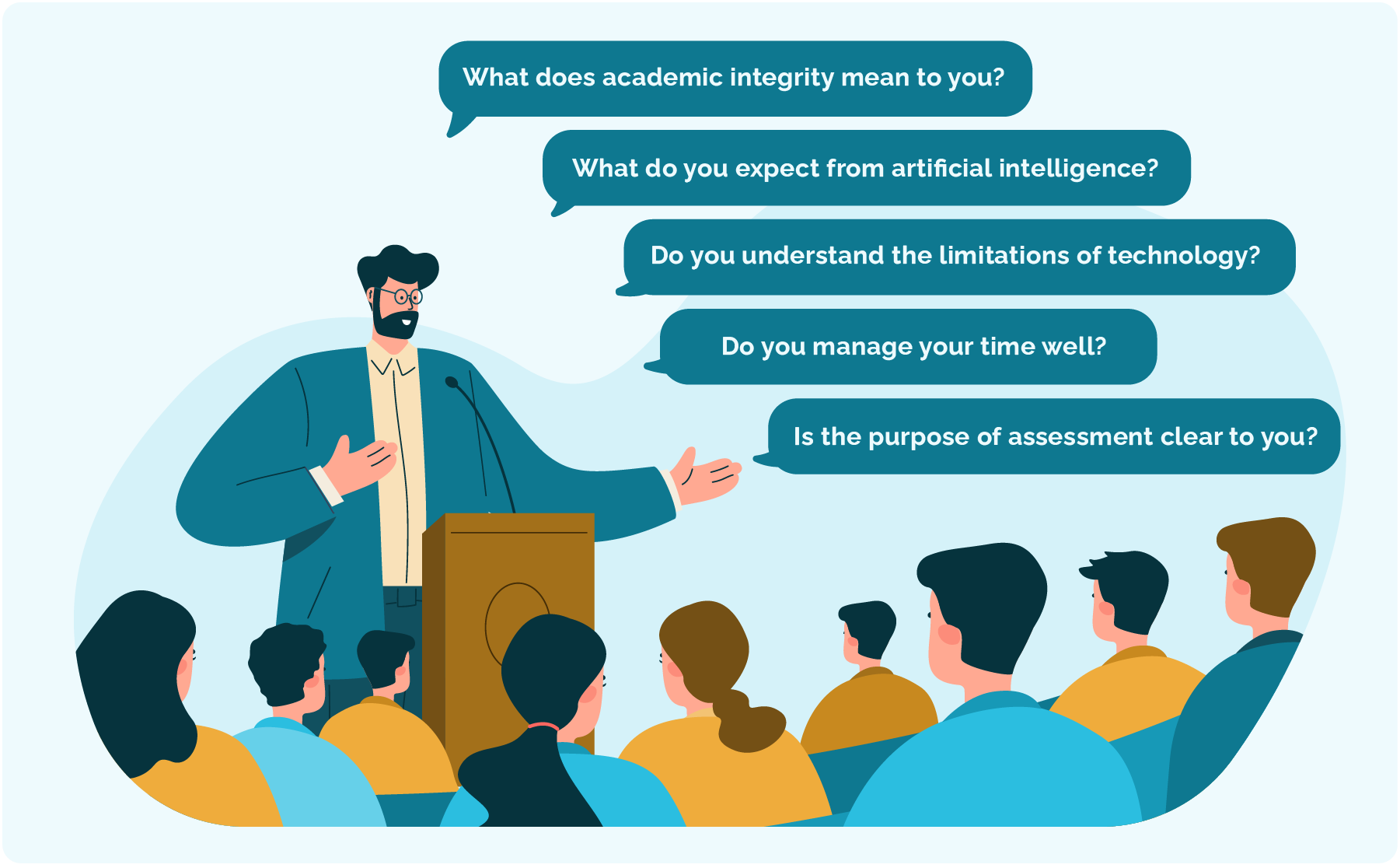
Image: Questions teachers should ask students
Factors influencing academic integrity and related strategies
1/ Lack of knowledge about academic integrity
-
Provide examples of correct work and discuss common forms of misconduct.
-
Share links to institutional policies and student support resources.
-
Clearly define what is permitted in open-book exams.
-
Explain acceptable citation styles.
-
Include a discussion about academic integrity in the forum.
-
Allow students to submit drafts for feedback.
-
Design short activities (mini-quiz, “rule hunt”) for learning integrity principles.
2/ Unclear expectations regarding the use of artificial intelligence
-
Openly discuss what is permitted regarding AI tools.
-
Clearly state whether the use of AI tools is allowed and to what extent.
-
Co-create rules with students for using AI tools in assignments.
-
Show an example of an assignment using AI and explain what is considered unacceptable.
-
If AI is allowed, provide resources and examples on how to cite it properly.
3/ Lack of confidence and access to technology
-
Give students the opportunity to familiarise themselves with the technology before the exam (e.g., an ungraded practice quiz).
-
Ensure the tool is free and does not require sensitive personal data.
4/ Poor time management skills
-
Communicate expectations early and use the Moodle calendar.
-
Talk openly about time management.
-
Send reminders about upcoming assignments and exams.
-
Refer students to available academic and advisory services.
5/ Lack of understanding of the purpose of assessment
-
Design assessments aligned with course outcomes (constructive alignment).
-
Connect learning activities with exam tasks.
-
Use tasks that require personal reflection and the application of knowledge in practice.
-
Offer students options for different formats (essay, video, infographic, etc.).
-
Ensure task instructions are clear and unambiguous.
Literature and additional resources
-
Bertram Gallant, T. (2017). Academic Integrity as a Teaching & Learning Issue: From Theory to Practice.
-
Bertram Gallant, T. (2018). Course Design, Assessment & Integrity: Strange Bedfellows? academicintegrity.org
-
Camosun College. Assessment: Academic Integrity.
-
Gutiérrez, J. D. Guidelines for the Use of Artificial Intelligence in University Courses (CC BY 4.0).
-
Eaton, S. E., Christensen Hughes, J. (2022). Academic Integrity in Canada: An Enduring and Essential Challenge. Springer.
-
International Center for Academic Integrity (ICAI). (2014). The Fundamental Values of Academic Integrity. Clemson University.
-
Lancaster, T. (2023). Artificial Intelligence, Text Generation Tools, and ChatGPT – Does Digital Watermarking Offer a Solution?
-
Sutton, A., Taylor, D. (2011). Confusion About Collusion: Working Together and Academic Integrity.
-
Velliaris, D. M., Pierce, J. M. (2019). Cheaters Beware! Redesigning Assessment Practices to Reduce Academic Misconduct.
Background Colour
Font Face
Font Size
Text Colour
Font Kerning
Image Visibility
Letter Spacing
Line Height
Link Highlight
Paragraph Width
Text Alignment