2. Teaching
Education is one of the fundamental pedagogical categories and functions, encompassing both knowledge and abilities. In didactics, the development of abilities represents the functional aspect of education, or the functional task of teaching, as it relates to the role of individuals as personalities in social life and work. Abilities are developed through activities, based on certain predispositions and objective environmental conditions. The task of teaching, therefore, is to encourage the development of abilities through numerous and diverse activities.
Teaching is a goal-oriented, planned, and programmed process involving two participants: the teacher and the learner (pupil or student). It takes place both within educational institutions (such as primary and secondary schools, higher education institutions, and adult education institutions) and outside them (for example, in companies or non-governmental organizations). Teaching is carried out according to teaching and/or thematic plans and programs. The focus of teaching should be on the activities of learners (Petričević et al., 2005).
An educational institution is an institution that meets prescribed conditions, such as goals, curriculum, teachers, instructional media, and facilities, for the education of preschool children, primary and secondary school students, higher education students, and adults. Within the lifelong learning system, educational institutions include kindergartens, primary schools, secondary schools (general, artistic, and vocational), higher education institutions (universities and professional institutions), and adult education institutions (Petričević et al., 2005).
The emergence of digital technology has initiated the transformation of traditional teaching into technology-supported forms of instruction. Initially, digital tools are used as supplements to classical teaching, for example, for presenting multimedia content, assigning online tasks, or enabling communication outside the classroom. Over time, these practices develop into blended (hybrid) teaching, in which face-to-face activities are systematically combined with activities in a virtual environment. Students process part of the content online, often at their own pace, while classroom time is focused on discussion, application of knowledge, and collaborative learning.
Further advances in technology and digital platforms have led to the development of online teaching, which takes place entirely in a virtual environment. In this model, there is no physical presence in an educational institution; instead, videoconferencing, virtual classrooms, digital materials, and interactive tools are used. Online teaching offers flexibility, access to education regardless of location, and opportunities for personalized learning, but it also requires a high level of digital competence and self-regulation on the part of students. This development illustrates how technology is gradually transforming pedagogy, teaching methods, and the role of teachers.
Within the structure of teaching, it is necessary to distinguish several aspects: organizational, cognitive, psychological, and methodological. According to Poljak (1980), these aspects represent stages of the teaching process. Organizational or didactic components include planning, preparation, introduction, problem formulation, collection of material, processing, task performance, practice, repetition, consolidation, assessment, and evaluation.
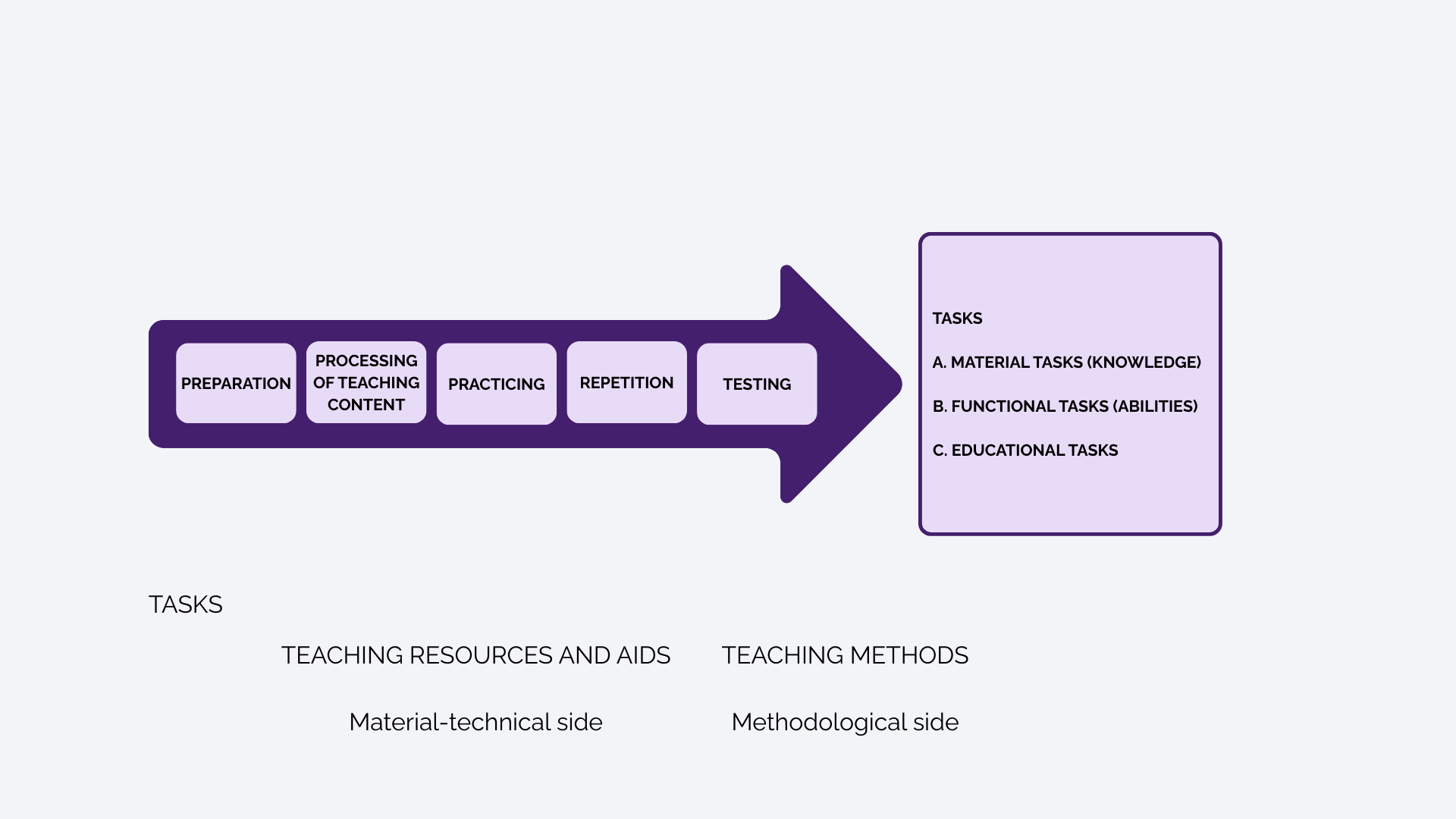
The graphical representation shows that the teaching process, including its individual stages, has a material-technical, cognitive, psychological, and methodological dimension. These dimensions consist of numerous elements that are integrated both successively and simultaneously at each stage of the teaching process as its microelements.
Teaching begins with planning and preparing teaching units and is carried out through various activities within the lesson, ranging from the use of technical tools to the construction and reconstruction of teaching content, educational measures, board work, and oral assessment. Teaching concludes with the evaluation of both the teaching process and student achievement (Pranjić, 2005). It is important to note that organizing teaching in a digital environment presents additional challenges, which will be discussed in more detail in the following parts of the course.
Background Colour
Font Face
Font Size
Text Colour
Font Kerning
Image Visibility
Letter Spacing
Line Height
Link Highlight
Paragraph Width
Text Alignment